 Vista
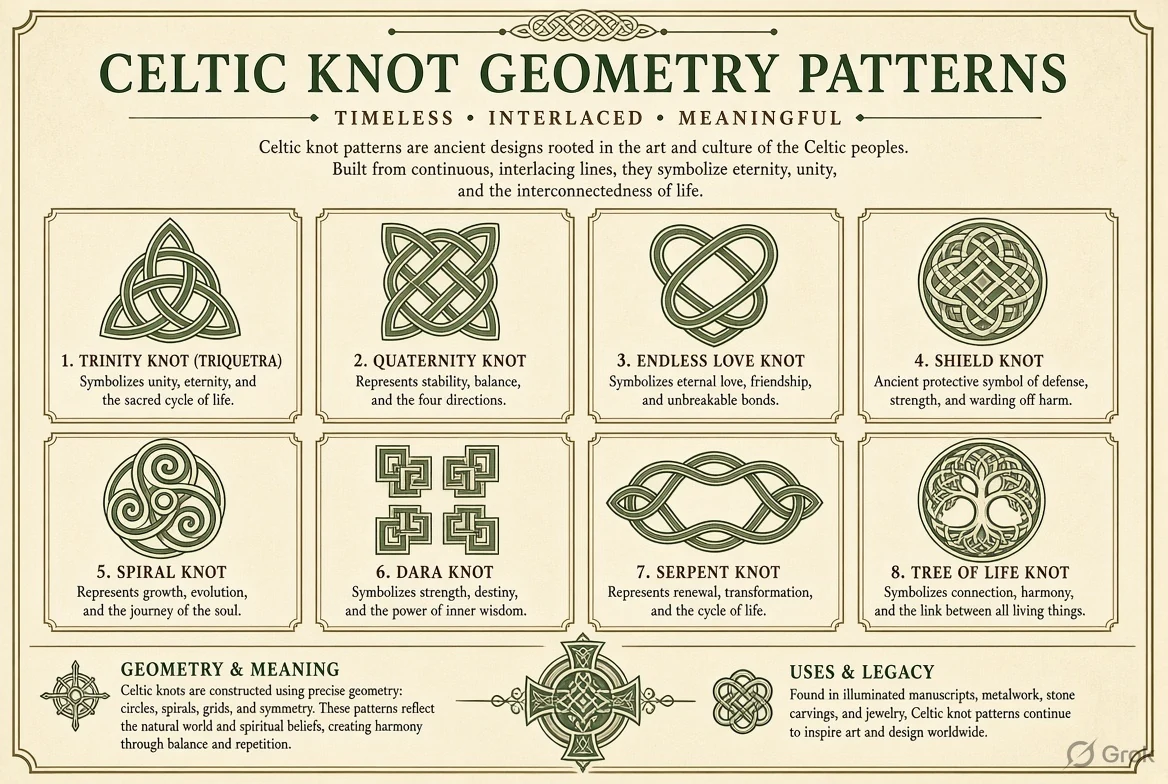
Direct answer: Celtic knot geometry patterns are interlaced designs built from repeated curves, grid connections and clear over-under crossings. The triquetra, endless square-knot grid and woven border can be studied as separate drawing structures. Their shapes can be documented historically, but many fixed “eternal love” meanings found on modern charts are later interpretations.
Updated 20 November 2026. Educational illustrated geometry rather than an authenticated facsimile of a particular historical manuscript.
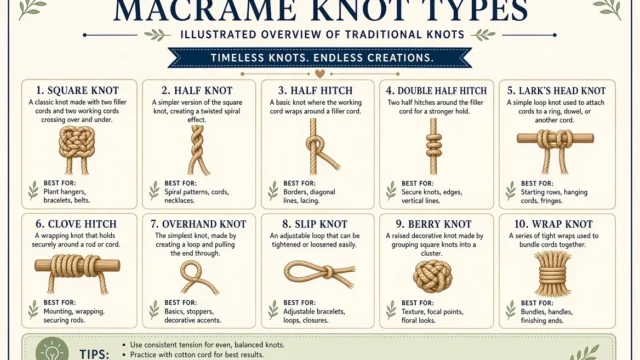
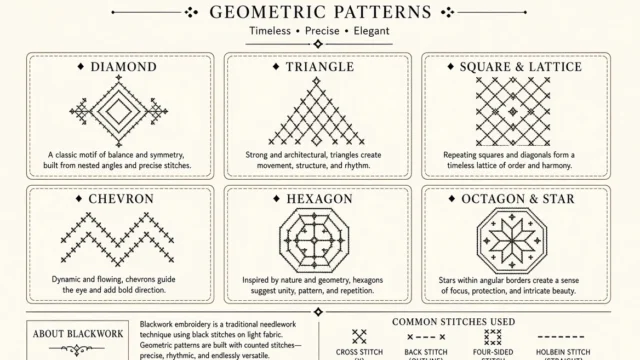
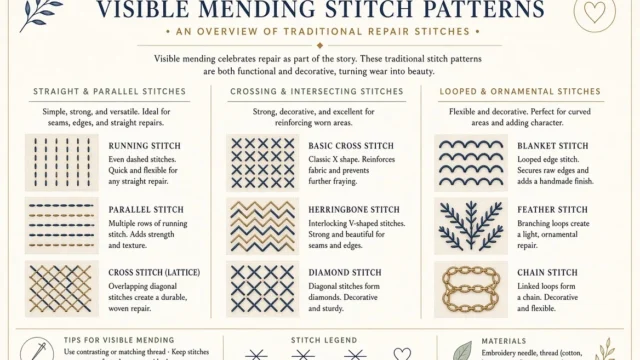
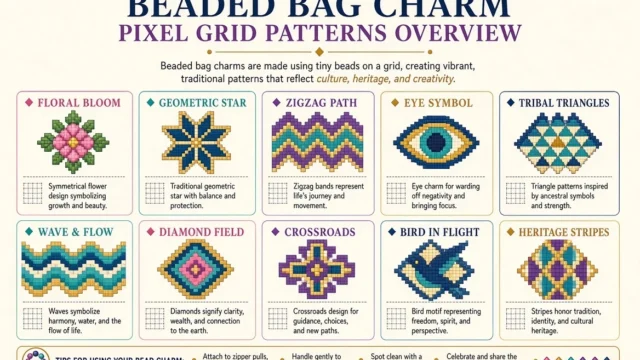
Celtic knot geometry patterns chart: four visual examples

Celtic knot geometry patterns: what makes a knot an interlace?
A Celtic knot geometry pattern is built by directing a ribbon-like path around itself to create a readable sequence of crossings. The resulting image may form a circle, a triangular motif, a border or an elaborate page-filling panel. Some patterns have one continuous strand; others have several interwoven strands. The important visual mechanism is not a mysterious formula but the relationship between line, space, symmetry and crossing order. A viewer can trace the ribbon with a finger and check whether each apparent crossing consistently moves over and then under.
In art history, knotwork is especially familiar from the Insular artistic tradition in early medieval Britain and Ireland, where manuscripts, stone carving and metalwork feature complex interlace. The famous Book of Kells displays a variety of minute crossings, decorated initials and other ornament. However, interlace is not exclusive to one people or one religion. Related forms occur in many artistic cultures. Calling every modern loop “an ancient Celtic knot” erases that wider history and sometimes gives a recent pattern a fictitious pedigree.
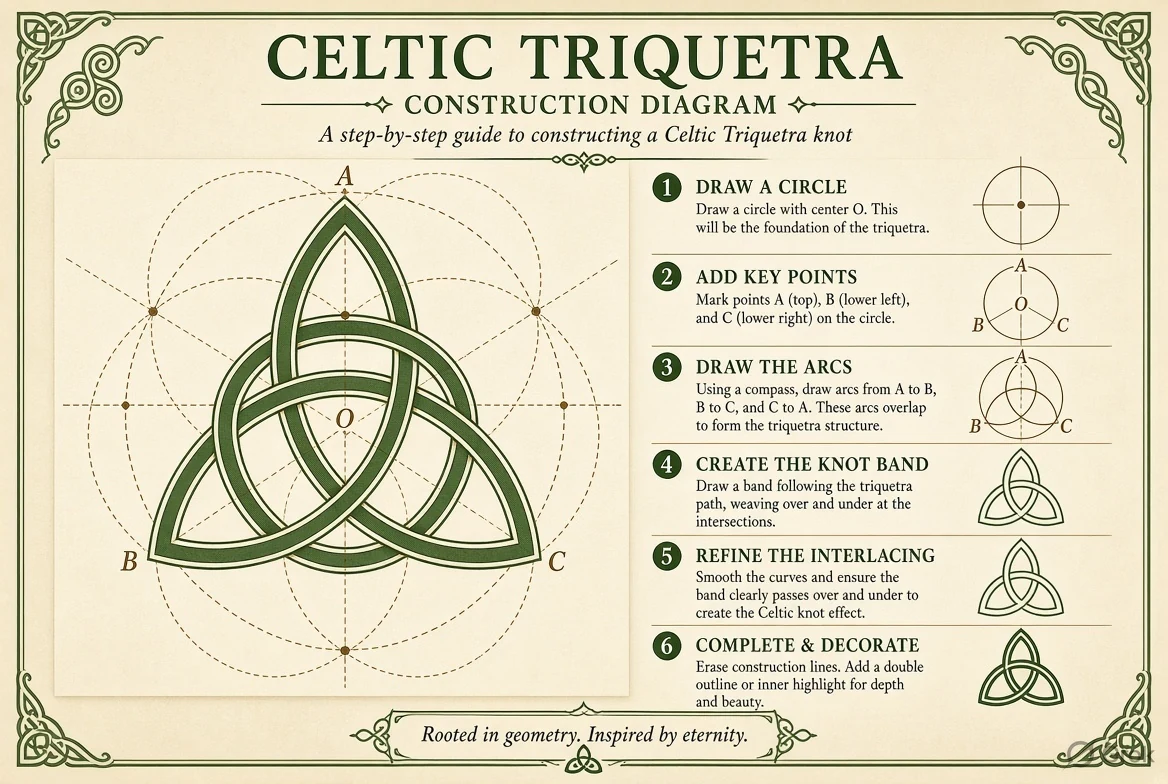
Triquetra knot pattern: the three-lobed construction
The triquetra is a recognisable three-pointed or three-lobed form with curves that can be arranged as an interlaced design. Many craft tutorials draw it using arcs and an inner triangular framework; the exact proportions vary. Some examples have an added ring. For beginners, start with a large triangular guide and draw three comparable rounded turns, then identify the locations where one curved band crosses another. Assign an over-under order at each crossing so the picture reads as a woven ribbon instead of unrelated overlapping lines.
What does a triquetra mean? In modern jewellery and spiritual design it may be used to express unity, a three-part relationship or the Christian Trinity. Those interpretations have different historical contexts. A designer should not claim that every three-cornered knot on an early medieval manuscript had a fixed pre-Christian secret meaning. The symbol’s actual use on a particular object and the interpretation people now give it must be considered separately. This diagram therefore shows construction first and meaning with appropriate qualification.
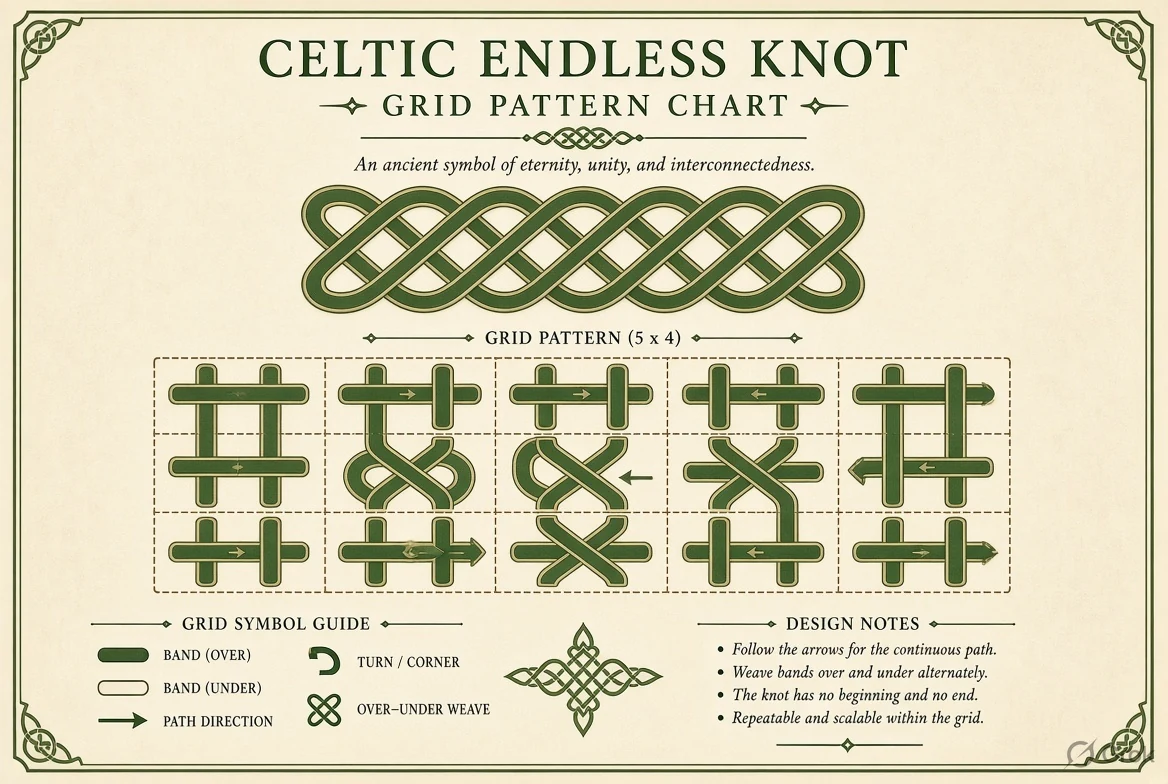
Endless knot grid: how continuous loops emerge
To make an endless Celtic knot grid pattern, draw a square grid and decide where the ribbon is allowed to pass. A repeated crossing module can be extended horizontally or vertically, while turns along the edges redirect the strands back into the design. The appeal lies in continuity: the eye follows one band through apparent complexity and discovers a rhythm of repeated crossings. Symmetry can simplify layout but does not force every valid interlace to be perfectly symmetrical.
A common digital mistake is to connect adjacent corners without planning the route; the output may look decorative but leave impossible overlaps. Check each crossing systematically, marking the top segment at one intersection and the bottom segment at the next along a strand when the pattern requires alternation. A second colour can help while drafting, but a final black-line chart should still communicate the crossings without relying on colour. Patterns with multiple loops can be intentional; do not advertise every closed motif as “one unbroken line” unless tracing confirms it.
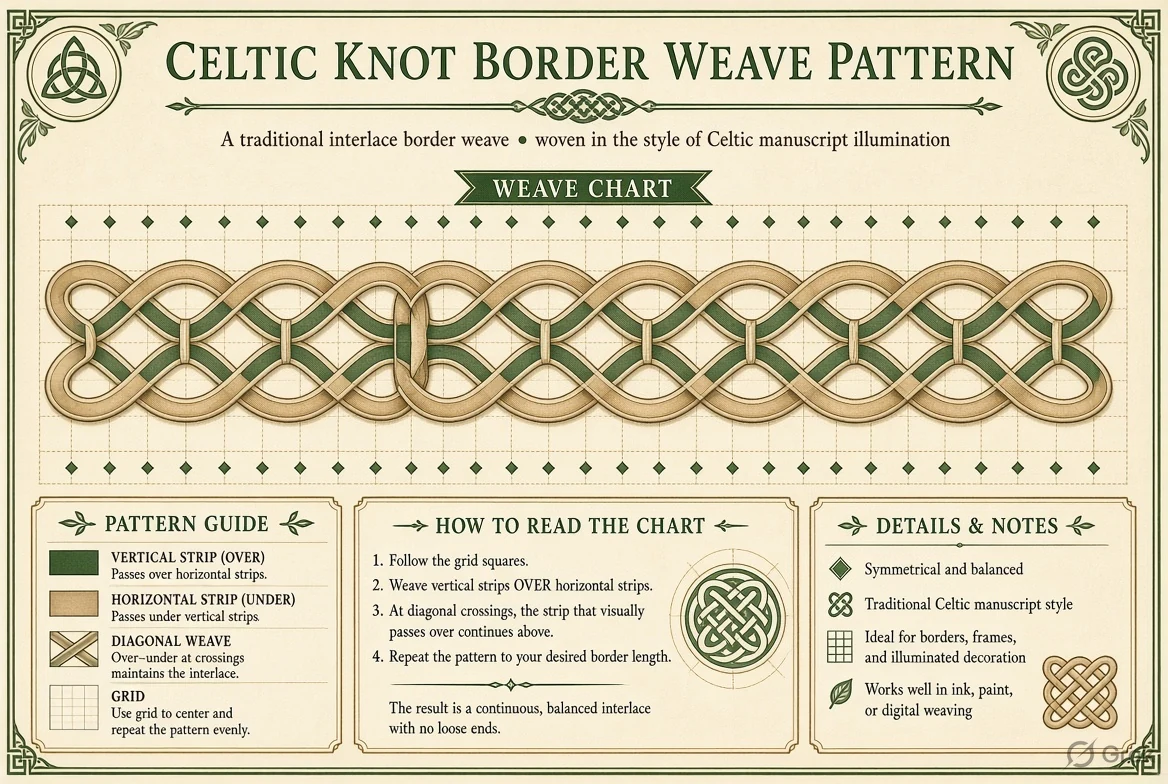
Celtic knot border patterns for pages, tattoos and craft
Border interlace runs around a rectangular frame or along an edge, which makes it ideal for a book-cover design, illustrated heading, textile panel or jewellery band. Draw a central strip and keep its width consistent. Establish a short repeat unit before copying it across the length of the border. At a corner, either turn the ribbon smoothly or design a special connecting section; otherwise bands end abruptly and spoil the visual logic. This is particularly important when wrapping a pattern around the side of a rectangular card or the circumference of a bracelet.
The chart here isolates the border shape so a reader can study one repeated section instead of a densely decorated full page. A short repeat may use only a few crossing points, while a complex border can incorporate animals, spirals and separate ornaments inspired by medieval manuscripts. Printing on fabric introduces practical limits: very narrow gaps may fill with ink and precise lines can blur at small scale. Test the design at intended output size. A clear simple crossing is often more useful than a visually crowded “intricate Celtic tattoo” that cannot be reproduced faithfully.
Over-under line diagram: four mistakes beginners should avoid
First, do not draw two strands merging at a crossing when they are meant to pass independently over and under. Leave a tiny interruption in the hidden strand to create depth. Second, do not change ribbon width unpredictably: thickness is one of the strongest visual clues to a coherent weave. Third, count turns as well as crossings, because a rushed border can create isolated ends. Fourth, do not assume a computer-made symmetrical diagram reproduces a specific manuscript motif unless you have actually compared it with the source object.
To debug an interlace, select one line and follow it from point to point without lifting your finger. Note whether it is intended to be a continuous closed loop. At every junction identify the overpass, underpass or deliberate connection. If a line stops at a point where it was supposed to continue, return to the grid and adjust the route. The four image panels in this article—triquetra, endless grid, border weave and crossing construction—form a practical visual workflow for correcting those mistakes.
Are Celtic knots really symbols of eternity and love?
Contemporary descriptions often say a Celtic knot “means eternity,” “means everlasting love,” or “means the four elements.” Such explanations can be meaningful choices for modern gifts or tattoos, and unbroken lines naturally invite ideas of continuity. But a modern interpretation is not the same thing as documented early medieval intention. Different knots have been reused in Christian art, secular decoration, revival movements and commercial designs. The old objects rarely provide an individual English-language legend for every isolated knot type.
For truthful captions, write “often used today to symbolise continuity” instead of “the ancient Celts always used this to mean eternal love.” The distinction is particularly important in a visual keyword article, where the most easily copied labels can spread far beyond the original context. Trinity College Dublin’s work on manuscript ornament discusses formal repetition, crossings and spirals, which can be studied directly. The historical evidence for that visible artistic practice is stronger than unverified lists assigning one magical power to each vector graphic.
Celtic knots, Ogham letters and Pictish stones are not the same
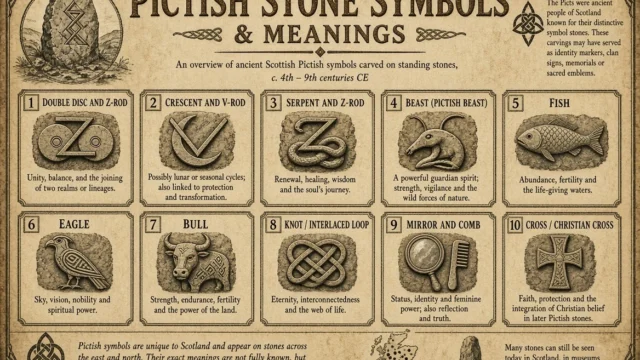
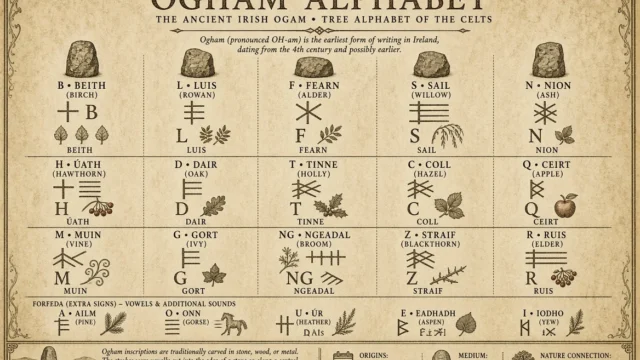
Searches for Celtic symbols often mix three subjects: interlace geometry, the Ogham writing system and the carved symbols of Pictish Scotland. They are related through broad regional interests but are different evidence categories. A knot can be a decorative interlaced band; an Ogham inscription is a sequence of letters made from notches and strokes; and a Pictish symbol stone may display animals or enigmatic geometric signs whose meanings are not securely decoded. A single “Celtic alphabet of knots” chart is therefore not historically reliable.
Some Pictish monuments also show later interlace decoration, and manuscripts can combine writing with ornament. That coexistence does not mean the patterns encode exactly the same words or symbols. For an art lesson, keep the page headings explicit: “Interlace,” “Ogham script,” and “Pictish symbols.” If your goal is a printable pattern for drawing, focus on geometry and crossings. If your goal is a linguistic translation or archaeological interpretation, seek the appropriate corpus and historical scholarship rather than relying on ornamental resemblance.
How to draw a Celtic knot pattern step by step
Choose a small grid, perhaps four columns by four rows, and lightly mark the centre of each potential crossing. Draw a smooth ribbon route using repeated curves or diagonal sections. Do not add shading yet. Select an initial junction and set the over-under relationship. Continue around the pathway, checking that the visual alternation is consistent and that the path connects as intended. Add a second parallel line to define the ribbon’s width and erase the hidden segments beneath each crossing. Then remove the guide grid and inspect the shape at reduced size.
For a triquetra, use a triangular arrangement of arcs instead of a rectangular border grid. For a straight border, preserve the repeat unit and test its join at both ends. For complex illuminated-page compositions, add spiral and animal forms only after the base weave works. These instructions teach design principles, not a claim that every historical artisan followed one identical drafting formula. Compare your result with museum images of Insular manuscripts to recognise where your modern reconstruction matches or departs from historical examples.
FAQs: knot names, drawings and meanings
Is a triquetra a Celtic knot?
It is commonly presented as a three-lobed interlaced Celtic-style motif, though examples and interpretations differ with their context.
Can a Celtic knot have more than one strand?
Yes. Some are a continuous loop while others weave multiple paths together. Trace the artwork instead of assuming.
What is an over-under Celtic knot pattern?
It is a design in which ribbon segments alternately pass visually above and below each other at crossings.
Does every Celtic knot mean eternal love?
No. Eternal love is a common contemporary interpretation, not a demonstrated universal historical translation.
Where can I see historic knotwork?
Look at documented Insular manuscripts such as the Book of Kells and associated medieval stone or metalwork collections.
Conclusion: follow the strands, then check the history
A useful Celtic knot chart teaches how curves repeat, where ribbon lines cross and which drawings are modern reconstructions. It can inspire tattoos, prints and classroom illustration without inventing a universal meaning for every knot. Trace your pattern and consult manuscript art scholarship before labelling a design as ancient.
Sources and further reading
Trinity College Dublin: Manuscript art, interlace and algorithmic repetition; Trinity College Dublin: The Book of Kells; The Metropolitan Museum of Art: Great Britain and Ireland, 500–1000 AD.




Share Your Opinion
Comments are closed on this post.