 Vista

Direct answer: I Ching Bagua and 64 hexagrams use combinations of unbroken yang and broken yin lines. The eight Bagua trigrams each have three lines; pairing two produces a six-line hexagram, making 64 possibilities. Read and number the lines from the bottom upward, and distinguish King Wen numbering from a binary-style grid when using this chart.
Updated 20 November 2026. Historical and philosophical visual guide, not scientifically verified fortune telling.
I Ching Bagua and 64 hexagrams: four illustrated charts
I Ching Bagua and 64 hexagrams chart: the simple explanation
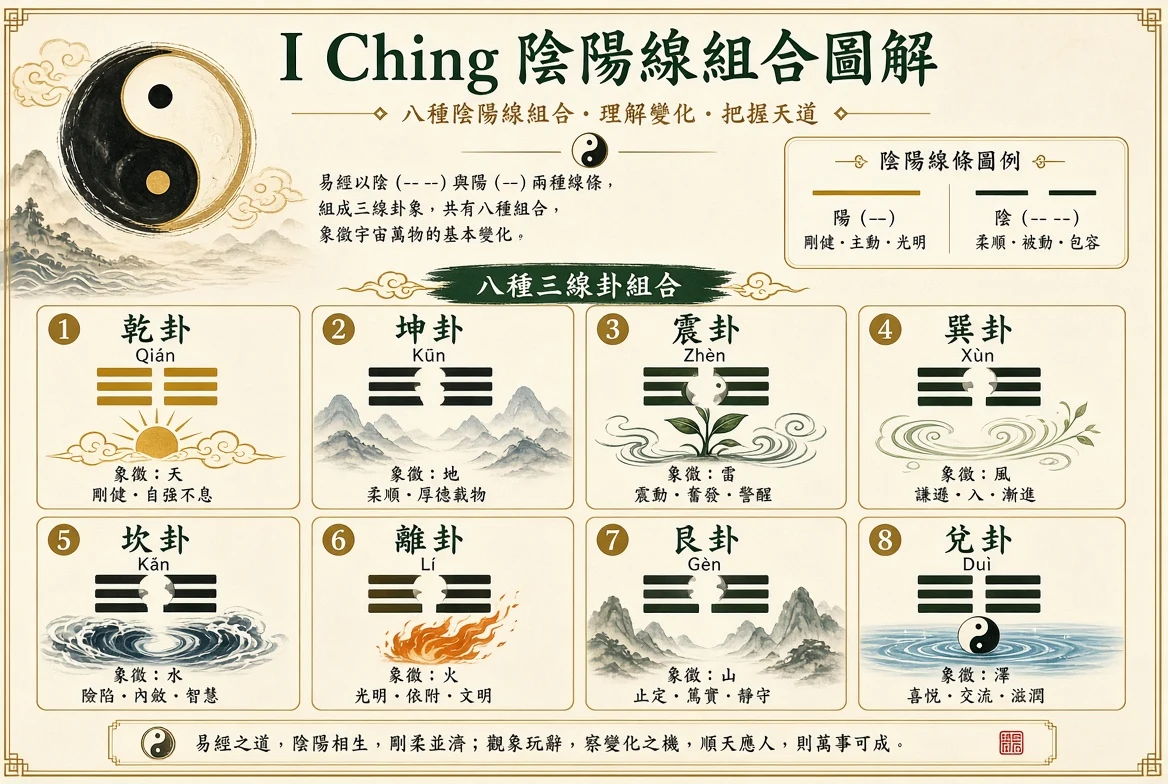
The I Ching, also written Yijing or Book of Changes, is a classical Chinese text with a long history of interpretation in philosophy, divination and reflection. Its most recognisable visual structure uses unbroken and broken horizontal lines. An unbroken line is commonly identified with yang; a line divided into two pieces with yin. Three such lines form a trigram, and six lines form a hexagram. That simple distinction is all the geometry needed to begin reading an I Ching Bagua and 64 hexagrams chart.
Because each line has two basic visual states, there are eight possible three-line trigrams (2³) and sixty-four possible six-line hexagrams (2⁶). The figures are associated with named images and commentarial traditions, not merely random binary shapes. The philosophical vocabulary has evolved through different periods and schools. A modern chart is helpful when it teaches the structure and labels, but it should not be marketed as a scientifically verified machine for predicting individual events.
The eight Bagua trigrams: names, symbols and images
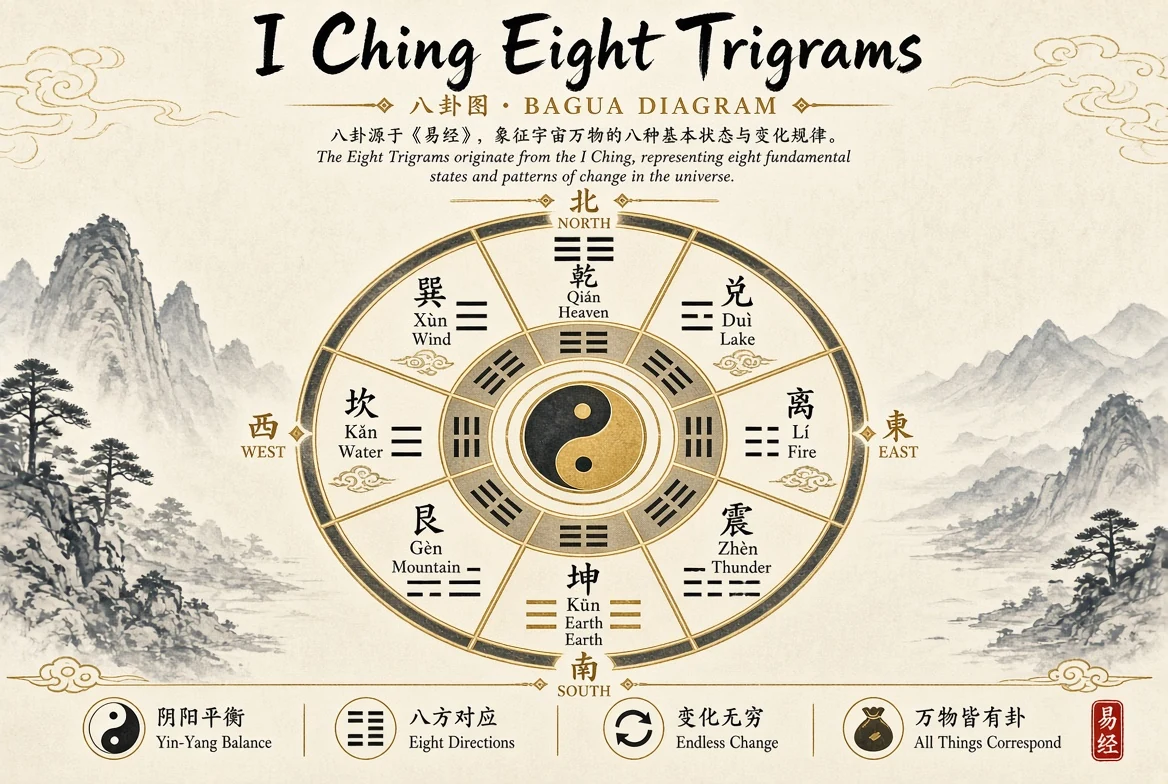
Bagua (八卦) means eight trigrams. The conventional names are Qian (☰, heaven), Dui (☱, lake or marsh), Li (☲, fire), Zhen (☳, thunder), Xun (☴, wind or wood), Kan (☵, water), Gen (☶, mountain) and Kun (☷, earth). Transliteration can appear with tones, such as Qián and Kūn, or alternative older spellings. The images are traditionally used in interpretation but are not a literal weather forecast.
Each trigram contains three stacked lines, and the exact arrangement of a broken line can distinguish two otherwise similar signs. The eight symbols are easier to remember with the nature imagery supplied by classic commentaries, but that does not mean there is only one fixed modern English definition. For an educational chart, show the Chinese character, transliteration, line symbol and a common image together. Readers can then identify a trigram without mistaking a poetic association for a scientific property.
How 8 trigrams become 64 I Ching hexagrams
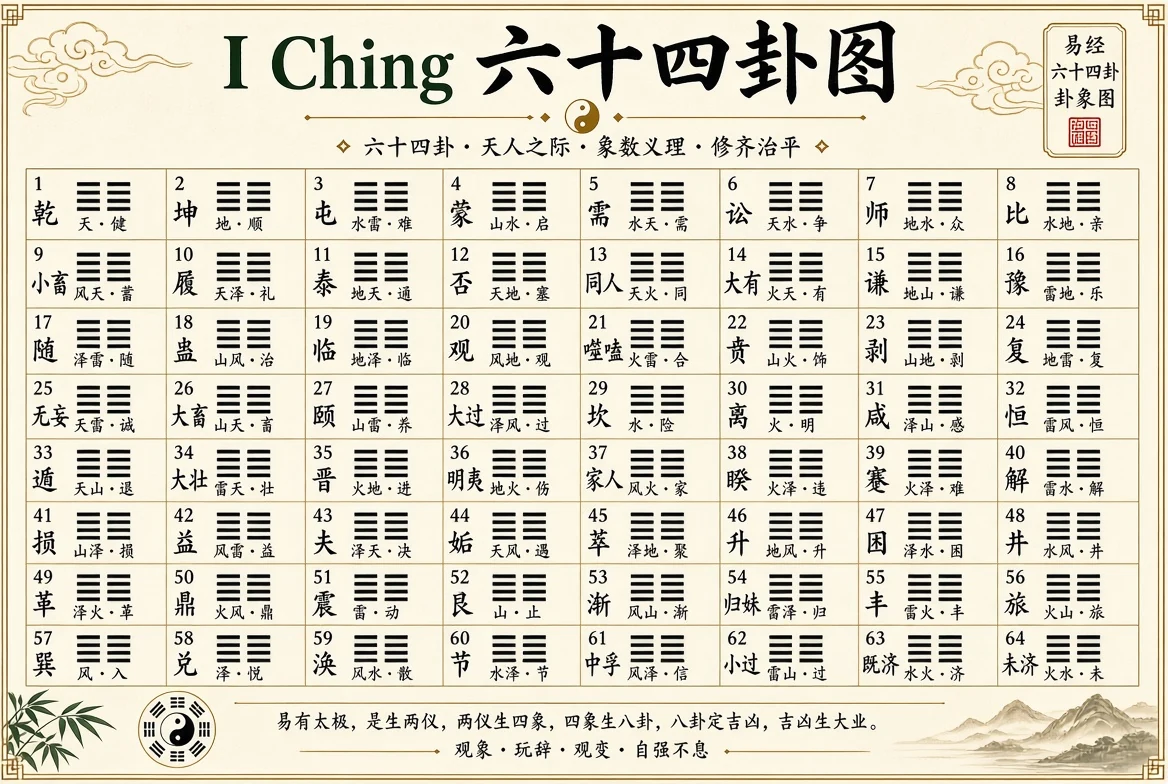
A six-line hexagram can be considered as two three-line trigrams stacked together, one lower and one upper. There are eight possibilities for the lower trigram and eight for the upper, giving 8 × 8 = 64 combinations. This is a convenient way to understand why a complete I Ching chart can be organised into an eight-by-eight grid. The arrangement in a particular chart depends on the sequence chosen for the trigrams and the corresponding hexagram numbering.
To identify a figure, start with its lower three lines. Read them from bottom to top, then read the upper three lines the same way. Once you know both trigrams, look up their combination in a consistent reference chart. Do not guess the hexagram’s number by counting squares from the top left of an unfamiliar grid: different layouts can place the same figure in different positions. The chart must make its ordering convention explicit. The Stanford Encyclopedia of Philosophy’s appendices provide useful labelled tables and explain the bottom-up reading approach.
I Ching yin and yang lines: reading from the bottom up
An I Ching hexagram has six line positions. Conventionally, line 1 is the bottom, and line 6 is the top. If all six lines are solid, the figure is the well-known Qian hexagram, traditionally numbered 1 in the King Wen sequence. If all six are broken, the figure is Kun, traditionally numbered 2. A single broken line where a solid one was expected changes the figure; an accurate diagram must preserve both line identity and position.
This bottom-to-top convention is particularly important in text explanations of changing lines. An instruction referring to the third line does not mean the third visible stripe counted downward from the top of the image. For beginners, write small numbers 1–6 on the left, beginning at the bottom. Then you can compare a printed passage with the artwork without flipping the sequence. Many mistaken “I Ching hexagram meanings” captions originate from a figure being inverted, mirrored or numbered under a different scheme.
King Wen order versus binary order: why chart numbers differ
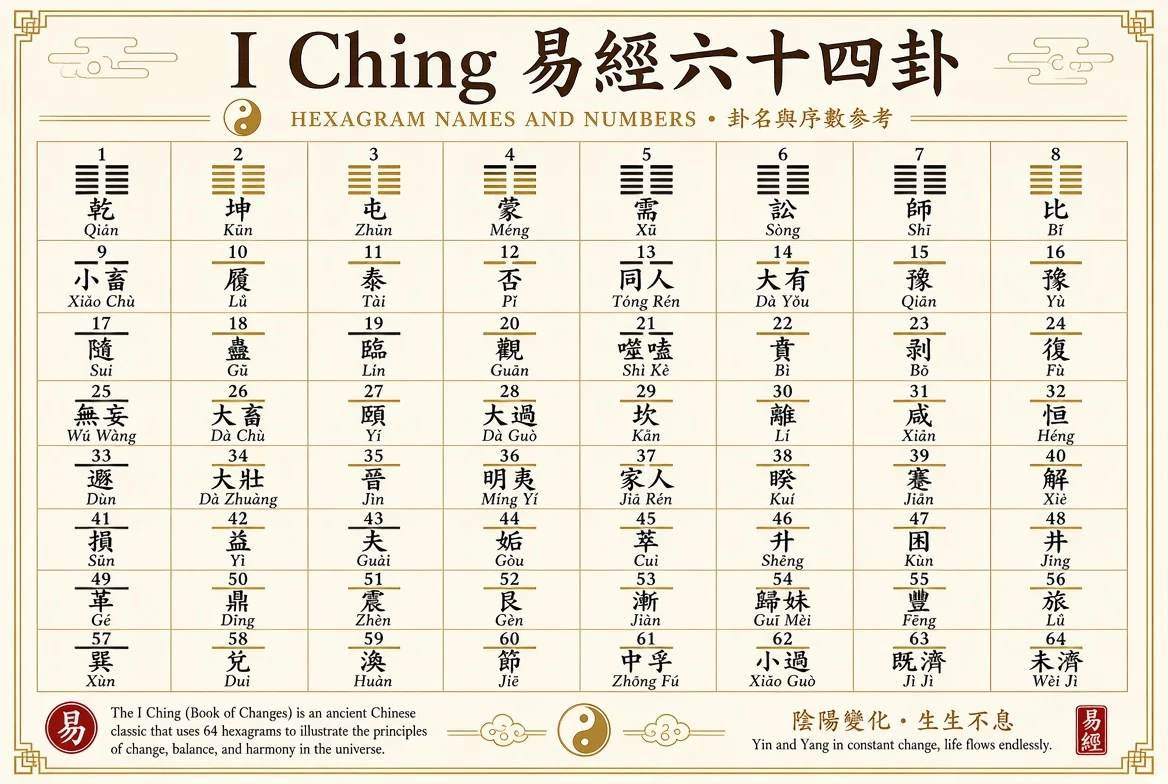
The sixty-four hexagrams have multiple ordering traditions. The most familiar numbered sequence in popular English-language translations is the King Wen sequence. In that sequence, Qian is number 1, Kun is number 2, and later figures include number 63, commonly translated as After Completion or Already Fording, and number 64, often translated as Before Completion or Not Yet Fording. Translations differ because classical Chinese names can carry more than one nuance.
Another way of sorting the same six-line combinations is mathematically, treating broken and solid lines as two states in a binary-like arrangement. That ordering is useful for visual comparison but is not the same as the King Wen numbering. An eight-by-eight grid arranged under one convention may look completely different from a chart of all 64 in numbered pairs. Do not label a square “Hexagram 17” merely because it is seventeenth in a homemade binary row; check the named ordering used by the source. Always disclose the sequence in the caption or introduction.
Fu Xi and Later Heaven Bagua: the two common arrangements
People searching for Bagua diagram meanings may find two ring arrangements, commonly labelled Earlier Heaven (often associated with Fu Xi) and Later Heaven (often associated with King Wen). They use the same eight trigrams, but their spatial arrangement differs. The distinction is crucial when a poster prints a directional compass or places trigrams around a central yin-yang graphic. Copying labels from one arrangement onto the other can produce an internally inconsistent diagram.
Attribution to legendary or historical sages belongs to the history of textual tradition and should not be presented as proof that one named individual personally invented every diagram seen in modern shops. Some contemporary Bagua graphics also add symbolic colours, family relations, seasons or Feng Shui sectors; those belong to specific interpretative systems and should be labelled. The image in this article introduces the trigram forms and avoids claiming that one arrangement is a universal formula for every interpretation or room layout.
How I Ching consultation traditionally uses lines
In different traditions, readers generate six line results and then consult the corresponding hexagram and sometimes passages relating to changing lines. Coin and yarrow-stalk methods are familiar modern and historical approaches, although their probability patterns and procedures are not identical. The key visual point is that a consultation constructs the hexagram beginning with the bottom line and working upward. A specific result can then be matched against a reliably numbered chart.
The text and its interpretive traditions are best approached as cultural and philosophical literature. Someone may use a consultation for reflection on choices, uncertainty or change, but the resulting figure is not scientifically proven to foretell events. Treat claims such as “Hexagram 24 guarantees success tomorrow” as interpretations or promotional statements, not empirical conclusions. For a serious reader, checking the translation, commentary and textual context provides more substance than attaching a dramatic one-sentence prediction to an icon.
I Ching symbols in tattoos, study notes and visual design
The trigrams and hexagrams are compact geometric forms, which makes them attractive for prints, mobile wallpapers, tattoos and learning flashcards. Yet a minimal line design is easy to miscopy. Preserve the breaks within yin lines; avoid filling a gap during image compression. Confirm the orientation before embedding a figure on a poster or rotating it in a tattoo stencil. If the artwork is intended to depict a named hexagram, double-check its six lines from bottom to top and match the name to a consistent scholarly list.
For educational content, include Chinese characters alongside transliterations when space allows, and explain why a given English translation differs from an alternative one. Do not confuse the taijitu—popularly called the yin-yang symbol—with a hexagram. They are distinct images, even when they appear together in a contemporary decorative arrangement. A truthful caption identifies which visual system is being shown and avoids inventing benefits such as healing, guaranteed wealth or cosmic energy measurable by a picture.
FAQ: Bagua, trigrams and hexagrams
What is the difference between a trigram and a hexagram?
A trigram has three yin/yang lines; a hexagram has six, and can be analysed as a lower and an upper trigram.
Why are there 64 I Ching hexagrams?
Each of six line positions can take one of two visual states, giving 2⁶ = 64 distinct combinations.
Do I read the lines from top or bottom?
In the standard textual convention, positions are numbered from the bottom up, with line 1 lowest.
Are all 64 hexagrams in King Wen number order on every chart?
No. Charts can use different arrangements, so their ordering convention must be checked.
Can the I Ching predict my future scientifically?
There is no established scientific proof that a hexagram predicts personal outcomes. The text is important as literature and philosophy.
Conclusion: follow the lines and identify the sequence
An accurate I Ching chart starts with two visual states, then the eight trigrams and their 64 six-line combinations. Reading lines from the bottom, using clear names and declaring the chart’s order prevents the most common mistakes. Its historical value lies in the many ways readers have used the Book of Changes to reflect on change, not in claims that a simple icon can guarantee future results.
Sources
Stanford Encyclopedia of Philosophy: Chinese Philosophy of Change (Yijing); Stanford Encyclopedia of Philosophy: Trigrams and 64 Hexagrams Appendices; Stanford Encyclopedia of Philosophy: Metaphysics in Chinese Philosophy.




Share Your Opinion
Comments are closed on this post.