 Vista

Direct answer: Kantha is a textile and embroidery tradition associated with Bengal, across today’s West Bengal and Bangladesh. Historic kantha quilts frequently reused layers of worn saris and dhotis, holding them together with close running stitches; more decorative nakshi kantha featured flowers, fish, people, scenes and patterned borders. This guide provides three clear illustrative references—running-stitch technique, Bengali floral and fish motifs, and border patterns—while explaining how to make a small practice piece without misrepresenting a modern graphic as a documented antique quilt.
Updated 20 November 2026. These diagrams are educational references rather than authenticated reproductions of historic cloth.
Kantha stitch patterns and Bengali motifs: quick facts
| Region | Bengal: West Bengal and Bangladesh |
|---|---|
| Basic stitch | Running stitch used for quilting and decorative outlines |
| Traditional base | Layered repurposed saris and other soft fabric |
| Motifs | Flowers, fish, birds, people, geometric borders, daily life |
| Nakshi Kantha | Decorated and often narrative embroidered quilt tradition |
| Charts | Three educational visuals; no separately hosted PDF pattern |
Illustrated Kantha running stitch, fish, floral and border charts
What is Kantha embroidery and where does it come from?
Kantha is associated with the household textile traditions of Bengal, including present-day West Bengal in India and Bangladesh. Older examples were often made from reused household fabrics, especially soft layers of worn saris or dhotis stitched together. Running stitch both connected the layers and produced a subtle rippled texture across the surface. Some kanthas were utilitarian quilts or covers, while richly decorated versions carried flowers, animals, geometric borders and narrative scenes. The tradition cannot be reduced to one fixed symbol or one contemporary pattern download. Regional makers and families developed their own arrangements, materials and practical purposes. An illustrated chart is a teaching tool, not a substitute for understanding the craft’s social context.
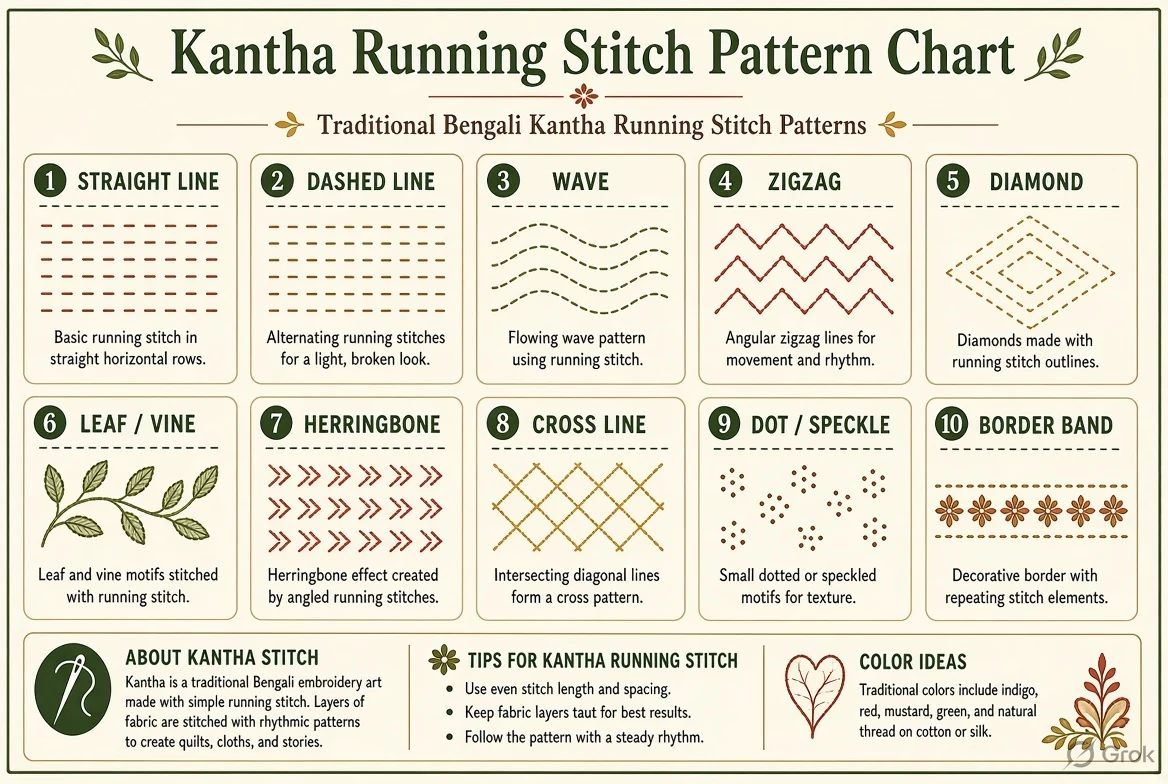
Kantha running stitch chart: how to read the stitch path
The core technique is a repeated in-and-out running stitch: the needle travels through the fabric, emerges, passes a short distance over the top and returns beneath. In a layered kantha, those stitches travel through multiple cloth layers to hold them together. Draw a practice line on fabric with a washable marker, then make a row with relatively regular visible stitches and spaces. The goal is control rather than a universal fixed stitch length. Dense rows can create subtle texture while looser spacing gives a very different feel. Check the reverse periodically; the thread path must hold the layers without pulling them into hard gathers. A grid drawing cannot predict tension on every cloth.
Nakshi Kantha and ordinary Kantha: what is the difference?
Nakshi Kantha refers to richly patterned, designed or pictorial kantha work, rather than a simple plain running-stitch quilt. The Bengali word naksha relates to a design or motif. Such examples may feature centered medallions, flowers, fish, village scenes, people or symbolic imagery, sometimes surrounded by decorative borders. The specific meaning of a motif cannot always be read without knowing the maker and local setting. It is tempting to claim that every fish means exactly one spiritual idea, but craft histories include both artistic storytelling and everyday depiction. Use the visual chart to identify recurring shapes while keeping interpretive claims modest and properly sourced.
Fish motifs in Bengal: meaning and visual construction
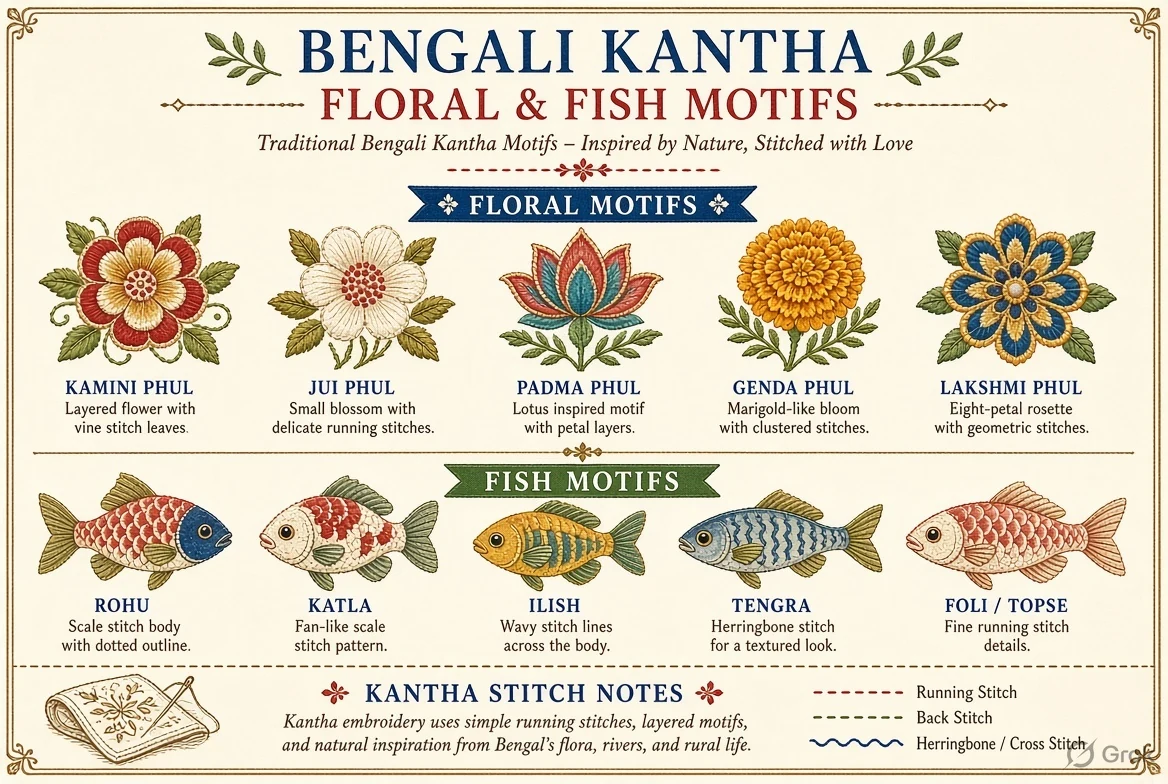
Fish appear in the broader visual culture of Bengal because rivers, water, agriculture and fishing are part of everyday life for many communities. Fish motifs can be decorative and sometimes carry associations of prosperity or abundance, but no single universal meaning applies to every historic kantha. A beginner can first sketch the body as a simple pointed oval, add tail and fins, and mark short running-stitch outlines. Small parallel or curved marks can suggest scales without making the entire shape stiff. For a quilt, place motifs so they do not interrupt the main rows securing fabric layers. The image is an illustrative contemporary reference rather than a claim to copy one dated textile.
Floral Kantha motifs: lotus, creepers and repeated leaves
Flowers and plants are prominent in historic Bengali kantha designs. Lotus forms, leafy creepers, flowering scrolls and tree-of-life imagery appear in published textile accounts and museum collections. A practical beginner floral panel can use a central flower plus a small border of repeated leaves. Mark the main curve first, then place the petals symmetrically and stitch each outline in small regular movements. Dense outlines around the flower can be balanced by quieter stitching in the background. Avoid copying an antique motif without checking whether its photograph has rights or whether the specific historical description matches the image. A modern flower inspired by the tradition should be labeled accordingly.
Kantha border patterns: repeats, corners and balance
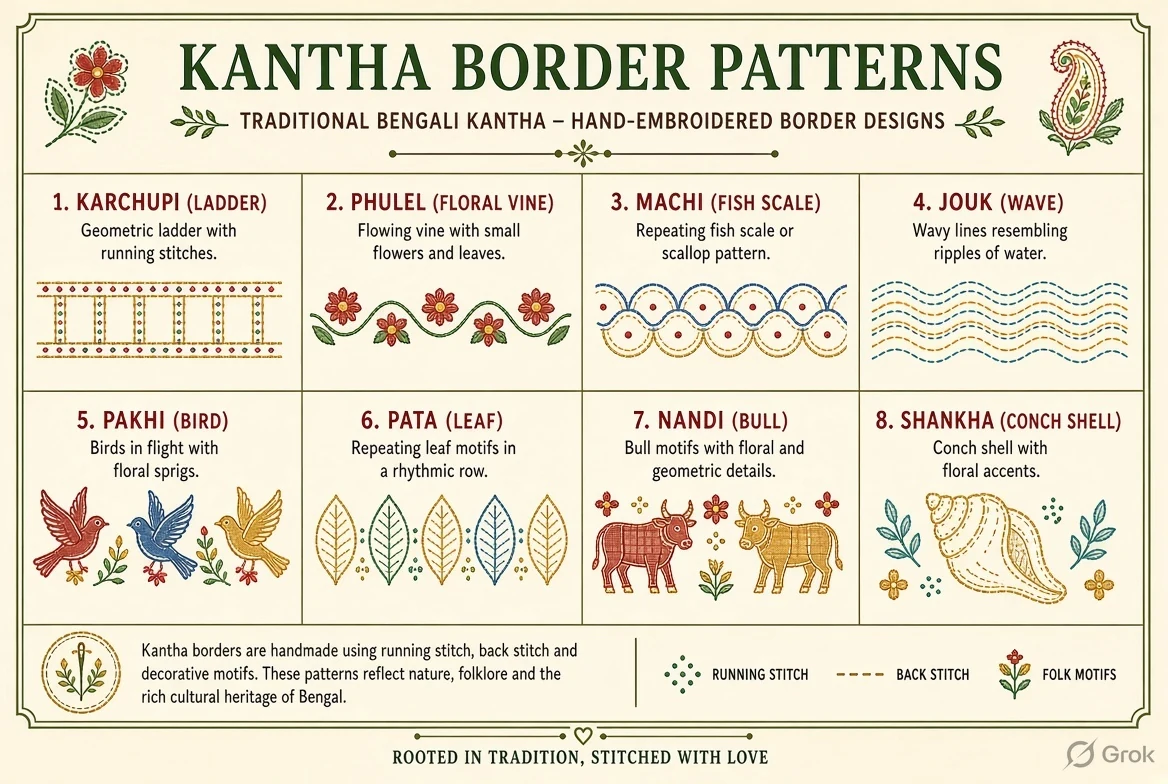
A border gives the quilt a visual frame and can help organize a crowded central design. Running-stitch zigzags, parallel lines, scallops or small repeated floral elements are all possible modern designs influenced by kantha. To plan one, measure the usable fabric area and divide it by the width of the desired repeating unit. Work out the corners before stitching the long sides; otherwise the last motif may be cut awkwardly. Use a removable marking tool and let the lines breathe so the edging does not become rigid. Keep a consistent distance from the edge if the cloth will later be hemmed or backed. A chart showing one border strip is not automatically a complete corner plan.
Layered fabric and why old saris were useful
Layers of worn, washed cotton or soft fabric can make a pliable kantha surface that is pleasant to handle. Historically, the reuse of textiles was a practical part of domestic life as well as an artistic opportunity. Modern makers can use new cotton or selected old textiles, provided the material is clean, strong enough to stitch and not so fragile that the needle tears it. Place the layers flat and secure them temporarily before quilting. Different thicknesses may shift during sewing, so check the reverse for unwanted folds. A loosely stitched edge may let fabric layers bunch after washing. Good preparation matters as much as attractive motifs.
Thread, needle and color planning for a first project
Select a needle that passes cleanly through the chosen cloth layers and thread that is not so thick it leaves large holes. Some historic kanthas reused threads drawn from sari borders; contemporary practitioners may prefer suitable cotton embroidery floss. Colors often add detail to motifs, but a monochrome practice sample can teach consistency first. Keep a small thread length rather than allowing a long strand to tangle on the reverse. Test dye fastness when mixing reclaimed fabrics and new thread. Dark outlines make fish and flowers easier to see on a pale ground, while densely repeated rows can add quiet background texture. Material suitability and comfort should decide choices.
How to make a beginner Kantha embroidery sample step by step
Start with two or three small, soft fabric layers and secure them together. Draw one simple flower or fish outline with a washable marker, leaving space around the shape for background quilting. Work a row of running stitches across an empty section, checking that the layers remain flat. Stitch the main motif outline using the same controlled in-and-out movement, then add small details without overloading the area. Create one narrow border from repeating triangles or leaves, planning how the corner will turn. Secure thread ends carefully and inspect both sides before removing markings. Begin with a practice square rather than committing to a full-sized family quilt.
Kantha versus Sashiko and ordinary visible mending
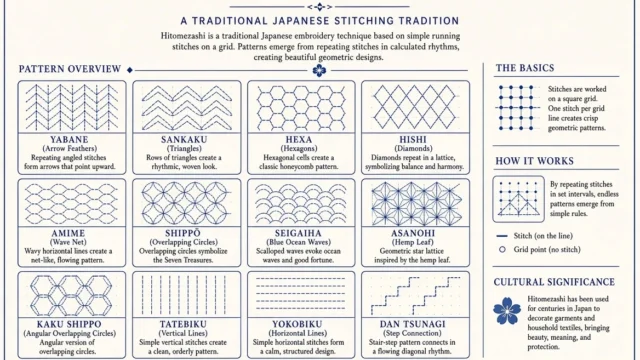
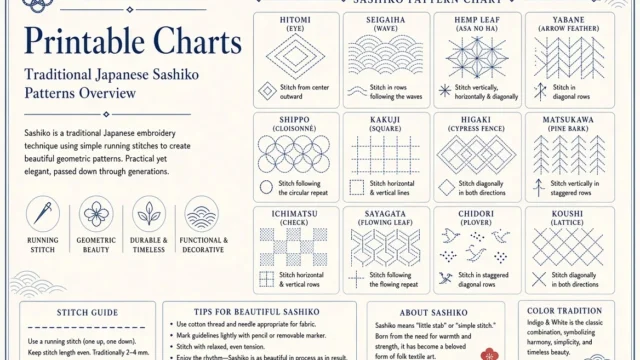
Kantha and Sashiko both use running stitches and have histories of functional textile reinforcement, but they are distinct traditions with different regional, historical and design contexts. Kantha is associated with Bengal; Sashiko belongs to Japanese textile practice. Modern visible mending may use running stitches for practical repairs regardless of their cultural source. A website should not relabel any running stitch as ‘authentic ancient Kantha’ or claim that an Indian fish motif came from a Japanese Sashiko pattern. A clear comparison helps readers appreciate similarities while recognizing differences. If adapting motifs for clothing repair, describe the result as Kantha-inspired and ensure the cloth is structurally supported.
Printing a Kantha motif chart for fabric transfer
The three figures on this page are online image references: running stitch, fish/floral motifs and a border sample. They can be printed using a browser where supported, but there is no separate stitch-counted downloadable PDF file promised. A decorative illustration may not have a specified grid or physical scale. Decide the intended motif size, print or redraw a clean outline and transfer it using a fabric-safe marking method. Test the marker on a scrap, particularly when using vintage fabric. If you enlarge the image, thin lines may blur. For accurate quilt planning, make your own measured drawing that accounts for fabric edges and the number of layers.
Common mistakes, historical care and next keywords
Beginners often pull running stitches too tight, sew a motif before securing all layers or assume one universal symbolism for every Kantha fish and flower. Another mistake is treating an illustration as a museum-verified antique original. Museum photographs and their catalog notes should be used when making a specific historical claim. If a cloth is fragile or old, avoid aggressive cleaning or stitching without expert guidance. Likely next searches include ‘Kantha stitch patterns’, ‘Nakshi Kantha motifs’, ‘Bengali Kantha running stitch’, ‘Kantha fish design’, ‘Kantha border embroidery pattern’ and ‘Kantha quilt tutorial’. These are useful reader-intent ideas, not invented Google Trends volumes.
Frequently asked questions
Where does Kantha embroidery originate?
Bengal, across present-day West Bengal and Bangladesh.
What is the basic Kantha stitch?
A repeated running stitch, often worked through layers of fabric.
What is Nakshi Kantha?
A richly decorated kantha often featuring pictorial motifs and elaborate borders.
Are fish and flowers common Kantha motifs?
Yes, along with plants, animals, figures and scenes of everyday life.
Is Kantha the same as Japanese Sashiko?
No. Both can use running stitches, but they are separate craft traditions.
Is there a free stitch-counted PDF download here?
These are reference images; no separately hosted tested PDF is promised.
Sources and conclusion
For historic Kantha practice and textile collections, see Victoria and Albert Museum: Kantha, a South Asian quilting tradition and Philadelphia Museum of Art: A Century of Kanthas. Related published reading: Sashiko stitch patterns. Learn the fabric construction and cultural context as well as the stitch motif before starting a full quilt.




Share Your Opinion
Comments are closed on this post.