 Vista
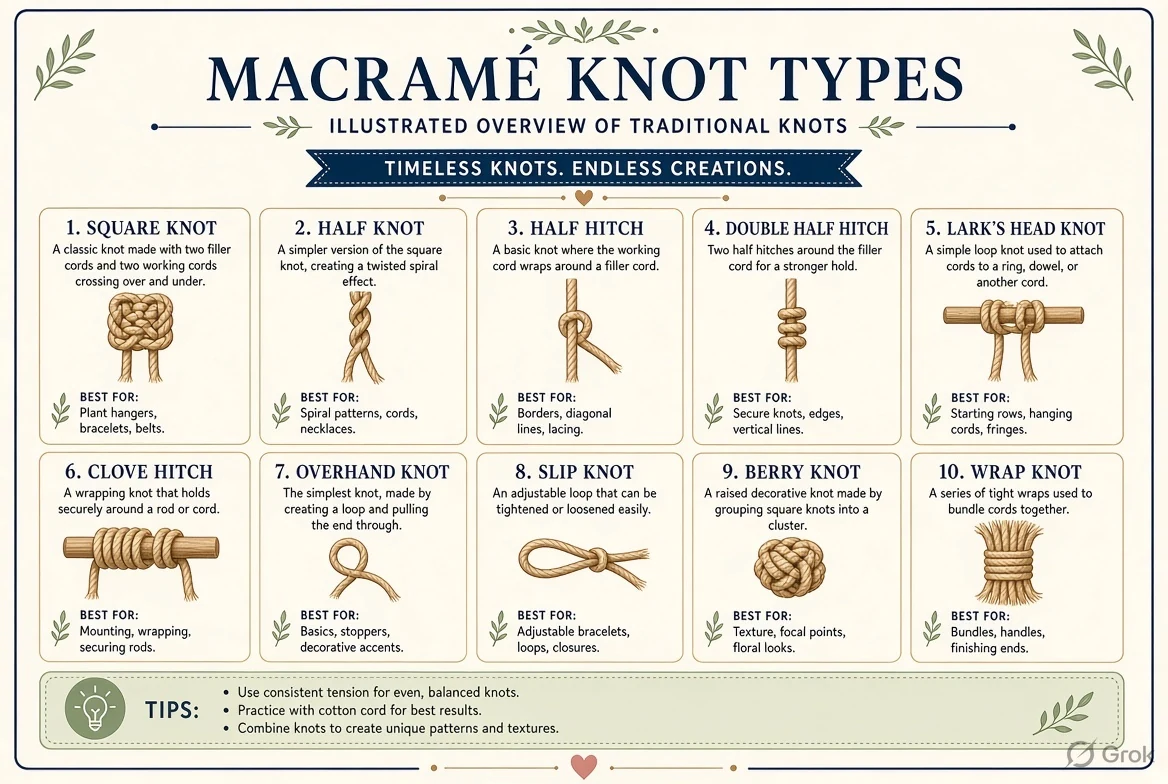
Direct answer: The most useful macramé knot types for beginners are the lark’s head mounting knot, square knot, repeated half-knot spiral, double half hitch for lines and diagonals, and gathering knot for finishing. A square knot alternates two opposite half-knot moves to make a comparatively flat column; repeating the same half-knot direction produces a spiral. Double half hitches use a holding cord to build structured rows. This article explains four illustrated charts, how cords are arranged, which knot suits each project and why a decorative drawing must not be mistaken for a tested safety-rated load-bearing knot.
Updated 20 November 2026. These knot diagrams are decorative craft references, not load-certified safety instructions.
Macramé knot types: quick chart
| First mounting knot | Lark’s head |
|---|---|
| Flat repeated knot | Square knot |
| Twisting pattern | Half square knot repeated on the same side |
| Lines and diagonals | Double half hitch |
| Finishing wrap | Gathering knot |
| Safety note | Decorative macramé is not climbing, lifting or life-safety ropework |
Four illustrated macramé knot diagrams
What is macramé and why should beginners learn knot types?
Macramé is a textile craft made by tying decorative knots in cords rather than weaving fabric on a conventional loom. The visual outcome can be a wall hanging, plant hanger, keychain, bracelet or other ornament. Its apparent complexity often comes from repeating a few basic knots in different positions and colors. Learning the structure of a square knot, spiral and double half hitch is more useful than memorizing a giant image gallery without understanding the movement. A beginner should distinguish working cords from the cords that form the stable core, and should practise each pattern separately before combining them into a project.
Lark’s head knot: how to mount cord on a dowel or ring
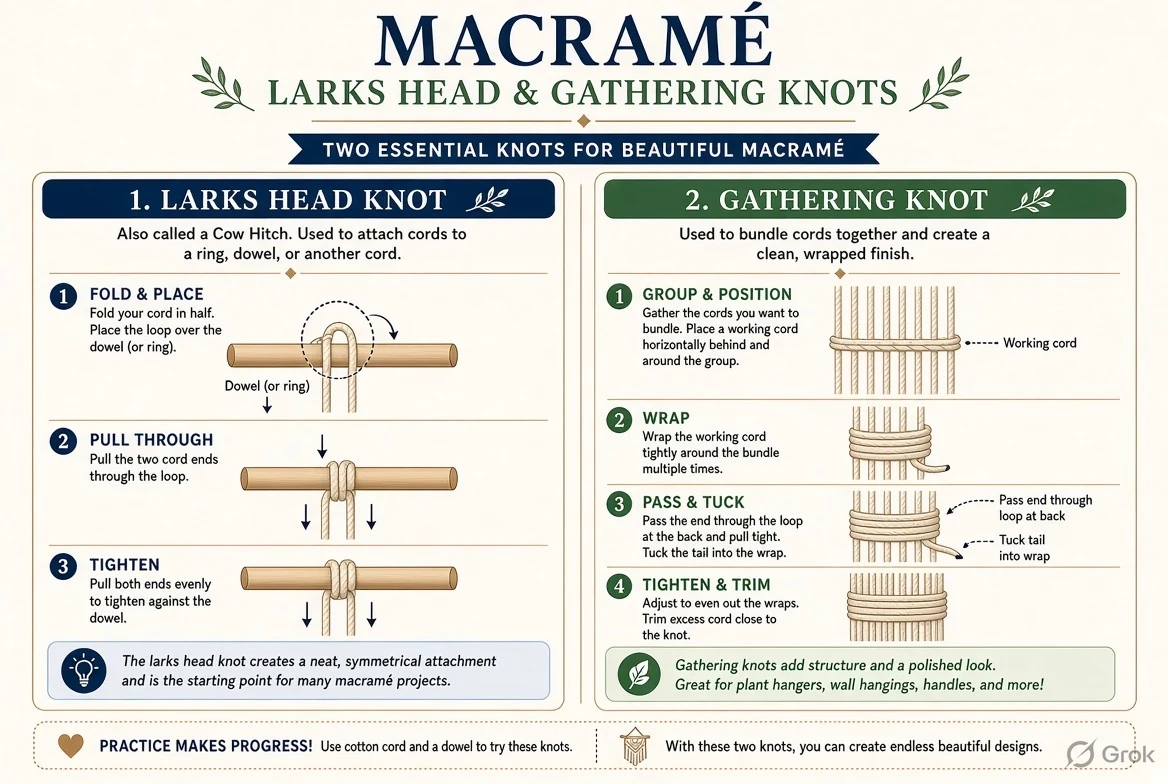
A lark’s head knot is a common way to attach a folded cord to a supporting rod or ring. Fold the cord in half, place the bend or loop around the support and draw both free ends through it. Adjust the knot so that the two working ends hang at a usable length. Whether the loop starts in front or behind the support affects the visible orientation of the mounting. A reverse lark’s head creates a different face while serving a similar mounting purpose. This knot is ideal for starting many decorative hangings, but the security of the whole structure also depends on cord material, support and what is later tied below.
Square knot: using four cords in an alternating pair of moves
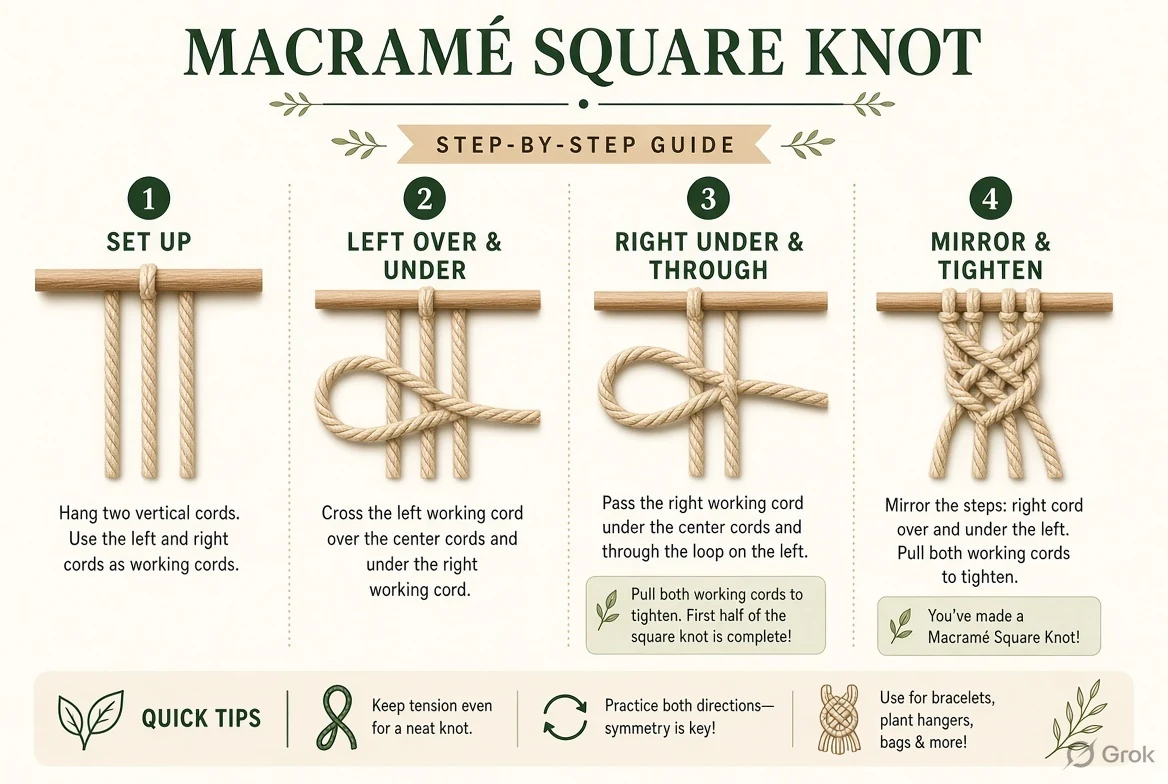
A common square knot sequence uses four strands: two inner filler cords and two outer working cords. Form one half knot by crossing the left working cord over the fillers, taking the right working cord behind them and bringing it through the loop. Tighten evenly, then perform the corresponding move from the opposite side. Alternating those halves produces a balanced square knot rather than a twisting chain. The left and right versions should be practised slowly to keep the cord pairs identified. Pull the outer ends snug but not so tightly that the inner fillers bend sharply. Repeating identical square knots makes a neat relatively flat band.
Why the spiral knot twists: half square versus full square
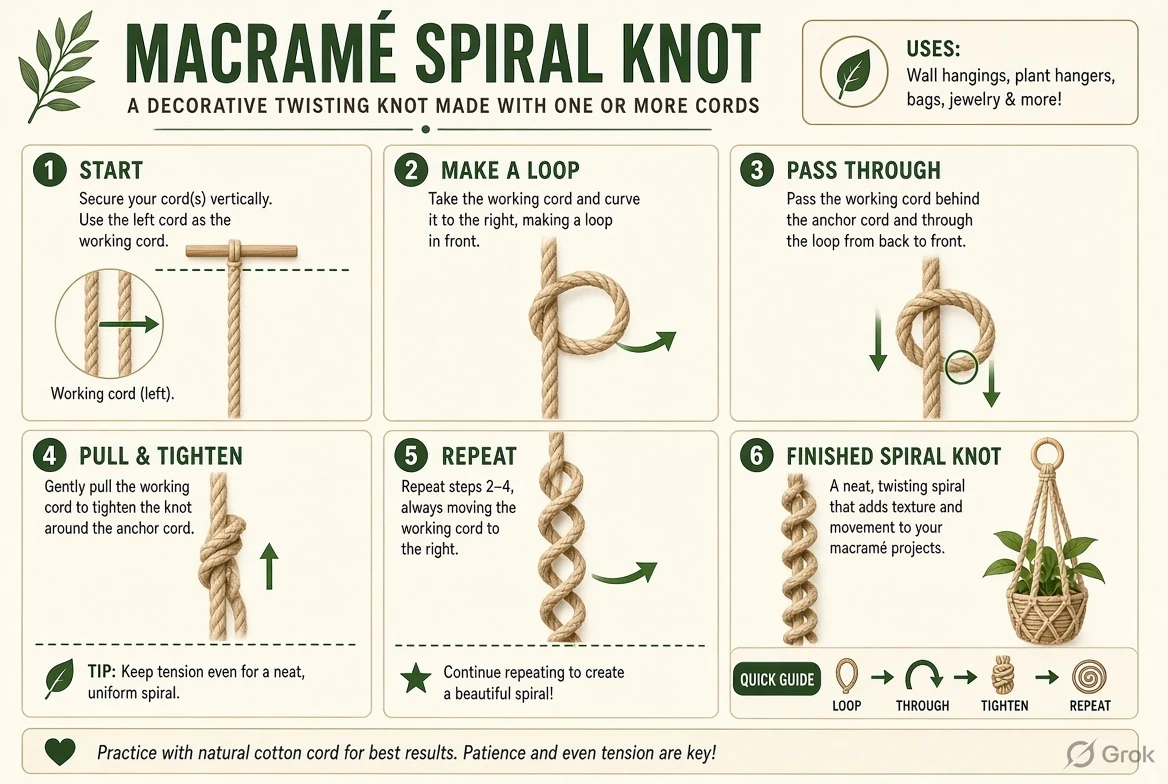
A macramé spiral is made by repeating a half knot from the same side rather than alternating its direction. Because each repetition pulls the work consistently around the filler cords, the column gradually twists. This is why two projects using four identical cords can produce very different textures with only a change in the knot sequence. If you want an even spiral, keep the chosen half-knot direction consistent and allow the work to rotate naturally. If you accidentally make the second half from the opposite side, you will start creating a square knot and the spiral may stop. The picture should show repeated half moves, not merely a tightly wound rope.
Double half hitch: horizontal, diagonal and vertical lines
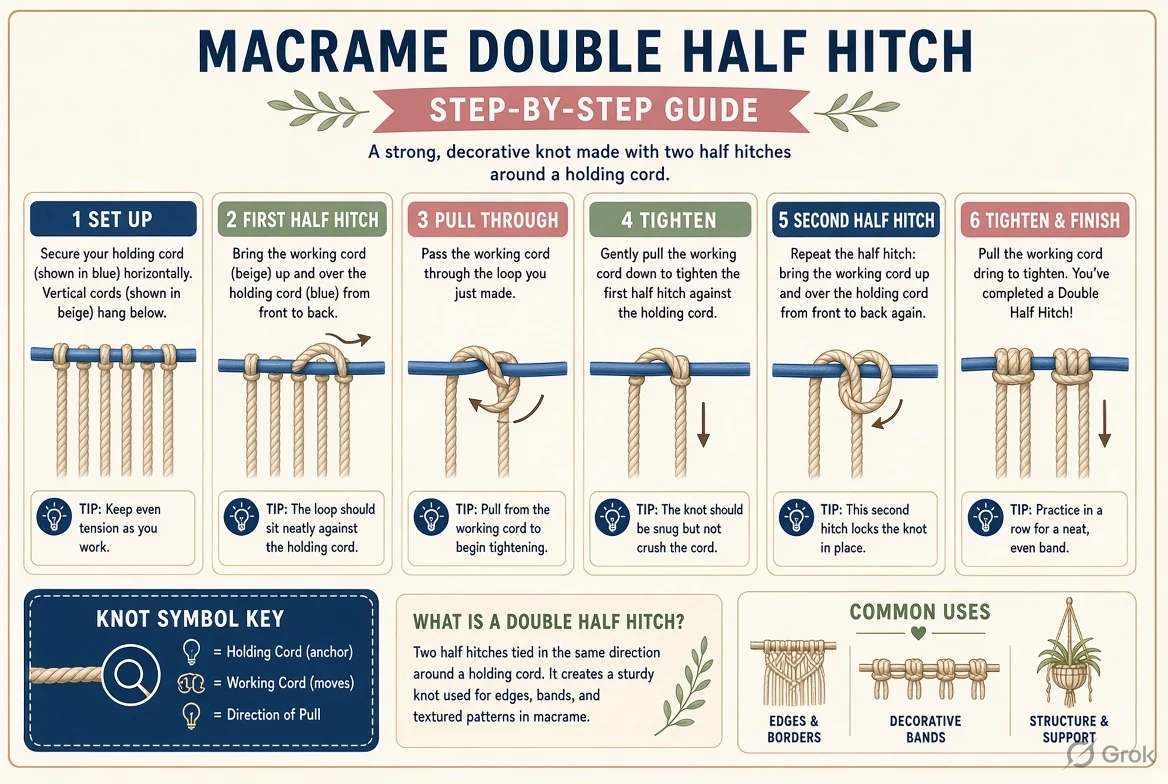
The double half hitch uses a holding cord around which a working cord makes two related hitch motions. Repeating the pair with neighboring working cords can build a straight horizontal line, a diagonal stripe or a vertical decorative section depending on the holding cord’s direction. The holding cord must be positioned where you want the line to travel before you tie the knots. Begin with just two working ends to understand the path. A single half hitch is not the same as a double half hitch, and loosely switching directions mid-row can distort the pattern. This knot is useful for diamonds, leaves, chevrons and structured edges.
Gathering knot: cleanly wrapping a tassel or bundle
A gathering knot wraps a separate cord around a bundle of strands, creating a neat tight band. It is commonly used to finish a macramé plant-hanger tail or decorative tassel. Arrange the hanging cords so they are untangled, then place a short separate wrapping cord with a loop toward the bottom. Wrap its long end evenly around the bundle, feed the tail through the loop and pull the other end to hide the join beneath the wraps. Trim carefully after confirming that the band is secure. Because this is decorative finishing, do not assume it is the sole load-rated attachment for a heavy hanging object. Use suitable engineered support where safety matters.
Macramé cords, thickness and how to prepare materials
Cotton macramé cord is widely used for beginner decorative projects, but different plies and fiber types change how knots sit and how a fringe combs out. Rope thickness matters: a thick cord produces a bold wall hanging but may overwhelm a tiny keychain. A common practice is to cut working cords substantially longer than the intended finished length because knotting uses up material. The exact length ratio varies greatly by knot type and density, so make a short test panel before cutting expensive full-length cords. Keep cord ends organized with clips. If the material frays badly, secure its ends temporarily until the final design is complete.
Simple beginner sample: square knots, spiral and hitch in one strip
Mount four cords or folded cord sections on a suitable stable support and label the two inner fillers and outer working ends. Begin with two square knots, deliberately alternating sides for each complete knot. In a separate section, repeat half knots from the same side and observe the twist. Then practise a double half hitch on an independent pair using a designated holding cord. Work a gathering wrap on the loose fringe at the end. This sequence is a learning sampler, not a complete hanging planter. Photograph each phase and compare the structure against the diagrams so you can recognize an accidental side change before it affects many rows.
Choosing the right knot for wall hangings, plant hangers and bags
A wall hanging often begins with lark’s head mounts and combines square knots with diagonals made using double half hitches. A keychain may use a simple square-knot or spiral column. Plant hanger arms can combine flat or twisted elements, but the structural load depends on the whole design and support—not merely on a pretty knot name. For a carrying strap, check cord strength, closure security and contact comfort. A decorative bracelet can use finer threads and lighter finishing methods than an item intended to support a pot. Match the craft technique to the stresses that the finished object will experience in ordinary use.
Read the four illustrated charts correctly
The square-knot chart should show two opposite moves; the spiral chart should show repeated same-side half knots; the double-half-hitch diagram needs a clearly identified holding cord; and the lark’s-head/gathering chart covers mounting and finishing. These four images are educational references, not a separately downloadable, safety-tested pattern booklet. Look for arrows showing cord travel, note which cords are working versus stationary, and make a small sample if the orientation is ambiguous. A drawing can accidentally mirror the knot’s direction, so compare both sides of the cord route before making a large item. Do not use unverified decorative diagrams for personal safety applications.
Troubleshooting: twisting square knots, uneven rows and loose wraps
If a supposed square-knot band spirals, the maker is probably repeating half knots on the same side rather than alternating left and right. If a double-half-hitch diagonal wanders, check the angle of the holding cord and the tension of successive knots. Uneven square knots may reflect mismatched outer cord lengths or changes in pulling pressure. A gathering knot may loosen if the wrap has too few secure turns or a poorly hidden tail. Take a short practice swatch apart, compare each movement with its diagram and rebuild slowly. Fixing the rhythm early is easier than disguising a large uneven pattern at the end.
Printable chart use, sources and next keyword ideas
Readers often search ‘macrame knots chart printable’, ‘square knot step by step’, ‘macrame spiral knot vs square knot’, ‘double half hitch diagram’, ‘larks head knot tutorial’, ‘macrame gathering knot’ and ‘macrame beginner wall hanging knots’. These are reasonable next-search questions rather than reported popularity numbers. The charts on this page can be viewed or printed through standard browser functions; no independent exact-scale PDF is claimed. For best results, label working cords on a copy, practise each knot separately and use strong, safe attachments appropriate to the actual finished project.
Frequently asked questions
What is the easiest macramé knot to start with?
Lark’s head for mounting or the simple square knot for a short decorative band.
What causes a macramé spiral?
Repeated half square knots made consistently from the same side.
How is a square knot different from a spiral knot?
A square knot alternates sides; a spiral repeats the same half-knot direction.
What is a double half hitch used for?
Straight, diagonal and shaped decorative lines using a holding cord.
What does a gathering knot do?
Wraps and finishes a bundle of hanging cords.
Are these macramé knots safe for climbing or heavy lifting?
No. Decorative knot tutorials do not establish life-safety or certified load ratings.
Sources and conclusion
For instructional knot diagrams: DMC Step-by-Step Macramé Knots and Macramé knots practice reference. Related reading: Crochet beginner patterns. Match the knot to its decorative purpose, and treat load-bearing applications separately.





Share Your Opinion
Comments are closed on this post.