 Vista

Short answer: No verified Egyptian carving shows a time traveller or a modern object. Viral posts usually rely on cropped photos, damaged reliefs, mistranslated signs or the human habit of seeing familiar shapes in random patterns. When scholars read the full inscription, the “modern object” turns out to be a normal Egyptian sign.

Quick Facts
| Point | Detail |
|---|---|
| Claim | Hieroglyphs show phones, machines or time travellers |
| Main causes | Cropping, edits, damage and pareidolia |
| Confirmed time-travel evidence | None |
| Reading method | Hieroglyphs are read in full context, line by line |
Where the claims come from
Social media posts often show one small part of a relief and say it looks like a gadget. They rarely show where the piece is, what the text says, or how it looks in other tombs. Similar claims about “helicopters” are explained in our guide on Egyptian helicopter hieroglyphs.
Why the brain sees modern objects
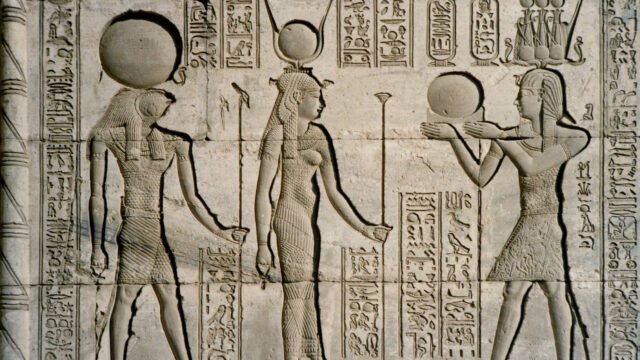
Pareidolia makes people see faces and familiar objects in patterns. If someone tells you a sign is a phone, you start seeing one. Egyptian signs are standard shapes: a hand holding an object may be a known sign for giving, not a device.
What hieroglyphs actually record
- Names and titles of kings and officials.
- Offerings, prayers and funerary spells.
- Records of campaigns, building work and daily life.
Story box (imagined): Someone posts a close-up of a carved hand and says it holds a phone. A scholar shows the whole wall: the hand holds a stick as part of an offering scene. Context turns a mystery into an ordinary sign.
A real example of why context matters
The well-known Abydos carving illustrates a useful problem in interpreting damaged inscriptions. Egyptologist Joshua Aaron Roberson discusses the overlapping text in a study of monumental palimpsests. Royal inscriptions were sometimes altered when a successor completed an earlier king’s monument. Lines from different periods can remain visible at the same time.
A modern-looking silhouette in such a photograph is not an independent depiction of an object. Before accepting a claim of time travel, ask whether the alleged object occurs in other securely dated inscriptions, whether there is a specialist transcription and whether the surrounding text supports the interpretation. Evidence for a modern device would also need material remains or other independently corroborating records, not just a resemblance.
Read the original research or museum reference
History, Mythology and Speculation
| Category | Examples |
|---|---|
| History | Documented reliefs and translated inscriptions |
| Mythology | Egyptian stories of the afterlife and divine journeys |
| Speculation | Time travellers, modern gadgets in carvings |
Myth vs Fact
| Popular claim | Careful answer |
|---|---|
| A carving shows a modern device | It is a normal Egyptian sign or object |
| Time travellers left proof | No evidence exists |
| Experts ignore it | Egyptologists read the full text |
Frequently Asked Questions
Are there time travellers in Egyptian art?
No verified example exists.
Why do carvings look like phones?
Pareidolia and cropped photos.
Can hieroglyphs be misread?
Yes, if read without context.
How do I check a viral carving?
Find the full photo, location and published translation.
Did Egyptians write about the future?
They wrote prophecy-like texts, but not time-travel records.
Are many images edited?
Yes, many viral images are edited or cropped.
Why do these claims spread?
They are surprising and easy to share.
Where can I learn to read hieroglyphs?
Museum guides and university courses are good starting points.
Reliable Sources
- World History Encyclopedia: Egyptian Mythology
- Egypt Exploration Society: Gods of Egypt
- The Met: Divine Egypt
Last updated: 25 November 2026. Related reading: Egyptian helicopter hieroglyphs, Dendera light.















Share Your Opinion
Comments are closed on this post.