 Vista

If the police arrive at your home or workplace to arrest you in India, remain calm, avoid physical resistance, ask why you are being arrested and request access to legal assistance. Ask for the arrest documentation and for a trusted person to be notified. An arrest is not a conviction. The Constitution of India and the Bharatiya Nagarik Suraksha Sanhita (BNSS), 2023 provide important safeguards, while allowing lawful criminal investigations to proceed. This guide focuses on what happens at the point of arrest and during initial custody, rather than how to avoid an arrest.
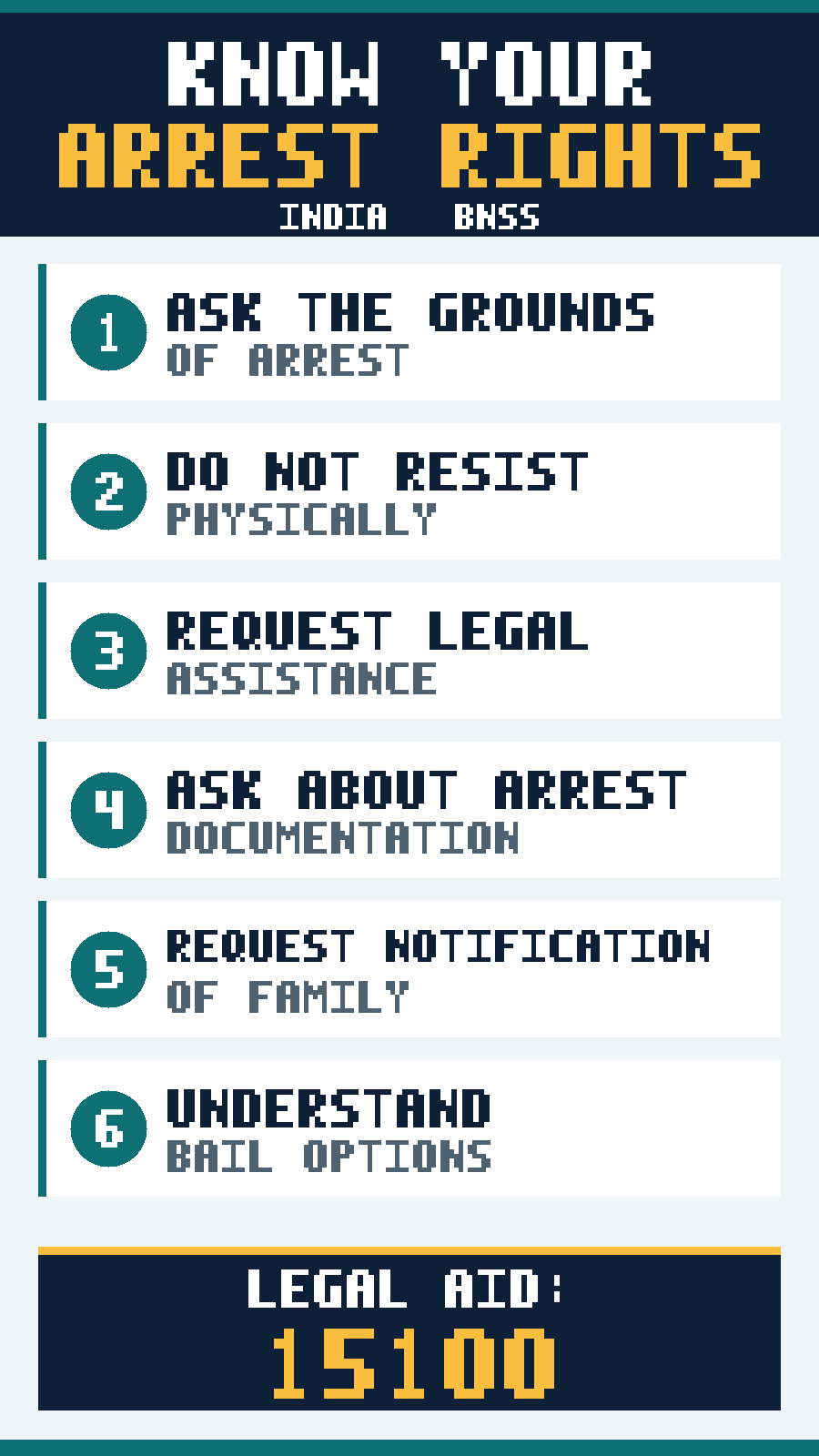
Legal references checked: 24 November 2026 | India
1. What should you do when police come to arrest you?
Ask whether you are being arrested or being requested to attend questioning. Note the officer’s name and police station. Under section 36 of the BNSS, an arresting police officer must have clear identifying information. If the arrest is under a warrant, section 77 requires notification of its substance and production of the warrant if requested. A lawful arrest without a warrant is also possible.
Cooperate peacefully and avoid obstructing the officers. Do not run away, destroy records, threaten witnesses or physically confront anyone. If there is genuine doubt about an officer’s identity, a family member can seek verification through the police station’s official contact details without obstructing lawful action. Inform the officers about essential medicines, disabilities or serious health conditions. Ask where you are being taken and request that your chosen contact be informed. Where possible, remember the time and circumstances of the arrest so that your lawyer can review them later.
2. Can police arrest without a warrant under BNSS section 35?
Yes. Section 35 identifies circumstances in which police can make a warrantless arrest. However, the existence of a complaint or FIR does not automatically justify arrest in every case. For cognizable offences within section 35(1)(b), punishable with imprisonment up to seven years, an officer must have the requisite belief concerning the person’s involvement and must consider whether arrest is necessary under the statutory criteria. These include preventing further offending, enabling proper investigation, protecting evidence and ensuring attendance before court. The required reasons must be recorded in writing.
When arrest is not required, section 35(3) provides for a notice to appear. Continued compliance with that notice ordinarily protects the person against arrest for that offence unless the officer records reasons for concluding that arrest is necessary. Section 35(7) also requires prior permission from an officer of at least Deputy Superintendent of Police rank in cases punishable with less than three years of imprisonment involving an infirm person or someone above sixty years of age. Different statutory circumstances and special laws can change the applicable procedure.
Read the separate guide to police calling without an FIR and BNSS notices if you have received a request to appear rather than being arrested.
3. Written grounds of arrest and the arrest memo
Article 22(1) of the Constitution and BNSS section 47 safeguard the right to be informed of the grounds of arrest. In Mihir Rajesh Shah v. State of Maharashtra, 2025 INSC 1288, decided on 6 November 2025, the Supreme Court explained that written communication of the grounds is a constitutional requirement across offences. Ordinarily, where the necessary information is available, the grounds should be given in writing at arrest. If exceptional circumstances make immediate written communication impracticable, oral communication may initially suffice, followed by written grounds within a reasonable time and no later than two hours before production before the Magistrate for remand proceedings.
The grounds of arrest and the arrest memo serve different purposes. Section 36 requires a memorandum of arrest, attestation by a family member or a respectable member of the locality where the arrest occurs, and countersignature by the arrested person. Check the recorded particulars and time. Ask for a copy and an explanation of anything you do not understand. Do not sign blank documents. If the details are disputed, explain the issue to your lawyer and the Magistrate. Where articles are taken during a search under section 49, request the applicable receipt. Keep any documents safely or ask your family to preserve copies.
4. Right to legal assistance and family notification
Article 22(1) protects access to a legal practitioner of the person’s choice. Under BNSS section 38, an arrested person being interrogated by police may meet their chosen advocate during interrogation, though the provision does not guarantee the lawyer’s continuous presence throughout questioning. Article 20(3) protects an accused person against compelled self-incrimination. Comply with lawful identification and investigative requirements, and ask a lawyer for advice before making consequential statements. Do not give false information or sign statements you have not understood.
Section 48 requires notification of the arrest and place of custody to the relative, friend or other person nominated by the arrested individual. The police must explain this right, maintain the required record and the Magistrate must check compliance with the relevant requirements. Give accurate contact details. A person in custody is within an eligible category for free legal aid. If private representation is unaffordable or unavailable, request assistance through the District Legal Services Authority (DLSA) or the National Legal Services Authority (NALSA). The national legal aid helpline is 15100.
5. The 24-hour rule, remand and medical examination
Article 22(2) and section 58 of the BNSS ordinarily prohibit detention beyond twenty-four hours without a Magistrate’s authority, excluding necessary travel time to the court. Further detention requires lawful judicial authorisation under the applicable procedure, including section 187. The 24-hour rule does not mean that everyone must automatically be released when that period ends. A Magistrate may authorise further custody or consider release according to the law. Tell the Magistrate if you have not received your grounds of arrest or been given access to legal assistance.
Section 53 provides for medical examination soon after arrest, documentation of injuries and a copy of the medical report for the arrested person or their nominee. Section 56 requires reasonable care for the person’s health and safety. Report injuries, ill-treatment and medical needs directly to your lawyer, examining clinician and Magistrate. Handcuffing is not required for every arrest: section 43(3) permits it for specified categories and circumstances, while section 46 limits restraint to what is necessary to prevent escape.
6. Special rules for the arrest of women
Under section 43(5), a woman should not ordinarily be arrested between sunset and sunrise. In exceptional circumstances, a woman police officer must submit a written report and obtain prior permission from the competent Judicial Magistrate of the first class. Section 43(1) also provides safeguards concerning physical contact during arrest. A woman’s personal search must be conducted by another woman with due regard for decency. Under section 53, examination of her body must be conducted by or under the supervision of the prescribed female medical professional. Children under eighteen are subject to separate safeguards under juvenile justice law.
7. Police station bail, regular bail and anticipatory bail
For bailable offences, section 478 provides a right to release on bail when applicable requirements are met, including provision for a personal bond in cases of indigence. For non-bailable offences, section 480 governs relevant discretionary bail powers subject to statutory restrictions. Regular bail is sought after arrest; anticipatory bail under section 482 may be available from the Sessions Court or High Court before arrest, subject to exceptions. A family member should consult a lawyer about the precise offence and conditions, not pay an intermediary promising guaranteed release.
Related: Download an FIR copy and check case status.
Frequently asked questions
Does every FIR require an arrest?
No. Police must follow the applicable statutory grounds and safeguards.
Can I ask for written grounds?
Yes. The Supreme Court has clarified the written communication requirement.
Can police refuse to notify my family?
Section 48 requires notification to the nominated person in accordance with the statutory procedure.
Can my lawyer attend every minute of interrogation?
Section 38 provides a right to meet an advocate during interrogation, not continuous attendance.
How can I obtain free legal aid?
Contact NALSA at 15100 or request assistance through the local DLSA.
Conclusion and legal references
Cooperate peacefully, request your safeguards and raise legal objections through counsel and the Magistrate.
Sources: Official BNSS text, Supreme Court judgment, Mihir Rajesh Shah, 6 November 2025, NALSA legal aid FAQs.
General legal information, not individual legal advice. Special statutes and transitional provisions for older proceedings may alter the applicable procedure.
For all topics: Where to Complain in India: Police, Courts, Consumer, Banking and Government Legal Help




























Share Your Opinion
Comments are closed on this post.