 Vista
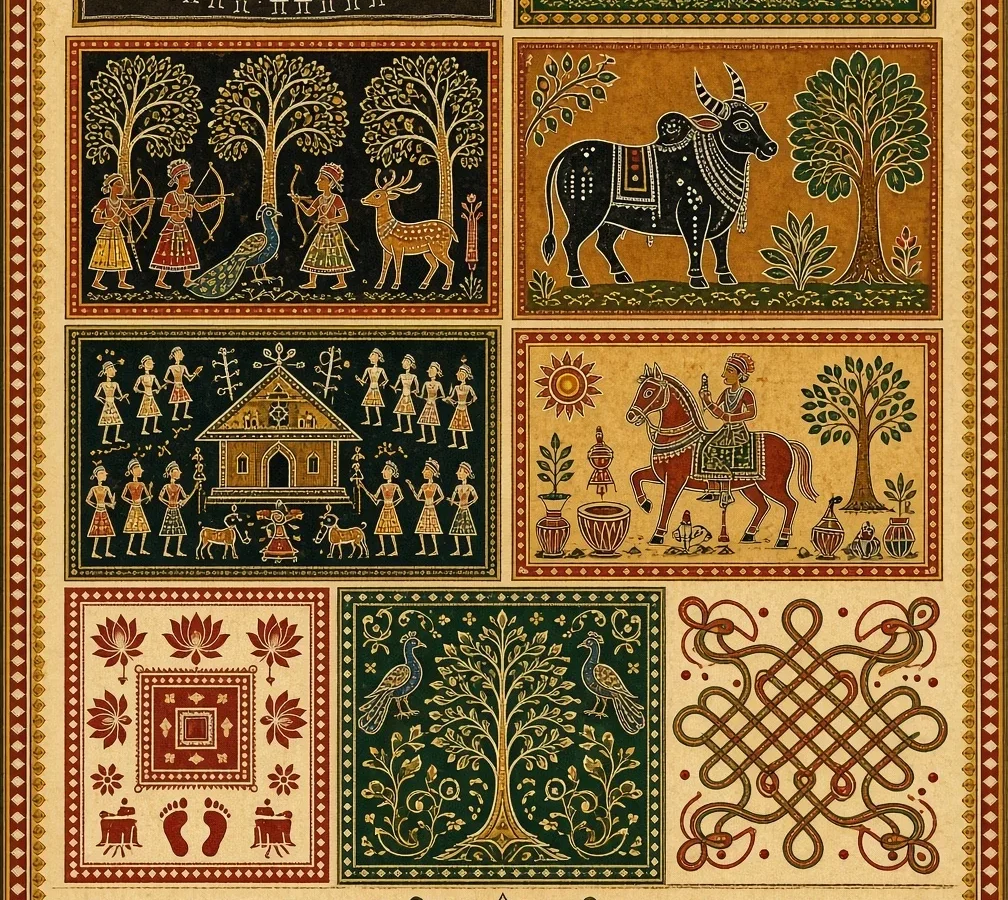
Indian tribal art and Indian folk art are not one style but a large family of living traditions: wall paintings made for harvests and weddings, floor designs drawn at dawn, storytelling scrolls, temple murals and textile paintings. This guide covers 19 traditional Indian art forms with pictures, from Sohrai, Khovar, Pithora, Saura, Baiga Godna, Kurumba, Warli, Gond and Bhil to Mandana, Aipan, Alpana, Kolam, Pattachitra, Kalamkari, Kerala Mural, Phad and Pichwai, with a state-wise list at the end. It is written for students working on an Indian folk art school project, teachers, craft learners and anyone who wants to tell look-alike styles apart.
One distinction runs through the whole article. Tribal (Adivasi) art is made by a specific tribal community inside its own belief system. Folk art belongs to regional village or caste-based traditions. Ritual floor art is drawn at home for festivals, devotional art grows around a deity’s worship, and classical temple murals follow written painting canons. Each section below states which label fits, and where sources disagree we say so. This is a verified overview, not a complete list of every tribal art in India; North-East, Himalayan and island traditions are not covered here.
In this guide
- Sohrai Art
- Khovar Art
- Pithora Art
- Saura Art
- Baiga Art and Godna
- Kurumba Tribal Painting
- Cheriyal Scroll Painting
- Warli Art
- Gond Art
- Bhil Art
- Mandana Art
- Aipan Art
- Alpana Art
- Kolam Art
- Pattachitra Art
- Kalamkari Art
- Kerala Mural Art
- Phad Art
- Pichwai Art
- Indian Tribal and Folk Art Visual Comparison
- FAQs
Sohrai Art
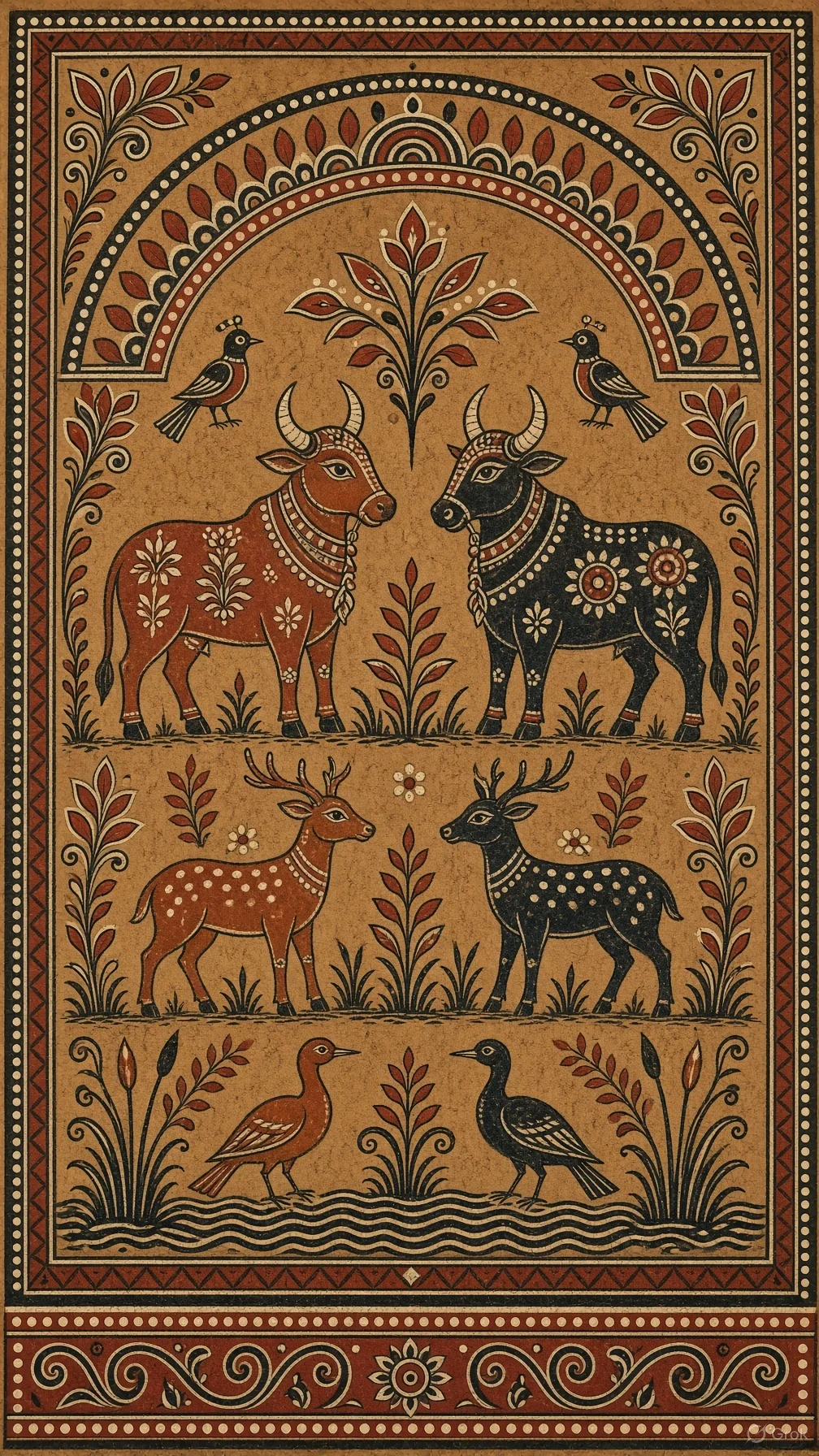
At a glance: Jharkhand (Hazaribagh region) | Tribal ritual wall painting | Made by women | Harvest and cattle festival.
Origin and communities
Sohrai is a mural tradition of eastern India, found particularly in Hazaribagh district of Jharkhand. It is tied to the Sohrai festival, celebrated in autumn after the harvest. The Government of India’s handicrafts portal says the wall art of Hazaribagh has been practised for centuries and links it to ancient cave paintings of the Isko and Satpahar ranges. The Geographical Indication application names several communities, including Santhal, Oraon, Munda, Agaria, Kurmi, Ghatwals, Ganju and Prajapati.
Colours, materials and motifs
Traditionally the colours come from local soils and minerals; one craft organisation lists red, black, white and yellow in soft earthy tones. Murals are painted on freshly prepared mud walls and often renewed each season. Commonly photographed motifs include cattle, horses, elephants and deer, trees and vines, and repeated borders, but there is no fixed template: each mural reflects the woman who paints it.
Cultural significance and GI tag
Sohrai welcomes the harvest and honours cattle; it began as a household ritual, not as decoration for sale. Sohrai-Khovar painting was registered as a Geographical Indication in 2020 and is reported as Jharkhand’s first GI, with the certificate held by a women’s cooperative of Hazaribagh. For a motif comparison, see our Sohrai vs Khovar chart.
Khovar Art
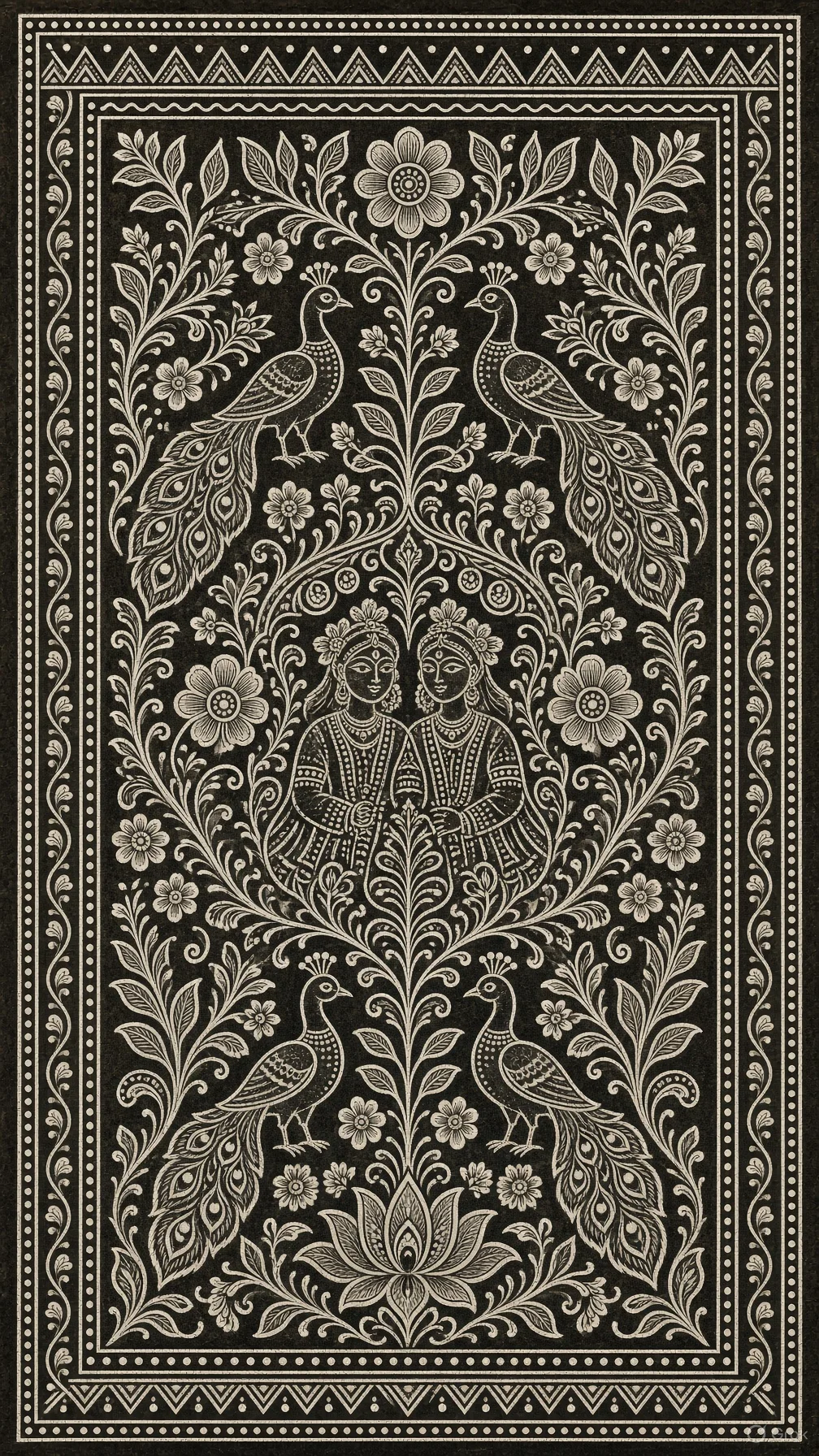
At a glance: Jharkhand (Hazaribagh region) | Tribal ritual wall painting | Made by women | Marriage season.
Origin and communities
Khovar is the sister tradition of Sohrai. A travel and craft source summarises the pair simply: Khovar is the marriage art and Sohrai is the harvest art. Both come from the same region, are made by women of the same local communities, and were registered together under one GI as Sohrai-Khovar painting, which covers paintings originating from Hazaribagh district.
Colours, materials and technique
Like Sohrai, Khovar uses naturally available coloured soils on prepared walls. Some descriptions also mention a scraping technique in which a darker coat is scratched away to reveal the lighter layer beneath. Treat that as a reported method rather than a rule for every village, and confirm local practice with the artists or their cooperative before quoting it in a project.
Cultural significance
Khovar belongs to the wedding season and the home. The easiest way to remember the difference for exams: Sohrai = harvest festival, Khovar = marriage season. Because the two share artists and materials, never guess from a photograph alone; check the occasion given by the artist.
Pithora Art
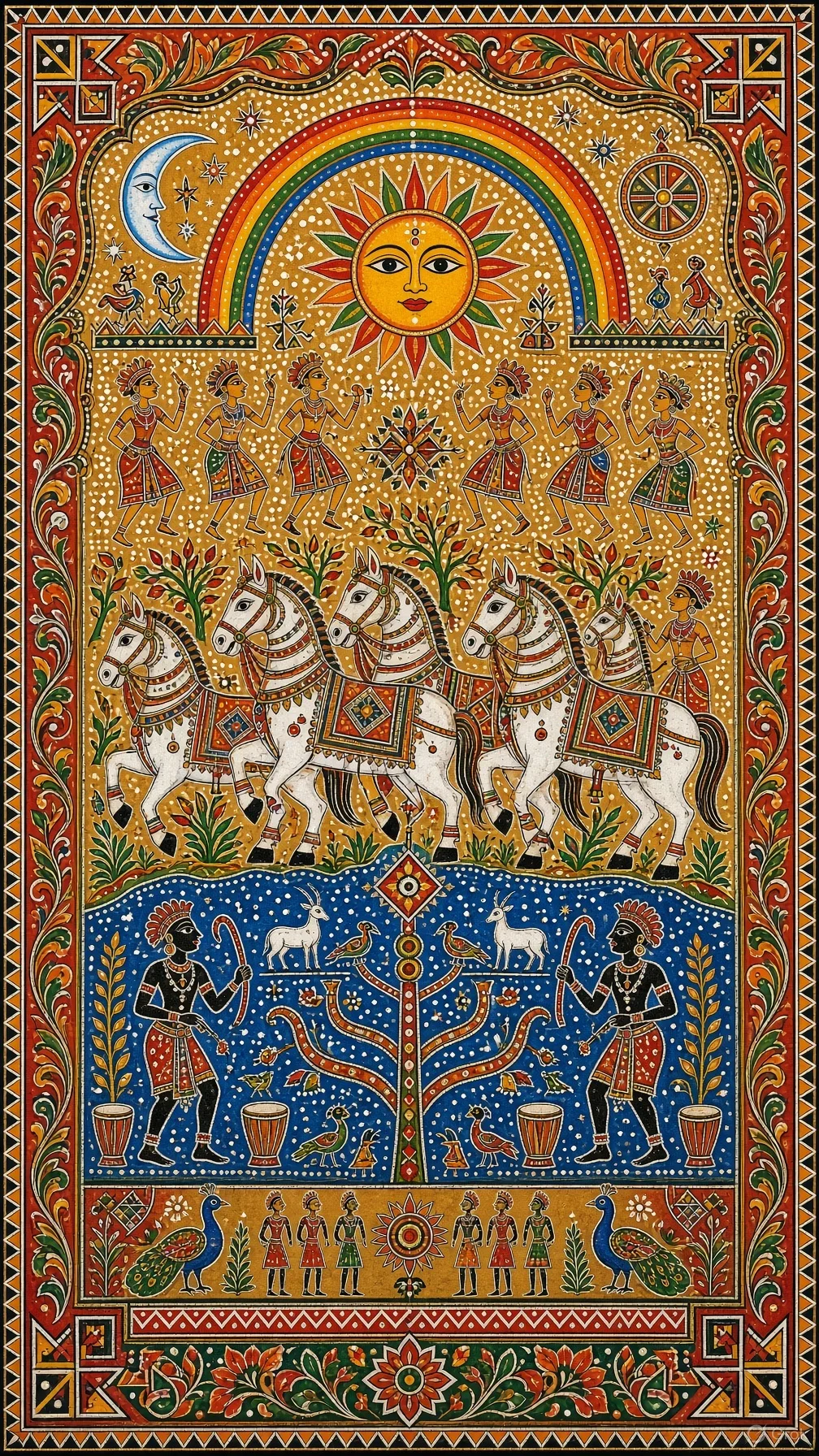
At a glance: Gujarat and Madhya Pradesh | Tribal ritual wall painting | Rathwa, Bhil and Bhilala communities | Horses as gods and ancestors.
Origin and communities
Pithora is a ritualistic wall painting of the Rathwa people of Chhota Udepur and Panchmahal in Gujarat, also associated with Bhil and Bhilala communities of Madhya Pradesh. Sahapedia documents it as part of the ritual for the chief god Baba Pithora. A family takes a vow in hard times and, when it is fulfilled, invites a respected painter, the Lakhara, and a priest, the Badva, to create the painting on the house walls.
Colours, materials and motifs
The wall is prepared with cow dung and chalk plaster, and reports describe a ritual of about three days. The central motif is the horse, which symbolically represents gods, goddesses and ancestors; Sahapedia also lists figures such as Baba Ganeh, Baba Ind, Pithori Rani and the Panch Ghoda (five ancestral horses). No two Pithora paintings are exactly alike because each is made for a particular family and vow.
Cultural meaning and respect
Rathwa practitioners describe Pithora as a sacred ritual, not merely art, and have objected when its motifs were used on products or public walls without understanding. Practise only generic horse-and-border studies, label them “Pithora-inspired”, and do not sell copies of ritual scenes. Our Pithora motifs chart gives the wider detail.
Saura Art
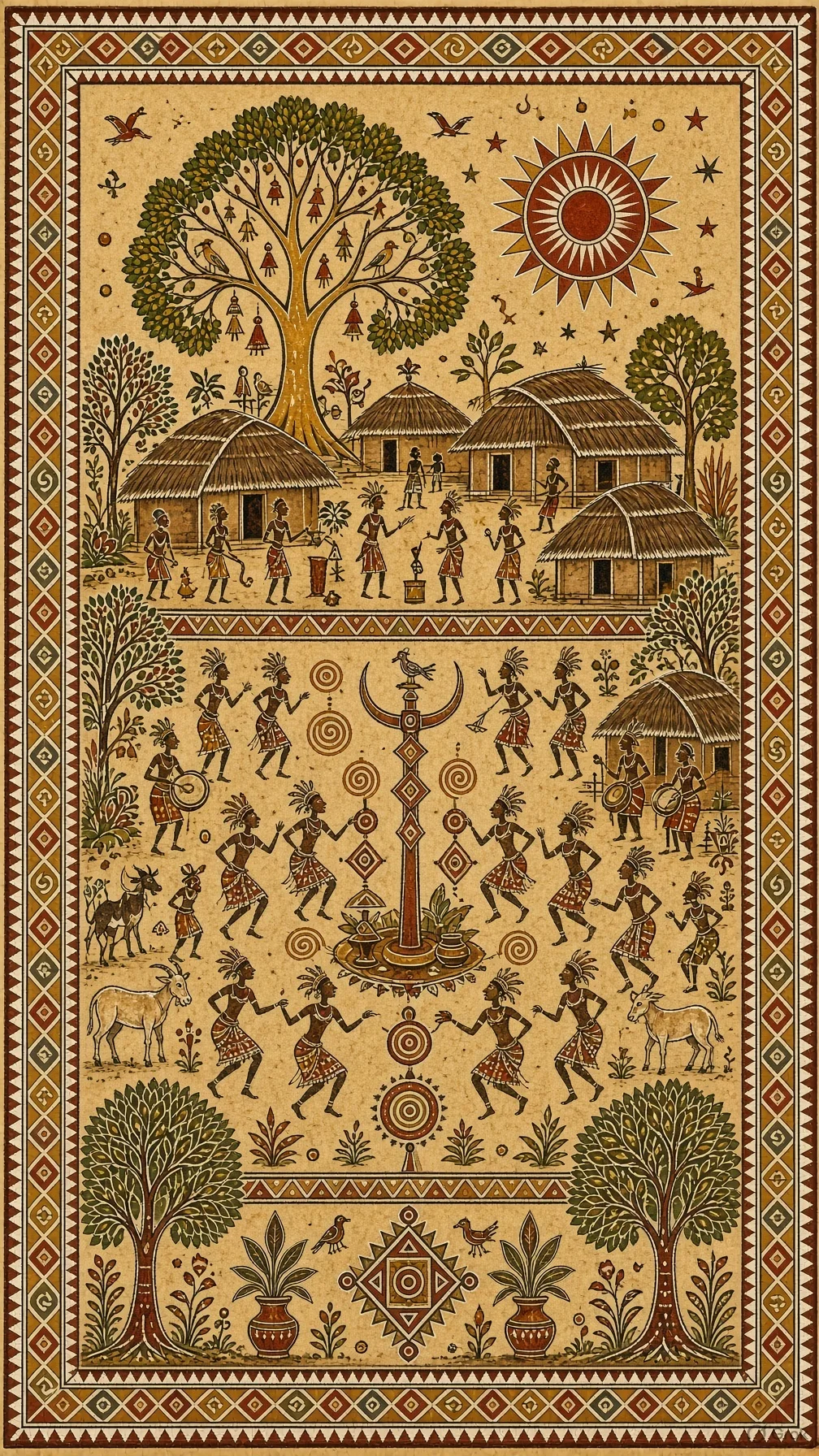
At a glance: Southern Odisha | Tribal ritual wall painting (Idital) | Saura or Sora people, especially Lanjia Saura | Rice paste on mud walls.
Origin and communities
Saura painting, also spelled Saora or Soura, is a wall mural style of the Saura tribe in southern Odisha districts such as Rayagada, Ganjam, Gajapati and Koraput. Outside the community it was first studied by the anthropologist Verrier Elwin. Its best-known form is the Idital, a painting made for an ancestral or divine spirit; the Lanjia Saura (hill Saura) are described as keeping the tradition most completely.
Colours, materials and motifs
Idital is drawn with rice paste and thin bamboo sticks on mud or plastered walls. A notable technique is a fish-net approach, building the picture from the border inward. Main figures called ikons include humans, the tree of life, the sun, the moon, horses and elephants, along with scenes of farming and village life, which is why the murals are called pictographs.
Saura vs Warli and cultural meaning
The thin human figures resemble Warli, but Saura is from Odisha, is built from the border inward and does not clearly separate male and female forms, while Warli is from Maharashtra. An Idital is a devotional offering, so families commission it to appease ancestors or deities. Credit the Saura community and avoid presenting classroom work as Idital.
Baiga Art and Godna
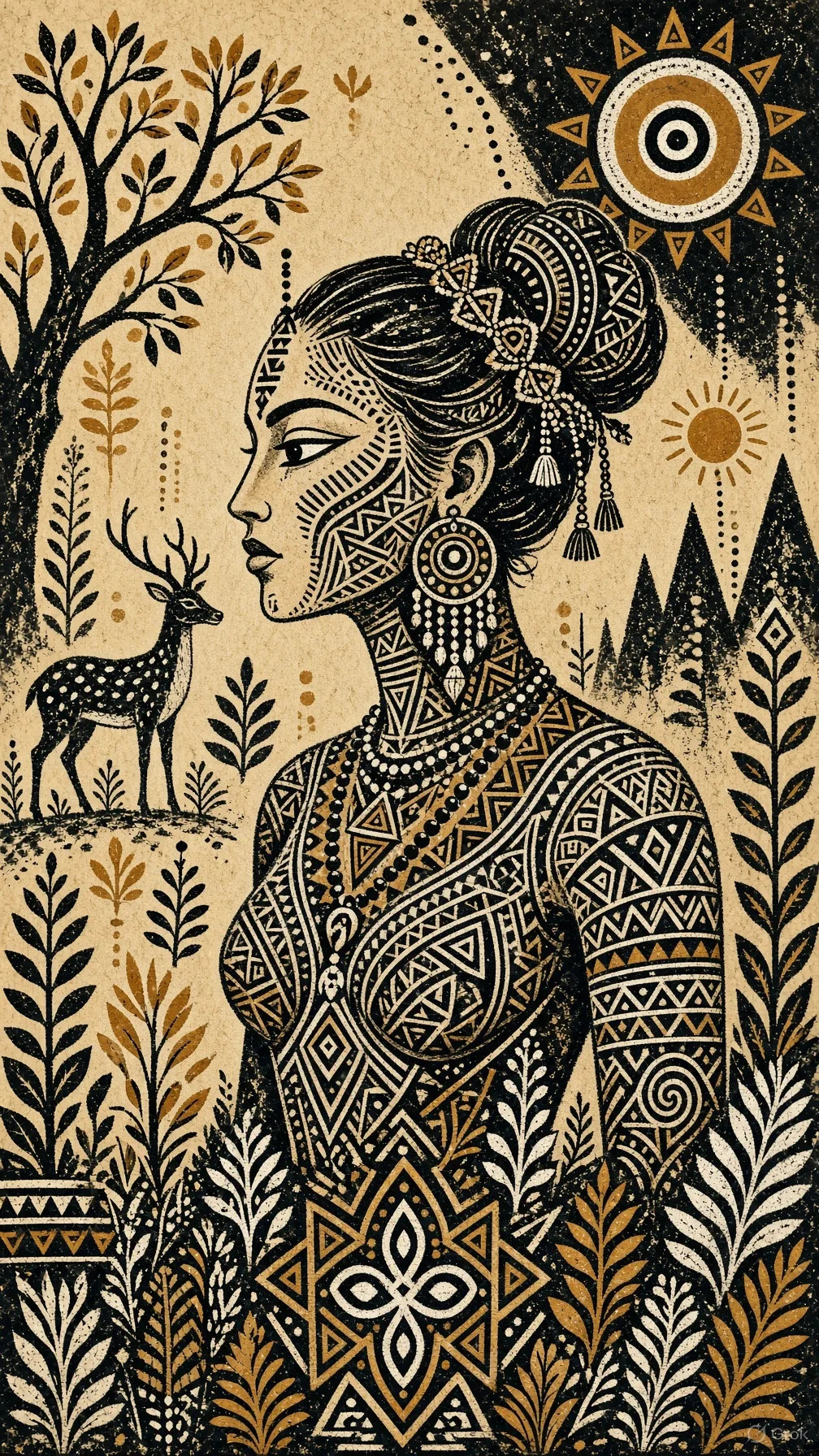
At a glance: Madhya Pradesh and Chhattisgarh | Tribal body art (tattooing) | Baiga women | Marks of identity and life stage.
Origin and communities
The Baiga are a forest-dwelling community of central India, identified in research as a Particularly Vulnerable Tribal Group. Godna is the tattooing tradition of Central India, practised by Baiga, Gond, Korku and other communities, and it is more prevalent among the Baiga, whose women regard it as an ornament that stays with them. Unlike most arts here, the canvas is the body.
Life stages and marks
Reports say the first tattoo comes around age nine or ten on the forehead and identifies the tribe, with later marks added on the body as a girl nears marriage. The characteristic Baiga forehead mark is described as V-shaped. Healing takes about a week, with herbal extracts used. Reliable motif-by-motif meanings are not catalogued in the sources we could verify, so we do not publish a decoding chart.
Cultural significance and revival
A Baiga artist quoted by Euronews explains that without Godna a woman is not considered part of the tribe. The practice is declining among younger Baiga, while artists such as Jodhaiya Bai of Umaria, who received the Padma Shri in 2023, have brought Baiga art to wider audiences. Do not copy Godna as a fashion tattoo; at most, practise simple dot-and-line borders on paper labelled “Baiga-inspired”. Gond painting is a different tradition; see the Gond section below.
Kurumba Tribal Painting
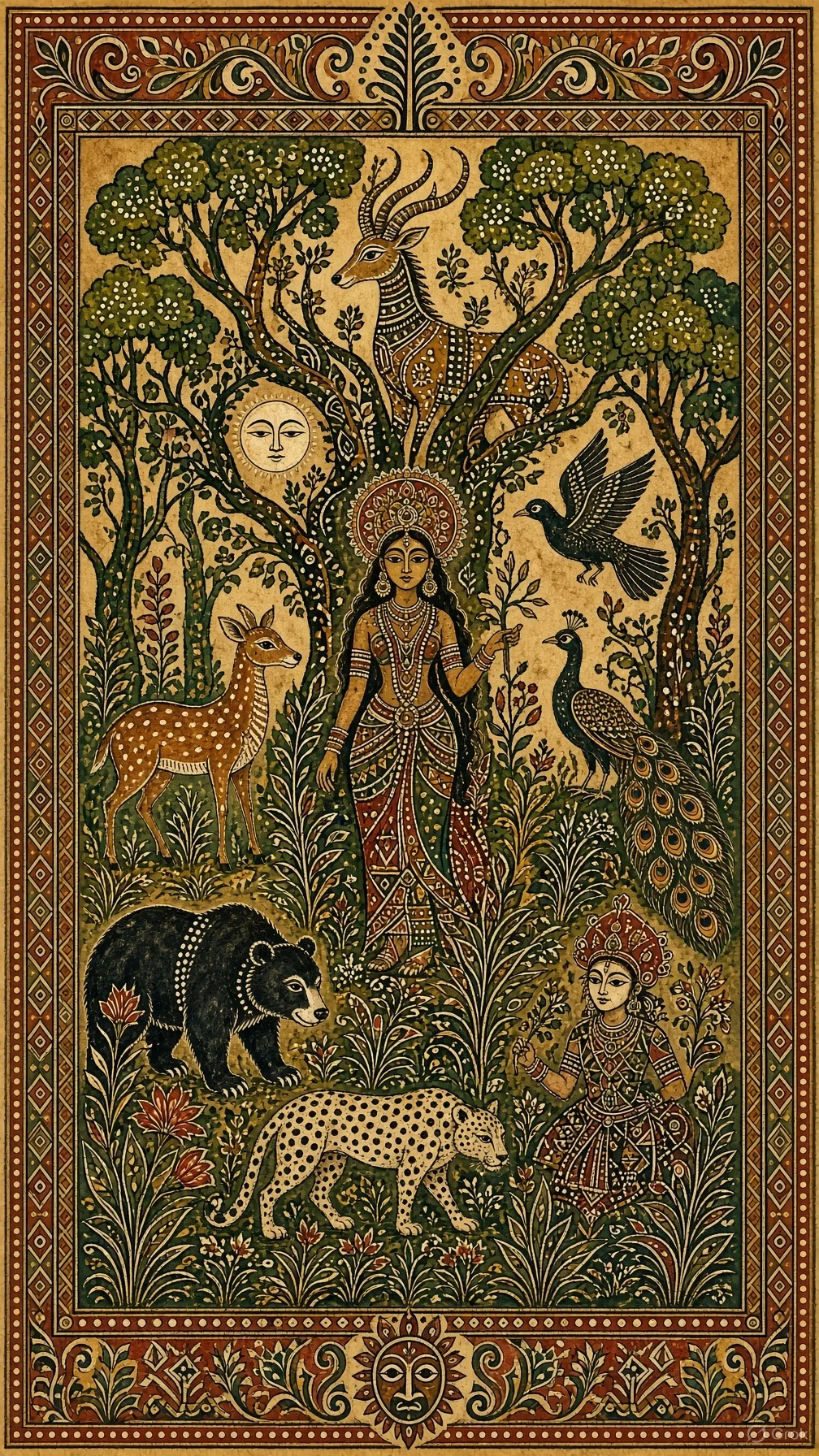
At a glance: Tamil Nadu (Nilgiri hills) | Tribal painting | Alu (Ala) Kurumba community | Forest life and honey collection.
Origin and history
The Kurumbas are an indigenous Nilgiris tribe known as forest dwellers and healers. Their painting reflects the rituals and daily life of the Alu Kurumba subgroup, who decorate dwelling walls and sketch figures on rock outcrops. Many outlets call the art about 3,000 years old, but that is an estimate; the earliest firm record of Kurumba painting on dwellings dates to 1871 to 1872.
Colours, materials and motifs
Reports list pigments from soil, leaves, bark and tree resin, applied with cloth or fibre brushes on cow-dung-coated walls, though sources describe the recipe differently. Themes include honey collection, cattle gathering, farming, harvest festivals and forest animals, in a palette dominated by earth reds, whites, greens and blacks.
Kurumba is not Warli
Both use simple figures, but Kurumba artists say plainly that theirs is not Warli, because it tells Kurumba stories of the Nilgiri forest. Only a handful of Kurumba artists remain, and the posthumous Padma Shri announced for Krishnan Raghavan, known as Kitna, drew attention to the fragile legacy. Credit the community rather than copying a few figures and calling them Kurumba art.
Cheriyal Scroll Painting
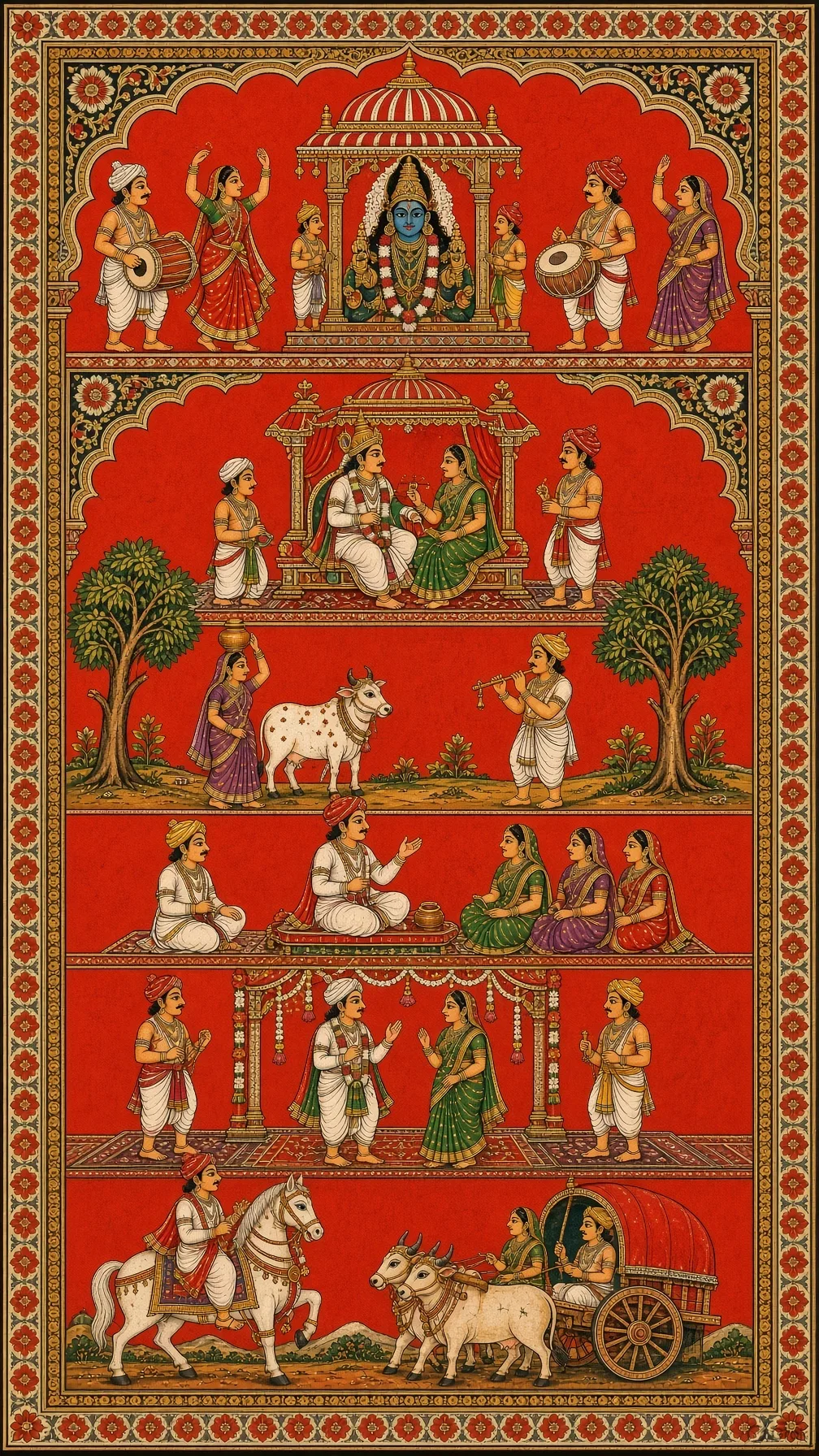
At a glance: Telangana | Folk scroll painting (not tribal) | Nakashi painter families | Storytelling scrolls and masks.
Origin and classification
Telangana Tourism describes Cheriyal scroll painting as a modified version of Nakashi art, named for Cheriyal village and made by the Nakashi family of painters; today it is made mainly in Hyderabad. It is often listed with tribal arts, but it grew around storytelling for particular communities, so we classify it as a folk scroll tradition. The earliest known painted scroll in the Telangana region is reported to date to 1625, and old scrolls ran up to about 60 feet.
Stories, colours and technique
Scrolls show Ramayana episodes, Bathukamma and wedding scenes, community legends and village life. A Google Arts & Culture walk-through describes squirrel and camel-hair brushes and freehand outlines with no preliminary markings; clean lines mark an experienced artist. Nakashi artists also make masks, and the art has shifted from long scrolls to masks and smaller panels as demand fell.
GI status
Cheriyal scroll painting carries a GI tag, but sources give 2007, 2008 and 2010 as the year, so check the GI Registry before quoting one. Compare it with Phad and with the Pattachitra border chart.
Warli Art
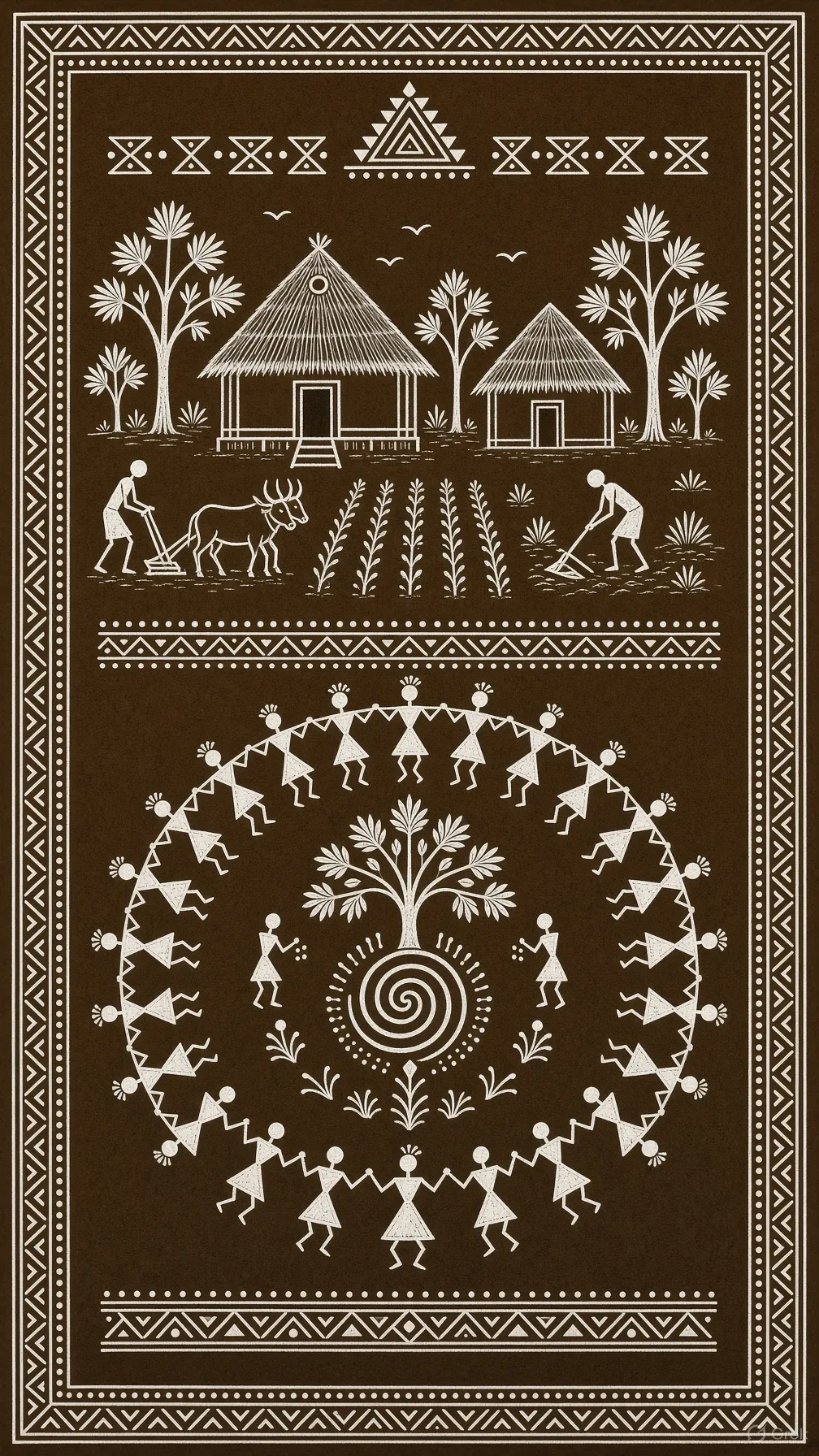
At a glance: Maharashtra (Palghar and Thane districts) | Tribal wall painting | Warli community | White geometric figures.
Origin and communities
Warli paintings take their name from the Warli community on the northern edge of the Sahyadri range, mainly in Thane and Palghar districts, with Dahanu and Jawhar at the forefront. Traditionally they were painted by women on the walls of mud huts to mark auspicious and ceremonial occasions. Estimates of age vary widely, so treat claims of a precise start date with caution.
Colours, materials and motifs
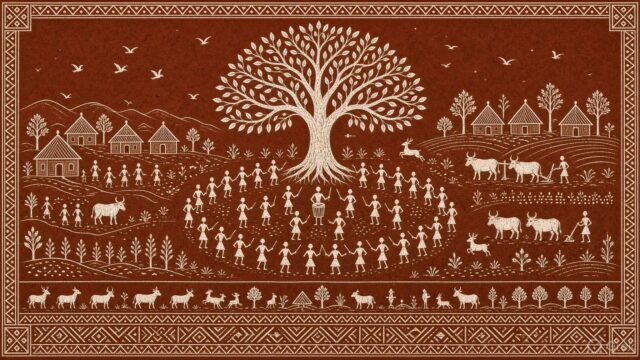
The wall is coated with cow dung and red earth, and the white pigment is rice paste with gum as a binder, applied with a chewed bamboo stick. The visual language uses a circle, a triangle and a square. In ritual paintings the central motif is a square called the chauk (Devchauk or Lagnachauk), and the Devchauk usually shows Palaghata, the mother goddess symbolising fertility. Tarpa dance, farming and village scenes are common.
Jivya Soma Mashe and today
The artist Jivya Soma Mashe (1934 to 2018) of Ganjad village, Dahanu, popularised Warli worldwide; he painted on paper and canvas for artistic reasons rather than ritual, received a National Award for tribal art and the Padma Shri in 2011. See our Warli art guide and Warli symbols chart.
Gond Art
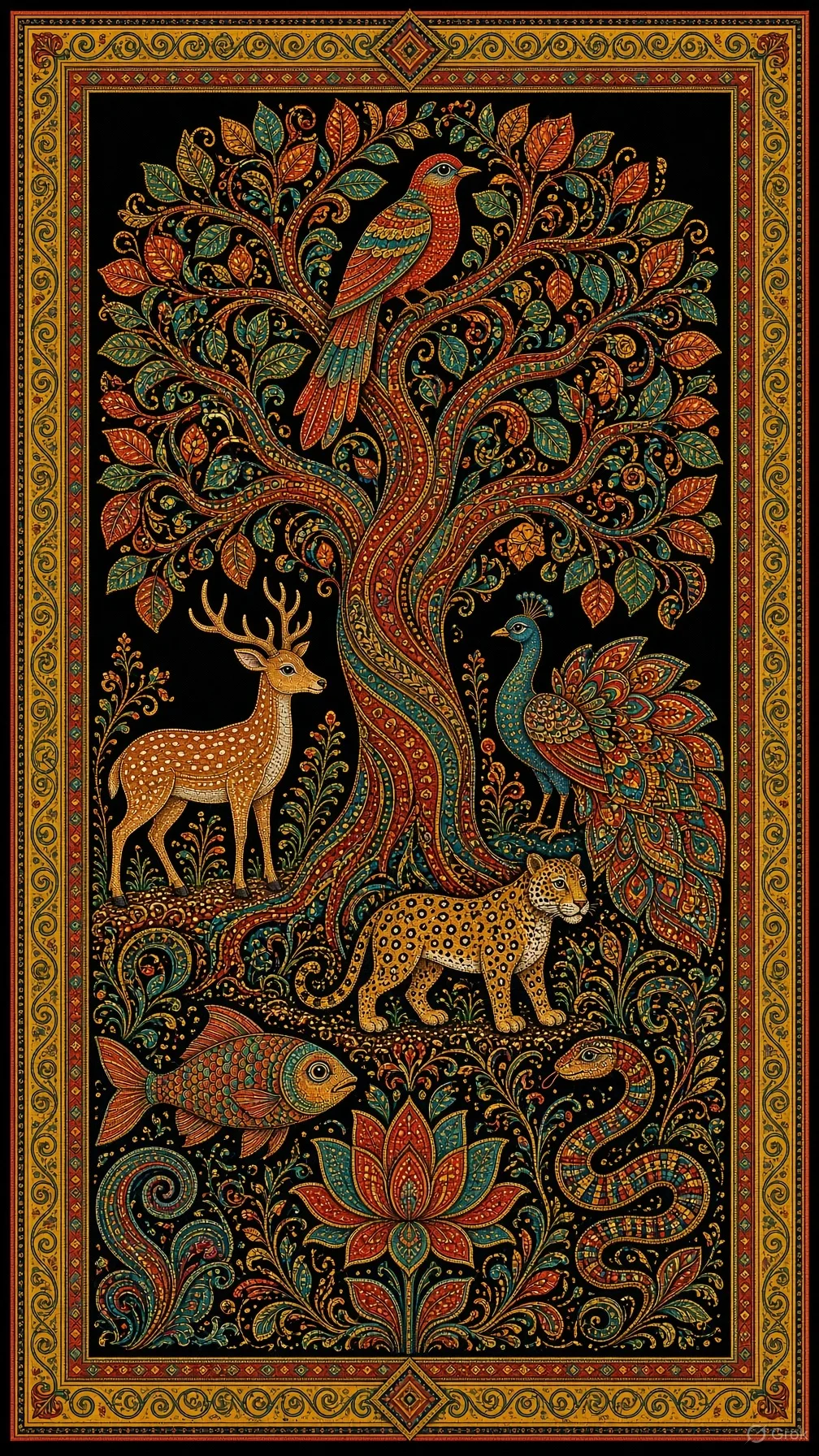
At a glance: Madhya Pradesh (Dindori and Mandla) | Tribal painting | Gond and Pardhan Gond artists | Dots, dashes and flowing lines.
Origin and communities
Gond painting originated in the Gond regions of Madhya Pradesh, and traditionally Pardhan community artists decorated interior village walls. Patangarh, a village in Dindori district, is called the unofficial cradle of the art. The Gonds spread across central India, so the same community also appears in neighbouring states.
Jangarh Singh Shyam and Jangarh Kalam
Jangarh Singh Shyam (1962 to 2001), a Pardhan Gond from Patangarh, was discovered as a teenager by scouts of the modern artist J. Swaminathan and brought to Bhopal’s Bharat Bhavan. He was the first Gond artist to use paper and canvas, and his style is called Jangarh Kalam. Artists such as Bhajju Shyam, a Padma Shri awardee, trained in this lineage.
Motifs and style
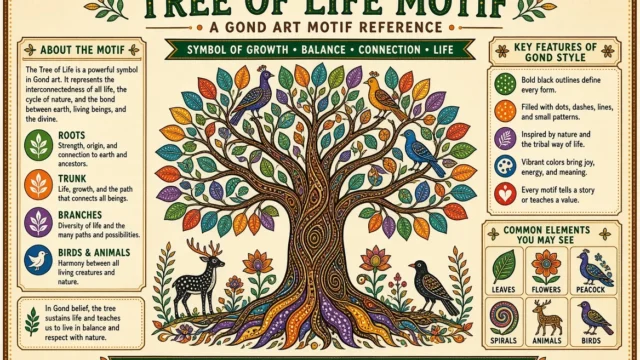
Animals, birds, fish and trees are filled with dots, dashes and waves, and the tree of life is a favourite subject. Compared with Bhil art, which builds scenes from dots, Gond relies on fine line-and-dash fills. Start with our Gond tutorial and Gond motifs guide.
Bhil Art
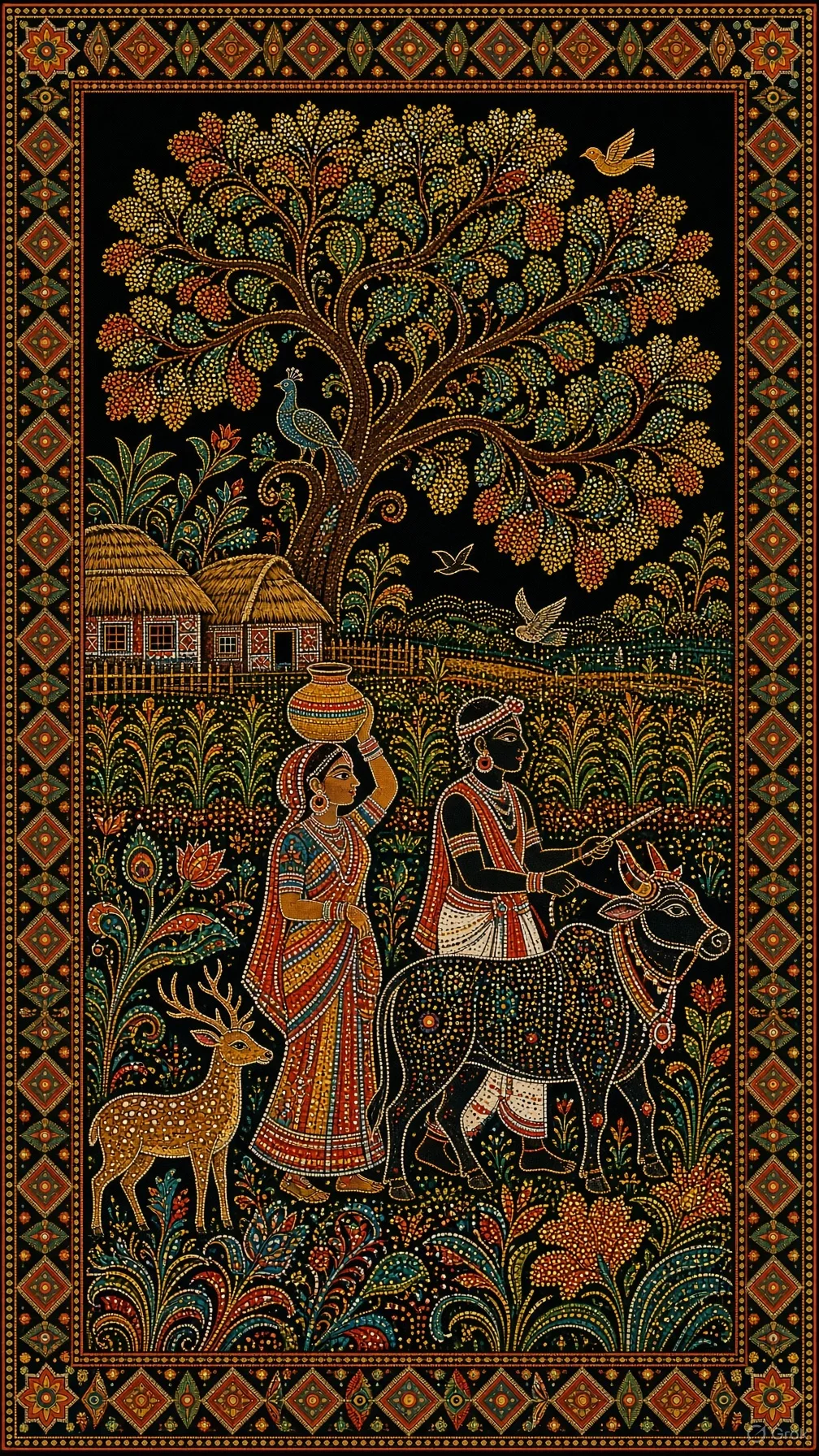
At a glance: Madhya Pradesh, with Bhil communities also in Rajasthan, Gujarat and Maharashtra | Tribal painting | Bhil community | Multi-coloured dots.
Origin and communities
The Bhils are often described as the largest tribal group of India, and Bhil art is considered by some to be the oldest of India’s tribal art forms. Its best-known modern voice is Bhuri Bai of Pitol village, Jhabua district, the first artist of her community to paint on paper. She received the Padma Shri in 2021 and the Shikhar Samman of Madhya Pradesh in 1986.
Colours, materials and motifs
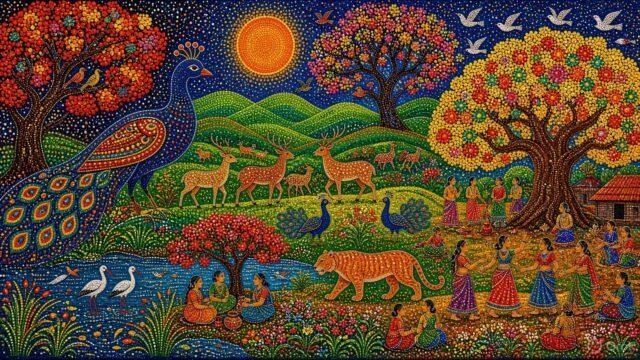
Bhil painting fills large, simple forms with rows of multi-coloured dots; the style has been compared to Aboriginal Australian dot painting. Bhuri Bai recalls making colours from turmeric, soot, leaves and red soil and using chewed twigs or cloth for dots, and artists link the dots to maize kernels and to Pithora wall paintings.
Cultural significance
Scenes show cattle grazing, festivals, nature and village life, and artists such as Lado Bai bring human figures forward. Bhil art and Pithora share roots but differ: Pithora is a ritual with horses as ancestors, while Bhil paper painting is a more open storytelling practice. Learn the dot technique in our Bhil art guide.
Mandana Art
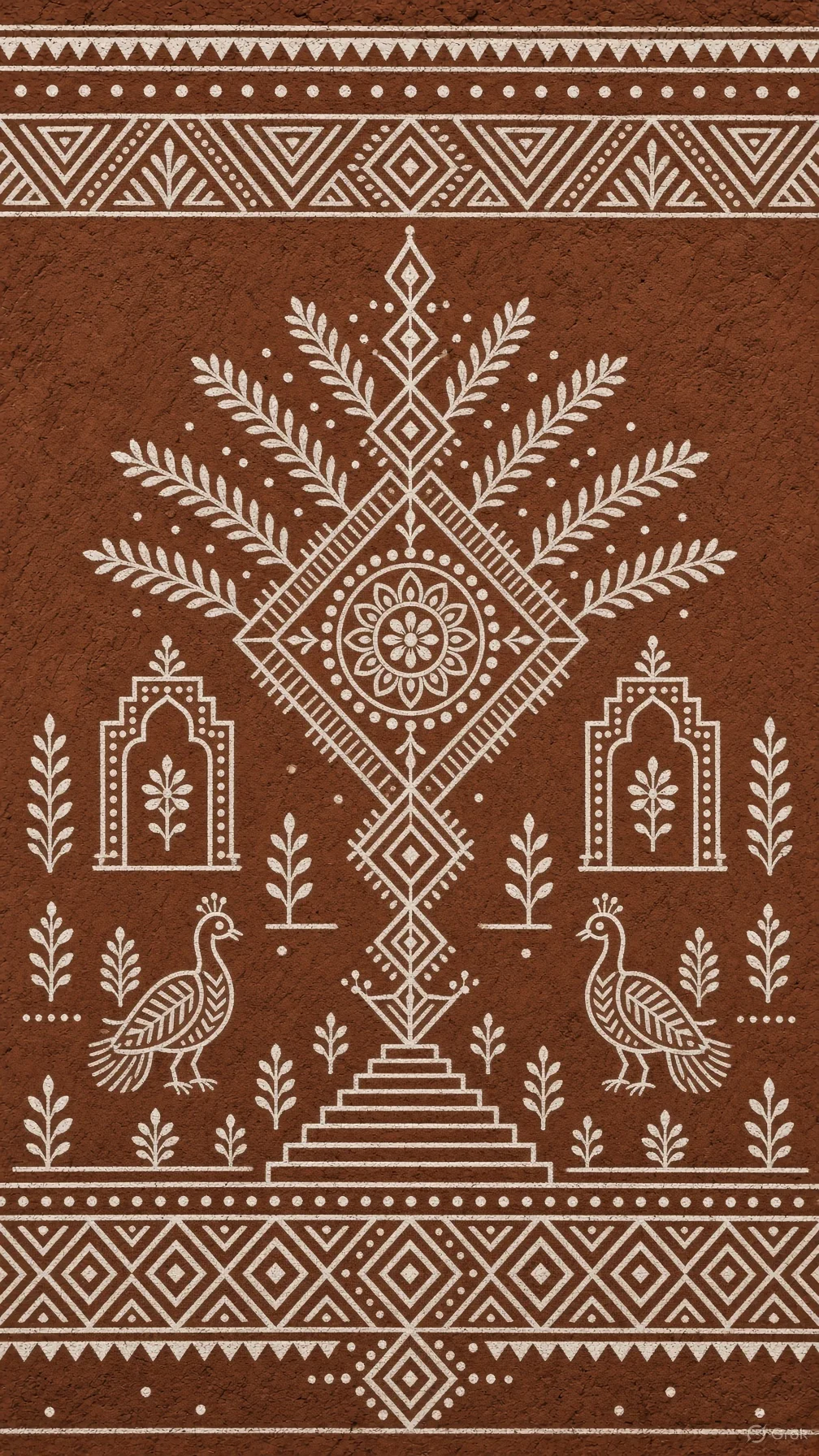
At a glance: Rajasthan and Madhya Pradesh | Ritual floor and wall art | Women, strongly associated with the Meena community | Red ground, white chalk designs.
Origin and communities
Mandana paintings are wall and floor paintings of Rajasthan and Madhya Pradesh, drawn to protect the home, welcome the gods and mark festivals. Many sources link the tradition to the Meena community and some describe the Meenas as a tribal community, but Mandana is practised by other communities too, so we classify it as ritual floor and wall art. In Rajasthan it appears on walls and floors, while in Madhya Pradesh it is mostly on floors.
Colours, materials and motifs
The ground is prepared with cow dung mixed with rati clay and red ochre (geru). Designs are drawn in white khadiya, a chalk or lime solution, using a piece of cotton, a tuft of hair or a brush from a date stick. Motifs range from geometric lines and floral patterns to nature and daily-life scenes.
Cultural significance
NIOS notes that Mandana is made on auspicious occasions such as Dussehra, Diwali and Holi, mostly by women, and that the same idea is called Chowk Purana in Uttar Pradesh and Alpana in Bengal. The skill passes from mother to daughter. See our Mandana patterns chart.
Aipan Art
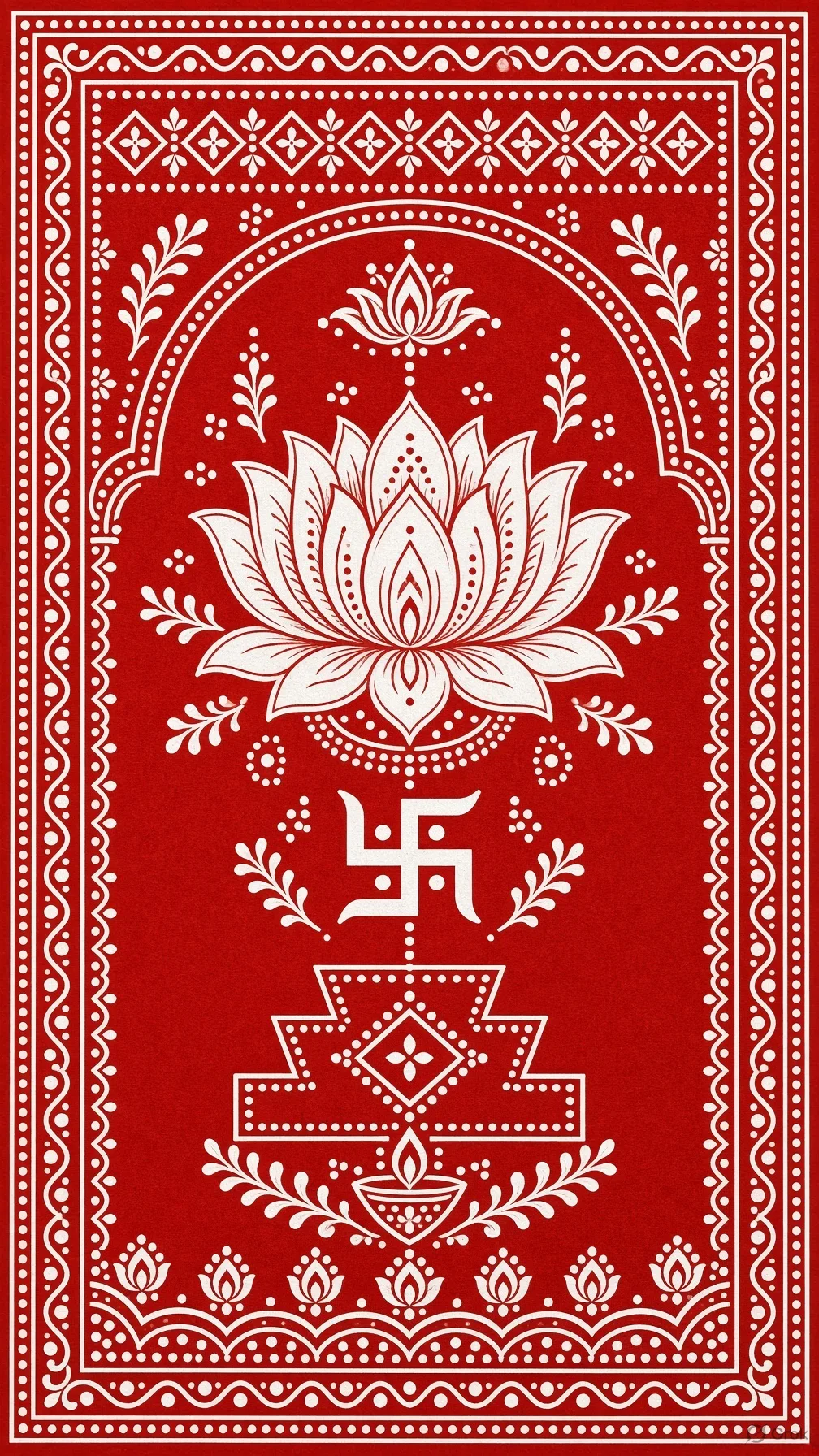
At a glance: Uttarakhand (Kumaon) | Ritual floor and wall art | Made by women | Red geru base with white rice-paste designs.
Origin and communities
Aipan is the ritual art of the Kumaon region of Uttarakhand, drawn by women on floors, walls, thresholds and puja spaces for festivals and rites of passage. It is a folk and ritual tradition rather than the art of a single tribe, which is why it sits with Mandana, Alpana and Kolam in this guide.
Colours, materials and motifs
The surface is first coloured with red earth (geru) and the design is added in white rice paste, called biswar, usually with the fingers. Typical motifs include the Lakshmi chowki, Lakshmi footprints, geometric borders and stylised deity symbols.
Cultural significance
Aipan marks the home as auspicious and is especially associated with Diwali and other festival worship. Read the motif details in our Aipan motifs chart.
Alpana Art
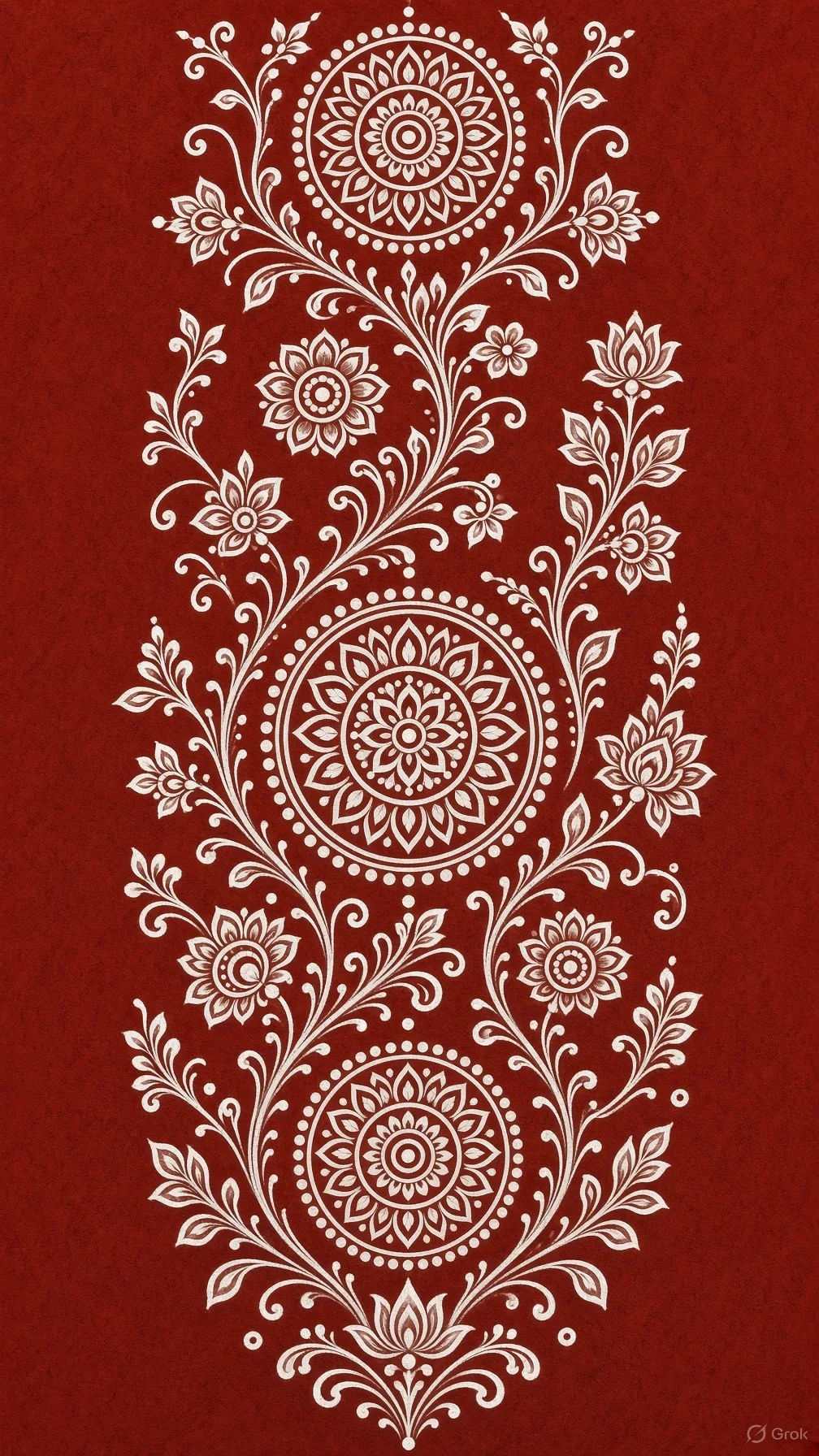
At a glance: West Bengal | Ritual floor art | Made by women | Rice-paste patterns at festivals and weddings.
Origin and communities
Alpana is the Bengali tradition of drawing auspicious patterns on floors, doorsteps and ritual spaces. The name is commonly traced to a Sanskrit word meaning to coat or plaster. Like Mandana and Kolam, it is a household ritual art, not a tribal art, and it is passed down by women.
Colours, materials and motifs
The traditional medium is a white paste of rice flour, applied freehand with the fingers. Common designs are lotuses, circular and radiating patterns, conches, fish and paddy sheaves, and the footprints of Lakshmi leading into the house.
Cultural significance
Alpana welcomes Lakshmi and marks festivals such as Lakshmi Puja and weddings. Because it is meant to be temporary, the beauty lies in the act of drawing. Our Alpana motif patterns guide shows the main designs.
Kolam Art
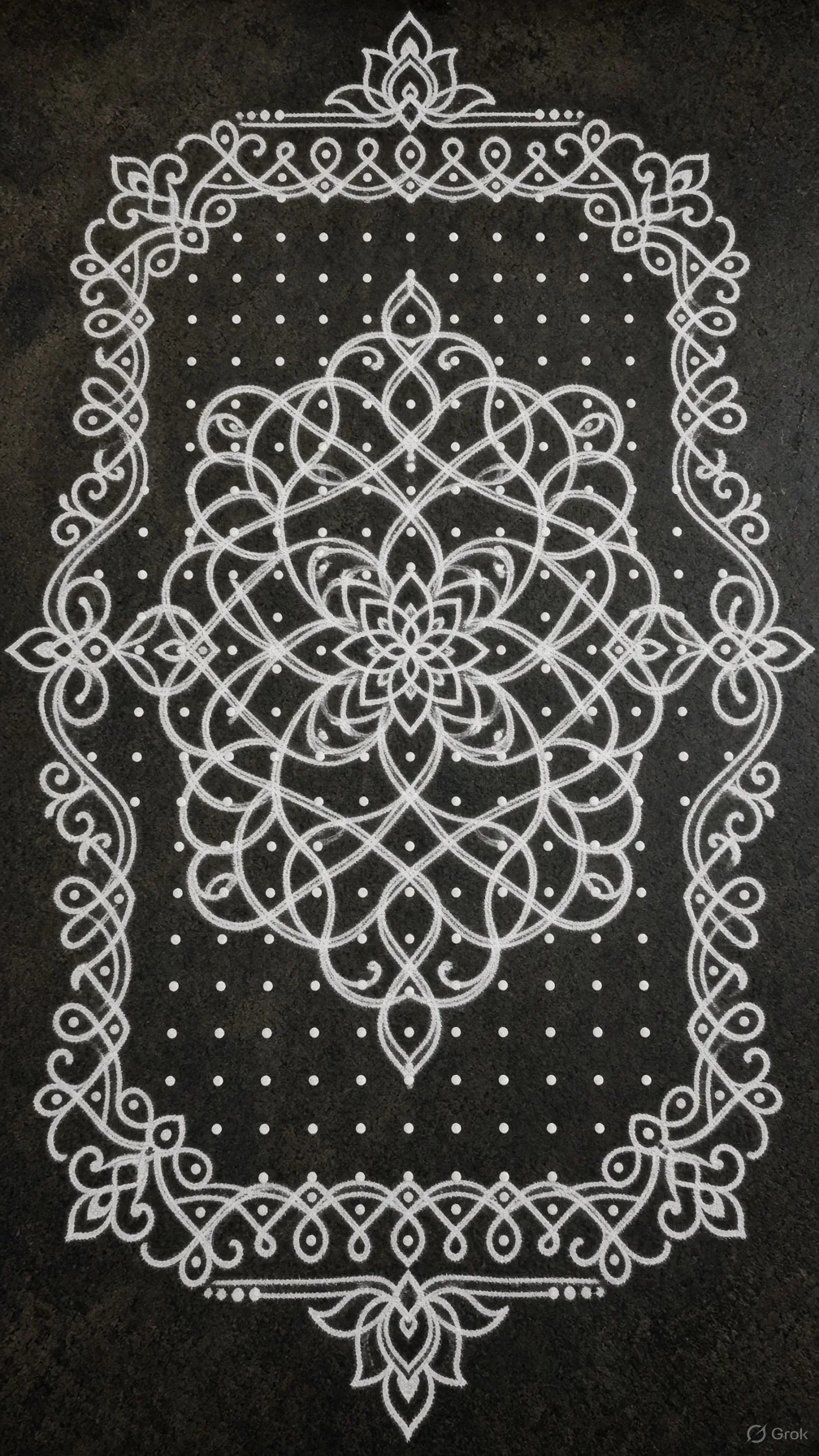
At a glance: Tamil Nadu and other southern regions | Ritual floor art | Made by women at the doorstep | Rice-flour dots and looping lines.
Origin and communities
Kolam is the daily floor drawing of Tamil households, traditionally made at the entrance in the early morning after sweeping and sprinkling the ground. It is a domestic ritual practised across communities, not a tribal art, and it is the best-known example of Indian geometric floor design.
Colours, materials and technique
Dry rice flour is dropped between the fingers. The two main families are pulli kolam, built around a grid of dots (pulli), and sikku or kambi kolam, where one continuous line loops around the dots without breaking. Festival versions add colour powders, and symmetry is central to the design.
Cultural significance
Kolam welcomes prosperity into the home, and its rice-flour medium is often explained as a small offering to birds and ants. It is a good first drawing project because the rules are simple and visible. Step through the dot patterns in our Kolam chart, and see Pookalam for Kerala’s flower version.
Pattachitra Art
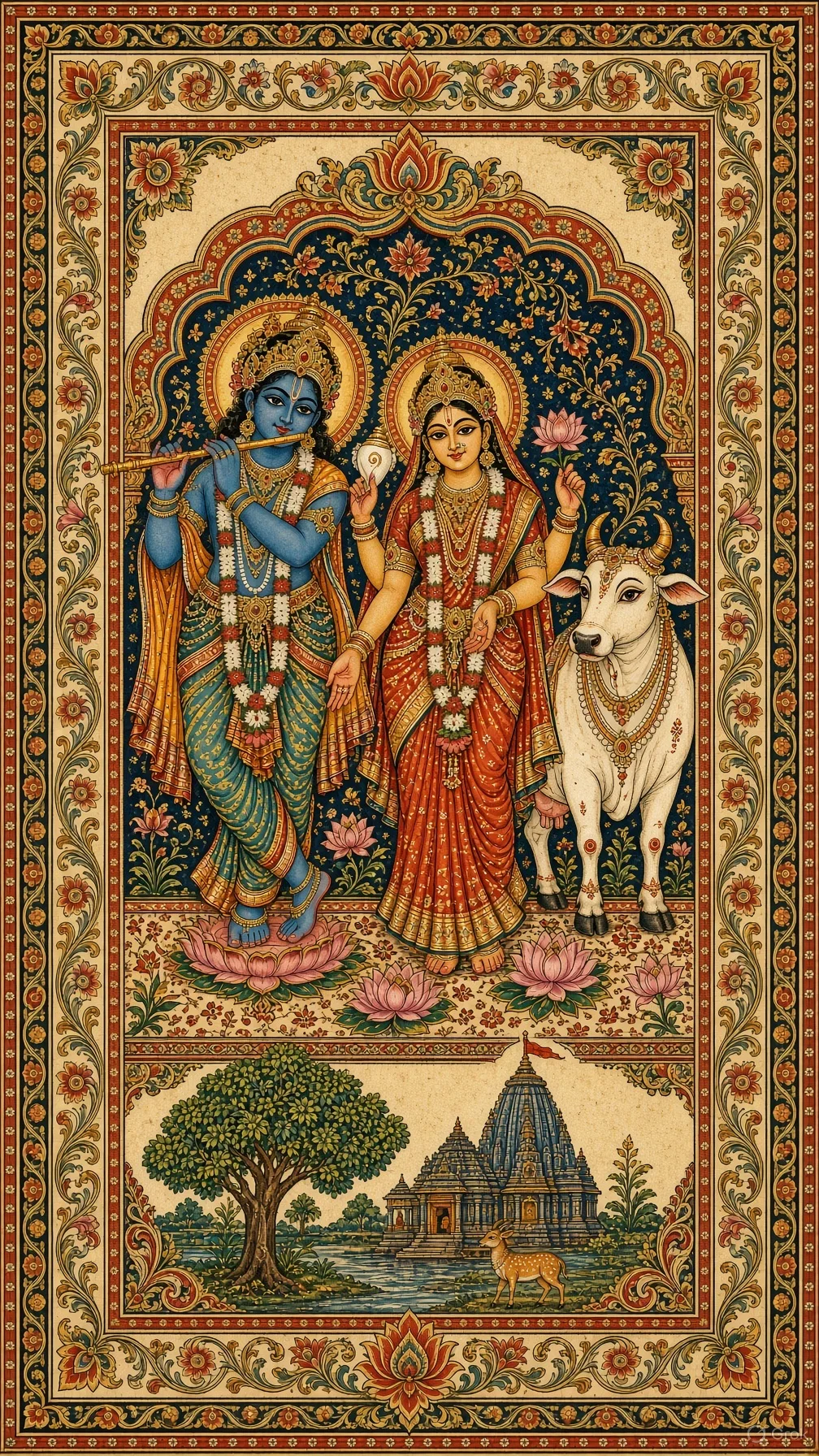
At a glance: Odisha (also a Bengal Patachitra tradition) | Folk and devotional cloth painting | Chitrakara artisan families | Jagannath and Krishna themes.
Origin and communities
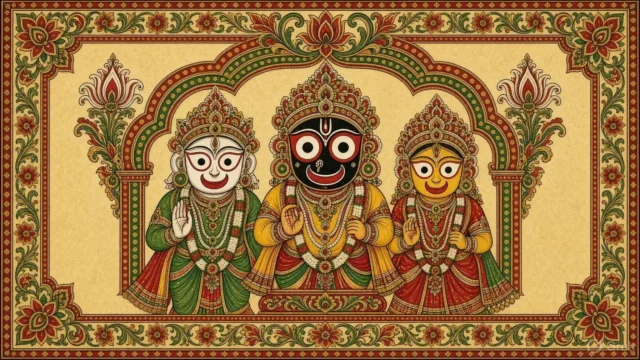
Pattachitra comes from the words for cloth (patta) and picture (chitra). Odisha’s tradition is centred on Puri and the heritage village of Raghurajpur, where Chitrakara artisan families paint scenes around Lord Jagannath, Krishna and episodes from the epics. West Bengal has a separate Patachitra tradition of narrative scrolls, so always name the state.
Colours, materials and motifs
The cloth is stiffened with a paste before painting, and the palette is traditionally natural, with whites from shell and reds and yellows from minerals. Characteristic features are strong outlines, flat colour, expressive large eyes and elaborate floral and animal borders; the palm-leaf form is a related craft.
Cultural significance
Pattachitra is devotional and narrative art made by hereditary artists, so it is classed with folk and devotional painting, not tribal art. Learn the border language in our Pattachitra border chart and the fuller Pattachitra art guide.
Kalamkari Art
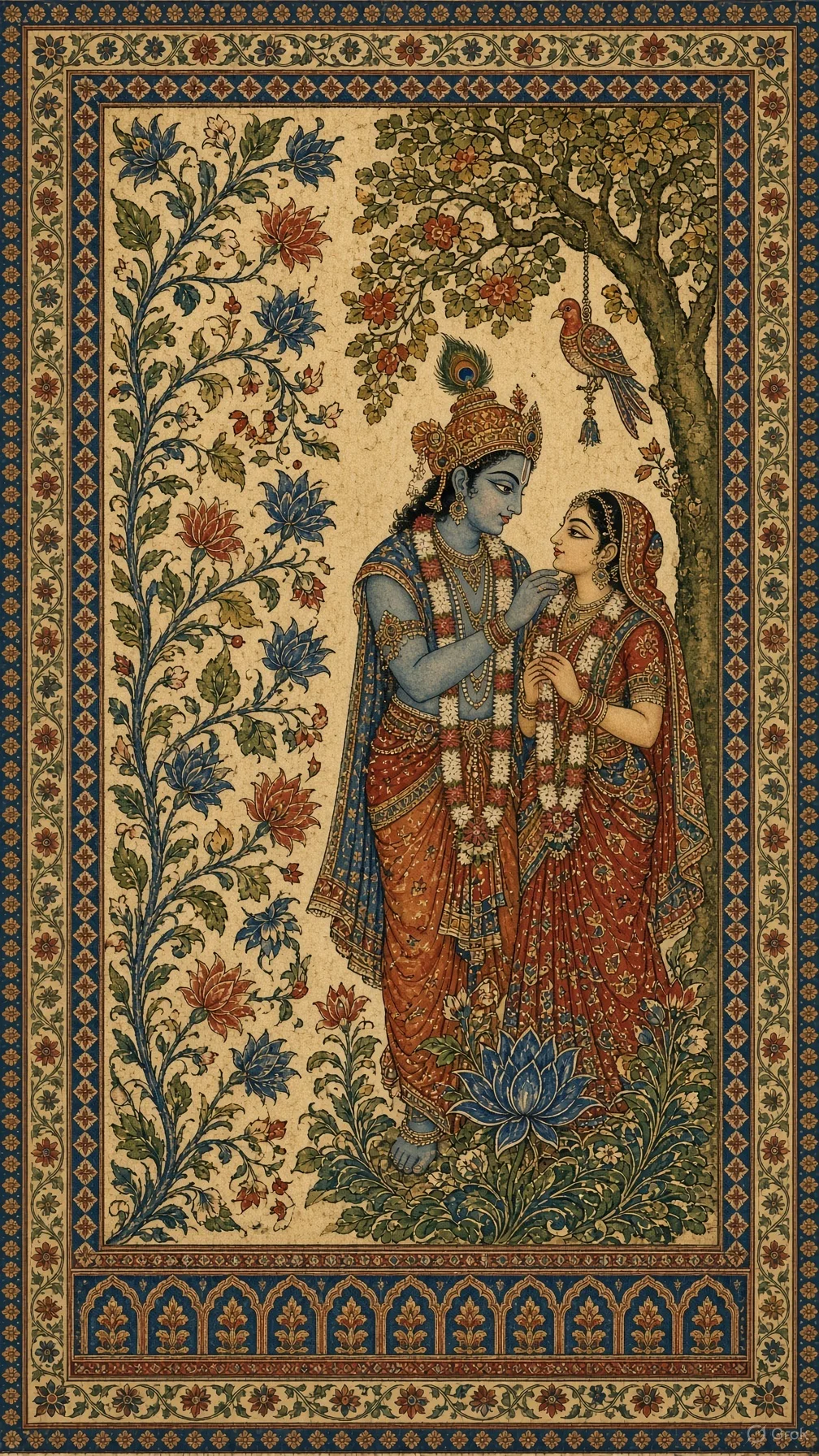
At a glance: Andhra Pradesh | Textile painting and block printing | Artisan families | Natural dyes on cotton.
Origin and styles
Kalamkari is a hand-painted or block-printed cotton textile of Andhra Pradesh, made only with natural dyes. There are two distinctive styles. The Srikalahasti style uses a kalam (pen) for freehand drawing and filling in colours, while the Machilipatnam style, also called Pedana Kalamkari, applies natural dyes with wooden blocks.
Colours and materials
Dyes are drawn from roots, leaves, flowers and mineral salts such as iron and alum. The cloth is treated with buffalo milk and myrobalan before painting so that colours hold, and the work is reported to involve around twenty-three steps. Both styles have Geographical Indication status, with Machilipatnam Kalamkari reported as registered in 2013.
Cultural significance
Srikalahasti work is known for temple-linked and mythological narratives, while Machilipatnam is known for floral and tree-of-life borders. Kalamkari is a textile craft tradition, not tribal art. Explore the motifs in our Kalamkari motifs chart.
Kerala Mural Art
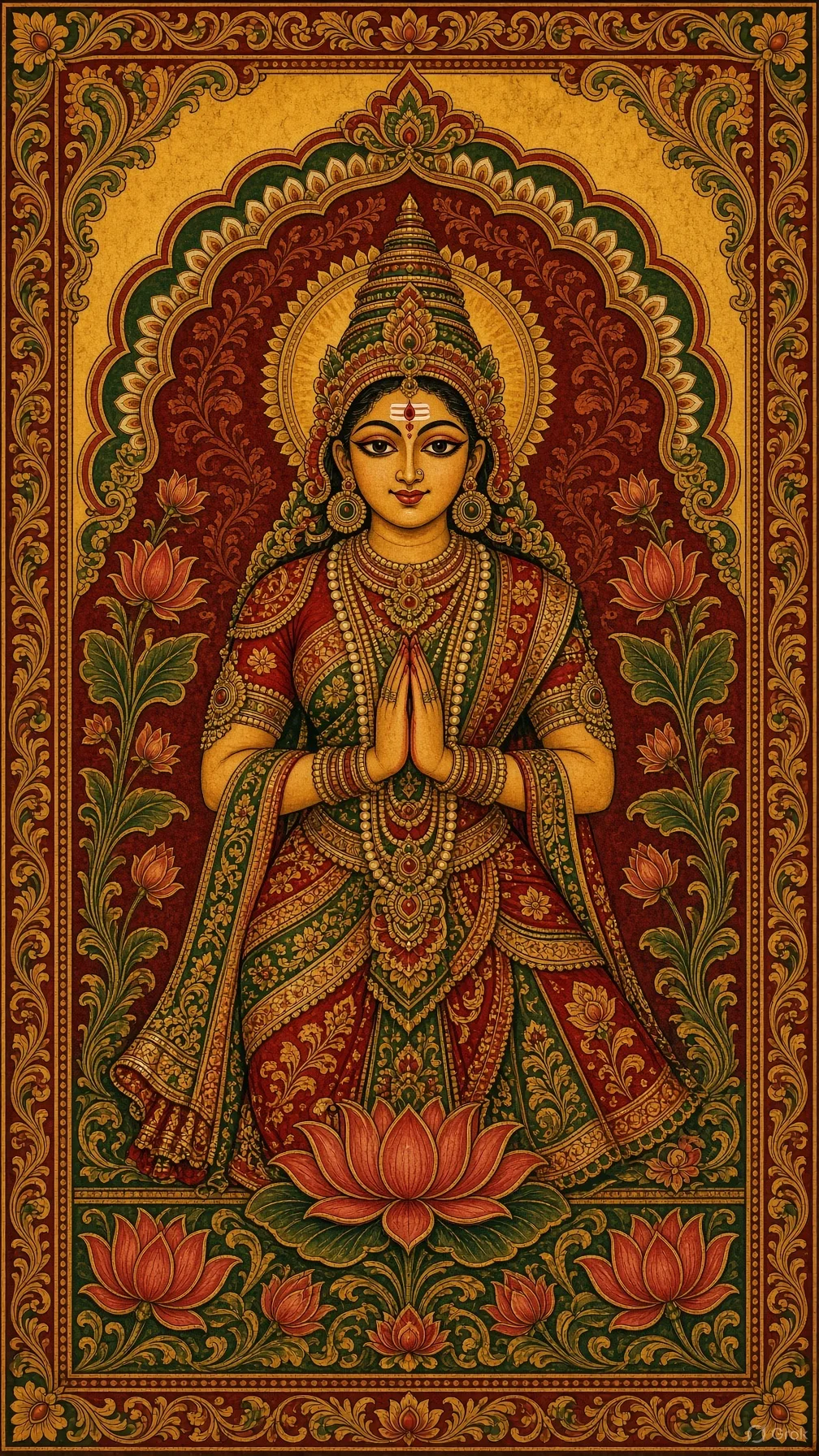
At a glance: Kerala | Classical temple and palace mural painting | Hereditary mural artists | Panchavarna five-colour palette.
Origin and history
Kerala murals are frescoes depicting Hindu mythology on the walls of temples, palaces and some churches. The earliest surviving fragment is generally placed at the Tirunandikkara cave temple, assigned to about the 9th century, though the cave now lies in Tamil Nadu’s Kanyakumari district. Most murals seen today belong to the period from the 15th century onwards, with the most prolific phase from the mid-16th to 18th centuries.
Colours, materials and motifs
The palette is the five colours of Panchavarna: red, yellow, green, black and white, derived from natural sources. Iconography follows texts such as the Tantrasamuchaya and the Silparatna, and figures are drawn from epics and Puranas with rich ornament. Famous sites include the Shiva temple at Ettumanoor, the Ramayana murals of Mattancherry Palace, the Vadakkunnathan temple and Padmanabhapuram Palace.
Cultural significance
This is canon-based temple art, so it is classed as classical, not folk or tribal. Training centres such as the Institute of Mural Painting at Guruvayur keep the craft alive. For practice, start with our Kerala mural art guide.
Phad Art
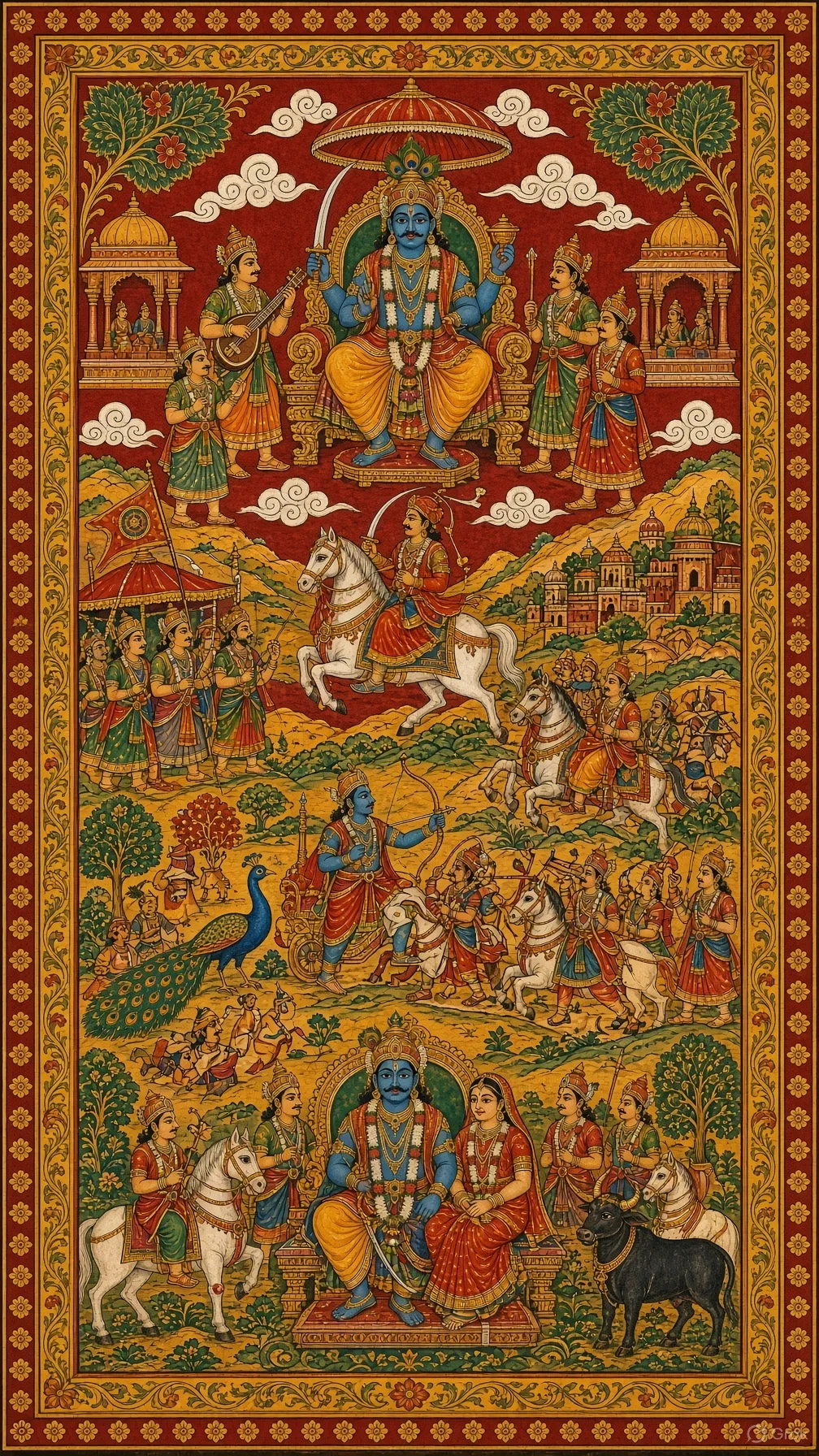
At a glance: Rajasthan (Bhilwara and Shahpura) | Folk narrative scroll | Joshi painter families | Epics of local heroes and deities.
Origin and communities
Phad is a long cloth scroll painting of Rajasthan, centred on Shahpura in Bhilwara district and made by painter families, traditionally the Joshis. The word phad refers to the painted cloth. The scrolls tell the epics of folk deities and heroes, with Pabuji and Devnarayan among the best known.
Performance and style
A phad is a travelling temple: Bhopa priest-singers unroll it at night and sing the story while pointing to each scene. The composition packs many episodes onto one cloth in bold colour with strong outlines, and the figures usually face sideways.
Cultural significance
Phad sits between folk and devotional art, which is why it is not listed as tribal. Compare it with Cheriyal, another narrative cloth scroll from Telangana. Start drawing with our Phad art guide.
Pichwai Art
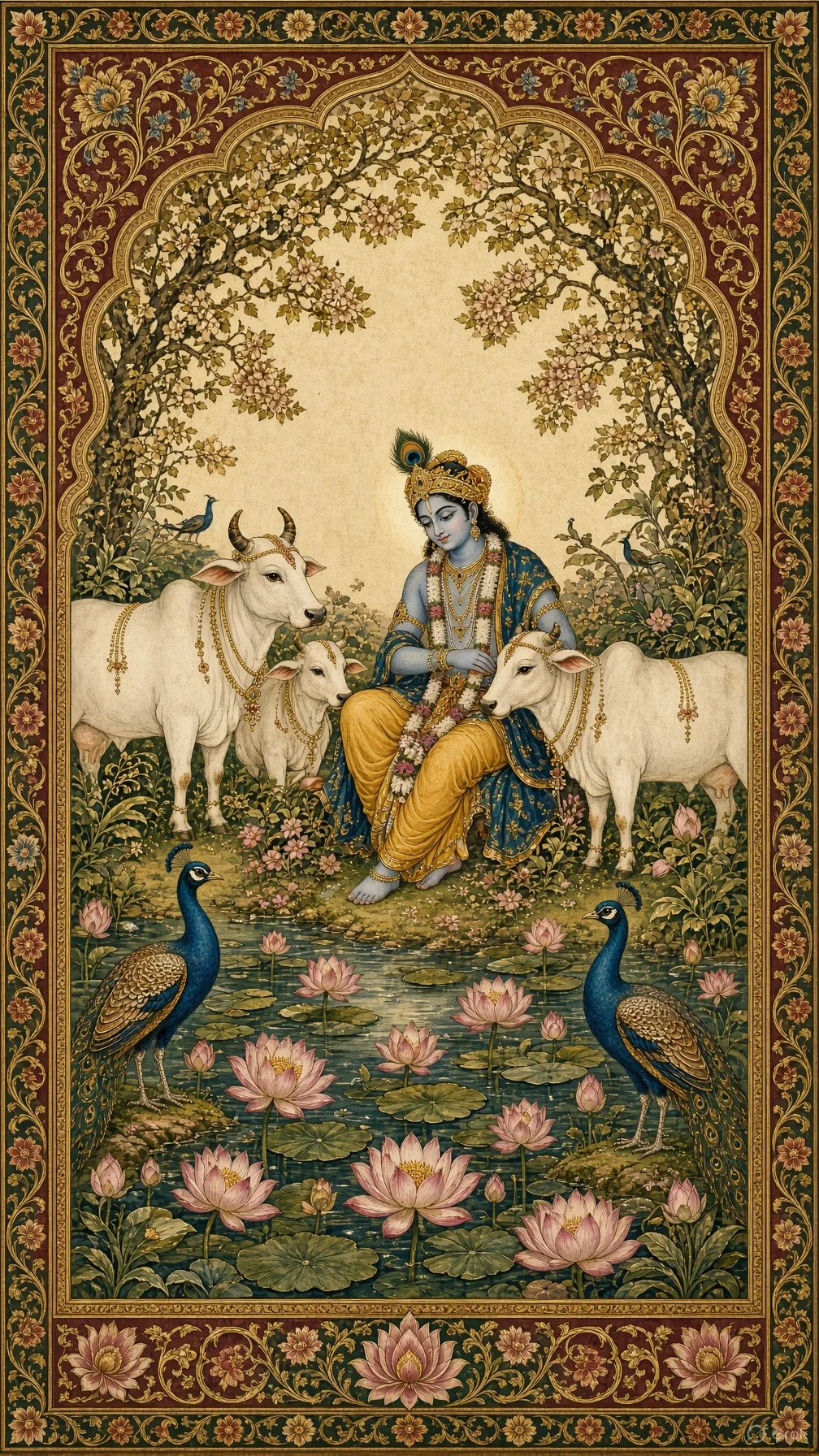
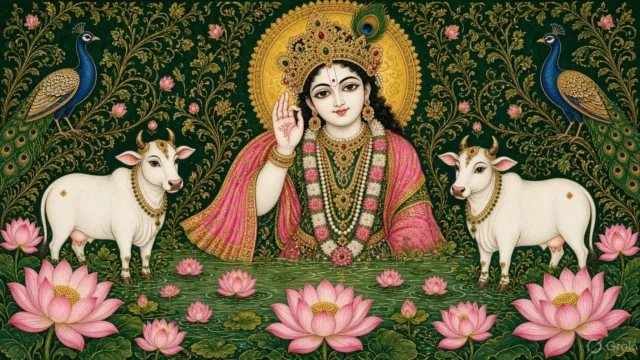
At a glance: Nathdwara, Rajasthan | Devotional temple cloth painting | Artist families serving the Shrinathji temple | Krishna, cows and lotus.
Origin and communities
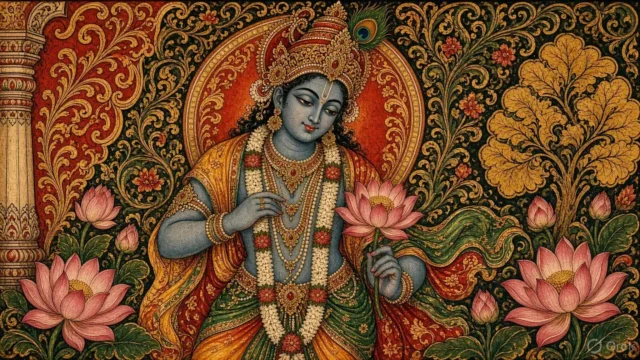
Pichwai are large painted cloth hangings placed behind the image of Shrinathji, the child form of Krishna worshipped at Nathdwara in the Pushtimarg tradition. The name is commonly explained as pichh (back) and wai (hanging). Its makers are hereditary artists of Nathdwara.
Colours, materials and motifs
The paintings are made on cloth with fine detail and rich colour, often with a dark ground and decorative borders. Common themes are cows with Krishna, lotus pools, peacocks and scenes of seasonal festivals such as Sharad Purnima, Annakut and Janmashtami.
Cultural significance
Pichwai is purely devotional temple art, changed with the festival calendar, so it belongs to the devotional category and not to tribal art. Its cow and lotus motifs are popular for rangoli and school practice; see our Pichwai art guide.
Indian Tribal and Folk Art Visual Comparison
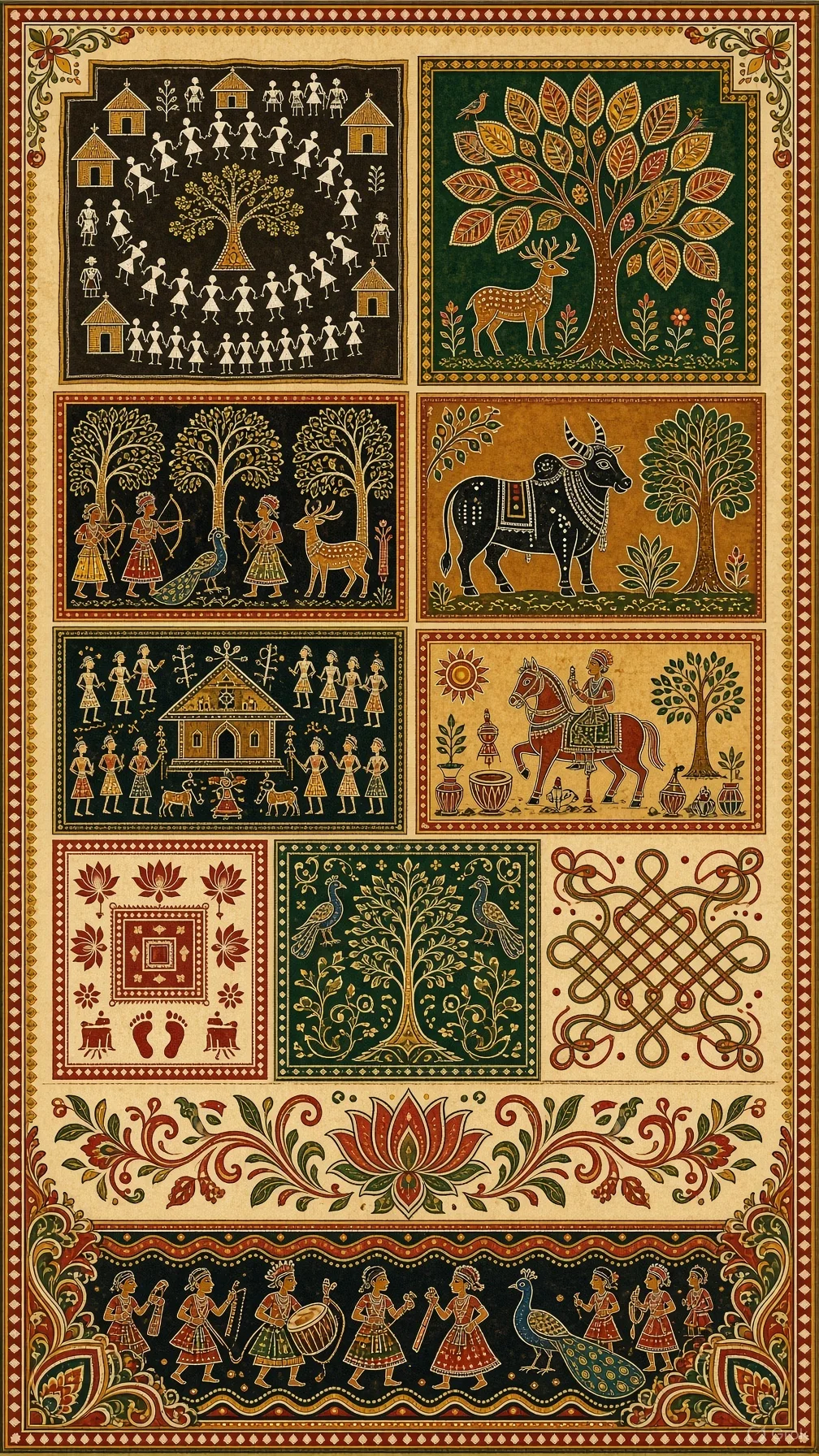
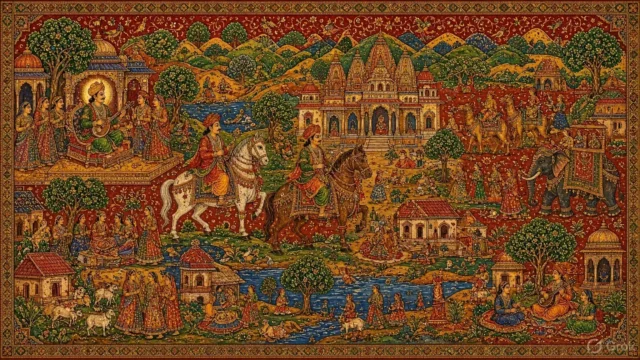
The final image shows all the arts side by side. Use the tables below to compare them by state, label and look.
State-wise list of Indian tribal and folk art
| State | Art form | Community or makers | Type | Main medium |
|---|---|---|---|---|
| Jharkhand | Sohrai, Khovar | Santhal, Oraon, Munda, Kurmi and others | Tribal wall art | Natural soils on mud walls |
| Gujarat, Madhya Pradesh | Pithora | Rathwa, Bhil, Bhilala | Tribal ritual wall art | Cow-dung and chalk walls |
| Odisha | Saura (Idital) | Saura, Lanjia Saura | Tribal ritual art | Rice paste |
| Madhya Pradesh, Chhattisgarh | Baiga Godna | Baiga women | Tribal body art | Tattooing |
| Tamil Nadu | Kurumba | Alu Kurumba | Tribal painting | Forest pigments |
| Telangana | Cheriyal | Nakashi families | Folk scroll | Cloth and natural colours |
| Maharashtra | Warli | Warli | Tribal wall art | White rice paste |
| Madhya Pradesh | Gond | Gond, Pardhan Gond | Tribal painting | Colours on wall, paper, canvas |
| Madhya Pradesh | Bhil | Bhil | Tribal painting | Dots on wall, paper, canvas |
| Rajasthan, Madhya Pradesh | Mandana | Meena and others | Ritual floor and wall art | Red geru, white khadiya |
| Uttarakhand | Aipan | Kumaoni women | Ritual floor art | Geru and rice paste |
| West Bengal | Alpana | Bengali households | Ritual floor art | Rice paste |
| Tamil Nadu | Kolam | Tamil households | Ritual floor art | Rice flour |
| Odisha | Pattachitra | Chitrakara families | Folk and devotional painting | Cloth, natural colours |
| Andhra Pradesh | Kalamkari | Artisan families | Textile art | Natural dyes on cotton |
| Kerala | Kerala Mural | Hereditary mural artists | Classical temple mural | Panchavarna on walls |
| Rajasthan | Phad | Joshi painter families | Folk scroll | Cloth scroll |
| Rajasthan | Pichwai | Nathdwara artists | Devotional temple art | Cloth hangings |
Tribal, folk, ritual and classical: the labels
| Label | Meaning | Examples here |
|---|---|---|
| Tribal art | Made by one tribal community within its own beliefs | Sohrai, Khovar, Pithora, Saura, Baiga, Kurumba, Warli, Gond, Bhil |
| Folk art | Regional village or caste traditions | Cheriyal, Phad, Pattachitra |
| Ritual floor art | Seasonal home patterns for festivals | Mandana, Aipan, Alpana, Kolam |
| Devotional and classical art | Made around a deity or a written canon | Pichwai, Kerala Mural, Kalamkari (textile craft) |
How to tell look-alike styles apart
| Look-alikes | Key difference |
|---|---|
| Warli vs Saura | Saura is from Odisha and built from the border inward; Warli is from Maharashtra with distinguishable male and female figures. |
| Warli vs Kurumba | Kurumba shows Nilgiri forest scenes such as honey collection; artists insist it is not Warli. |
| Sohrai vs Khovar | Same region and artists; Sohrai is the harvest festival, Khovar the marriage season. |
| Gond vs Bhil vs Pithora | Gond uses line and dash fills, Bhil builds scenes from dots, Pithora is a ritual with horses as ancestors. |
| Phad vs Cheriyal | Both are narrative cloth scrolls, from Rajasthan and Telangana respectively. |
| Mandana vs Aipan vs Alpana vs Kolam | All are floor art; Mandana is red and white on clay, Aipan is geru and rice paste, Alpana is Bengali rice paste, Kolam is South Indian rice-flour dots. |
Easy drawing and school project ideas
- Draw a map of India and pin one art form in each state with a small sketch.
- Make a five-art chart: state, community, material and purpose.
- Create a “spot the difference” poster for Warli, Saura and Kurumba.
- Practise one art at a time on brown paper (Warli, Saura, Sohrai) or light paper (Gond, Bhil), starting with a border, and label it “-inspired”.
- Present why Pithora is a ritual and not decoration, or why Sohrai-Khovar earned a GI tag. Browse related practice in our Madhubani guide and Lippan guide.
Respecting communities
Many of these traditions are sacred, tied to identity or endangered. Credit the community, avoid presenting AI-made or classroom pictures as authentic tribal art, do not turn ritual scenes or body marks into products, and buy from artists or cooperatives where possible.
FAQs
What is the most famous tribal art of India?
Warli and Gond are among the best known, but there is no official ranking.
What is the difference between tribal art and folk art?
Tribal art belongs to a specific tribal community and its beliefs; folk art belongs to regional village or caste traditions.
Is Madhubani a tribal art?
No, it is generally classed as a folk painting of the Mithila region.
Is Cheriyal tribal art?
No, it is a folk scroll tradition of Nakashi families in Telangana.
Which tribal arts are painted on walls?
Sohrai, Khovar, Pithora, Saura, Warli, Kurumba and traditional Gond and Bhil work.
What is the difference between Sohrai and Khovar?
Sohrai is linked to the harvest festival and Khovar to the marriage season.
Which Indian art is built from the border inward?
Saura (Idital) from Odisha.
Which art forms use rice paste or rice flour?
Warli, Saura, Aipan, Alpana and Kolam.
Which arts have a GI tag?
Sohrai-Khovar (2020), Cheriyal and Kalamkari are examples; check the GI Registry for the year.
Can I use these arts in a school project?
Yes, with credit to the community and by labelling practice work “-inspired”.
Sources: NIOS Folk Art, NIOS Mandana, GI Registry, Handicrafts portal, Sahapedia, Wikipedia: Warli, Wikipedia: Jivya Soma Mashe, Wikipedia: Bhuri Bai, Wikipedia: Mandana, Wikipedia: Kerala mural, Wikipedia: Kalamkari, Wikipedia: Saura, Wikipedia: Kurumba, MP Tourism: Gond, Live History India, NVLI: Godna, Telangana Tourism, Google Arts & Culture.










Share Your Opinion
Comments are closed on this post.