 Vista

Warli art drawing is a simple way to paint using basic shapes: a circle, a triangle and a square. In traditional Warli painting from Maharashtra, white rice paste is used on a red-brown earthen wall. To draw it at home, use a white pen, paint or chalk on dark paper (or a dark pen on white paper), draw people as two triangles joined at the tips, add circles for heads, and build a village scene with houses, trees, animals and a dancing circle. It is one of the easiest folk art styles for beginners and for Warli art for kids, because every figure is made from repeated, simple shapes.
This guide covers Warli art drawing easy designs, a full step-by-step village scene, Warli art border designs, kids and school project ideas, and ways to use Warli-inspired patterns on walls, canvas, fabric and pots. One point matters throughout: traditional Warli artwork is made by Warli artists, mostly women in the community, and some compositions, such as the wedding chauk, have ritual meaning. The designs in this article are contemporary, Warli-inspired practice exercises. They are not authentic ritual paintings, and we do not present any digitally made illustration as tribal artwork. For the symbols and their meanings, see our Warli art symbols chart; this page is about how to draw and paint.
Contents
- What Is Warli Art? History and Origin
- Warli Art Materials and Beginner Painting Kit
- Easy Warli Art Drawing for Beginners
- How to Draw Warli Painting Step by Step
- Warli Art Images and Painting Designs
- Warli Art for Kids and School Projects
- Warli Art Border Designs
- Warli Painting on Wall and Canvas
- Warli Art on Saree, Pots and Everyday Objects
- Warli Art Outline Designs and Practice Patterns
- Warli Painting Mistakes, FAQs and Final Tips
What Is Warli Art? History and Origin
Warli art, also called Warli painting or Warli tribal art, is a tribal art form from Maharashtra, India. It is made by the Warli people of the northern Sahyadri range. The style uses a small set of geometric shapes to show daily life: farming, dancing, animals, trees and festivals. Because the shapes are so simple, Warli art drawing is a favourite first lesson in folk art.
Warli Painting Belongs to Which State?
Warli painting belongs to Maharashtra. It originated there and is mainly made by the Warli people of the northern Sahyadri range, with Dahanu, Talasari, Jawhar, Palghar and Mokhada among the places where it is found. Warli communities also live in parts of Nashik and Dhule, and across the border in parts of Gujarat. When someone asks “Warli art of Maharashtra” or “Warli painting which state”, the short answer is Maharashtra, especially the Palghar and Thane region near Mumbai.
The age of the tradition is debated. One overview says the style is thought to date back as early as the 10th century CE, while some craft sources claim far older roots. Because there is no single settled date, it is safest to say that Warli art is an old community tradition whose exact beginning is uncertain. We do not give a precise year here.

Warli Tribe, Cultural Heritage and Famous Artists
The Warli are one of the large tribal communities of the region, and farming and nature are central to their culture. Traditionally, walls were painted mainly for special occasions such as weddings, festivals and harvests. In traditional practice, married women often did the wall painting during ceremonies, and the wedding square, called the chauk, is a ritual composition rather than simple decoration. When you draw Warli-inspired designs, treat those ritual elements with respect and do not reuse them casually as party decoration.
The artist most often credited with bringing Warli painting to a wider audience is Jivya Soma Mashe (born 1934, died 15 May 2018 in Dahanu). According to the People’s Archive of Rural India, he was the first Warli Adivasi to begin painting on canvas, in 1971, which moved the art beyond ritual walls. His honours include the National Award for Tribal Art (1976), the Shilp Guru award (2002), the Prince Claus Award (2009) and the Padma Shri (2011). Several members of his family continue to paint. Other Warli artists also work today, and buying directly from them supports the community. One craft source notes that Warli painting has a GI tag, listed there as 2023, which you can check on the AIACA Craftkatha page on Warli.
Warli Art Materials and Beginner Painting Kit
Warli painting materials are simple, which is part of the charm. You can start with items from a school bag, then move to better supplies later.
Traditional Rice Paste and Mud Wall Painting
Traditional Warli work follows a clear sequence. According to Incredible India, the wall is first coated with an earth mixture called geru, then a cow dung and water layer creates the background, white comes from a rice powder paste, and the painting is done with a bamboo stick crushed at the end. The white pigment is described as rice flour and water with gum as a binder. The strong contrast between white lines and the red-brown wall is the signature look of Warli rice paste painting.
We do not give a rice paste recipe for kids because traditional preparation differs from household to household, and wall coatings use cow dung and earth that are not suitable for classroom practice. If you want to try a natural white at home, use a very thin cooked flour paste on paper and treat it as an experiment, since it spoils and attracts insects when stored.
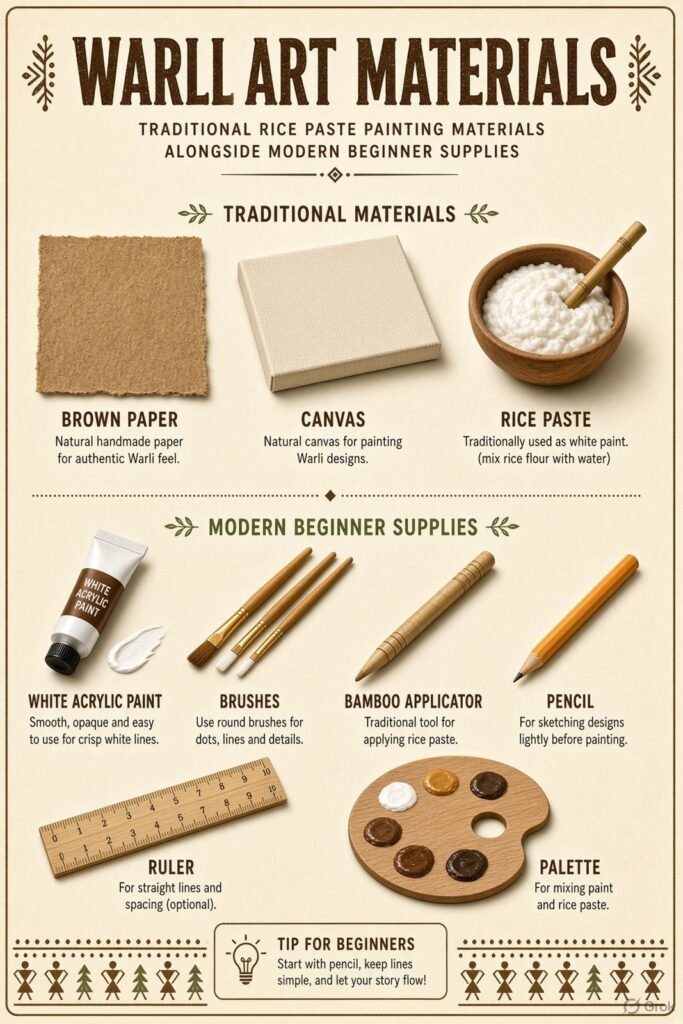
Modern Warli Art Kit, Paper, Canvas, Brushes and Colours
- Surface: Brown or terracotta craft paper, kraft paper, a painted-brown canvas board or a dark cardstock for Warli painting on paper. Warli painting on canvas works best on primed canvas.
- White colour: White acrylic, poster colour, a white gel pen or a paint marker with a fine tip.
- Brushes: A size 0 or 1 round brush for lines, and a small flat brush for backgrounds. A thin bamboo stick or toothpick can imitate the traditional tool for dots.
- Background colour: Terracotta, brick red, brown or ochre paint if you prepare your own canvas.
- Tools: A pencil, eraser, ruler and a small water jar.
A ready Warli art kit is sold online, usually with a pre-printed board, paints and a brush. Check that the paints are labelled non-toxic and age-appropriate before giving them to children.
| Item | Traditional | Modern or beginner |
|---|---|---|
| Surface | Mud wall with cow dung and geru coating | Paper, canvas, wood, cloth |
| White | Rice paste with gum | White acrylic, poster colour, gel pen |
| Tool | Bamboo stick crushed at the end | Fine brush, pen, marker |
| Background | Earthen red-brown from geru | Brown paper or painted board |
| Lasting power | Renewed on festive occasions | Lasts longer when sealed |

Easy Warli Art Drawing for Beginners
Easy Warli art drawing begins with just three shapes. Practise each one on rough paper until your lines are steady, then combine them.
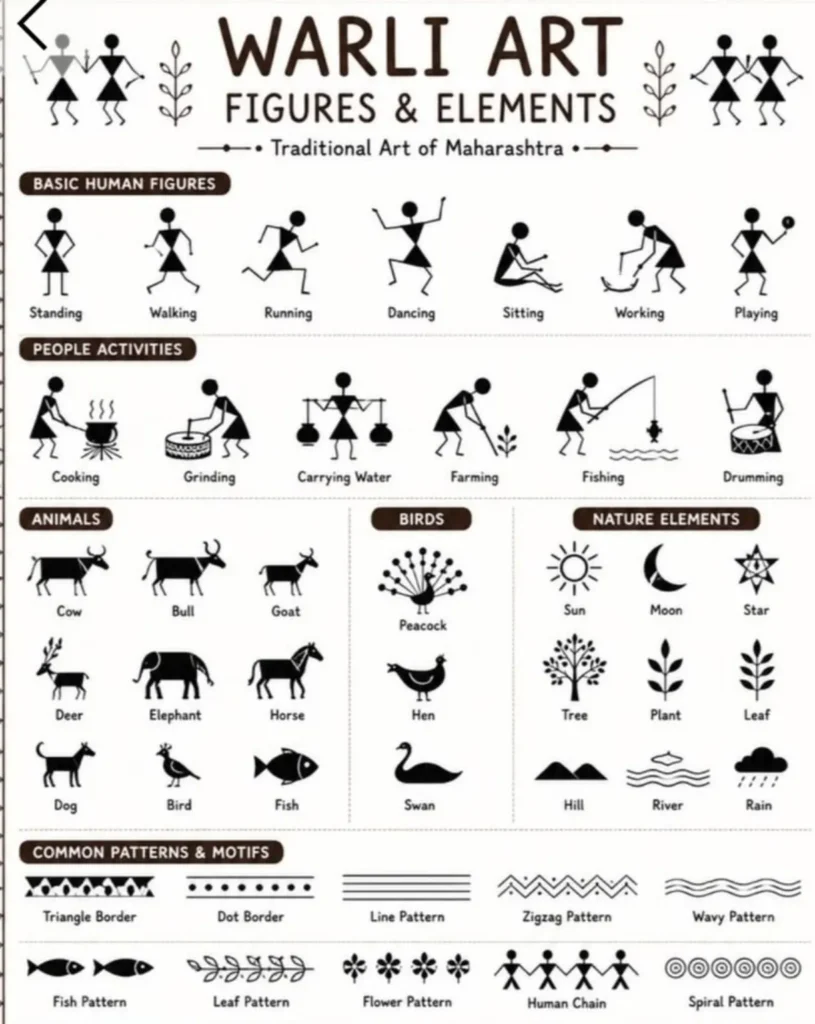
Basic Circle, Triangle, Square and Human Figures
In the usual explanation, the circle stands for the sun and moon, the triangle for mountains and conical trees, and the square for a human creation, a sacred enclosure or piece of land. You can use these three shapes as your drawing alphabet.
- Head: Draw a small circle, which can be filled or left open.
- Body: Draw one triangle with its point downward below the head.
- Hips: Draw a second triangle with its point upward, touching the first at the tips. The two triangles form the Warli human figure, often called a Warli stick figure.
- Arms and legs: Add thin straight lines for arms and legs. Bend them to show dancing, carrying, farming or sitting.
Draw ten figures in a row, each with a different arm and leg position. This is the best warm-up before a full composition. Our Warli symbols chart shows the same figures with their cultural context.



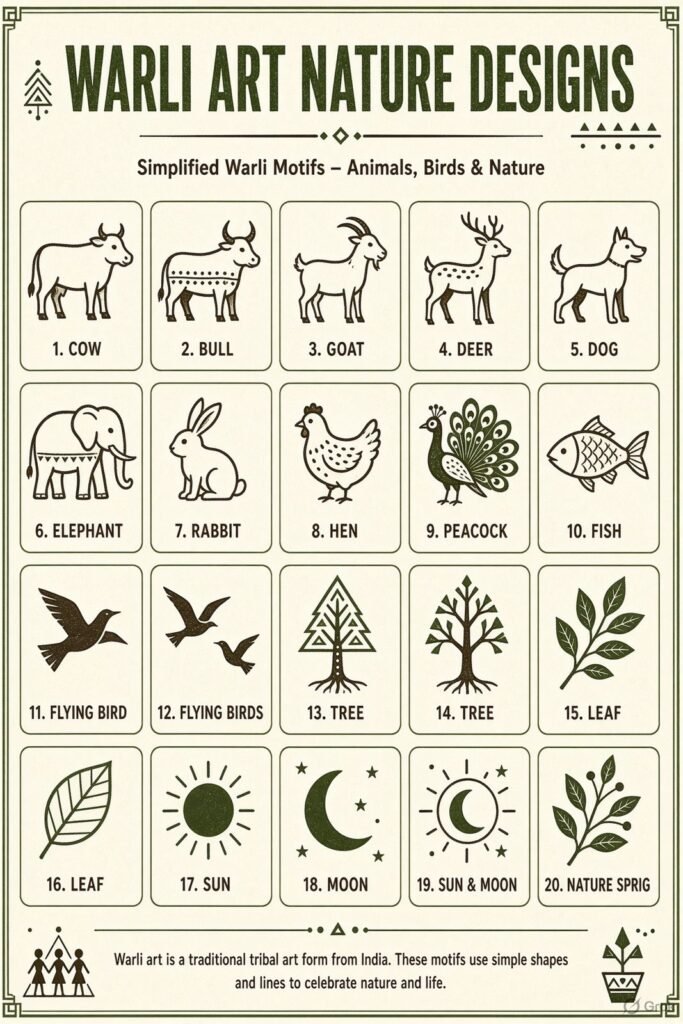
Easy Warli Animals, Birds, Trees and Houses
- Warli tree drawing: Draw a vertical trunk, then add branches as short lines. Finish each branch with a small leaf, dot or a tiny triangle. Fruit can be small circles.
- Warli animal drawing: A cow or deer is a long oval or two triangles for the body, four thin legs, a small head and a tail line. Add horns as two short lines.
- Warli bird drawing: A small triangle or oval body, a circle head, a short beak and two or three tail lines. Birds can sit on tree branches.
- Houses: A square with a triangle roof, a small door and, if you like, a line pattern on the walls. Huts are often drawn very simply.
Everything in a Warli scene is flat, with no shading or perspective. Keep lines thin and even, and leave space between figures so they can be read clearly.
How to Draw Warli Painting Step by Step
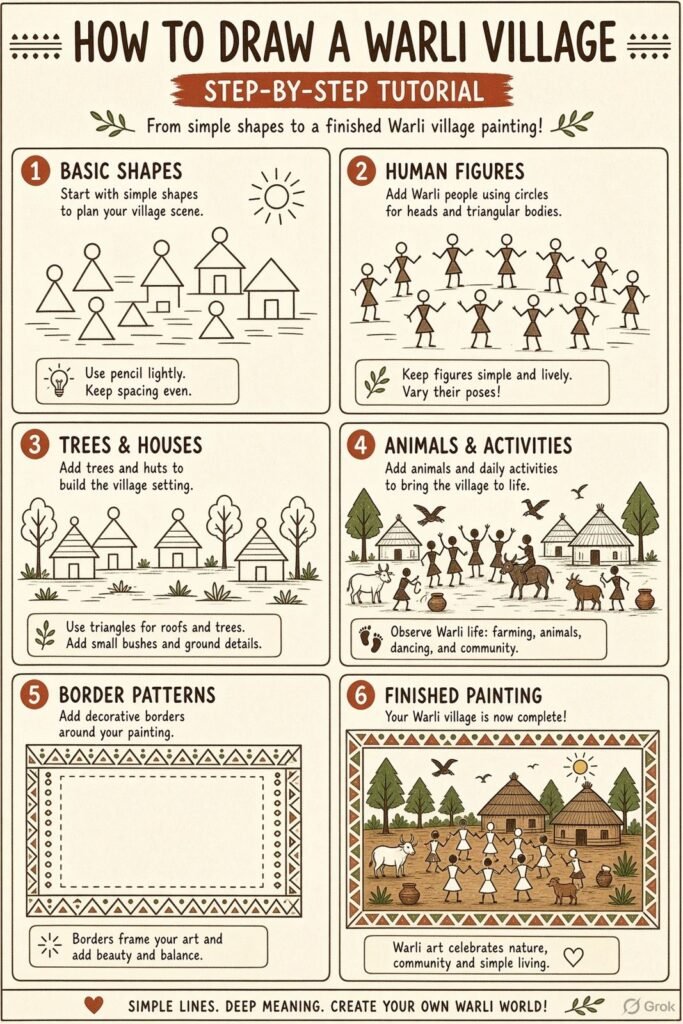
Follow this Warli drawing step by step lesson to make a complete scene on A4 paper. Use a pencil first, then ink or paint over it.
Drawing Human Figures and Body Movements
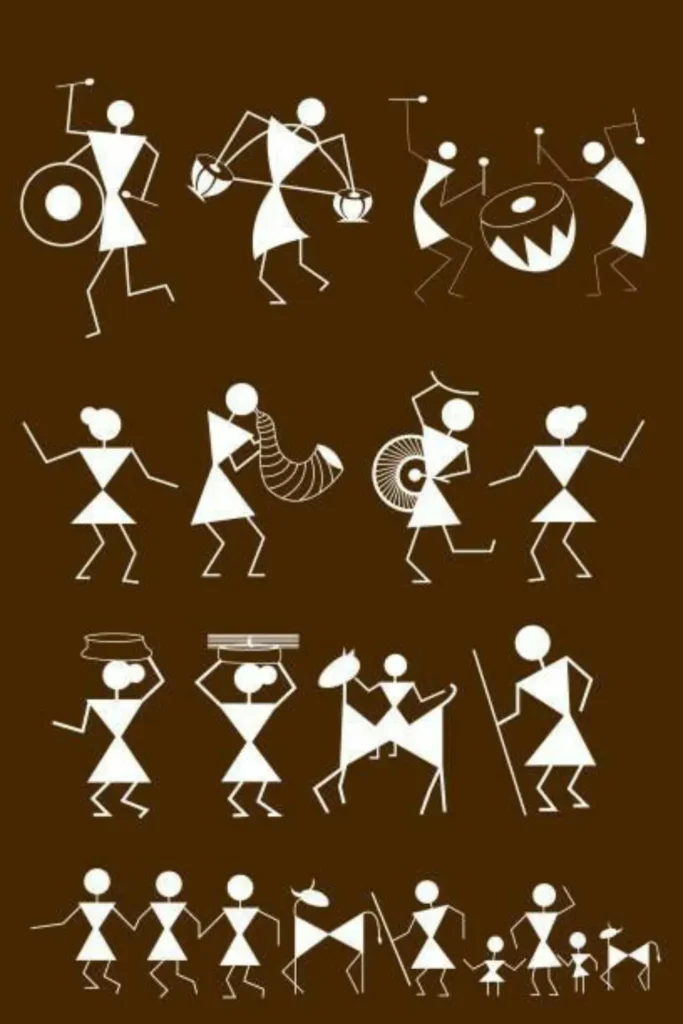
Movement is the heart of Warli figures. Keep the two-triangle body but change the limbs: raise both arms for dancing, bend one arm to carry a pot, bend knees for sitting, or draw a line over the shoulder for a bundle of wood. For a farmer, draw a figure bending forward with a long thin line for a plough. For a group, vary the angles so the figures do not look like copies. A good way to practise is to draw the same figure three times, once standing, once dancing, once working.
Keep the head small, the waist narrow and the triangles of equal size, otherwise the figure looks heavy. If your triangles feel uneven, use a ruler for the first few drawings and then switch to freehand.
Creating a Complete Village Scene from Sketch to Finish
- Plan the page. Draw a light frame about 2 cm inside the edge. Decide the centre: usually a dancing circle, a tree or a house.
- Place the large shapes. Draw one or two big trees and two or three huts first, since they set the layout.
- Add people. Draw groups of two or three figures near the huts, one figure at the tree, and a ring of dancers in the centre.
- Add animals and birds. Put a cow near a hut, a bird on a branch and a small animal at the bottom.
- Fill small gaps. Add dots, small plants, fish in a pond or a wavy line for a path.
- Ink or paint. Trace the pencil with white paint or a white pen on dark paper, or black on white paper. Work from the top down so your hand does not smudge fresh paint.
- Finish with a border. Add a repeating border (see the border section) and erase leftover pencil lines after the paint dries.

Warli Art Images and Painting Designs
People often search for a Warli art image to copy, but the best way to learn is to build your own composition from the shapes above. Here are theme ideas for Warli art designs.
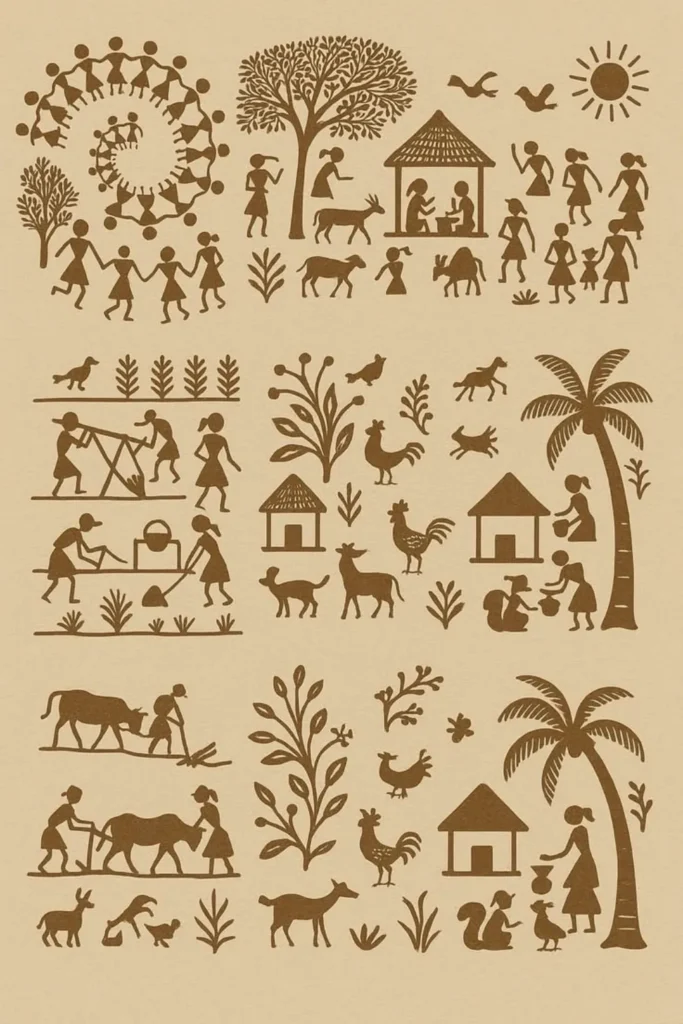
Village Life, Farming, Animals and Nature Designs
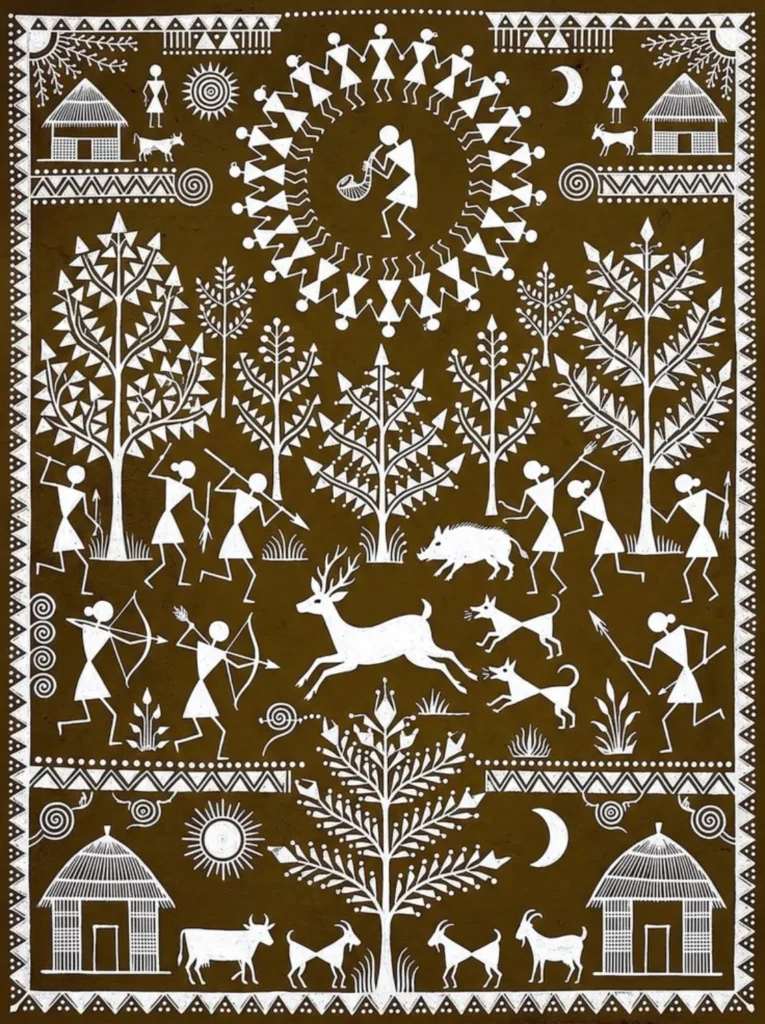
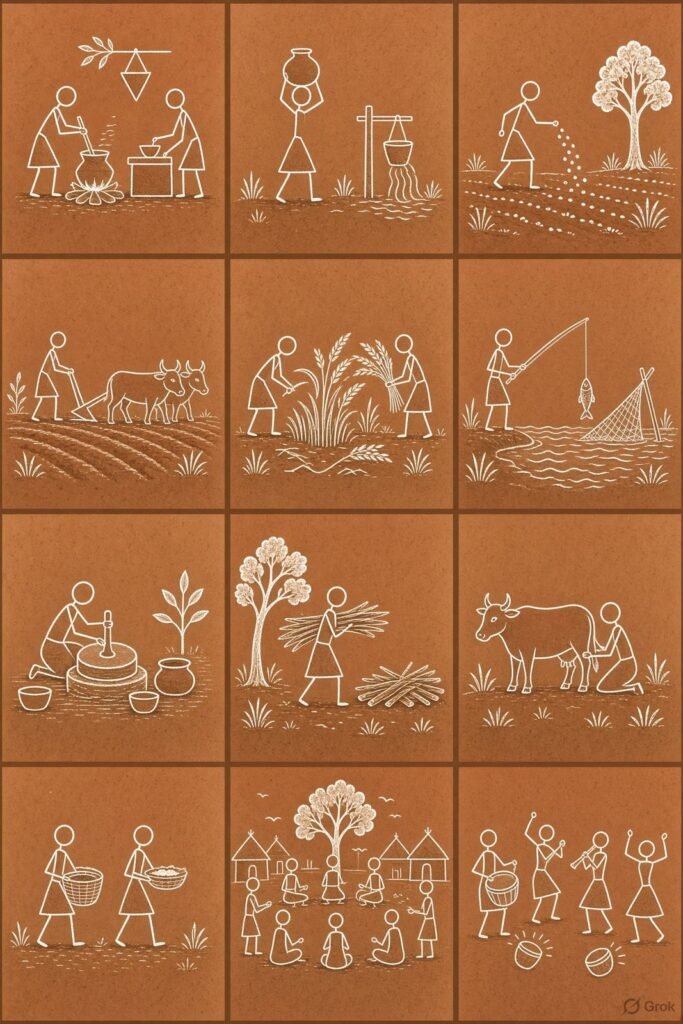
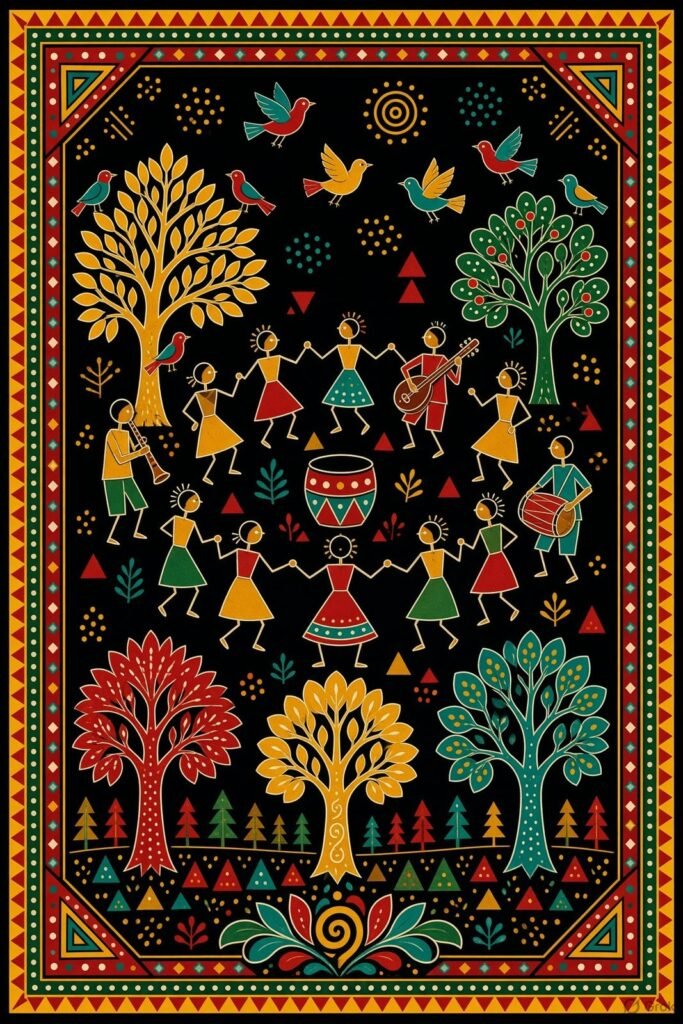
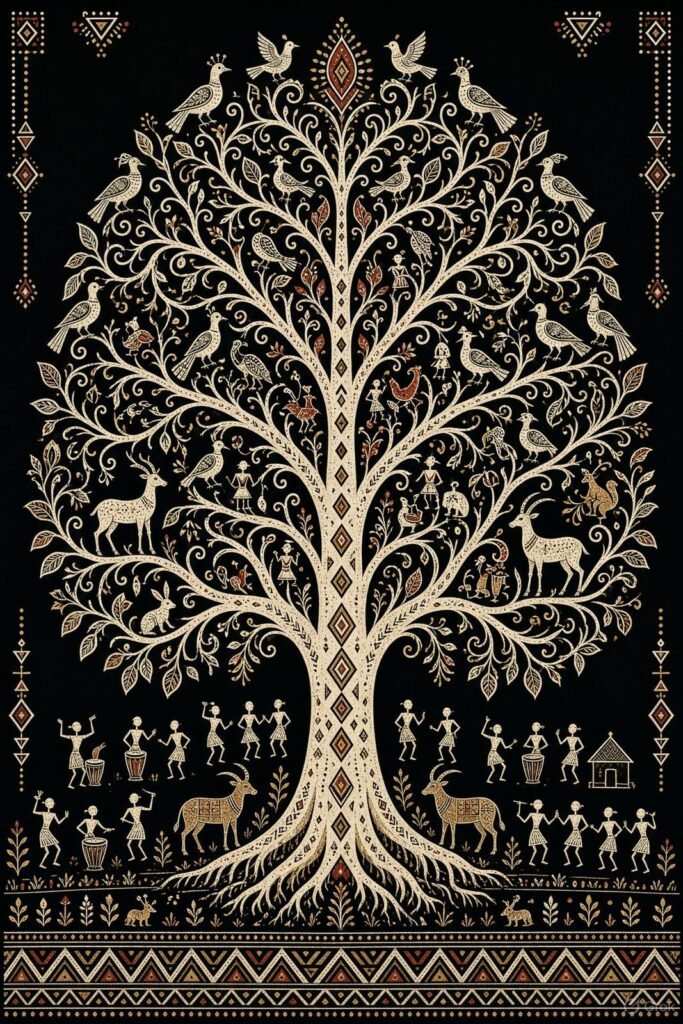
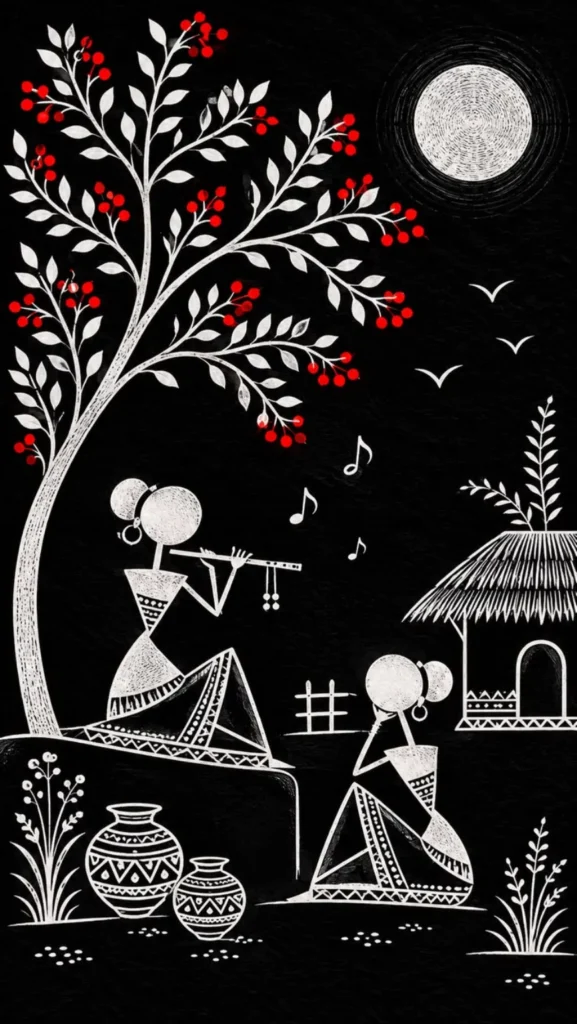
Warli art shows ordinary village life: sowing, harvesting, drawing water, grinding grain, fishing, and cattle returning home. A good composition has one main activity and a few smaller scenes around it. For a harvest scene, draw a field as a grid of lines, add bending figures, and place a tree and a hut at the edge. For a water scene, show a well or river with women carrying pots. For a nature scene, add a large sun circle, a moon, birds and rows of trees.


Tarpa Dance, Festival and Wedding-Inspired Compositions
The tarpa is a trumpet-like instrument played in turns by village men. Dancers hold hands in a circle around the player and move as he turns, never turning their backs to him. A Warli Tarpa dance drawing shows a ring of figures with joined arms around one central figure with a curved horn. Draw the circle first, space the dancers evenly, then add the player. It is a very popular Warli dance painting idea.
For festival scenes, add drums, lamps and decorated huts. Wedding-inspired scenes need care. The central square, called the chauk, has traditional forms such as the Devchauk and Lagnachauk. These are sacred, ritual compositions painted by community members for ceremonies, so avoid copying a full chauk as a casual decoration. A respectful alternative is a general scene of dancing and celebration without trying to reproduce the ritual square, with a note that your work is Warli-inspired.


Warli Art for Kids and School Projects
Warli art for kids is popular in schools because it needs no shading, uses simple shapes and teaches about a living tribal tradition. It suits a Warli art school project, art class or Warli drawing competition.
Easy Warli Drawing for Classes 1–5
- Class 1–2: Practise circles, triangles and squares on dotted lines, then make one stick figure and one hut.
- Class 3: A Warli drawing for class 3 can be a tree with two birds and one person, drawn in pencil and traced with a white gel pen on brown paper.
- Class 4–5: A Warli drawing for class 5 can be an easy Warli village drawing with three huts, a tree, two animals and a ring of dancers.
Pre-draw a light frame on the paper so children keep their work inside the border. Use thick white markers for younger children and ask them to say aloud what each figure is doing, which helps them plan.
Warli Painting Projects for Classes 6–8
Older students can work on a larger composition with a theme, such as a harvest festival, a market day, a village procession (without the ritual chauk) or a nature scene with seasons. Ask them to include at least three types of figures, a repeating border and two kinds of trees. For a project file, they can write a short note on Warli tribal art, the region, the materials and a respectful credit to Warli artists such as Jivya Soma Mashe. A Warli painting for students should show the tradition honestly: simple shapes, white on a brown ground, and a clear statement that the work is inspired by Warli art.
A Warli practice sheet helps before the final page: fill one row with figures, one with trees, one with houses and one with animals. For competitions, neat lines, balanced spacing and a clear theme matter more than the number of figures.


Warli Art Border Designs
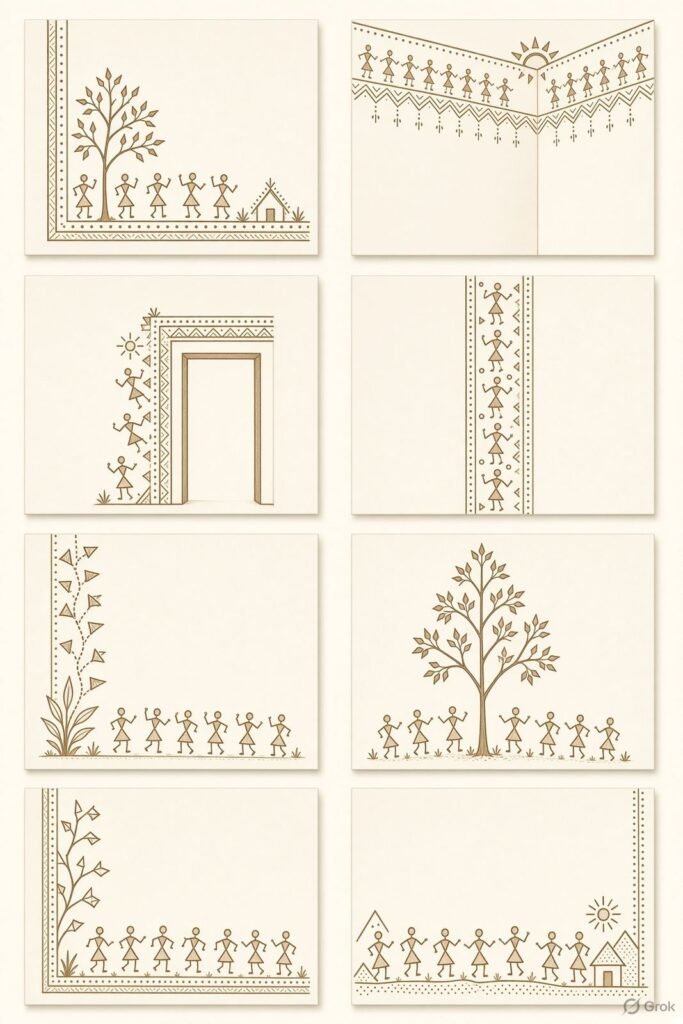
A Warli art border design frames a drawing and is quick to practise. The key is repetition with even spacing, which also builds hand control.
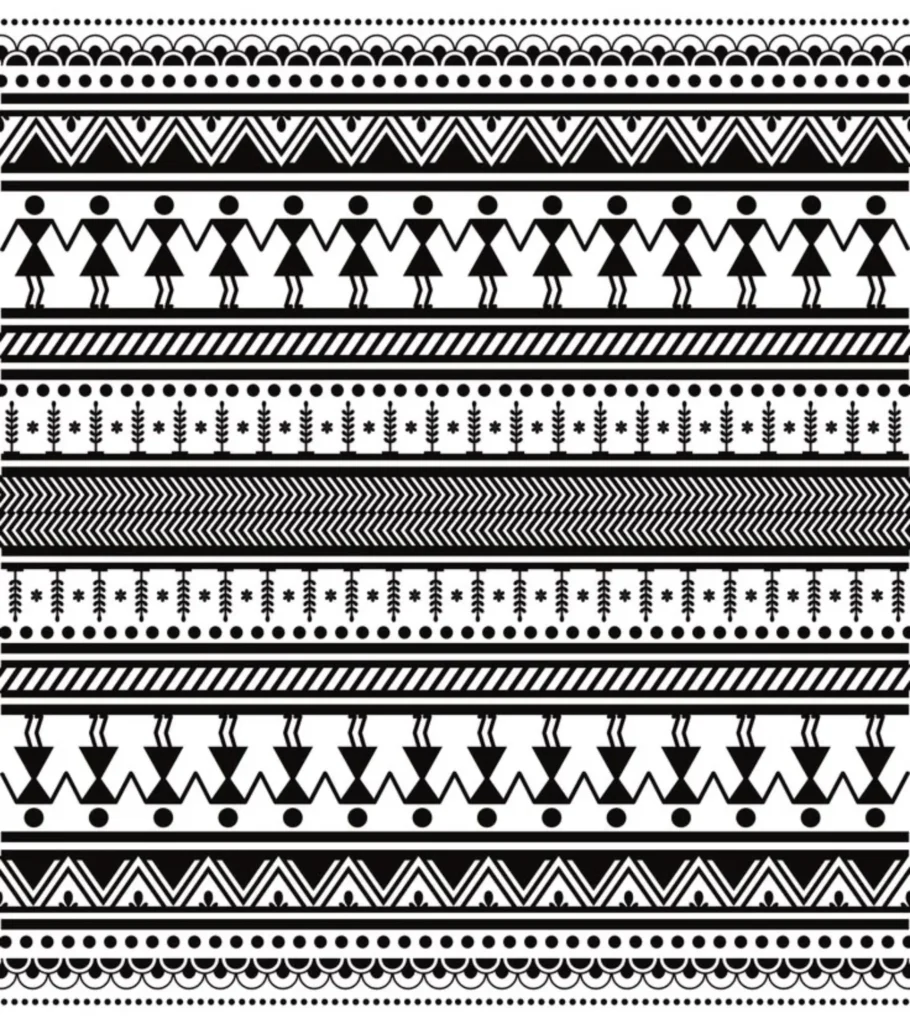
Simple Human Figure, Geometric and Traditional-Inspired Borders
| Border | How to draw | Good for |
|---|---|---|
| Dancing figures | Row of two-triangle figures with joined arms | Frames, wall art |
| Triangle chain | Alternate up and down triangles in a line | Notebook edges |
| Diamond chain | Squares turned into diamonds, touching at corners | Saree, dupatta edges |
| Tree and bird | Small tree, bird, tree, bird in repeat | Cards, bookmarks |
| Dots and dashes | Short lines between rows of dots | Quick easy Warli border |
To keep spacing even, draw two light guide lines for the top and bottom of the band, mark equal intervals with a ruler, and repeat one shape at each mark. For a figure border, mark the centre of each figure and draw the circle head first. Start in the middle of a long side and work outward so errors show up at the corners, where you can adjust.

Notebook, Project File, Corner and Page Border Designs
A Warli notebook border should be narrow, about 1 cm, so it does not crowd the writing space. For a project file border, use a wider band and leave a clear space for the title. A Warli corner design can be a small tree, a triangle fan or a circle with dots in each corner, which gives the page a finished look. Draw all four corners the same, turn the page as you work, and check by holding the page up to a light. Warli geometric patterns, such as repeated triangles and squares, are the easiest for beginners, and a Warli border drawing in black on white paper is ideal for a first attempt.
Warli Painting on Wall and Canvas
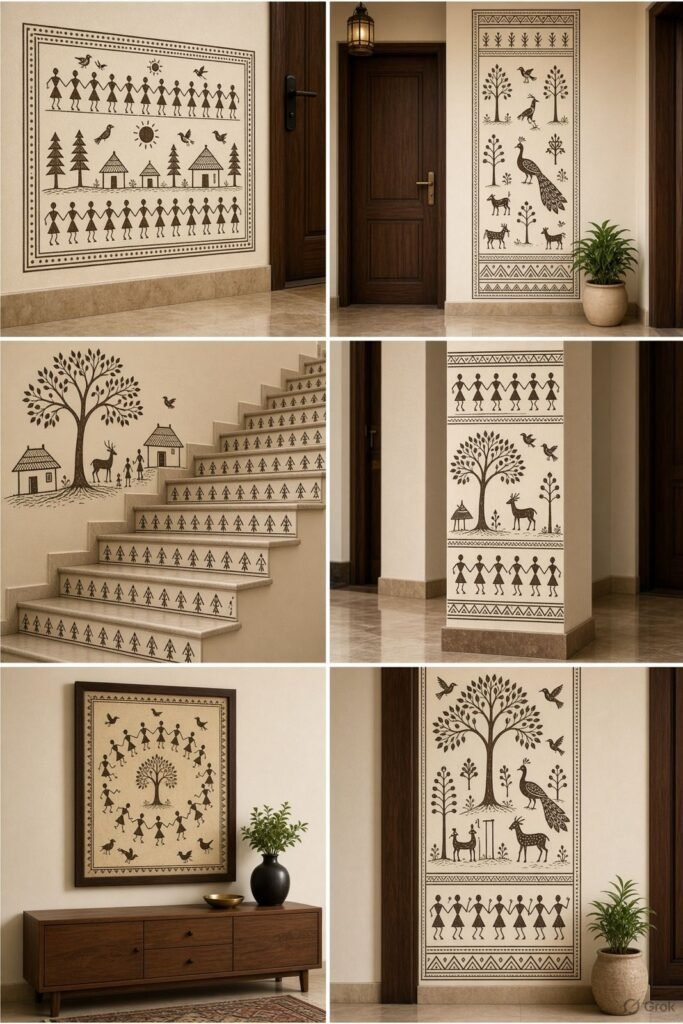
Warli wall painting started on mud walls, and today people adapt it for homes and canvases. If you are not part of a Warli community, think of your home version as Warli-inspired decor and credit the tradition.
Living Room, Bedroom and Traditional Wall Decoration
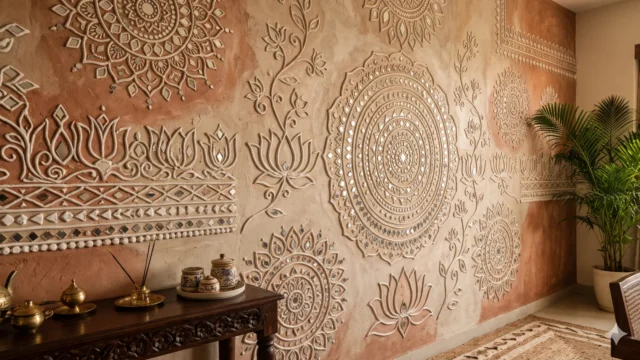
The classic look is white on an earthy background. For a wall, choose a terracotta or brown paint, let it dry completely, then draw with a pencil or chalk and paint over it with white acrylic and a fine brush. Good places are an entrance wall, a stair wall or the area behind a console table. In a bedroom, a calm scene of trees and birds above the bed suits the quiet mood. Keep the figures at a size that reads from a distance, and test a small patch first. Use wall paint that suits your surface, and ventilate the room while painting.
Warli Canvas Painting and Modern Home Decor
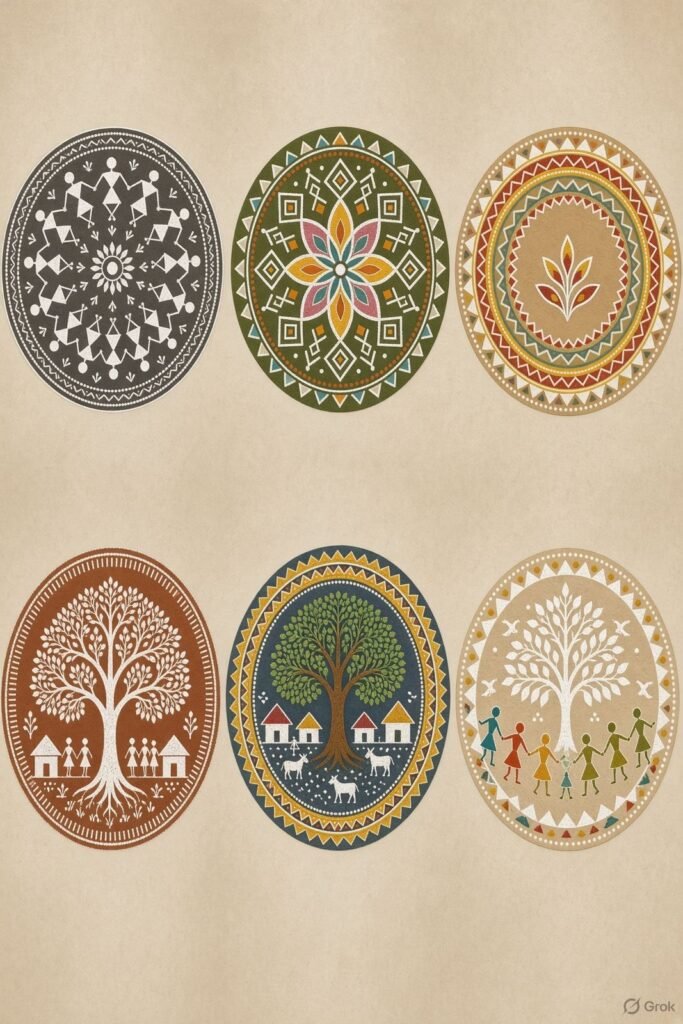
Warli canvas painting is easier to start than a wall because you can correct, move and frame it. Prime the canvas, paint a brown or ochre ground and let it dry, then add white figures. Modern Warli art home decor goes beyond the classic palette: black on white, white on indigo, or white on olive green. These are contemporary adaptations, so label them as Warli-inspired. A set of three small canvases with a tree, a dance circle and a village hut looks good on a shelf wall. If you like folk-art decor projects, try our guide to Madhubani painting designs or compare the red-white geometry in Rajasthani Mandana art.


Warli Art on Saree, Pots and Everyday Objects
Warli patterns look good on cloth and pots because they are bold and simple. Remember that what you make is a decorative adaptation, and hand-painted pieces from the community are best bought from artists directly.
Warli Fabric Painting, Saree, Dupatta and Tote Bag
- Choose cotton, linen or a cotton blend in a dark or earthy shade such as maroon, brown, indigo or black.
- Pre-wash and iron the cloth to remove starch.
- Draw lightly with a chalk pencil or a fabric marker.
- Paint with white fabric paint, or acrylic mixed with a fabric medium as the label directs, using a fine brush.
- Let it dry fully, then heat set as the paint label instructs, usually by ironing on the reverse side with a cloth.
Paint maker Golden advises drying the paint fully before heat-setting or washing, and washing in cold water on a gentle cycle. For a Warli saree painting, place a border band along the edge, a dance circle on the pallu and small trees across the body. A dupatta suits a border at both ends. A tote bag works with one large village scene. Silk should be painted by an experienced painter, so test on a hidden corner first.
Warli Bottle Painting, Terracotta Pots and Handmade Crafts
For a Warli pot painting, paint the pot with a terracotta or brown base coat if it is not already earthy, let it dry, and draw white figures with a fine brush or a paint marker. A band of dancers around the belly and a tree on the front look striking. For a Warli bottle painting, clean glass with rubbing alcohol, use paint made for glass or multi-surface acrylic, and keep the design simple. Seal with a clear varnish suitable for your paint.
Safety note: Keep painted bottles and pots decorative. Standard craft acrylic and varnish are not certified for food contact, and a non-toxic or ASTM D-4236 label means a hazard review for normal art use rather than food safety. Do not paint inside a water pot, on a rim, or on plates and cups used for eating and drinking unless the paint maker states that the product is food safe. See the Mayco note on decorative-use products. Handmade crafts such as coasters, bookmarks and greeting cards are good projects that avoid the food-contact question.

Warli Art Outline Designs and Practice Patterns
Black and White Drawing Templates and Practice Sheets
A Warli outline drawing in black and white is the best way to plan before you paint. Warli art black and white designs also suit printing, stamping and embroidery. To plan a composition, divide the page into a grid of nine boxes, assign each box a subject (hut, tree, dancers, animal, bird, pond) and sketch them lightly. For tracing, place thin paper over a pencil sketch, trace with a fine black pen and transfer the result to a final page with a lightbox or a sunny window.
For geometric practice, fill a page with rows of triangles, squares and circles, changing the size in each row. Then make a row of figures with different arm positions. Finally, combine them in a small scene of three huts, two trees and a dancing ring.
We plan to add original, downloadable Warli practice sheets later. They are not available yet, so please do not look for a download link on this page. Until then, draw your own guide sheet with the exercises above.

Warli Painting Mistakes, FAQs and Final Tips
Common Drawing Mistakes and Frequently Asked Questions
| Mistake | Why it happens | Fix |
|---|---|---|
| Figures look stiff | All limbs are straight and the same | Vary arm and leg angles |
| Triangles are uneven | Drawing too fast | Use a ruler first, then freehand |
| Page looks crowded | Too many figures, no space | Leave gaps and use a clear centre |
| Paint smudges | Touching wet lines | Work top to bottom, let dry |
| Looks like clipart | Copying images exactly | Build your own scene from shapes |
1. Warli painting belongs to which state?
It belongs to Maharashtra, mainly the Palghar and Thane region, and is made by the Warli people.
2. What materials are used in traditional Warli painting?
White rice paste with gum, a bamboo stick brush and a wall coated with earth and cow dung.
3. How do I start Warli art drawing easy for beginners?
Practise a circle, triangle and square, then draw a human figure from two triangles, and combine figures with huts, trees and animals.
4. Is Warli art good for kids?
Yes. The shapes are simple and there is no shading, so children from Class 1 can start with stick figures and huts.
5. How do I make a Warli art border?
Draw two guide lines, mark equal spaces, and repeat a figure, triangle or diamond shape along the band.
6. What colours are traditional?
White paint on a red-brown earthen background. Modern work may use other colours, which are contemporary adaptations.
7. Can I do Warli wall painting at home?
Yes, as Warli-inspired decor. Prepare a dry, clean wall, paint an earthy base, and draw simple white figures, crediting the tradition.
8. Can I use Warli designs on a plate or cup?
Do not paint surfaces that touch food with ordinary craft paint. Keep painted items decorative.
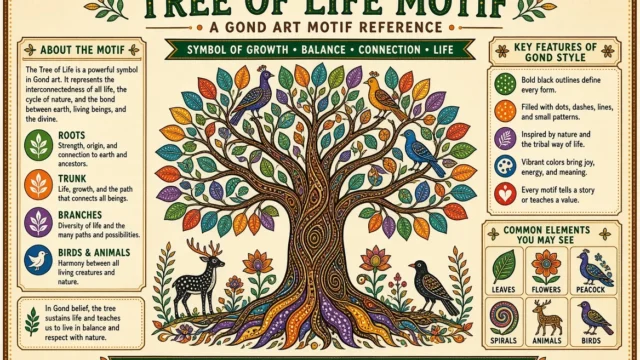
Final tips: Start with figures, then a hut and tree, then a full scene. Keep spacing even, leave breathing room, and describe your work as Warli-inspired. If you want to explore more tribal art, read our Gond art motifs guide, which shows how Gond and Warli differ.
Sources and further reading: Wikipedia: Warli painting; Incredible India: Warli paintings; Vikaspedia: Warli painting; People’s Archive of Rural India; Wikipedia: Jivya Soma Mashe; AIACA Craftkatha: Warli.



















Share Your Opinion
Comments are closed on this post.