 Vista
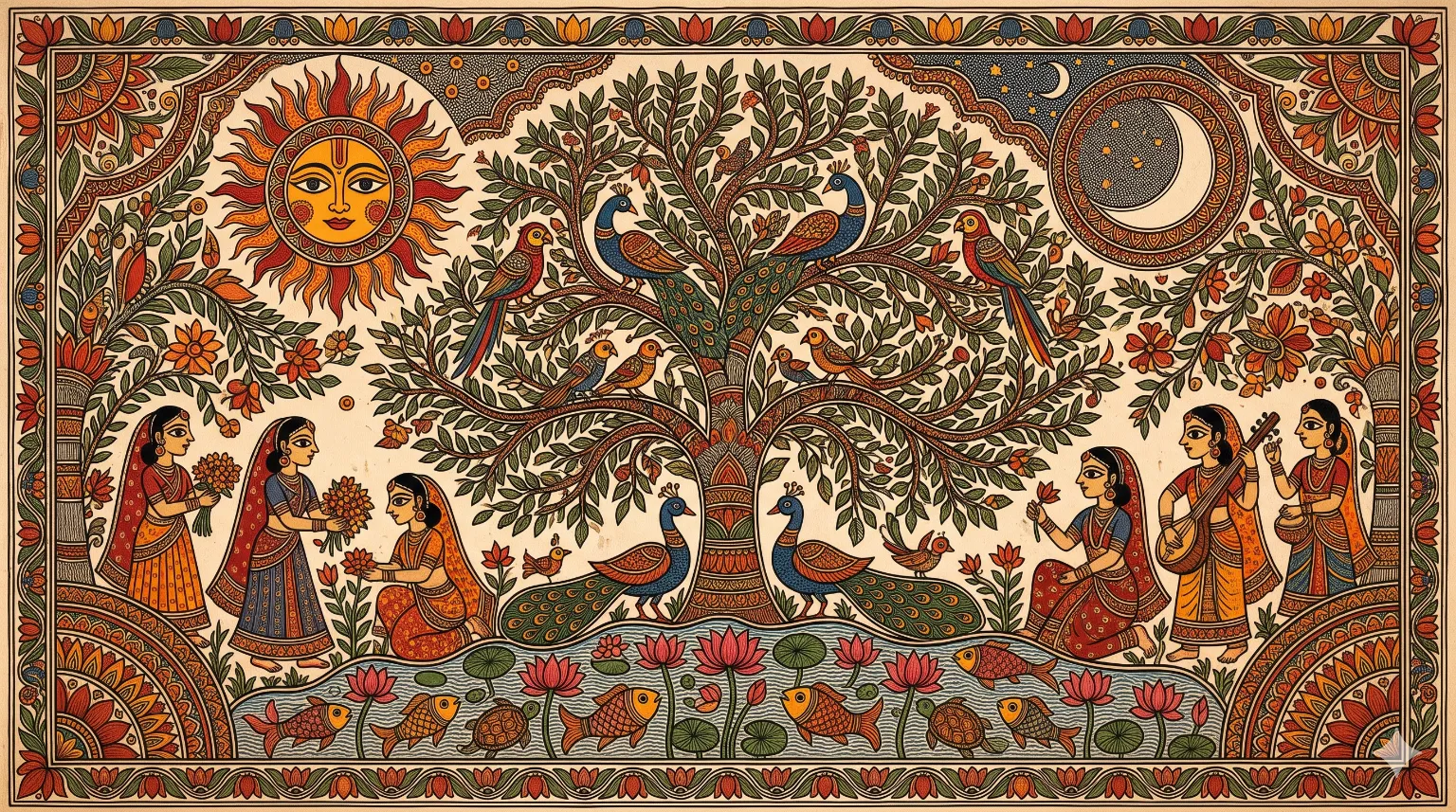
Madhubani painting, also called Mithila painting, is a Bihar folk art known for double-line outlines, flat bright colours and patterns that fill every corner. To draw it at home, start with a pencil sketch of a simple motif such as a fish or lotus, trace a double outline, add borders, fill the shapes with flat colour and finish with fine black lines. Beginners usually work on handmade or heavy drawing paper with a fine pen, a small brush and acrylic or poster colours.
This guide is written for people who want to actually draw. You will find easy Madhubani painting designs, step-by-step drawing, border patterns, colour combinations, and ideas for school projects, sarees, pots, bottles and wall art. One distinction runs through the whole article: authentic Madhubani artwork is made by Mithila artists who learned the craft within their communities, while the practice designs here are contemporary, Madhubani-inspired exercises. Please credit the tradition and, when you can, buy from Mithila artists. For what each motif means, see our existing Madhubani motifs chart; this page focuses on how to draw and paint.
Contents
- What Is Madhubani Painting?
- Madhubani Painting Materials for Beginners
- Easy Madhubani Painting Designs
- Madhubani Painting Step by Step
- Black and White Madhubani Painting
- Madhubani Border Designs
- Madhubani Painting Colour Combinations
- Madhubani Painting for School Projects
- Madhubani Painting on Saree and Fabric
- Madhubani Painting on Pots and Bottles
- Madhubani Wall Art and Modern Home Decoration
- Printable Patterns, Troubleshooting and FAQs
What Is Madhubani Painting?
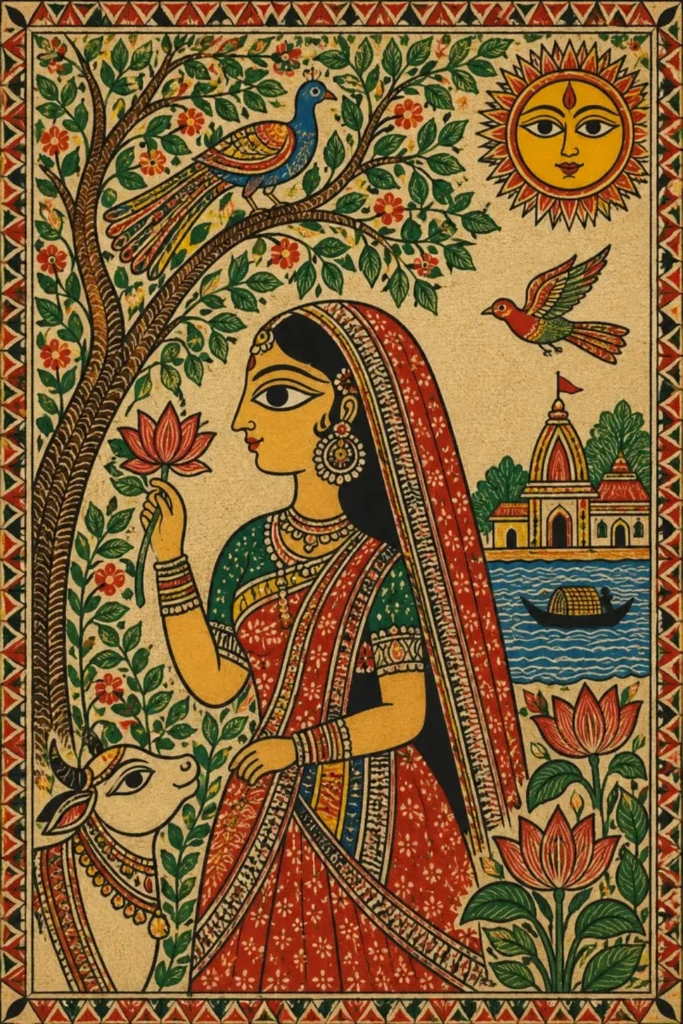
Madhubani art, also known as Mithila art, is a traditional Indian folk painting from the Mithila region, which covers parts of Bihar in India and parts of Nepal. It is one of the best known examples of Bihar folk art. Traditional Madhubani painting is flat and decorative: figures are outlined, colours are filled evenly, there is no shading or perspective, and empty space is crowded with flowers, birds, fish and geometric patterns.
Mithila Painting History and Cultural Heritage
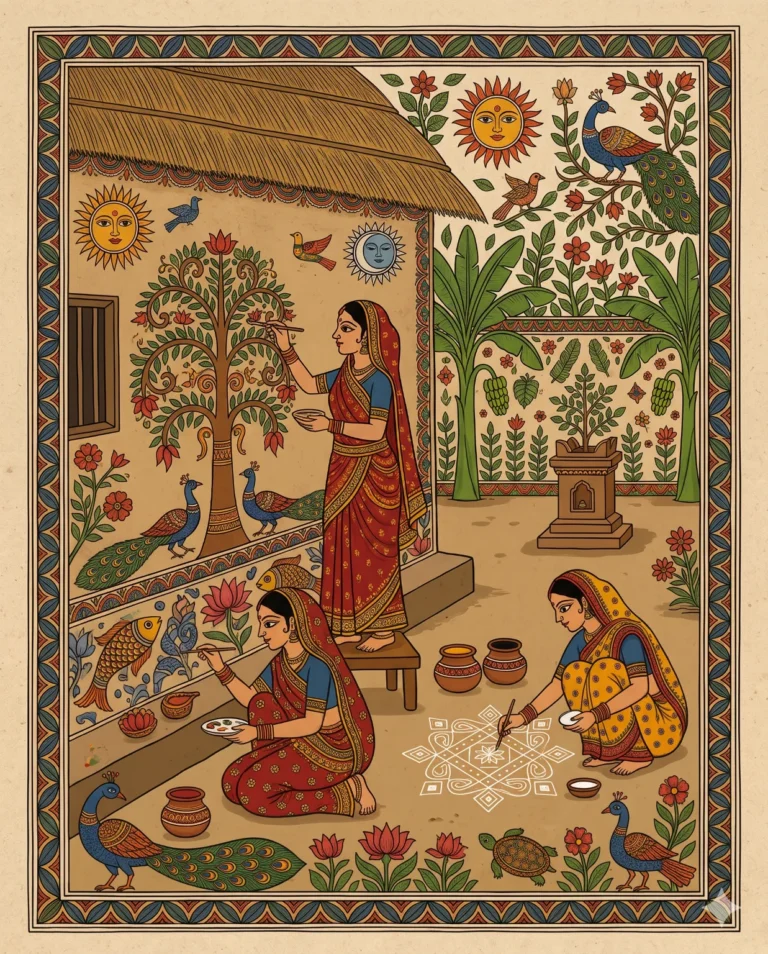
Mithila painting began as a domestic, ritual art. According to the Wikipedia overview of Madhubani art and the Government of India craft portal, women traditionally painted on freshly plastered mud walls and floors of their homes, marking births, weddings and festivals. Later, from around the 1960s, the work moved onto paper, cloth and canvas, partly to give women in the region a source of income, and that is how the name “Madhubani painting” became common alongside “Mithila painting”.
Madhubani painting also earned a Geographical Indication (GI) status, a recognition linked to its compact home region and a style that stayed consistent over generations. Artists such as Sita Devi, Ganga Devi, Baua Devi, Jagdamba Devi and Mahasundari Devi are widely credited for carrying Mithila art to national and international audiences. When you share your own practice work, it is respectful to say it is inspired by their tradition. For wider context, you can read the Wikipedia article on Madhubani art and the Mithila painting page on the Handicrafts portal.
Kachni, Bharni and Other Traditional Styles
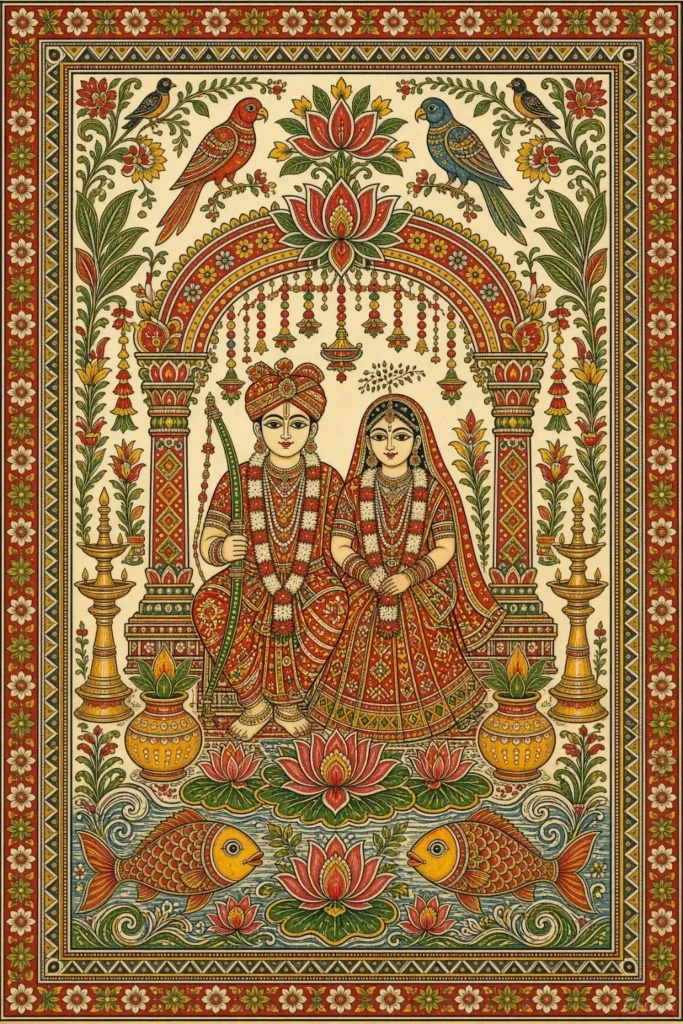
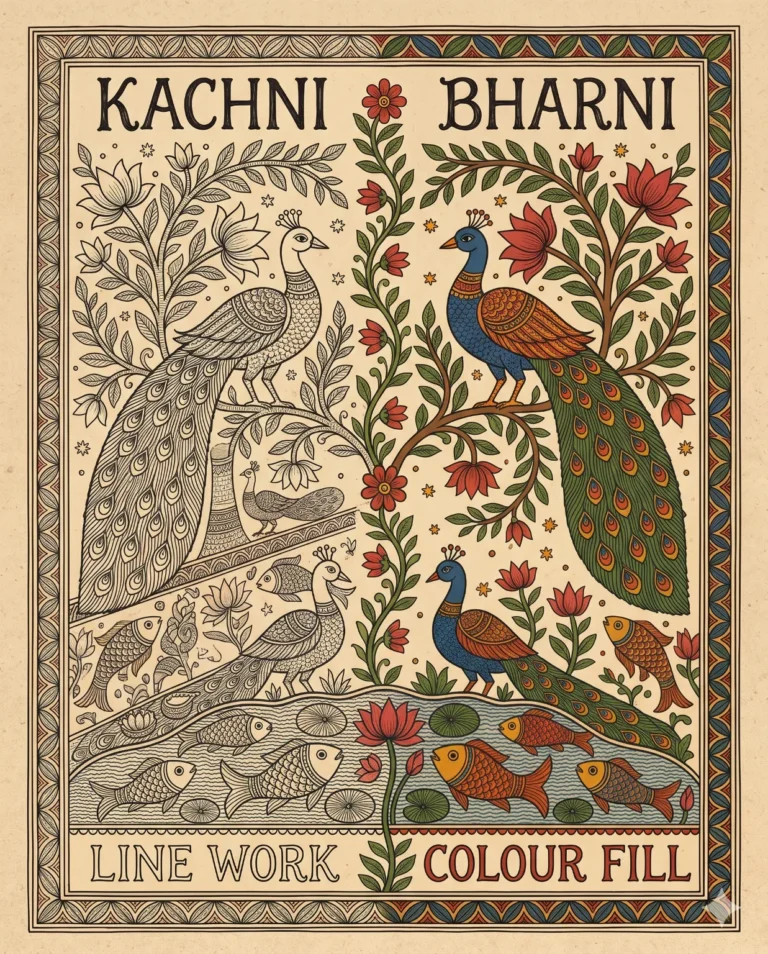
Sources commonly list five styles: Bharni, Kachni, Tantrik, Godna and Kohbar. Kachni and Bharni are the two a beginner meets first. Bharni means “filling”, and the painting is filled with rich colour, often showing deities and mythological scenes with bold black outlines. Kachni is built from fine, firm lines and hatching, often in one or two colours. Several sources link Bharni with Brahmin women and Kachni with Kayastha women, but today the art is practised across communities.
| Feature | Kachni | Bharni |
|---|---|---|
| Main idea | Line work and fine detail | Colour filling |
| Typical palette | One or two colours, often black and red | Many bright flat colours |
| Technique | Hatching, stippling, repeated lines | Solid fills inside outlines |
| Good for beginners as | Pen practice and black and white drawing | First coloured painting |
Tantrik, Godna and Kohbar styles are more specialised. Godna is tattoo-inspired and geometric, while Kohbar is traditionally associated with wedding chambers. If you want to see how other Indian folk traditions compare, try our guides to Pichwai motifs and Pattachitra border patterns.
Madhubani Painting Materials for Beginners
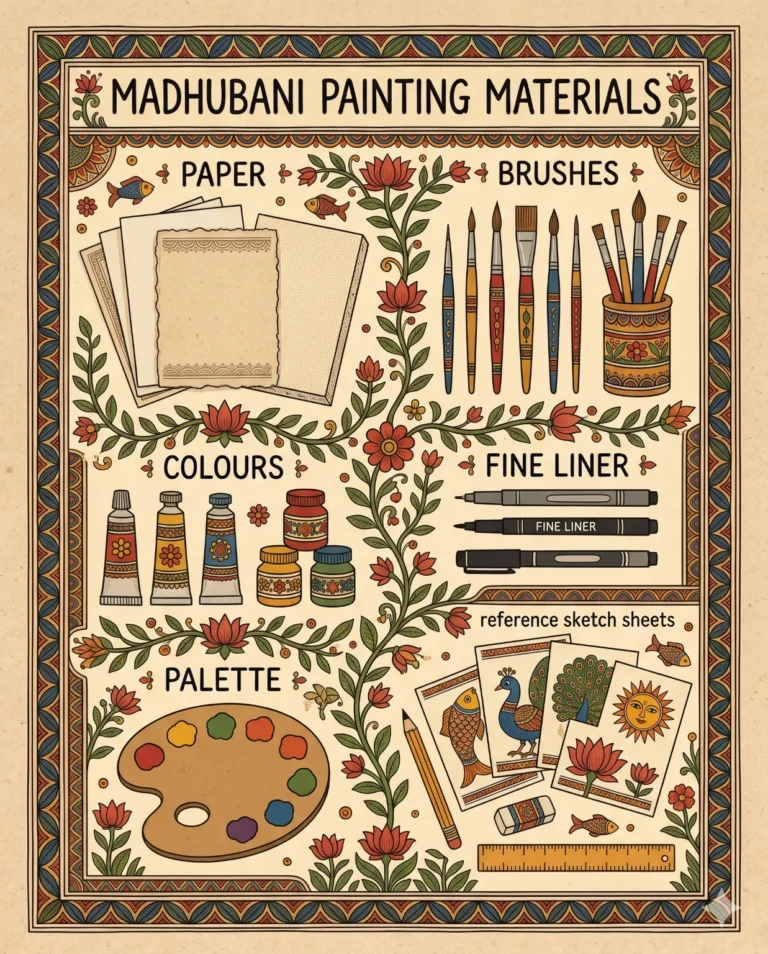
You do not need an expensive Madhubani painting kit to start. A few basic tools are enough, and you can upgrade later. Whatever you buy, test the colour and the pen on a scrap of the same paper first.
Paper, Canvas, Brushes, Pens and Colours
- Surface: Madhubani painting on paper is the easiest start. Use handmade paper or thick drawing paper that does not curl when wet. Madhubani painting on canvas suits acrylic colours; prime the canvas if it is unprimed.
- Pencil and eraser: A soft pencil (HB or 2B) and a kneadable eraser for the first sketch.
- Pens: A black fineliner or Madhubani pen drawing set with 0.1, 0.3 and 0.5 mm tips for outlines and line patterns. Check that the ink is waterproof before you paint over it.
- Brushes: One small flat brush for fills and one fine round brush (size 0 or 00) for details. Traditional artists also used twigs, bamboo slivers, cloth and even matchsticks.
- Colours: Poster colours for school work, acrylic for permanent work, or a ready Madhubani painting colours set.
- Extras: A ruler, a compass for circles, a water jar, a palette and a clean cloth.
Traditional Natural Colours vs Modern Acrylic Paint
Historically, Mithila artists made their own natural colours. Sources mention rice paste for white, lampblack or soot for black, turmeric for yellow, indigo for blue, flower extracts for orange and red, and leaves for green, bound with gum arabic on paper. Chemical powder colours became available in the 1940s, and many contemporary artists now use commercial paints alongside, or instead of, natural ones. Natural colours give a softer, earthier look, but they are laborious to prepare and fade differently, so most beginners choose acrylic. Exact recipes vary by artist, so we do not give mixing quantities here.
| Point | Natural colours | Acrylic paint |
|---|---|---|
| Look | Soft, earthy, slightly uneven | Bright, opaque, even |
| Effort | Needs preparation and a binder | Ready to use |
| Surface | Mud walls, handmade paper, cloth | Paper, canvas, wood, fabric with medium |
| Washing and weather | Sensitive to water and sunlight | Water resistant once dry |
| Best use | Traditional practice, cultural study | Practice, gifts, home decor |
For safety, choose paints marked non-toxic (many carry the ACMI AP seal), keep them away from your mouth, wash hands after painting, and ventilate the room when you use sprays or varnish.
Easy Madhubani Painting Designs
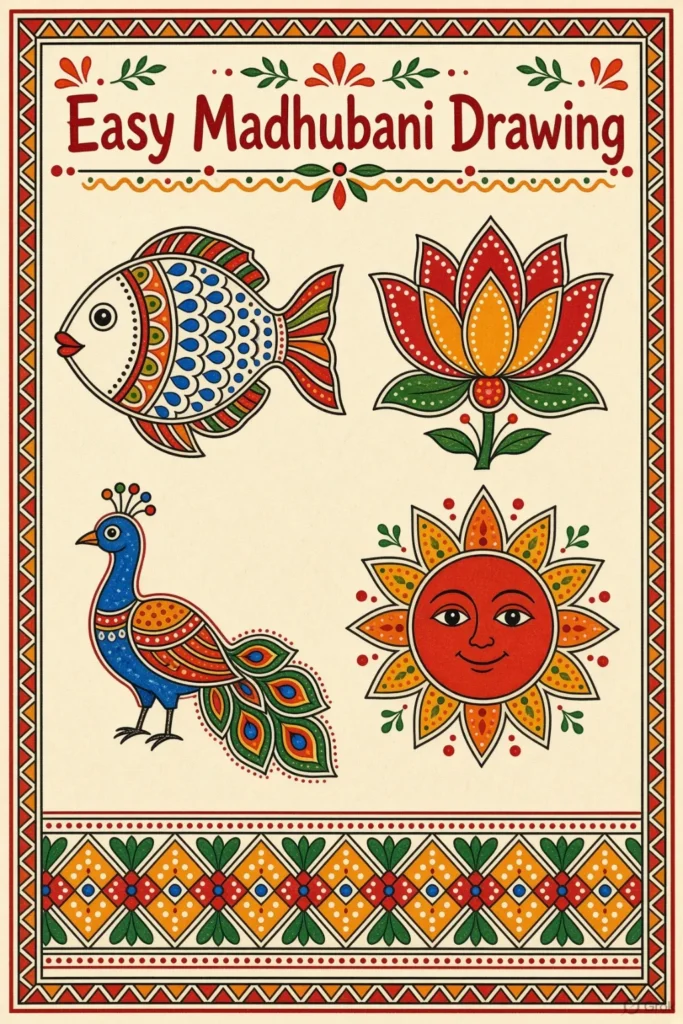
The easiest Madhubani painting designs use simple shapes you can build from circles, curves and triangles. These are contemporary practice versions, not copies of any one artist’s work.
Simple Fish, Lotus and Sun Drawing
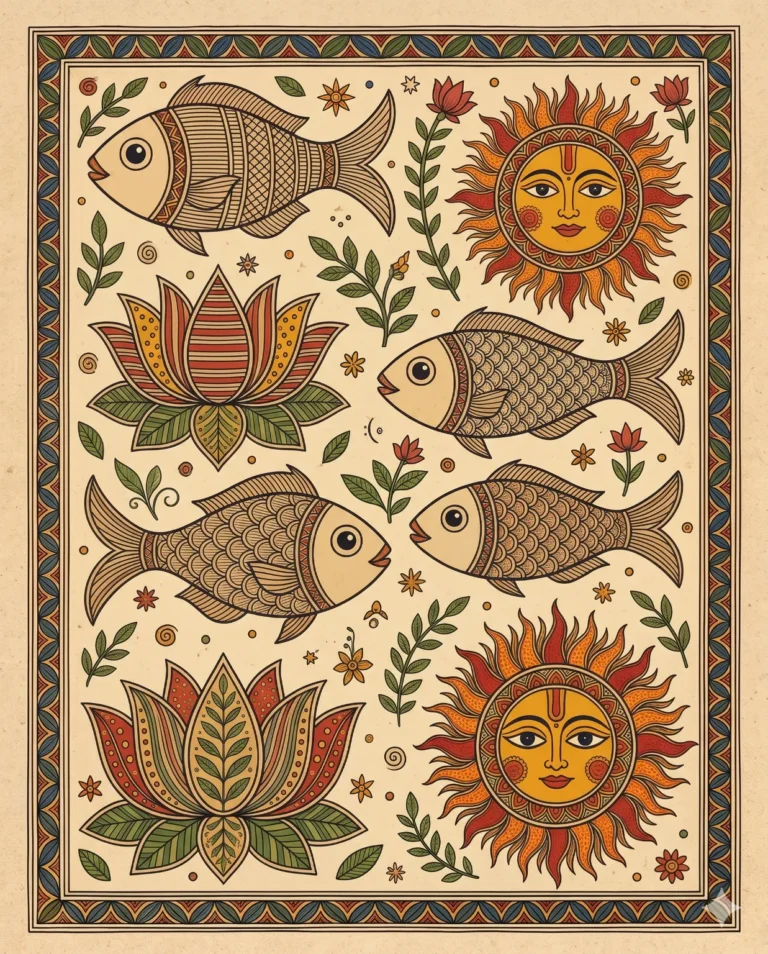
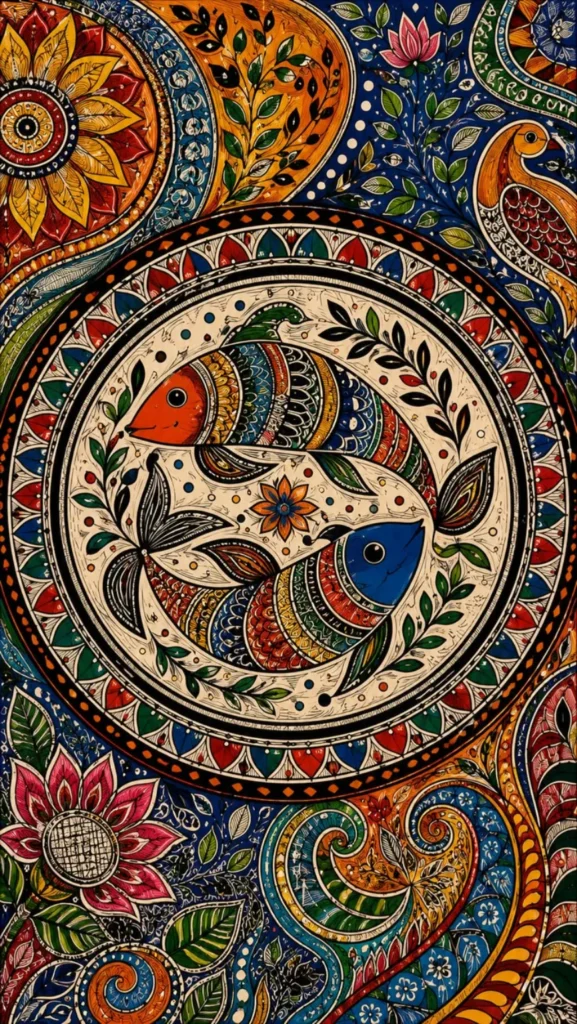
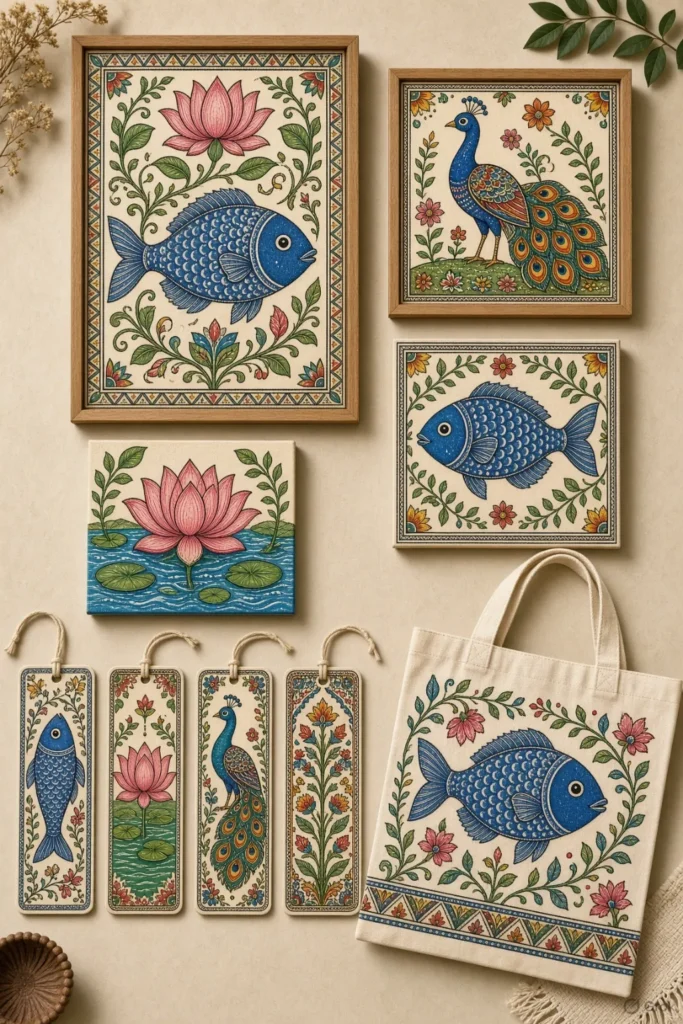
Madhubani fish painting: Draw a long almond shape for the body, a pointed tail and a large round eye with a dot inside. Add a curved line behind the gills and fill the body with rows of scales, small circles or zigzag lines. A pair of fish facing each other makes a balanced composition.
Madhubani lotus painting: Start with a small circle at the centre, then draw pointed petals around it in two or three layers. Fill each petal with a different line pattern, such as dots, short strokes or a small leaf vein. Add a double-line stem and two or three leaves.
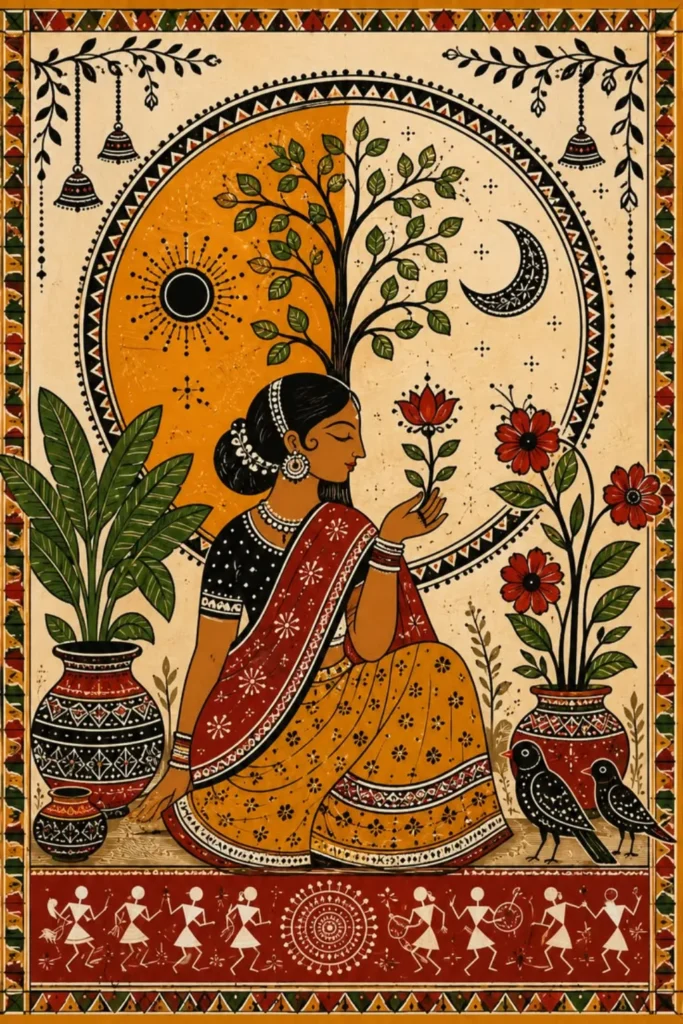
Madhubani sun drawing: Draw a circle with a smaller circle inside, a face if you like, and rays around it as triangles or flame-like curves. A sun with alternating long and short rays looks balanced and is easy to colour in yellow, orange and red.
Easy Madhubani Painting Images and Fish Designs
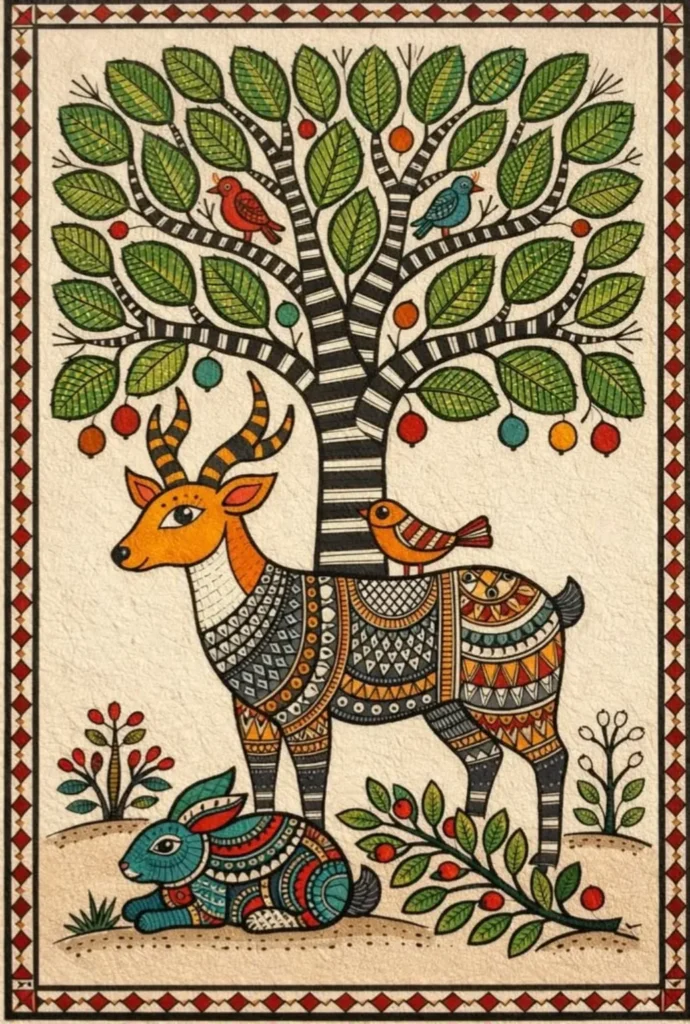
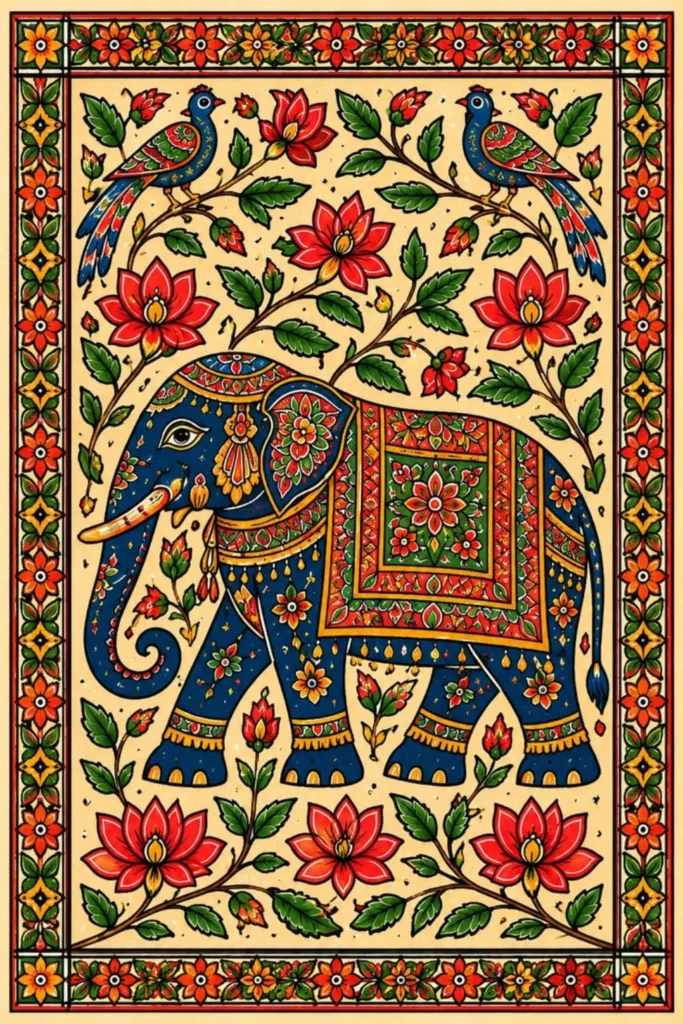
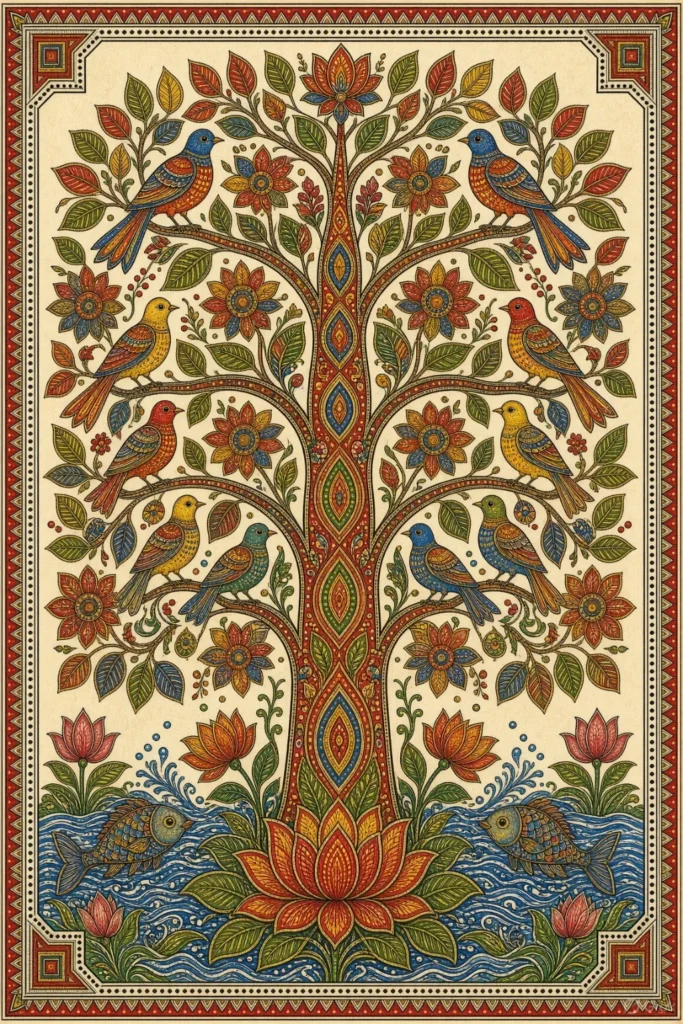
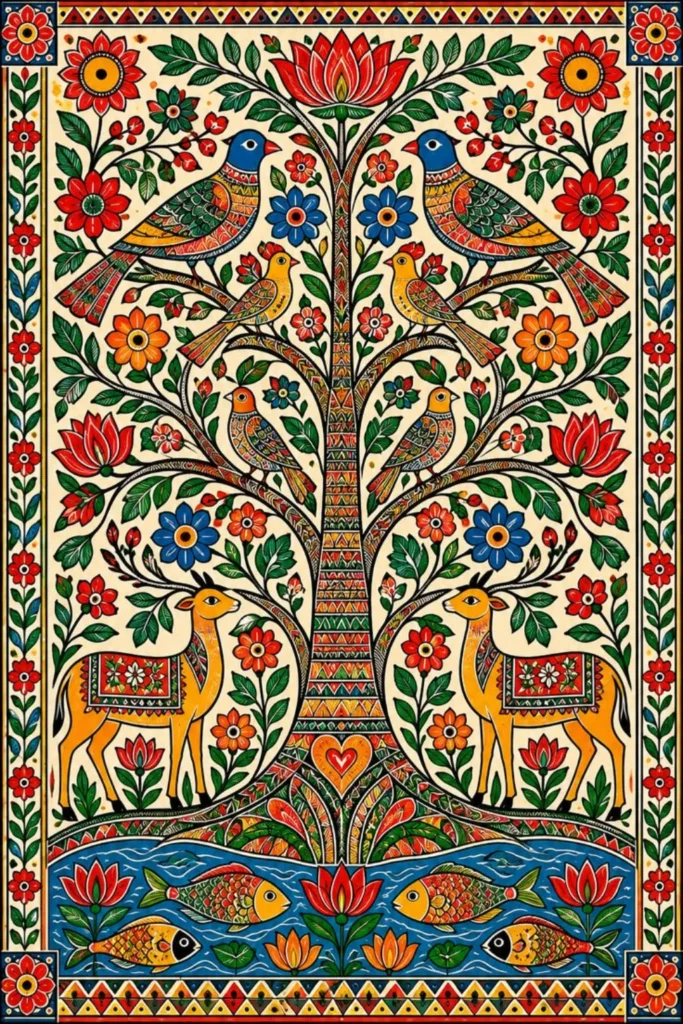
Peacock, Elephant and Tree of Life Designs
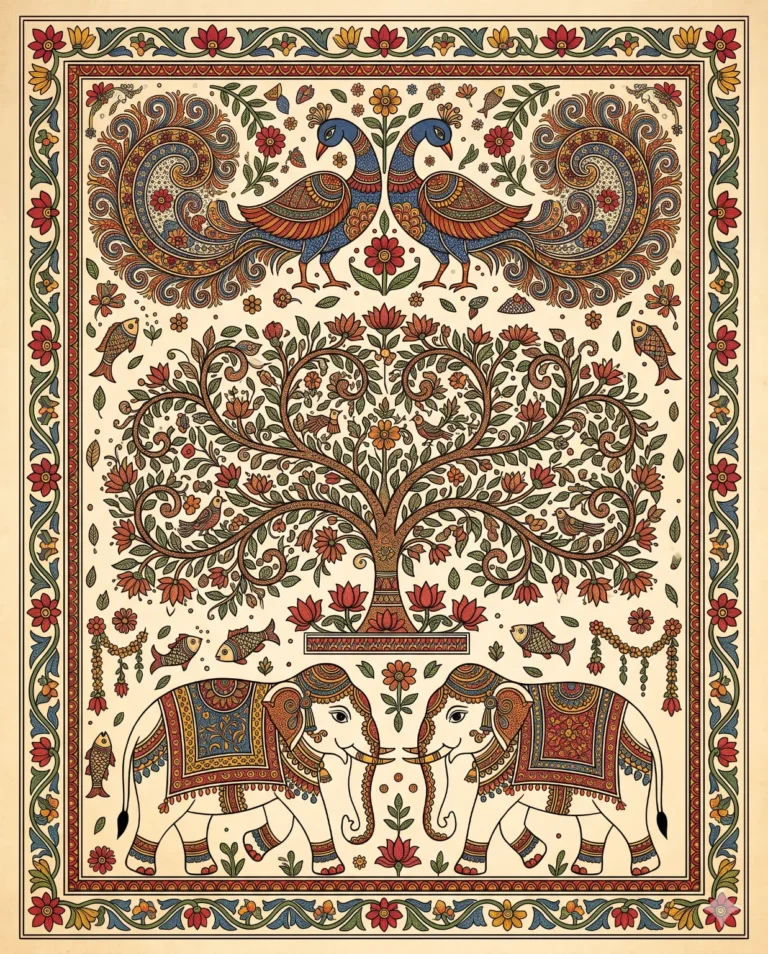
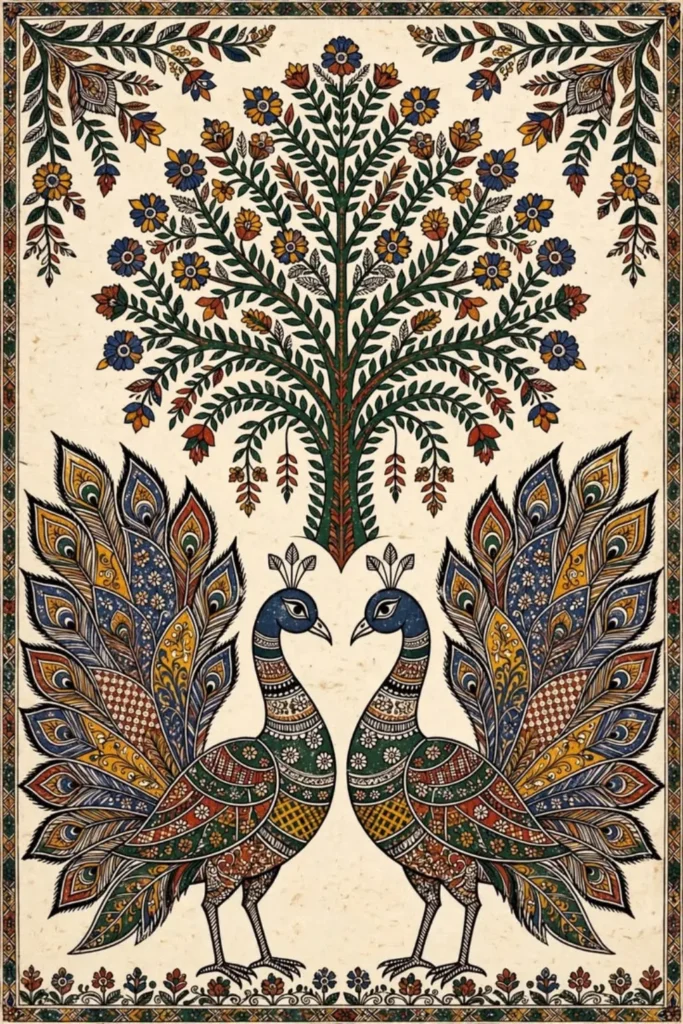
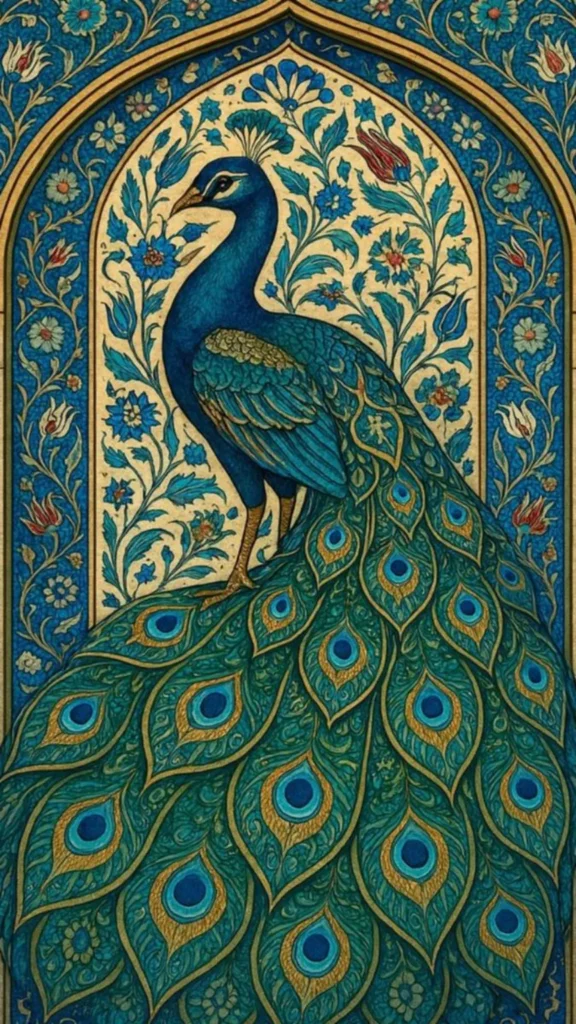
Madhubani peacock painting: Build the body from a teardrop, add a long curved neck, a small crest of three lines and a beak. For the tail, draw a fan of large feathers, each with an eye-shaped centre, and fill the spaces between them with dots and lines. Peacock designs also work well as a bird painting subject for beginners.
Madhubani elephant painting: Use a large rounded body, a curved trunk, a raised ear drawn as a leaf shape, and decorative cloth on the back. Fill the body with floral bands, scale patterns or stripes, and give the legs ankle bands.
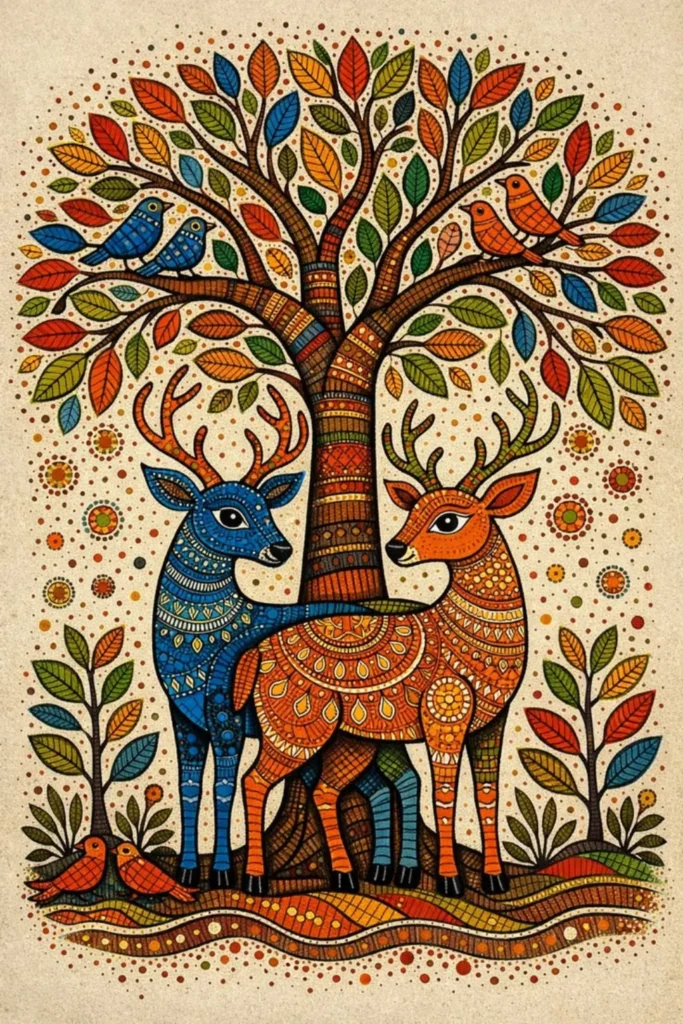
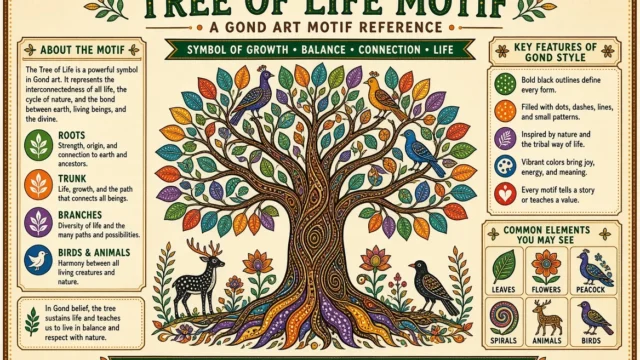
Madhubani tree of life: Draw a strong trunk with branching curves, then fill the branches with leaves, flowers and small birds. Roots can be a simple pattern at the base. The tree is a popular composition because it holds many small motifs and balances well inside a frame. If you want the background on these motifs, our Madhubani motifs chart covers the traditions around them.
Madhubani Peacock Painting, Elephant and Tree of Life Design Gallery
Madhubani Painting Step by Step
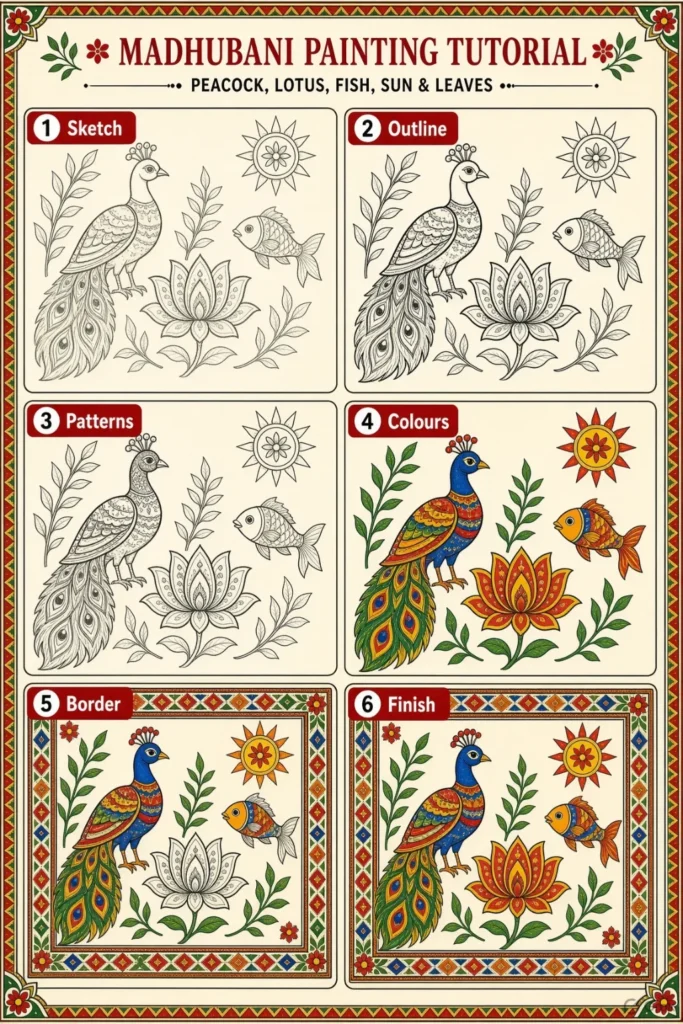
This is the simple routine for an easy Madhubani painting on A4 paper. Work lightly and slowly; the repeated patterns reward patience more than speed.
Drawing Double Outlines and Decorative Patterns
- Plan the page. Mark a margin of about 2 cm with a pencil and draw a rectangular frame. The border will go inside this frame.
- Sketch the main motif lightly. Place one big subject, such as a fish or peacock, in the centre and keep space around it.
- Draw the double line. Trace each outline twice with a small gap between the lines. Many sources describe this double-line outline as a defining feature of Madhubani drawing, and the gap is often filled with hatching or small dashes.
- Fill the inside with patterns. Divide the body into zones and give each zone its own pattern: dots, waves, scales, petals or checks.
- Fill empty spaces. Add small flowers, leaves, birds or fish so that no large blank area is left, as in traditional work.
Filling Colours, Fine Lines and Final Details
- Ink the outlines. Go over the pencil lines with a black pen and let the ink dry completely before painting.
- Erase the pencil. Rub out visible pencil marks gently.
- Fill the colours flat. Paint one colour at a time, keep the layer even and avoid shading. Leave some areas white for contrast.
- Wait for each colour to dry before painting beside it so colours do not bleed.
- Add fine details. Use a fine pen or fine brush for eyes, scale lines and small dots, and strengthen the outline where the colour has covered it.
- Sign and protect. Sign the corner, and for permanent work apply a clear varnish suited to your paint, following the label.
Black and White Madhubani Painting
A black and white Madhubani painting is the best way to learn line control before you worry about colour. It follows the spirit of Kachni, where lines do the work that colour does elsewhere.
Kachni Line Art and Hatching Techniques
Kachni painting relies on fine lines. Three techniques are worth practising: parallel hatching (straight lines close together), cross-hatching (two layers of lines crossing) and stippling (small dots). Between the two lines of a double outline, hatching gives the figure a textured edge. Keep the lines evenly spaced, and turn the page rather than twisting your wrist. Start with a 0.3 mm pen, and use a 0.1 mm pen for the finest detail.
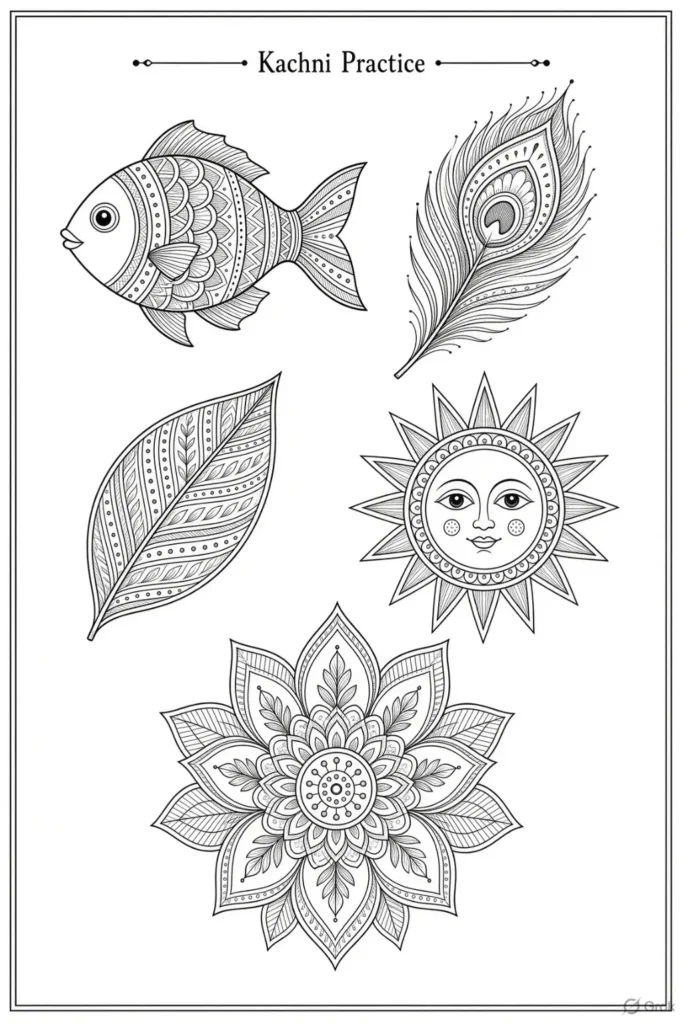
Black and White Outline Practice Designs
A good Madhubani outline drawing exercise is to draw one fish, one lotus and one leaf pattern, and then fill each with a different line pattern. Try a fish with scales as arcs, a lotus with striped petals, and a leaf with a dotted vein. After two or three pages you will notice your lines becoming steadier. When you are happy with the outline, you can trace it onto fresh paper and colour it as a practice for the Bharni style.
Madhubani Border Designs
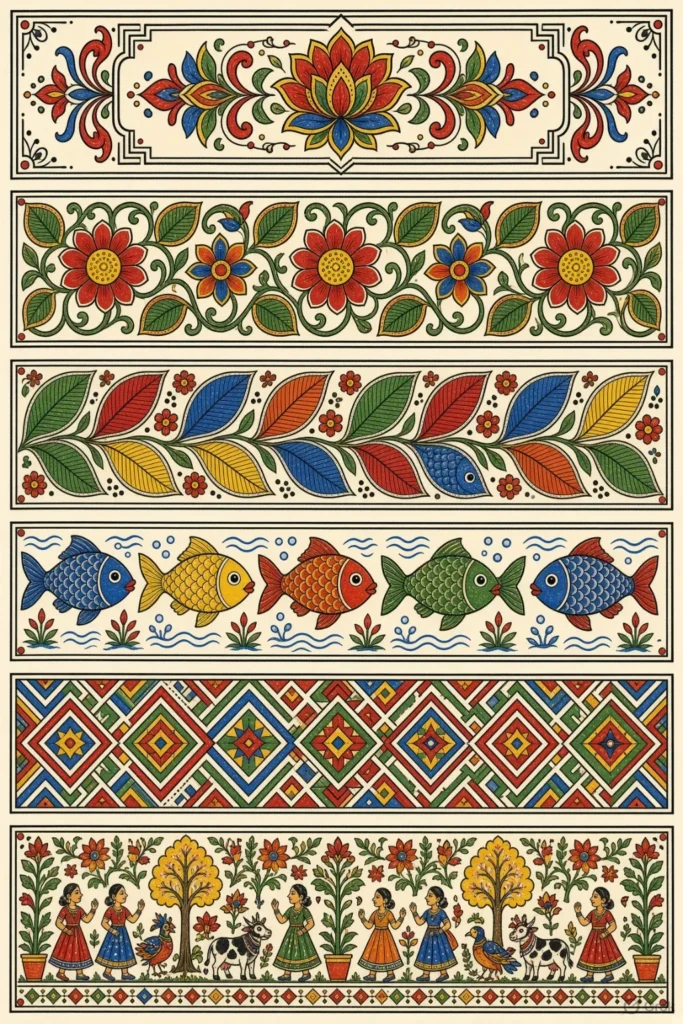
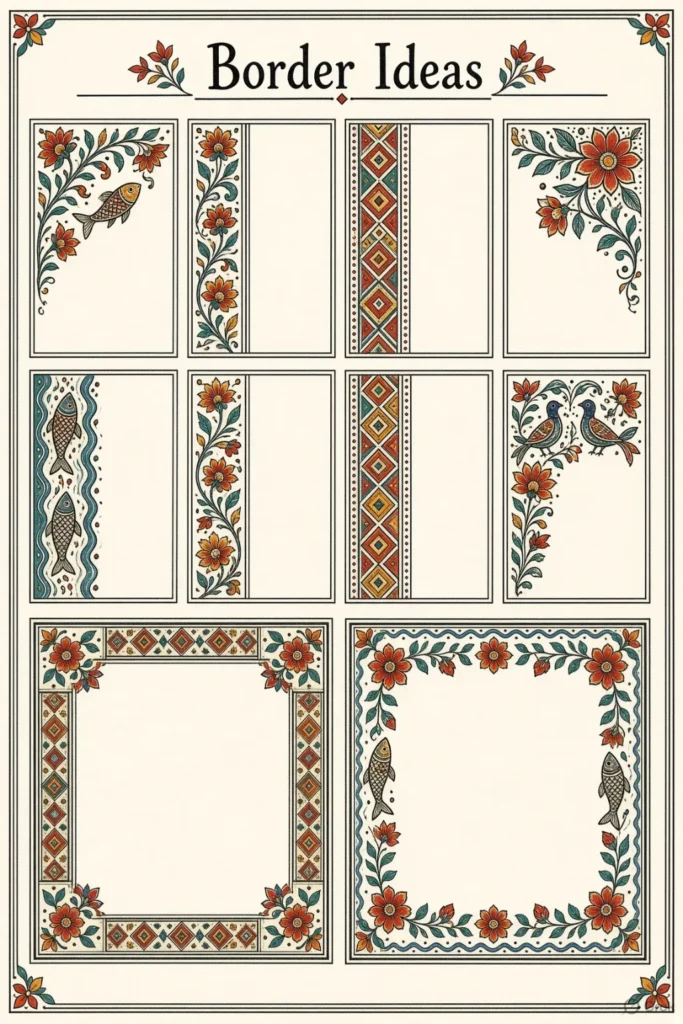
Borders are a signature of Madhubani painting. A double-line frame holds the composition, and the band between the lines is filled with repeating shapes. An easy Madhubani border is a good first project because it needs no complex figures.
Floral, Leaf, Fish and Geometric Borders
| Border type | How to draw it | Best used for |
|---|---|---|
| Floral | Alternate a small flower with two leaves along the band | Frames, bookmarks, cards |
| Leaf pattern | Repeat pointed leaves on both sides of a wavy stem | Notebook pages, tote bags |
| Fish | Small fish facing in one direction, like a procession | Pots, wall frames |
| Geometric | Triangles, diamonds, zigzags and dots in rows | Beginners, saree borders |
Tip: measure the band width first and use a ruler to keep it even. Traditional work often looks hand-drawn and slightly irregular, but evenness helps beginners keep the pattern readable. Madhubani geometric patterns work well in black and white, and Madhubani floral designs shine in colour.
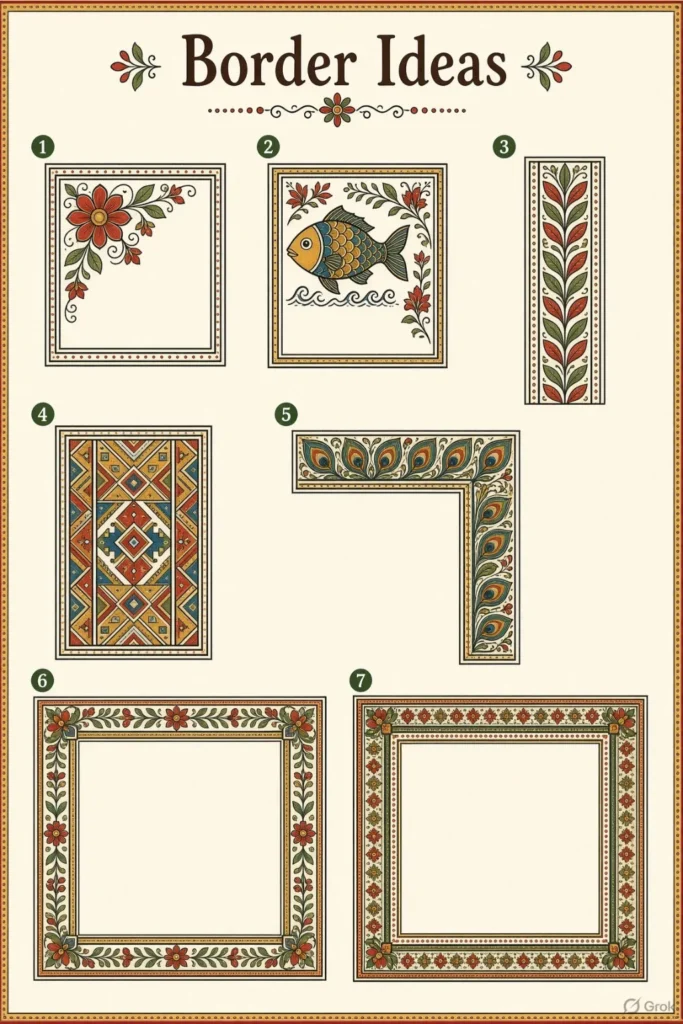
Corner Designs and Notebook Page Borders
A Madhubani corner design makes a frame look finished. Draw a quarter-circle fan or a small flower at each corner, and let the border pattern flow into it. For school notebooks, keep the border narrow, about 1 cm, and use one or two colours so it does not distract from the writing. A Madhubani border for project files can be wider, but leave enough clear space for the title. Draw all four corners the same way, then rotate the page as you work to keep them identical.
Madhubani Painting Colour Combinations
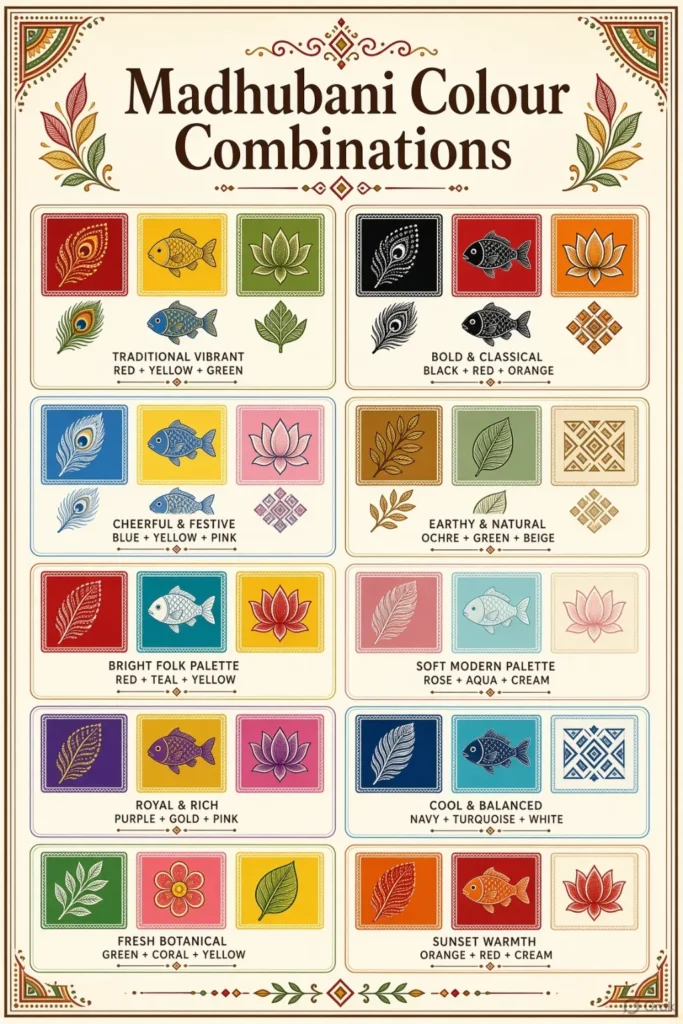
Madhubani colours are flat, bright and bold. A good Madhubani colour combination uses a few main colours, contrasts them with white space and black outlines, and repeats them across the picture so it feels unified.
Traditional Mithila Colour Palettes
Traditional palettes are linked to the natural sources mentioned earlier: yellow from turmeric, blue from indigo, red from clay or flowers, green from leaves, black from soot and white from rice paste. Kachni work is often limited to black and red. If you want to echo these tones with modern paint, choose earthy shades rather than neon ones, and mark your work as inspired by the tradition. Natural colours also look softer, which acrylic can only approximate.
Modern Colour Combinations for Beginners
| Palette | Colours | Works well on |
|---|---|---|
| Classic warm | Yellow, red, black, white | Sun, fish, borders |
| Earthy | Ochre, brick red, olive green, cream | Canvas, wall frames |
| Indigo and white | Deep blue, white, a touch of yellow | Fish, tote bags |
| Peacock | Teal, green, blue, gold | Peacock paintings |
| Bright festive | Orange, pink, green, blue | Pots, school projects |
| Black and red | Black, red, white paper | Kachni practice |
Use no more than five main colours, keep outlines black or dark brown, and test combinations on scrap paper first because acrylic dries slightly darker.
Madhubani Painting for School Projects
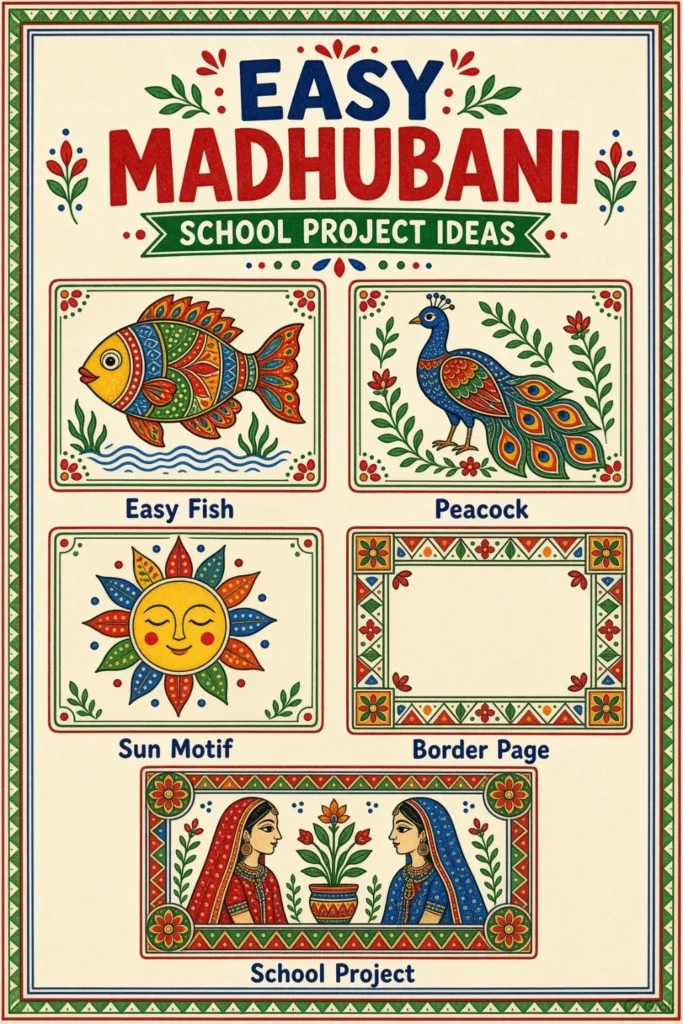
Madhubani painting for kids is a popular school art task because it teaches patience, pattern and cultural awareness. Teachers and parents can use these ideas for a Madhubani painting school project or a Madhubani drawing competition entry.
Easy Drawings for Classes 1–5
- A big fish with scales drawn as circles, coloured with poster colours.
- A sun with triangle rays and a single-line border.
- A lotus with five large petals and a simple leaf border.
- A bird on a branch, with dots and strokes on the wings.
For younger children, pre-draw the main outline in pencil, use thick crayons or markers, and focus on repeating one simple pattern at a time. Short sessions of 20 to 30 minutes work better than a long one.
Detailed Art Projects for Classes 6–8
Older students can attempt a peacock with a patterned tail, a tree of life, or an elephant with a decorated back. Ask them to draw a double-line border, use at least three line patterns, and write two or three lines about Mithila art and its artists on the back of the sheet. For a Madhubani drawing competition, neatness, clear outlines and balanced colours matter more than the number of motifs. Remind students that their work is “Madhubani-inspired” and encourage them to read about Mithila artists. Use a Madhubani practice sheet for warm-up before the final page.
Madhubani Painting on Saree and Fabric
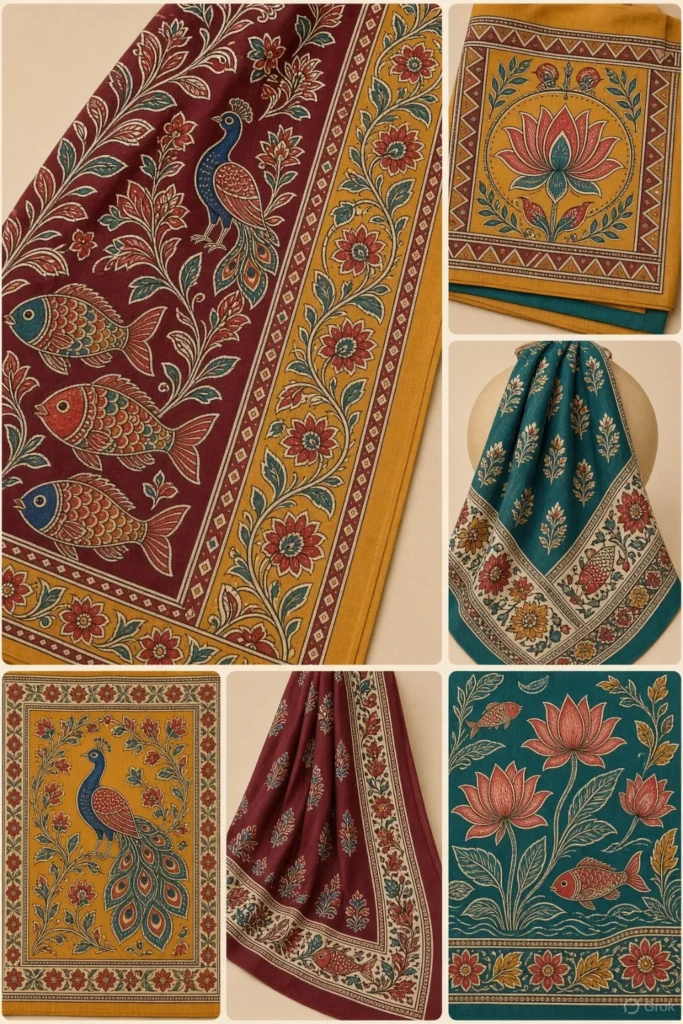
Madhubani painting on a saree, dupatta or bag is a lovely way to wear the art, but fabric needs more preparation than paper. Many Mithila artists also paint on cloth, and hand-painted textiles from the region are widely sold, so if you want a truly traditional piece, buy from an artist or cooperative.
Fabric Preparation, Tracing and Painting
- Choose fabric. Cotton, linen and cotton blends take paint best. Avoid very stretchy fabric.
- Pre-wash and iron the fabric to remove starch and sizing.
- Trace the design. Place the paper pattern under the fabric on a light surface and trace with a pencil or a fabric marker.
- Use fabric paint. Use paint labelled for fabric, or acrylic mixed with a fabric medium as the label instructs.
- Test first. Test on an offcut to check bleeding and stiffness. Place cardboard under the fabric.
- Let it dry, then heat set according to the paint label, usually by ironing on the reverse with a cloth between iron and fabric.
Paint makers such as Golden advise letting the paint dry fully before heat setting or washing, and washing in cold water on a gentle cycle, since hot water can soften acrylic. Their fabric application notes are a useful reference. For silk and delicate sarees, ask a professional painter or use a low-heat method suited to the fabric, and always test.
Saree Pallu, Dupatta, Blouse and Tote Bag Designs
- Saree pallu: A fish or peacock panel in one corner with a narrow geometric border along the edge.
- Dupatta: Repeating small motifs at both ends, such as lotus and leaves.
- Madhubani blouse design: A small motif on the back or sleeve edge, such as a lotus or a pair of fish.
- Tote bag: A large central tree of life or peacock, with a border at the bottom. Canvas totes are easy for beginners.
Madhubani Painting on Pots and Bottles
Madhubani pot painting and bottle painting turn everyday objects into decor. The curved surface suits borders, bands and repeated motifs.
Terracotta Matka and Clay Pot Painting
Clean the pot, let it dry fully, and sand rough spots lightly. Paint a plain base coat in white or cream so the colours stay bright. Draw with a pencil, then use acrylic paints and a fine brush. Fish bands around the neck, a sun on the belly and a leaf border at the rim look good. Finish with a clear sealer sold for outdoor craft use if the pot will sit outside, and follow its drying instructions.
Decorative Glass Bottle and Planter Designs
Wash the bottle and wipe it with rubbing alcohol so the paint grips. Use paints labelled for glass or multi-surface acrylic, apply thin coats and let each dry. A peacock wrapped around the bottle or a tree of life on a planter makes a good gift. Add a varnish for protection.
Safety note: Treat painted pots, bottles and planters as decorative objects. Standard craft acrylic paint and varnish are not certified for food contact, and a non-toxic or ASTM D-4236 label means the product was reviewed for health hazards during normal art use, not that it is safe for food or drink. Do not paint surfaces that touch food or drink, such as the inside of a matka used for drinking water, a mug rim or a plate, unless the paint maker states that the product is food safe. Paint the outside only, keep it away from the rim, and use a pot as a planter or a decor piece. See the Mayco note on decorative-use products for an example of how makers label this.
Madhubani Wall Art and Modern Home Decoration
Canvas, Wall Frames and Handmade Bookmark Ideas
Madhubani wall painting has moved from mud walls to framed paper and canvas, and Madhubani home decor ranges from big statement canvases to small gifts. For a living room, a single tall tree of life on canvas, a pair of fish in matching frames, or a peacock above a console table all work. Use a mat inside the frame so the border breathes. Choose one dominant colour and repeat it in cushions or curtains.
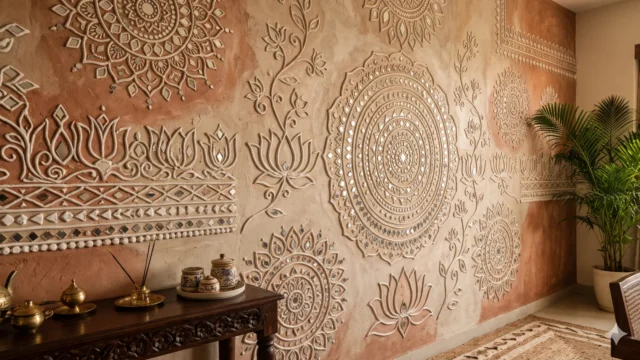
For small gifts, a Madhubani bookmark design is a quick project: cut a strip of thick paper about 5 by 15 cm, draw a double border, add a lotus or fish, colour it, and laminate or seal it. Tote bags, greeting cards and coasters follow the same pattern. If you are making things to sell, say clearly that they are Madhubani-inspired and avoid copying a specific living artist’s composition. If you enjoy decorative craft, our guide to Lippan art designs shows another folk-inspired home decor project.
Contemporary Indian Folk Art Fusion Designs
Printable Madhubani Patterns, Troubleshooting and FAQs
Outline Practice Sheets, Common Mistakes and 8 FAQs
We plan to add original, downloadable Madhubani practice sheets in the future. They are not available yet, so please do not look for a download link on this page. Until then, draw your own outlines using the exercises above: one fish, one lotus, one leaf pattern and a simple border.
View the black and white Madhubani outline practice sheet
| Common mistake | Why it happens | Fix |
|---|---|---|
| Colours bleed | Layer is too wet or paper is thin | Use thicker paper, thinner coats, and let each colour dry |
| Black ink smudges | Ink is not waterproof or not dry | Test pens first and wait before painting |
| Uneven lines | Rushing or hand tension | Draw slowly, rotate the page, use a ruler for borders |
| Design looks empty | Too much white space | Fill gaps with dots, leaves and small flowers |
| Colours look dull | Too many colours mixed | Limit to five colours and add black outlines |
1. What is Madhubani painting?
It is a folk art from the Mithila region of Bihar and Nepal, known for double-line drawing, flat colours and filled patterns.
2. Is Madhubani painting easy for beginners?
Yes, if you begin with simple shapes such as fish, lotus or sun, use a pencil sketch first and practise one pattern at a time.
3. What is the difference between Kachni and Bharni?
Kachni uses fine line work and limited colours. Bharni fills outlined figures with bright colours.
4. What materials do I need?
Paper, a pencil, a fine black pen, small brushes and acrylic or poster colours. Use waterproof ink if you paint over the lines.
5. Are natural colours necessary?
No. Traditional artists used natural pigments, but many modern artists use commercial paints. Natural colours give a distinct soft look.
6. How do I paint Madhubani on fabric?
Pre-wash cotton, trace the design, use fabric paint or acrylic with fabric medium, let it dry fully and heat set as the paint label says.
7. Can I paint a drinking pot or plate?
Do not paint any surface that touches food or drink with ordinary craft paint. Keep painted pots and bottles decorative, and paint the outside only.
8. Can I sell my Madhubani-inspired work?
You can sell your own original work, but describe it as Madhubani-inspired, credit the tradition, and avoid copying any particular artist’s piece.
Final tip: Start with one border, one fish and one lotus on paper, and repeat until your lines feel steady. Then move to fabric, pots or canvas.
Sources and further reading: Wikipedia: Madhubani art; Handicrafts portal: Mithila painting; Google Arts and Culture: Styles of Madhubani art; AIACA Craftkatha: Madhubani; Golden Artist Colors: fabric applications; Mayco: decorative use and AP seal.





















Share Your Opinion
Comments are closed on this post.