 Vista
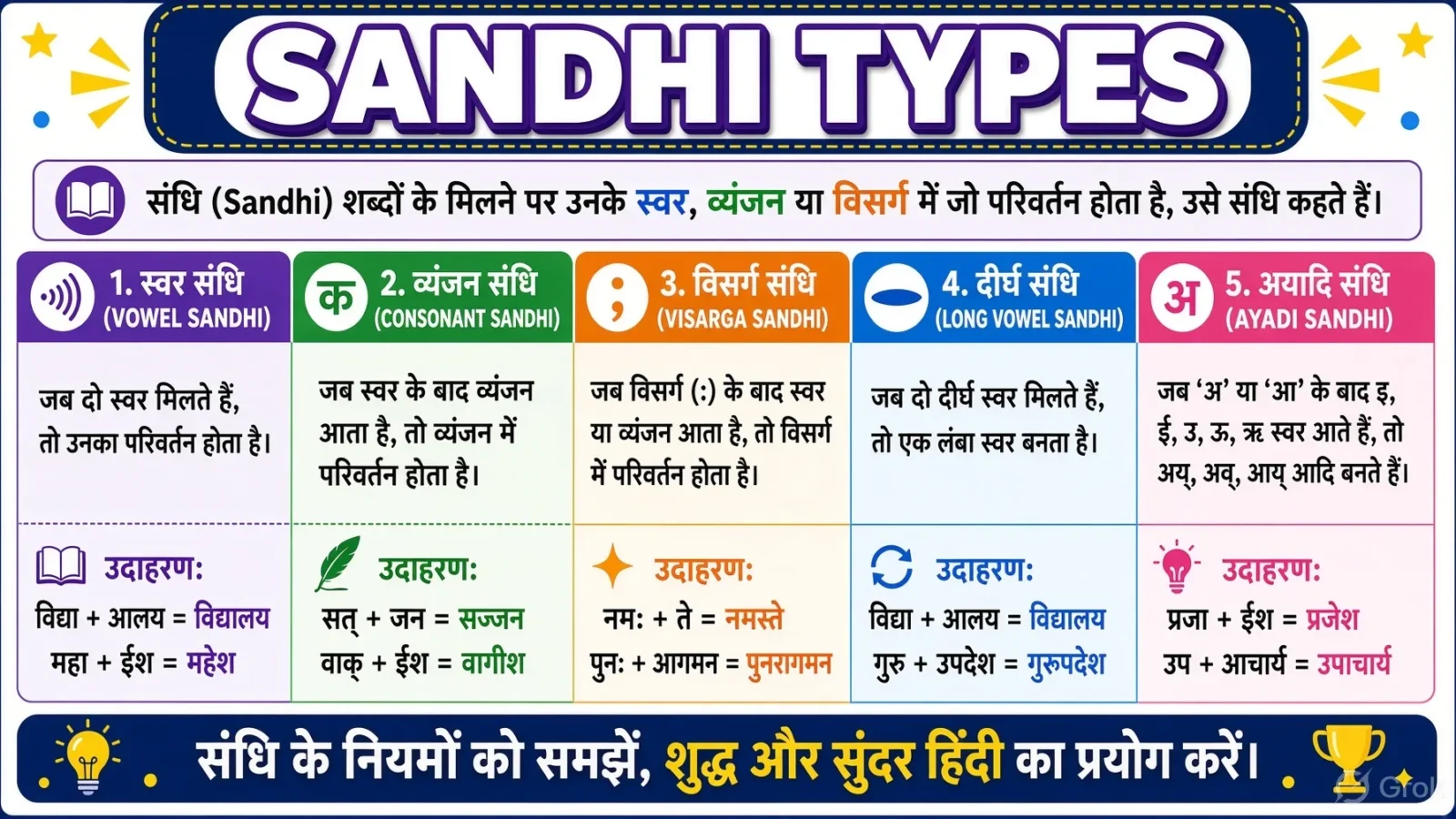
Sandhi is a topic in Hindi grammar that appears in school exams and in teacher recruitment tests. The word means “joining”. When two neighbouring letters or sounds meet and one or both change, the result is called Sandhi. This guide lays out every type with examples in simple tables.
How many types of Sandhi are there?

There are three types: Swar Sandhi (vowel), Vyanjan Sandhi (consonant) and Visarg Sandhi. Swar Sandhi has five sub-types: Dirgha, Guna, Vriddhi, Yan and Ayadi.
The 5 types of Swar Sandhi
| Type | Rule | Examples |
|---|---|---|
| Dirgha | a/aa + a/aa = aa; i/ii + i/ii = ii; u/uu + u/uu = uu | vidya + alay = vidyalay; ravi + indra = ravindra; bhanu + uday = bhanuday |
| Guna | a/aa + i/ii = e; a/aa + u/uu = o; a/aa + ri = ar | gan + ish = ganesh; chandra + uday = chandroday; dev + rishi = devarshi |
| Vriddhi | a/aa + e/ai = ai; a/aa + o/au = au | ek + ek = ekaik; jal + ogh = jalaugh |
| Yan | When i/ii, u/uu or ri is followed by a different vowel, it becomes y, v or r | ati + adhik = atyadhik; su + agat = swagat; pitri + adesh = pitradesh |
| Ayadi | When e, ai, o or au is followed by a vowel, it becomes ay, aay, av or aav | ne + an = nayan; gai + ak = gayak; po + an = pavan; pau + ak = pavak |
Vyanjan Sandhi
When a consonant meets a vowel or another consonant and changes, it is called Vyanjan Sandhi.
| Joined word | Split (Sandhi-vichchhed) |
|---|---|
| diggaj | dik + gaj |
| sajjan | sat + jan |
| ullekh | ut + lekh |
| samyak | sam + yak |
Visarg Sandhi
When a visarg (ः) is followed by a vowel or consonant and the visarg changes, it is called Visarg Sandhi.
| Joined word | Split (Sandhi-vichchhed) |
|---|---|
| manohar | manah + har |
| tapovan | tapah + van |
| nirashray | nih + ashray |
| nishchal | nih + chal |
Easy tips to split words correctly
- Try breaking the word into two parts and see which vowel or consonant changed at the join.
- If the middle contains e, ai, o or au, check for Ayadi or Vriddhi Sandhi.
- If you see y, v or r in the middle, test for Yan Sandhi.
- If a visarg turns into o, r or sh, suspect Visarg Sandhi.
- Learn each example together with its rule rather than memorising lists alone.
Some splits are written slightly differently in different books, so check with your own syllabus grammar book before exams. For more language learning, see our guide to parts of speech in English and the post on direct and indirect speech rules.
Frequently asked questions (FAQ)
What is Sandhi?
It is the change that happens when two neighbouring letters or sounds join.
How many types of Sandhi are there?
Three: Swar, Vyanjan and Visarg Sandhi. Swar Sandhi has five forms.
What is the difference between Sandhi and Sandhi-vichchhed?
Sandhi joins two words or letters, while sandhi-vichchhed splits the joined word back into its parts.
This is general study information. For exams, treat the rules and examples in your board’s textbook as final.
Sources
- Adda247: Sandhi: definition, types and examples
- Tiwari Academy: Class 6, 7 and 8 Hindi Grammar: Sandhi (NCERT based)
- SuccessCDS: Sandhi definition, types and examples
- Anantam IAS: Hindi Sandhi: rules for Swar, Vyanjan and Visarg Sandhi



























Share Your Opinion
Comments are closed on this post.