 Vista
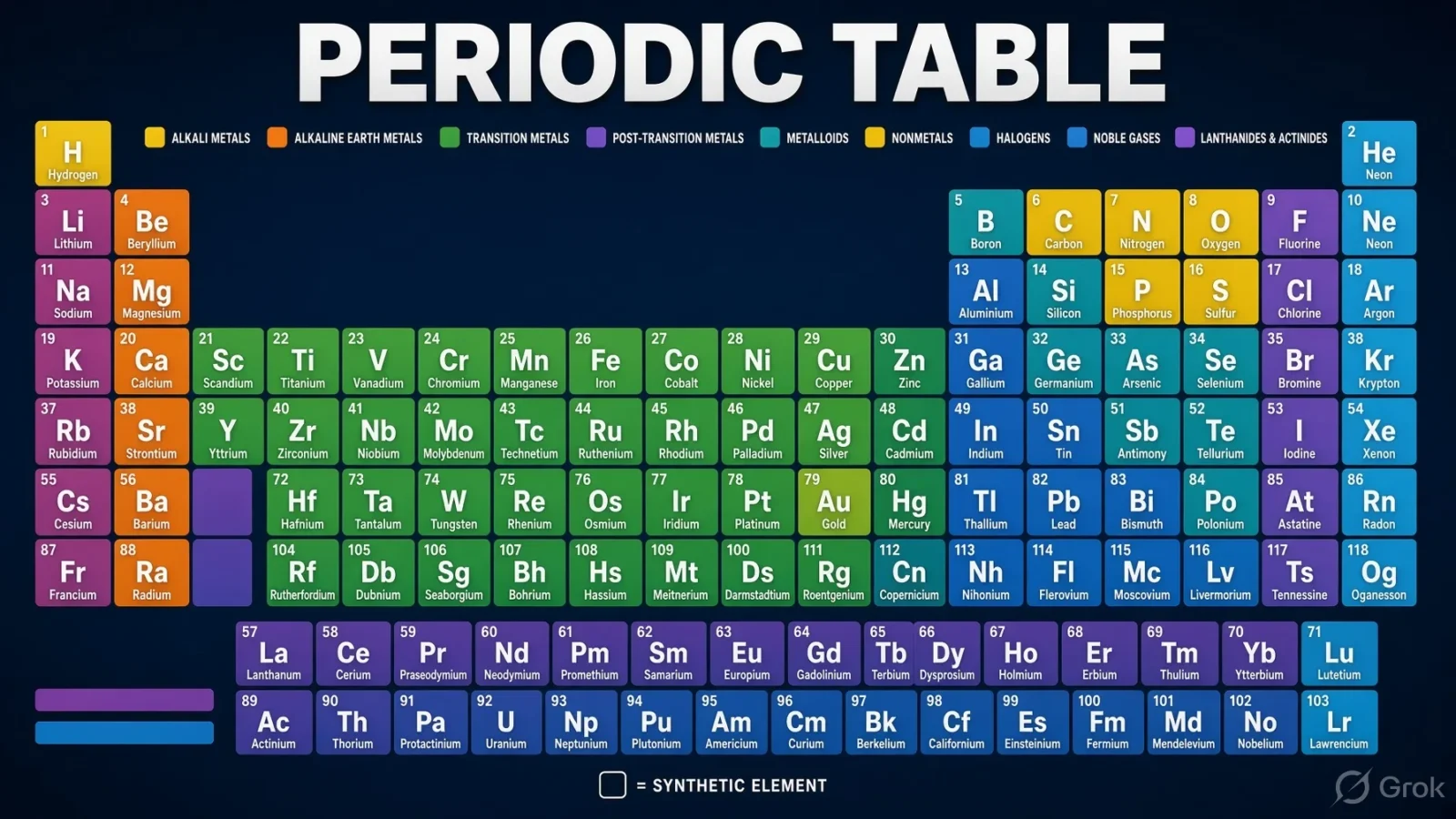
The periodic table arranges every known chemical element by atomic number so that elements with similar properties fall into the same column. It is one of the most useful reference charts in science. This guide explains its layout, the main element families and the first 20 elements in simple language.
How many elements, groups and periods are there?

- Elements: 118 known elements, arranged in increasing atomic number.
- Periods: 7 horizontal rows.
- Groups: 18 vertical columns.
The seventh period is now complete. IUPAC confirmed the discovery of elements 113, 115, 117 and 118 in December 2015 and approved their names and symbols in November 2016: nihonium (Nh), moscovium (Mc), tennessine (Ts) and oganesson (Og).
Main families of the periodic table
| Family | Group | Examples |
|---|---|---|
| Alkali metals | 1 (excluding hydrogen) | Lithium, sodium, potassium |
| Alkaline earth metals | 2 | Beryllium, magnesium, calcium |
| Transition elements | 3 to 12 | Iron, copper, zinc |
| Halogens | 17 | Fluorine, chlorine, bromine |
| Noble gases | 18 | Helium, neon, argon |
The table is also split into s, p, d and f blocks, depending on which sub-shell receives the last electron. The lanthanides and actinides belong to the f block and are usually drawn as two separate rows below the main table.
The first 20 elements: symbol and atomic number
| Atomic number | Symbol | Name |
|---|---|---|
| 1 | H | Hydrogen |
| 2 | He | Helium |
| 3 | Li | Lithium |
| 4 | Be | Beryllium |
| 5 | B | Boron |
| 6 | C | Carbon |
| 7 | N | Nitrogen |
| 8 | O | Oxygen |
| 9 | F | Fluorine |
| 10 | Ne | Neon |
| 11 | Na | Sodium |
| 12 | Mg | Magnesium |
| 13 | Al | Aluminium |
| 14 | Si | Silicon |
| 15 | P | Phosphorus |
| 16 | S | Sulfur |
| 17 | Cl | Chlorine |
| 18 | Ar | Argon |
| 19 | K | Potassium |
| 20 | Ca | Calcium |
Periodic trends in simple words
- Across a period, from left to right, atomic number and outer electrons increase, and metallic character generally decreases.
- Down a group, the number of electron shells increases, so atoms get larger.
- Elements in the same group behave similarly because they have the same number of outer-shell electrons.
Where to get the official periodic table PDF
The most dependable version is published by IUPAC at iupac.org, where the table is offered as a PDF in letter, A4 and A3 sizes and includes atomic weights. Check the date of the latest version, because atomic weights are revised from time to time. For printing, choose A4 or A3 and keep the “actual size” print option so the small text stays sharp.
For more chemistry reading, see our posts on medieval alchemy symbols and electrolysis, electroplating and food adulteration tests. For biology diagrams, read school science labelled diagrams.
Frequently asked questions (FAQ)
How many elements are in the periodic table?
There are 118 known elements, in 7 periods and 18 groups.
What is the difference between a period and a group?
Periods are the horizontal rows (7) and groups are the vertical columns (18).
What is the modern periodic table based on?
It is based on increasing atomic number and the electronic configuration of the elements.
This guide is for study. Always confirm atomic weights against the latest IUPAC table and your own textbook or board syllabus.
Also read: Labelled Diagram of the Human Heart (Class 10): Parts, Chambers, Valves and Blood Flow
Sources
- IUPAC: Periodic Table of Elements, iupac.org
- IUPAC: Earlier versions of the Periodic Table released since 1999, iupac.org
- Particle Data Group (CERN): Periodic Table, 2020 (confirmation and names of elements 113, 115, 117, 118)
- GeeksforGeeks: Periodic Table of Elements
- NIST: Periodic Table version history
























Share Your Opinion
Comments are closed on this post.