 Vista
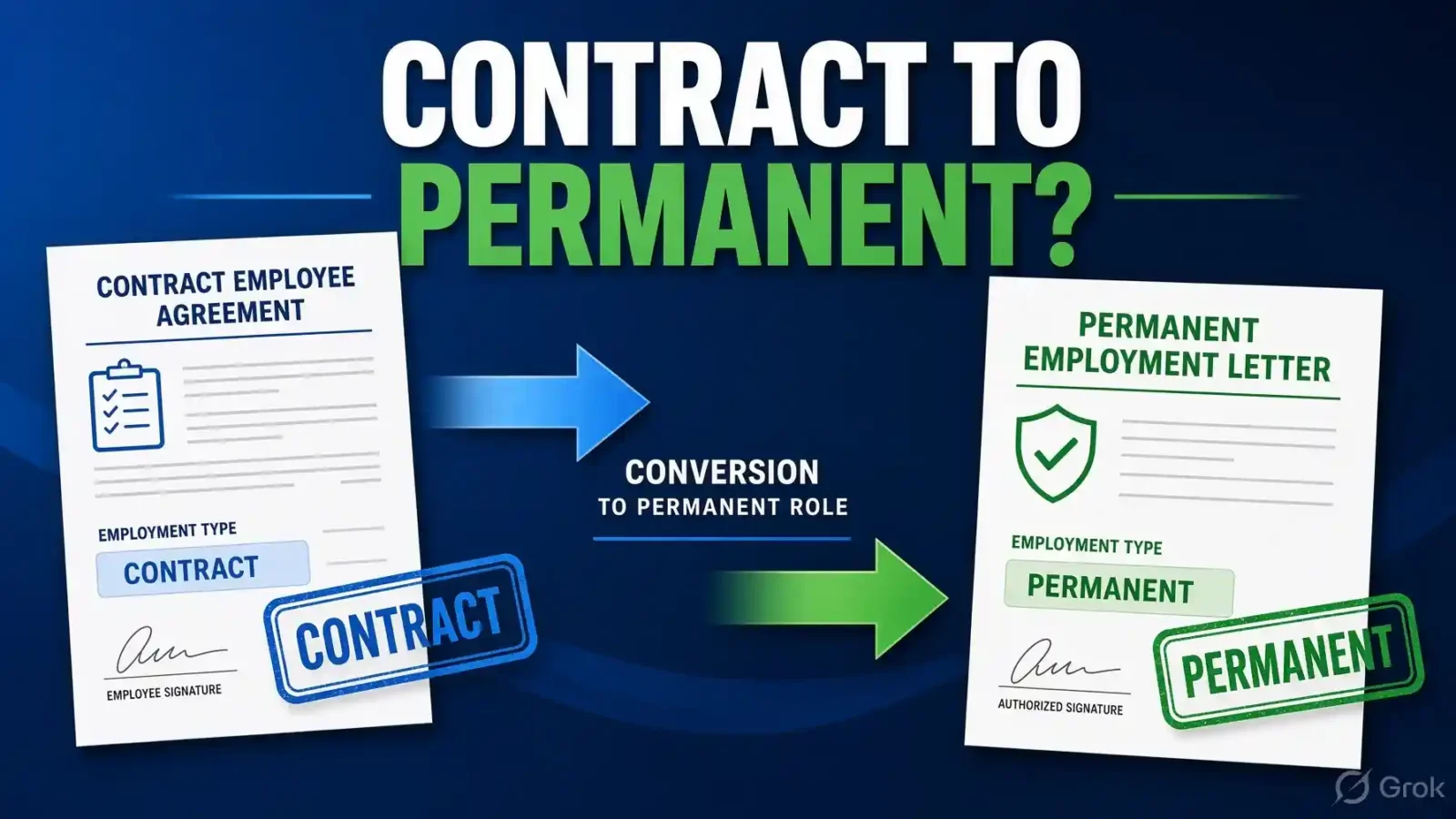
Many people work on contract or through an outsourcing agency for years, doing the same job as permanent staff but without job security, pension or increments. The common question is whether long service makes you permanent automatically. The short answer is no, but courts have given relief in some situations. Here is the position in plain language.
First: Government vs Private Employment
| Point | Government / public bodies | Private company |
|---|---|---|
| Basis of appointment | Recruitment rules and a fair process matter | Appointment letter and company policy |
| Chance of court relief | Limited, in specific situations | Depends on contract terms and law |
| First step | Written representation to the department | Written request to HR, then labour department |
Does 240 Days of Work Make You Permanent?
This is the most common myth. The 240-day figure comes from industrial disputes law and is mainly relevant to matters like retrenchment. In a recent Delhi High Court matter, the argument recorded was that completing 240 days alone does not give a right to regularisation or a post. It can support your case, but it does not make you permanent by itself.
What Is the Umadevi Judgment?
In Secretary, State of Karnataka v. Umadevi (2006), a Constitution Bench of the Supreme Court held that appointments made in violation of recruitment rules cannot be regularised. State governments often cite it to refuse regularisation.
When Have Courts Given Relief?
Over the last few years the Supreme Court has gradually softened its stance. In Jaggo v. Union of India (Supreme Court, 20 December 2024), the court quashed the termination of part-time workers of the Central Water Commission who had served for a decade or more, and directed their regularisation. It held that Umadevi should not be misused against long-serving workers doing permanent work. But the court is also strict about the hiring process. In Madan Singh v. State of Haryana (16 April 2026), it held that regularising ad hoc employees who were never appointed through advertisement or interview is arbitrary. It upheld only Haryana’s earlier, limited notifications, and protected affected employees by letting them continue at the lowest pay scale. So outcomes depend heavily on the facts of each case, especially how you were first appointed.
- The work is permanent and continuing, not a short project.
- You have served for many years without a break.
- You were appointed through a valid process.
- Regular employees do the same work.
Steps You Can Take
1. Collect Your Documents
Keep appointment and contract letters, every renewal, salary slips or bank statements, PF/UAN records, attendance proof and a description of your duties. These show how long and what kind of work you did.
2. Submit a Written Request
Write to the department or HR, state your service period and ask for regularisation. Take an acknowledgement or send it by registered post.
3. Check Your Basic Entitlements
Even if you are not made permanent, timely wages and PF deposits are your right. See our guides on company not paying salary and employer not depositing PF.
4. Take Legal Advice
Regularisation claims go to the High Court or labour court, and the route differs for government and private jobs. Show your papers to a service-law lawyer before acting. If you are asked to leave suddenly, read about notice period rules and try the notice period and gratuity calculator.
Common Mistakes to Avoid
- Relying on verbal promises of “we will make you permanent later”.
- Not keeping records.
- Waiting too long after leaving before raising a claim.
- Paying an agent who promises to get you regularised.
Frequently Asked Questions (FAQ)
Do I become permanent after 10 years of contract work?
Not automatically. The Supreme Court has treated long service as relevant in some cases, but it depends on the facts.
Can the company end my contract when it expires?
Usually as per the contract terms, though repeated renewals for permanent work can be challenged. Read your contract carefully.
Where can an outsourced worker complain?
For wages and PF dues, the labour department and EPFO. For regularisation, the courts.
Do contractual government employees get pension?
Generally not unless regularised. A LiveLaw analysis notes that many long-serving contractual workers are denied pensions, increments and social security.
Disclaimer: This article is general information, not legal advice. Facts differ in every case, so consult a qualified lawyer before taking a decision.
Also read: Salary Slip Explained: Basic, HRA, PF, Gross and Net Salary in Simple Words | New Labour Codes: What Changed in Your Salary? Take-Home, PF, Gratuity and the 50% Basic Rule
Sources
- LiveLaw: Legality Of Regularisation: What Courts Say About Contract Employees (livelaw.in)
- Legal Service India: Regularization of Contractual Employees, Evolving Jurisprudence (legalserviceindia.com)
- Delhi High Court: judgment on 240 days and regularisation (delhihighcourt.nic.in)
- Supreme Court of India: University of Delhi v. Delhi University Contract Employees, 2021 (sci.gov.in)
- SCC Online: The Concept of Regularisation in Service Jurisprudence (scconline.com); Supreme Court of India: Jaggo v. Union of India, 2024 INSC 1034 and Madan Singh v. State of Haryana, 2026 INSC 379 (sci.gov.in)





















Share Your Opinion
Comments are closed on this post.