 Vista

Bhil art painting is a tribal art form of the Bhil community, best known in Madhya Pradesh for its animals, trees and village scenes filled with rows of coloured dots. Bhil art of Madhya Pradesh is strongly linked with Jhabua district, and artists such as Bhuri Bai and Lado Bai made it famous. To try Bhil art drawing easy at home, outline a simple animal or bird, fill it with flat colour, then cover the shape with evenly spaced dots in contrasting colours. The method is gentle enough for kids and beginners, and it also works on fabric, which is why searches such as Bhil art saree are growing.
This guide covers the Bhil art form, its history and meaning, materials, easy drawing, step-by-step dot painting, Bhil art images and designs, borders, kids and school projects, saree and fabric painting, and wall decoration. It also explains how Bhil art differs from Gond art and Pithora painting. One point matters throughout. Every design here is a Bhil-inspired practice exercise, not a work by a Bhil artist. We encourage you to learn from original artists, credit them and buy from them directly. For a related ritual tradition, see our Pithora painting motifs chart.
Contents
- What Is Bhil Art? History and Origin
- Bhil Art Form, Cultural Meaning and Famous Artists
- Bhil Painting Materials and Colour Kit
- Easy Bhil Art Drawing for Beginners
- How to Draw Bhil Art Step by Step
- Bhil Art Images and Painting Designs
- Bhil Art Village Life and Cultural Storytelling
- Bhil Art Dot Patterns, Borders and Colour Combinations
- Bhil Art for Kids and School Projects
- Bhil Art Saree and Fabric Painting
- Bhil Art Wall Painting and Modern Home Decor
- Bhil vs Gond Art, Drawing Practice and FAQs
What Is Bhil Art? History and Origin
Bhil art, also called Bhil painting or Bhil tribal art, comes from the Bhils, one of the largest tribal communities in India. The Bhils live across Madhya Pradesh, Gujarat, Rajasthan, Maharashtra, Chhattisgarh and parts of other states, so the community and its culture are not limited to one place. Memeraki notes that Bhil painting is often built from large, simple forms filled with dots, and that the simple forms are a deliberate stylistic choice rather than a lack of skill. Some writers consider Bhil art among the oldest of India’s tribal art forms, and some compare its multi-coloured dot in-filling to Aboriginal art of Australia. Treat such comparisons as opinion; no exact start date is settled, so we do not give one.
Bhil Art of Madhya Pradesh
Bhil art of Madhya Pradesh is the version most people meet in galleries and museums. IGNCA describes the rich cultural tradition of the Bhils of Madhya Pradesh as shown in their rituals, songs and dances, community deities, tattoos, myths and lore. Wikipedia lists Dhar, Jhabua, Khargone and Ratlam among districts where Bhils live. Bhil artists from Jhabua, with Bhuri Bai among the first, moved from painting on house walls to painting on paper and canvas, and the dot-filled style became recognised across India. The Bhil art form continues to be taught within families and community workshops.

Jhabua, Alirajpur and Wider Bhil Cultural Regions
Jhabua is the district most often named in the story of Bhil painting. Bhuri Bai was born in Pitol village of Jhabua, and Lado Bai in Badi Bawadi village, also in Jhabua. Alirajpur, a neighbouring tribal district, is also Bhil country, and many searches mention Jhabua and Alirajpur tribal painting together. Beyond Madhya Pradesh, Bhil communities in Gujarat, Rajasthan and Maharashtra have their own customs, so a single description will not fit every Bhil artwork. When you write about Bhil art in a school project, say “Bhil art of Madhya Pradesh” rather than suggesting that Bhil art belongs to one state alone.
Bhil Art Form, Cultural Meaning and Famous Artists
The Cultural Significance of Dots and Storytelling
Dots are the visual signature of the Bhil art form. They fill the bodies of animals and birds, texture the ground and create rhythm across the picture. The art also tells stories: animals, forest life, festivals, deities and everyday village scenes. Writers on Bhil art describe the artists’ themes as drawn from mythology and folklore. A cautious reading is best here. Different artists use dots and colours in different ways, and we do not assign one universal meaning to every dot or colour. If you want to know what a particular painting means, read what the artist or the museum says about it.
Bhuri Bai, Lado Bai and Other Bhil Artists
Bhuri Bai, born in Pitol village in Jhabua, is widely regarded as a pioneer. She was proficient in making Pithora paintings, and Wikipedia records her as the first Bhil artist to use readymade colours and paper. According to Memeraki, she stepped outside the ritual conventions of Pithora and began painting in uniform dots on the mud walls of her family home. Her honours include the Madhya Pradesh Government’s Shikhar Samman (1986) and the Padma Shri (2021).
Lado Bai, from Badi Bawadi village in Jhabua, started working alongside Bhuri Bai. Her paintings are known for their formal simplicity, heightened by her use of dots, and she has exhibited in India, France and the UK. Other Bhil artists named in these sources include Gangu Bai Amliya, Sher Singh, Ram Singh and Dubu Bariya. Their personal styles differ, so avoid tracing their pictures. Look at their rhythm, spacing and use of colour, then design your own animals and patterns. If you buy, buy from the artists or from shops that name them.
Bhil Painting Materials and Colour Kit
Traditional Wall Painting and Natural Materials
Bhil painting began on the mud walls of village homes. The artists described in these sources painted on mud walls before moving to paper. We do not give recipes for traditional wall preparation or natural pigments here, because methods vary by family and region and should be learnt from artists. If you want authentic detail, see IGNCA’s materials on Bhil artists and museum collections.
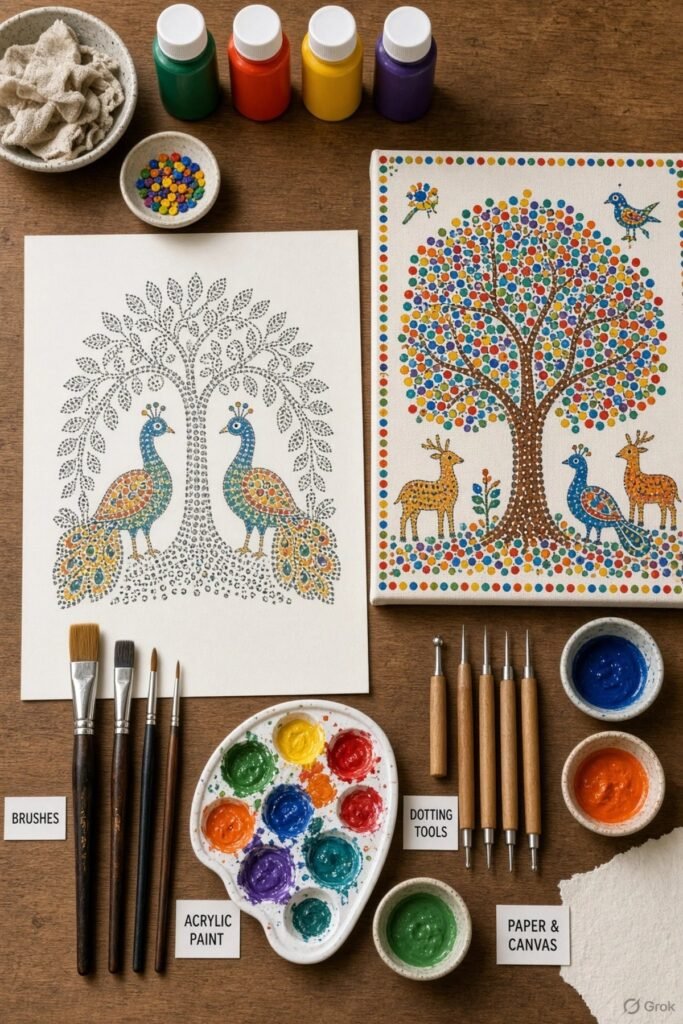
Modern Acrylic Paint, Brushes, Dotting Tools and Canvas
- Surface: thick drawing paper, cartridge paper, a primed canvas board or a small canvas. Coloured paper also works.
- Colours: acrylic or poster colours in red, yellow, blue, green, orange, white and black. Opaque colours show dots better.
- Brushes: a flat brush for background and a fine round brush for details.
- Dotting tools: ear buds, toothpicks, matchsticks, the back of a brush or a dotting tool set with different tips.
- Outline and guides: pencil, eraser, ruler and a fine liner if you want an outline.
- Extras: palette, water jar and tissue.
Check that colours are labelled non-toxic and age-appropriate when children use them. A readymade Bhil painting kit may include a printed outline and paints, which is a convenient start.
Easy Bhil Art Drawing for Beginners
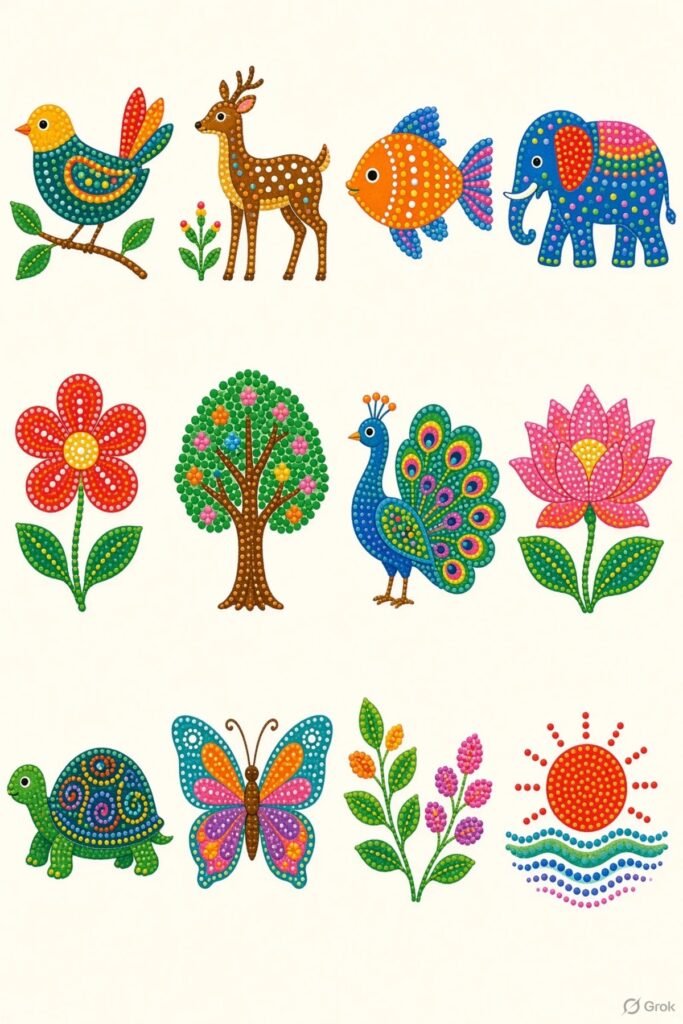
Bhil art easy drawing uses large, simple forms. Do not worry about realism; Bhil animals are deliberately rounded and bold.
Basic Animal, Bird and Human Outlines
- Animal: an oval body, four thick legs, a rounded head, a small tail. For a deer add antlers as simple branching lines.
- Bird: an oval body, a round head, a short beak, a fan tail and two thin legs. For a Bhil art peacock make the tail large and fan-shaped.
- Human figure: a rounded head, a long simple body, two arms and two legs, in a dancing or standing pose. Keep it simple and slightly stylised.
Practise each outline on rough paper until you can draw it without stopping. Keep the shapes large so there is room for dots.
Easy Dot Patterns and Colour Filling Techniques
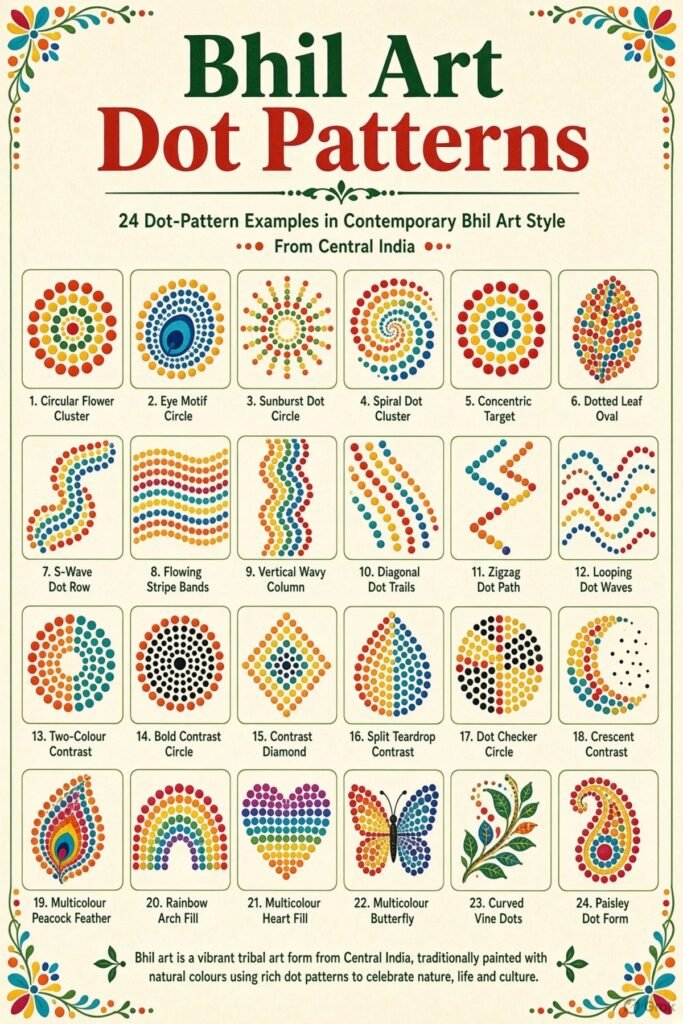
Dots are the heart of Bhil dot painting. Practise these on scrap paper first:
- Row dots: dots in even horizontal rows, like a grid.
- Offset rows: each row shifted by half a dot, so dots sit between the dots above.
- Ring dots: small dots circling a larger central dot.
- Outline dots: a single line of dots following the edge of a shape.
For colour filling, paint the shape with one flat colour and let it dry. Then dot with a contrasting colour: white or yellow on blue, red on green, and black on orange. Use the same dot size within one area, and change size or colour between areas. A steady hand matters less than even pressure and re-dipping the tool each time.
How to Draw Bhil Art Step by Step
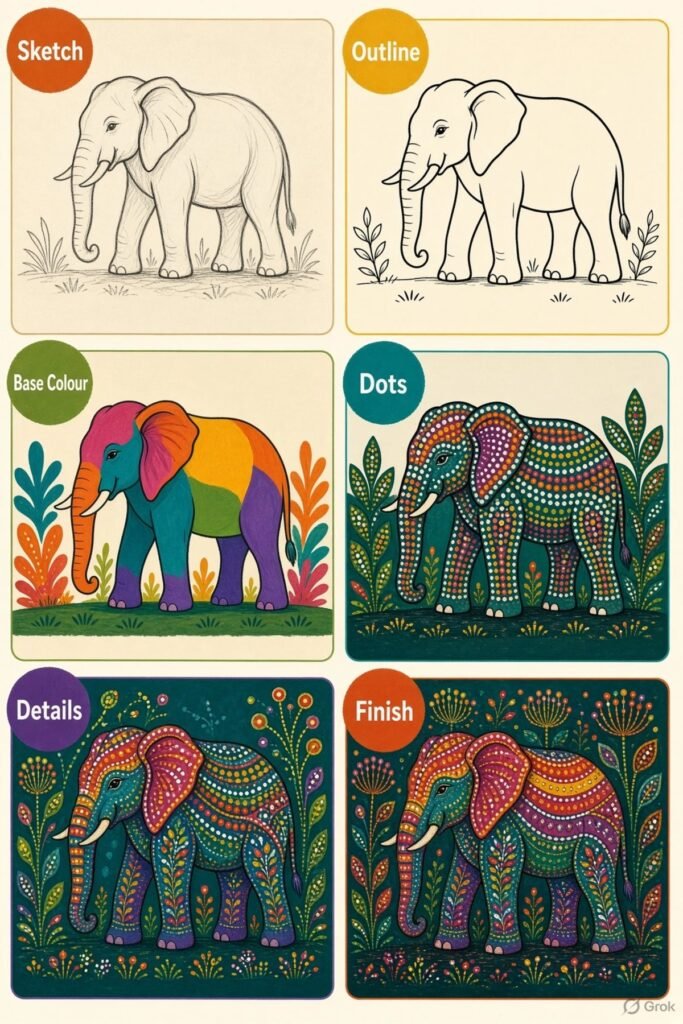
Follow this Bhil painting step by step method to finish a deer-and-tree painting.
Sketching and Filling the Main Colours
- Plan. Place one large animal in the centre of an A4 sheet. Add a tree on one side and a bird or two above.
- Light sketch. Draw the shapes in pencil, large and rounded, pressing lightly.
- Background. Paint the page a solid colour, or leave it white if you prefer a clean look. Let it dry fully.
- Main colours. Fill the animal, tree and birds with flat colour, using a different colour for each. Let each dry before painting next to it.

Applying Dots, Decorative Details and Finishing
- Dot the animal. Cover the body with evenly spaced dots in a contrasting colour. Keep the dot size the same within the body.
- Dot the tree and ground. Use different colours, sizes or spacing so the tree reads apart from the animal.
- Add details. Add eyes, small leaves, flowers and a few lines for grass.
- Finish. Fill leftover gaps with tiny dots, outline shapes if you want a firmer look, and erase pencil marks once dry.
Your first picture may look uneven. That is normal. Dot rhythm comes with repetition, so redo the same animal on a fresh page with a different colour scheme.
Bhil Art Images and Painting Designs
When people search for Bhil art images, they usually want ideas for subjects and colours. Use the ideas below to design your own picture instead of copying someone’s painting.
Deer, Peacock, Elephant, Fish and Animal Designs
| Subject | Simple shape | Dot idea |
|---|---|---|
| Bhil deer painting | Oval body, thick legs, branching antlers | Offset rows in white on a red body |
| Bhil art peacock | Oval body, long neck, big fan tail | Ring dots on each tail feather |
| Bhil elephant painting | Large rounded body, curved trunk | Dots in bands along the body |
| Bhil fish painting | Long oval, triangle tail | Dots in rows following the body |
| Bhil animal designs | Horse, bull, tiger, rabbit as bold ovals | Different colour per animal |
Mix two or three animals on one page and connect them with trees and dots on the ground. Vary sizes so the page does not feel repetitive.


Trees, Birds, Forests and Nature-Inspired Paintings
A Bhil tree painting starts with a wide trunk and rounded branches. Fill the crown with dots, add birds on the branches and place small animals below. For a Bhil forest painting, group several trees of different heights, add a deer and a bird, and fill the ground with rows of dots. A Bhil nature art composition can also include a sun, moon, river and hills drawn with large simple shapes. Use one dominant colour per area so the dots stand out. Avoid assigning symbolic meanings to your own invented patterns; describe them as decorative.

Bhil Art Village Life and Cultural Storytelling
Farming, Music, Festivals and Community Life
Bhil art often draws on the life of the community: forest, animals, farming, huts, songs and dance. IGNCA mentions the songs and dances of Bhil communities and notes that Ghoomar is a traditional dance associated with Bhil women, according to Wikipedia. A Bhil village painting might show huts with sloping roofs, a tree, people carrying pots, cattle and a few birds. For a harvest scene, draw a field as a block of coloured dots and add figures bending in rows. For a festival scene, add drums, dancers in a circle and decorated huts. Use simple human shapes and leave the details to dots and colour.

Traditional Stories and Contemporary Visual Interpretations
Traditional stories belong to the Bhil community, and some, such as the Pithora tradition, are sacred ritual narratives. IGNCA records that among the Bhils of Jhabua, Pithora painting is a ritual held in great esteem, and that Pithora wall paintings depict the Bhil creation myth. Please do not copy or alter ritual compositions as casual decoration. Contemporary interpretations, such as dot paintings of animals and village life on paper or canvas, are a different thing: they are the work of living artists, like Bhuri Bai, who adapted the tradition for new surfaces. Your own practice pieces should say “Bhil-inspired” and credit the tradition. Never label an AI-made or student-made picture as an authentic tribal painting.
Bhil Art Dot Patterns, Borders and Colour Combinations
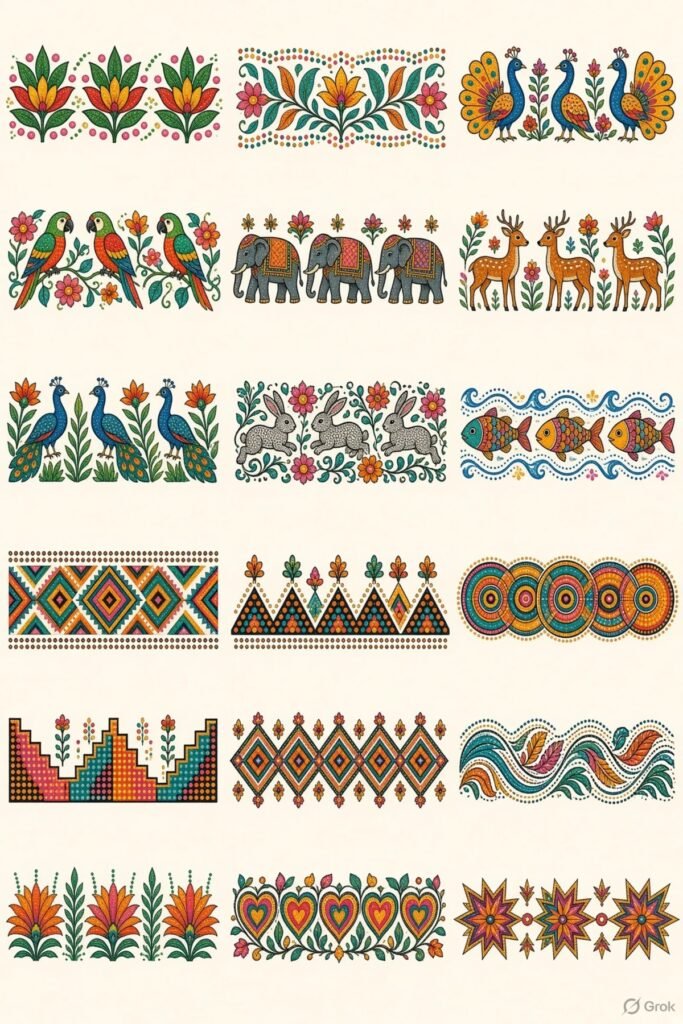
Easy Repeating Dot Patterns and Border Designs
| Border | How to draw | Good for |
|---|---|---|
| Single dot line | One row of equal dots | Notebook edges |
| Double dot row | Two rows, the second offset by half a dot | Project files |
| Big and small | A large dot, then two small dots, repeated | Cards |
| Dotted zigzag | Dots placed along a zigzag line | Saree and dupatta edges |
| Animal row | Small deer or birds in a line, each dotted | Wall frieze |
Draw two light guide lines and mark equal spaces with a ruler. Place a dot at each mark. For a Bhil art border design on fabric, press lightly with a chalk pencil first. The spacing rule is simple: the gap between dots should be about the width of one dot.
Traditional-Inspired and Modern Colour Palettes
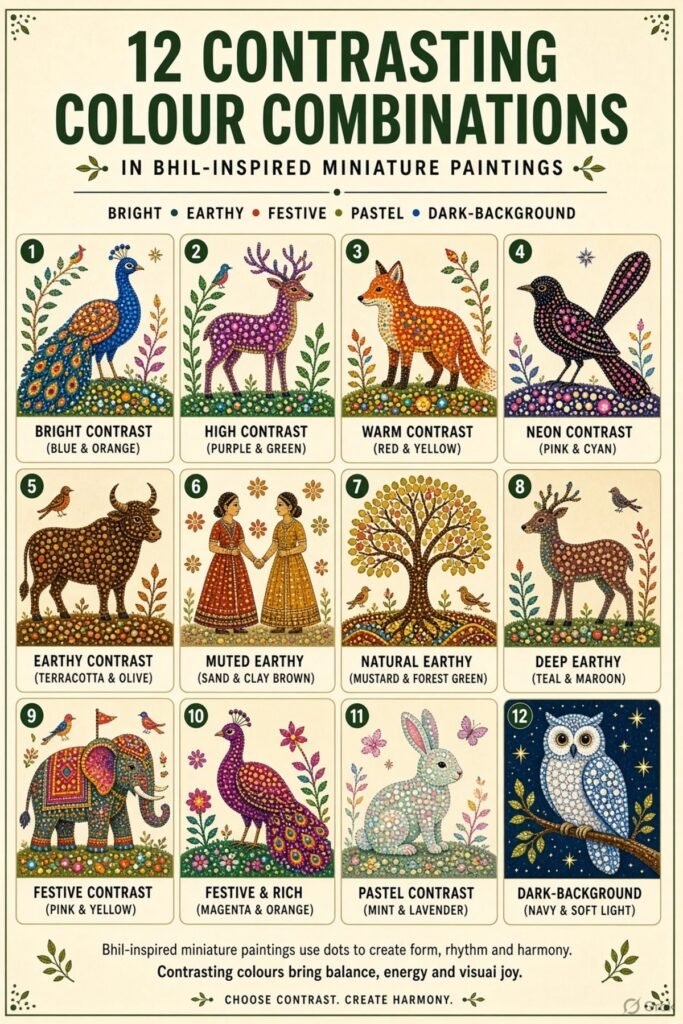
Bhil painting is colourful, but no single colour rule fits every artist. These palettes are design suggestions for Bhil-inspired work:
| Palette | Colours | Mood |
|---|---|---|
| Earth | Brown, ochre, rust, cream dots | Traditional-inspired |
| Festival | Red, yellow, orange, pink, white dots | Bright and lively |
| Forest | Deep green, teal, yellow, white dots | Fresh and natural |
| Night | Navy background, yellow and white dots | Modern |
| Mono | Black on white or white on black | Bold, graphic |
Use a background and three or four main colours. Choose dots that contrast clearly with the shape they sit on. Treat the table as practical advice and not as a statement of how traditional artists choose colours.
Bhil Art for Kids and School Projects
Bhil art for kids is a good match for dot play. Children can fill big shapes with coloured dots using ear buds or fingertip-safe paint, which builds control and colour sense.
Simple Bhil Dot Painting for Young Children
- Give a large printed or drawn animal outline, such as a bird or fish.
- Let children colour it in flat colour with crayon or paint.
- Ask them to cover it with dots in a different colour using ear buds.
- Praise effort, and keep sessions around 30 minutes.
School Charts, Creative Projects and Practice Ideas
For a Bhil art school project, students can make a chart with a short note on the Bhil community, Jhabua, and artists such as Bhuri Bai and Lado Bai, plus one original dot painting. For older classes, ask for a comparison with another folk art, for example a drawing in the style of our Warli art guide and a short paragraph on how Bhil art differs. Practice ideas: a page of dot patterns, a page of animal outlines, and one small final painting. A practice sheet of nine dot patterns helps before the final page. We plan to offer original downloadable sheets later; they are not available yet.

Bhil Art Saree and Fabric Painting
Bhil art saree is one of the most searched phrases for this art form. An honest note first. The documented Bhil tradition in our sources is wall painting and, later, painting on paper and canvas. Bhil-inspired sarees, dupattas and kurtis are contemporary textile adaptations made by designers and hobby painters, and we do not claim they are a documented traditional practice. If you want authentic work, buy from Bhil artists or from shops that name them.
Bhil-Inspired Saree Pallu and Border Designs
For a Bhil painting saree, keep the design simple and balanced. Common layouts are:
- Pallu: one large animal or tree, such as a deer or peacock, filled with dots.
- Border: a band of dotted zigzag, small animals or a double dot row along the edge.
- Body: sparse, scattered dot clusters or tiny birds spaced evenly so the saree still drapes well.
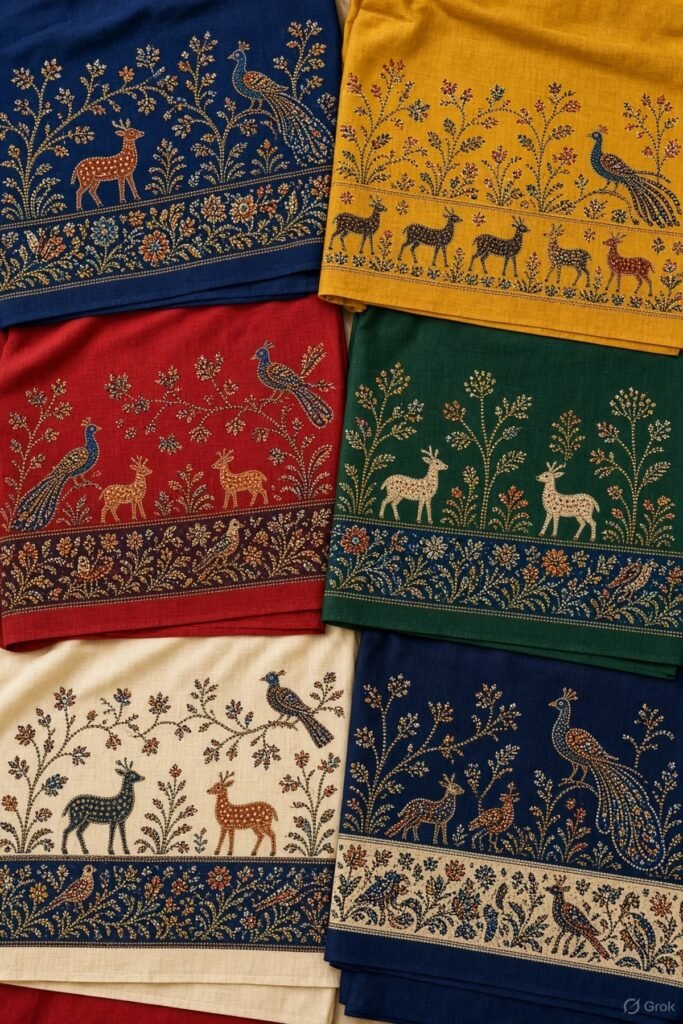
Bhil art saree designs look best on plain, medium or dark cotton, linen, cotton silk or chanderi-type fabric with a soft finish. Use fewer colours on fabric than on paper. Contrast matters: white and yellow on deep blue, maroon or black, or dark green on cream.
Dupatta, Kurti, Blouse, Tote Bag and Fabric Painting
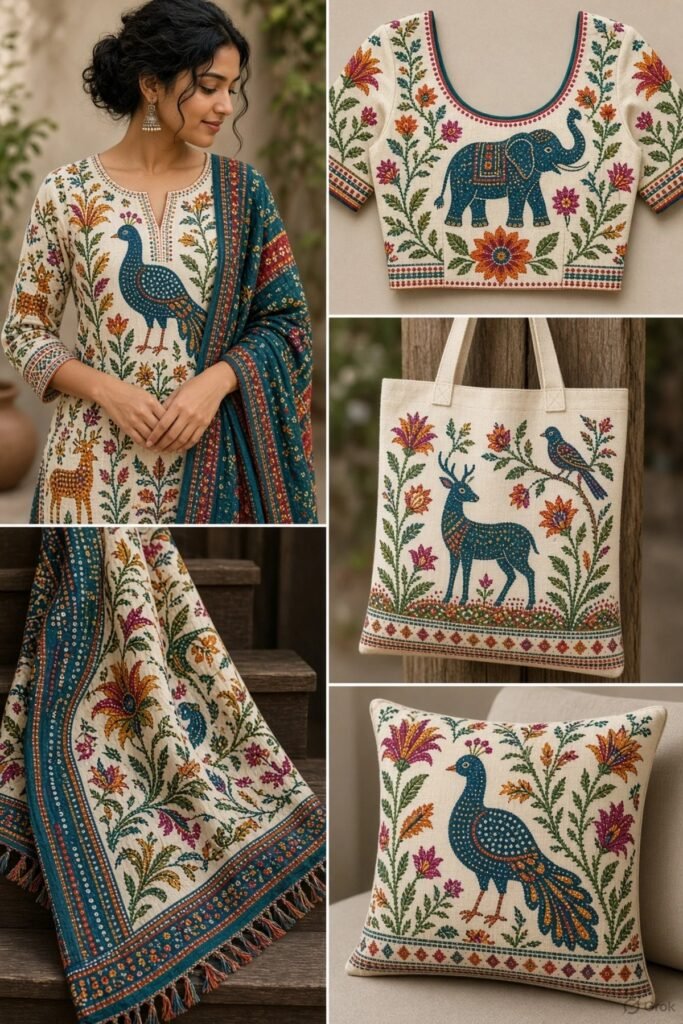
Follow this method for Bhil fabric painting on a dupatta, kurti, blouse or tote bag:
- Prepare the fabric. Wash and iron it to remove starch and sizing. Do not use fabric softener.
- Fix the cloth flat. Tape or pin it over a clean board with a sheet of paper under it so paint does not bleed through.
- Draw lightly. Use a chalk pencil or washable fabric marker. Draw only the main shapes.
- Use suitable colours. Choose fabric paints, or acrylic mixed with a fabric medium as the label directs. Plain craft acrylic can feel stiff and may crack.
- Fill and dot. Fill larger shapes first, let them dry, then add dots with an ear bud, a dotting tool or the back of a brush. Use the same pressure each time.
- Dot spacing. Keep the gap between dots about one dot width, and use the same dot size inside one shape. Mark a guide line with chalk for rows.
- Dry and heat set. Let the painting dry fully, then heat set as the paint label instructs, usually by ironing on the reverse side with a pressing cloth.
Paint maker Golden advises drying paint fully before heat setting or washing, and washing in cold water on a gentle cycle. Wash painted pieces inside out, and avoid wringing or scrubbing the dotted area. Test every paint on a scrap of the same fabric first. Silk and delicate weaves need an experienced painter. A tote bag with one dotted animal is a good starter project, because small mistakes are easy to forgive.
Bhil Art Wall Painting and Modern Home Decor
Bhil art began on house walls, so wall and canvas painting is a natural way to enjoy it at home. Label your work Bhil-inspired and credit the tradition.
Living Room Walls, Large Murals and Canvas Designs
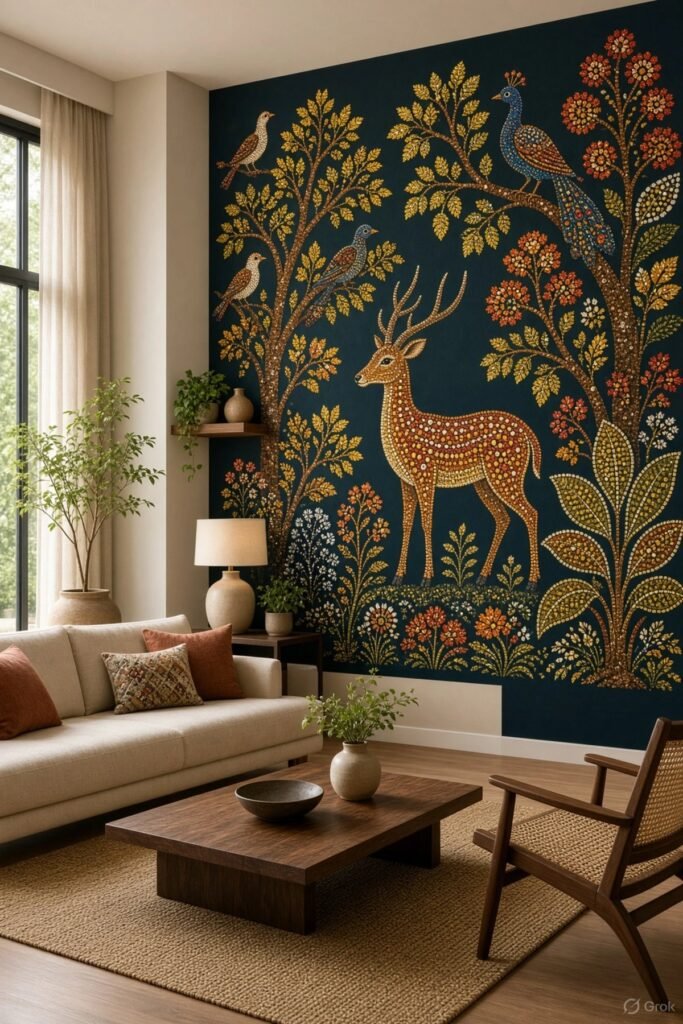
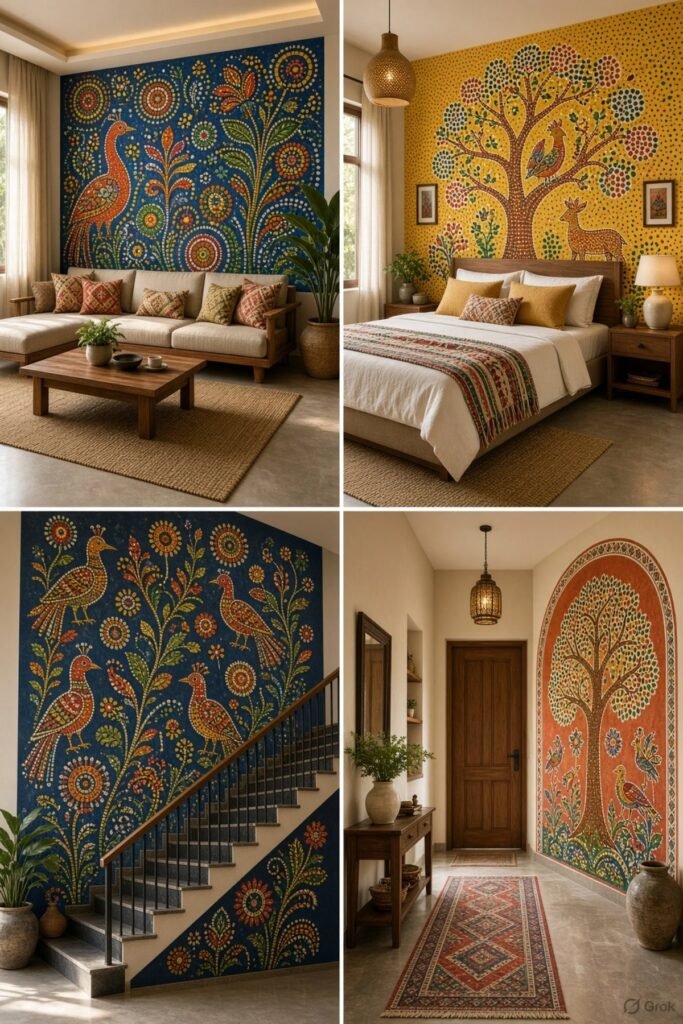
For a Bhil wall painting, choose a clean, dry wall in a plain colour. Sketch a large animal with chalk or pencil, and paint with wall-suitable acrylic. Dotting a large mural takes patience; use a round sponge dabber or dotting tool for bigger dots and keep spacing with a pencil grid. Good spots are the wall behind a sofa, a hallway or a reading corner. A Bhil canvas painting is easier to manage: prime the canvas, paint a coloured ground, add animals and dots, and frame it. A set of three small canvases, with a deer, a peacock and a tree, looks good on a shelf wall. Test colours on a small patch first and ventilate the room while painting.
Terracotta Pots, Decorative Bottles and Handmade Crafts
For Bhil pot painting, use terracotta, paint a base colour, let it dry and add dots in contrasting colours in bands around the pot. For bottles, clean the glass, use paint made for glass or multi-surface acrylic and keep the design simple. Seal with a suitable clear varnish. Handmade crafts such as bookmarks, coasters, greeting cards and notebook covers work well with dot patterns.
Safety note: Keep painted pots and bottles decorative. Standard craft acrylic and varnish are not certified for food contact, and a non-toxic label does not mean food safe. Do not paint plates, cups or the inside of water containers.
Bhil vs Gond Art, Drawing Practice and FAQs
Difference Between Bhil Art, Gond Art and Pithora Painting
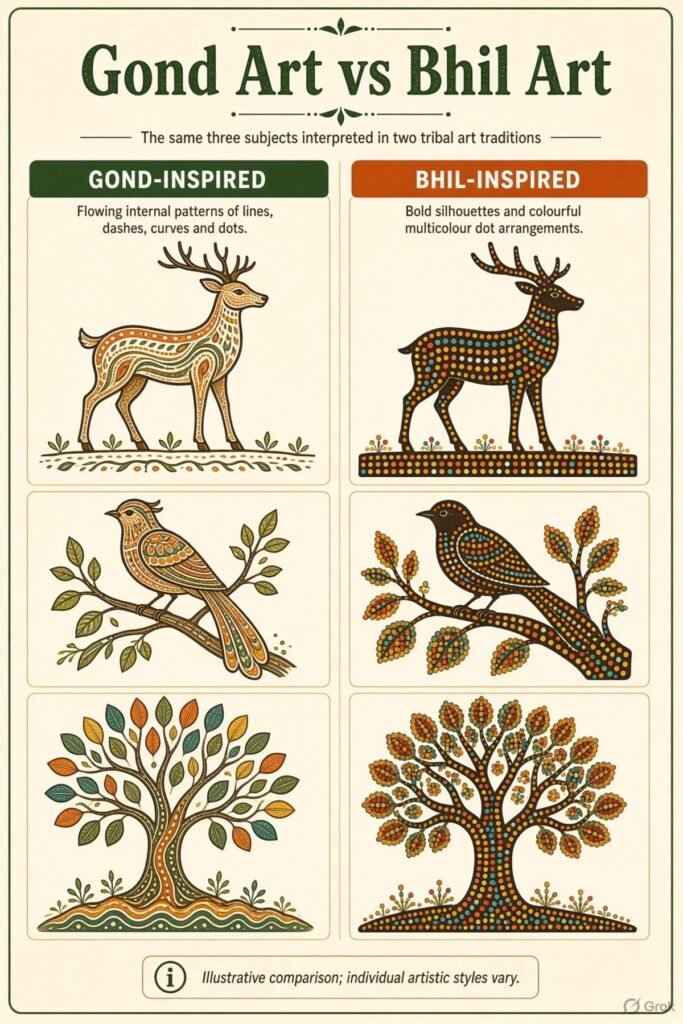
Bhil art and Gond art are different traditions of different communities, and both use dots. That is why dots alone cannot tell you which is which. Use the table as a guide, not a test; individual artists vary.
| Feature | Bhil art | Gond art | Pithora painting |
|---|---|---|---|
| Community | Bhil | Gond, especially the Pardhan subgroup | Ritual tradition of communities such as Bhilala and Rathwa |
| Well-known region | Jhabua and other Bhil areas of Madhya Pradesh, with Bhils also in other states | Patangarh, Dindori and nearby areas of Madhya Pradesh | Jhabua area and parts of Gujarat |
| Typical look | Large simple forms filled with rows of coloured dots | Flat colour shapes with black outline and varied dots, lines and dashes | Ritual wall paintings, often with horses and figures |
| Purpose | Storytelling and village life, and contemporary art on paper and canvas | Myths, forest and animals; contemporary art on paper and canvas | Ritual offered to deities |
| Key artists named here | Bhuri Bai, Lado Bai | Jangarh Singh Shyam, Bhajju Shyam | Ritual painters, called lekhindra in Jhabua |
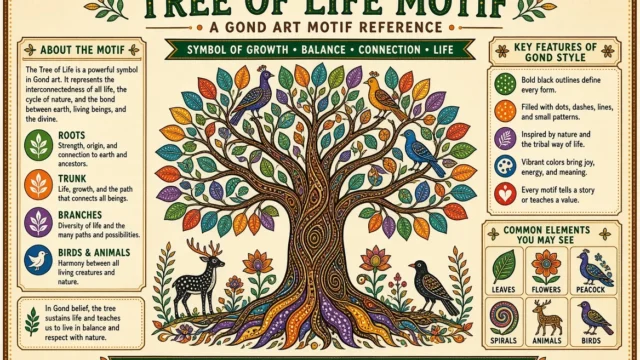
For more on Gond art, see our Gond art step-by-step guide and motifs and meanings. For Pithora, see the Pithora motifs chart. Remember that Pithora is a ritual tradition, and contemporary Bhil dot paintings by artists such as Bhuri Bai grew partly from that background but are a separate practice.
Outline Practice Sheets, Common Mistakes and FAQs
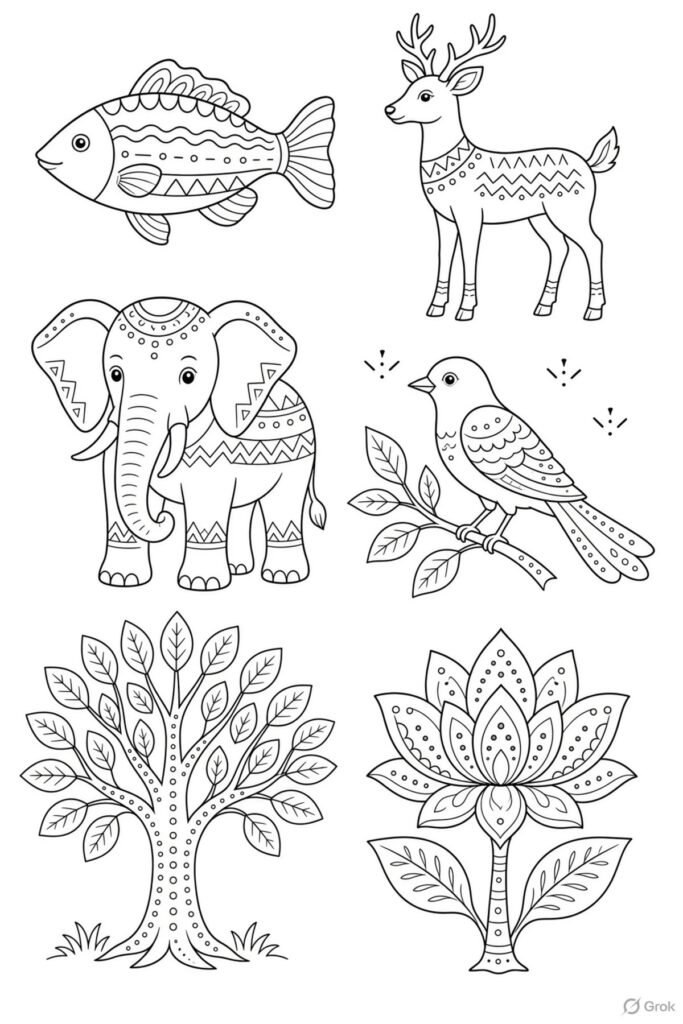
A Bhil painting outline and Bhil black and white drawing are the best way to plan before painting. Draw an animal outline in black pen, then try three dot patterns on photocopies. A Bhil art practice sheet can be a page of nine dot patterns. Original downloadable practice sheets are not available yet.
| Mistake | Fix |
|---|---|
| Dots of uneven size | Re-dip the tool each time and keep the same pressure |
| Dots too close or too far | Leave about one dot width between dots |
| Colours bleeding | Let the base colour dry before dotting |
| Shapes too small | Draw large forms so dots have room |
| Copying a famous painting | Study the rhythm, then design your own animals |
1. What is Bhil art?
It is the art of the Bhil community, known for dot-filled animals, trees and village scenes, painted first on walls and now also on paper and canvas.
2. What is Bhil art of Madhya Pradesh?
It is the Bhil painting tradition found in districts such as Jhabua, linked with artists like Bhuri Bai and Lado Bai.
3. How do I start Bhil art drawing easy for beginners?
Draw a large simple animal or bird, fill it with flat colour, then cover it with evenly spaced dots in a contrasting colour.
4. What are Bhil art images used for?
People use them for ideas, school projects and decoration. Use them for inspiration and make your own designs.
5. Is Bhil art only from one state?
No. Bhil communities live in several states, though Bhil painting is especially well documented in Madhya Pradesh.
6. Can I make a Bhil art saree at home?
You can make a Bhil-inspired saree with fabric paint, dots and heat setting. It is a contemporary adaptation, not a documented traditional practice.
7. Which paint is best for Bhil art?
Opaque acrylic or poster colours on paper, and fabric paint on cloth.
8. Is Bhil art the same as Gond art?
No. They are different communities and traditions, though both use dots.
9. Is Bhil art the same as Pithora painting?
No. Pithora is a ritual wall painting tradition. Contemporary Bhil dot paintings are a related but separate practice.
10. How can I support Bhil artists?
Buy directly from artists or from shops that name them, credit them in your work and avoid presenting practice pieces as authentic tribal art.
Final tips: Draw large, dot evenly, keep colours few and always credit the tradition. For more folk art, try our Madhubani painting guide.
Sources and further reading: IGNCA: The Bhils of Madhya Pradesh; Wikipedia: Bhuri Bai; Wikipedia: Lado Bai; Wikipedia: Bhil; Memeraki: Pioneering women of Bhil art; Memeraki: Bhil painting explained; Golden: fabric applications.

















Share Your Opinion
Comments are closed on this post.