 Vista
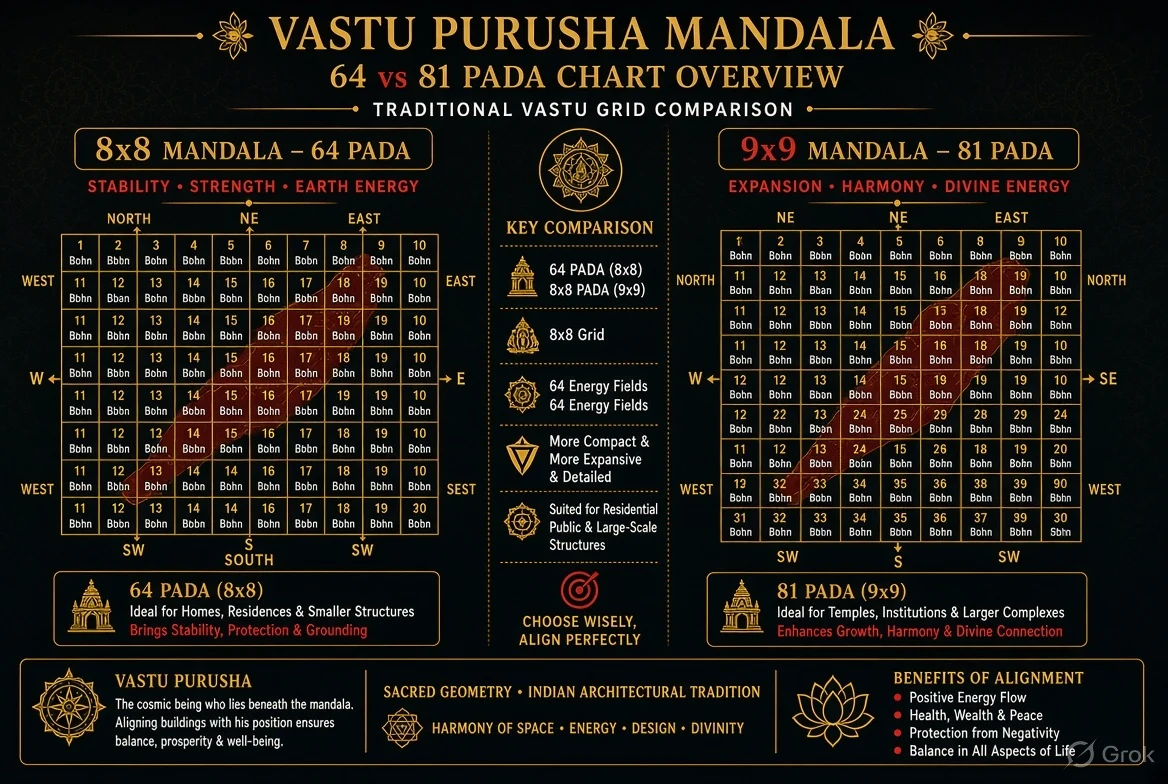
The 64-pada Vastu Purusha Mandala is an 8×8 grid called Manduka; the 81-pada mandala is a 9×9 grid called Paramasayika. Both are historical planning diagrams. They differ in grid size, central allocation and some deity placements. Neither grid is an engineering approval or a guarantee of health or prosperity.
Updated 20 November 2026. Cultural and architectural history, not structural-engineering advice.
64 vs 81 Pada Vastu comparison
| Feature | 64 Pada | 81 Pada |
|---|---|---|
| Cells | 8×8 | 9×9 |
| Name | Manduka | Paramasayika |
| Common central Brahma area | 4 cells | 9 cells |
| Use across texts | Various, often temples | Various, often houses/settlements |
Understanding pada and Vastu Purusha Mandala
A pada is a cell or unit of a traditional square planning grid. In Vastu architectural literature, such a grid is also called a vastumandala or pada-vinyasa. The number of padas follows directly from the number of rows multiplied by the number of columns. An 8×8 grid has exactly 64 cells; a 9×9 grid has exactly 81. The numbers should never be interpreted as 64 directions or 81 independent gods.
In classical sources the square becomes a framework for locating deities, regions of a site, boundaries and functional zones. The Vastu Purusha is represented symbolically within that arrangement. The mandala is a cultural planning model rather than a measured electrical or physical field that can independently certify whether a house will be safe, healthy or prosperous. Modern structural engineering, lawful building permission, drainage, ventilation, accessibility and fire safety remain essential.
There are many other historical grid sizes. Sanskrit architectural texts discuss 1×1, 2×2, 3×3, 7×7, 8×8, 9×9 and larger configurations. Focusing on the two best-known layouts makes comparison easier, but it does not imply that all Vastu traditions use only 64 and 81 cells.
The 64-pada or Manduka grid
The Manduka, also called Chandita in some accounts, divides a square into eight equal rows and eight equal columns. Counting eight squares in every row gives 64 padas. It is common in descriptions of traditional sacred planning, and some text traditions associate it particularly with temples. However, source descriptions of building uses do not agree in every case, so labelling it a universally mandatory temple grid would oversimplify the literature.
One distinctive feature concerns the centre. A symmetric 8×8 grid has no single central cell. Instead, the four cells at the crossing of the two central rows and columns form the central group. Classical accounts associate that central group with Brahma. This is an easy way to tell an 8×8 chart apart from a 9×9 chart even before reading the deity names.
When creating a printable 64-pada diagram, start from an unlabelled square, divide each side into eight equal segments, draw parallel lines, then number the resulting cells consistently. Only after the geometry is correct should a text-specific deity scheme be overlaid. A modern design that simply assigns any 64 names to the boxes is not automatically a documented Manduka arrangement.
The 81-pada or Paramasayika grid
Paramasayika has nine rows and nine columns, giving 81 padas. Because nine is odd, the overall grid has a true central cell; classical layouts commonly allot a central region of nine squares to Brahma. The surrounding areas are occupied by other named deities and zones. A 9×9 chart with every box assigned one independent deity therefore does not accurately express the traditional approach.
The 81-pada arrangement features in architectural literature on houses, larger sites, settlements and ritual contexts. Different texts use different emphases. Some sources associate 64 more frequently with temples and 81 with domestic or settlement plans; other educational glossaries present alternative examples. The important point is to name the particular source rather than treating one simplified internet infographic as a universal decree.
A careful illustrator should orient the grid clearly. If north is at the top, east is to the right and west to the left. Some traditional diagrams instead place east at the top. Either orientation can be explained if the directional key is complete and consistent; mixing two systems in one poster produces a misleading chart.
64 vs 81: comparison of the central squares and deities
Both systems describe deity assignments within a square scheme. A commonly discussed model names 45 deities rather than one deity for every pada. The central Brahma region covers four squares in the 64-pada version and nine in the 81-pada version. The outer ring contains 32 positions in common presentations of the 81-pada deity scheme, with other deities occupying multiple central or intermediate cells.
These differences make direct copying between charts dangerous. One cannot take a list intended for a 9×9 grid, remove seventeen names and assume the result is a valid 8×8 mandala. Cells, directions, shared regions and textual variants all matter. In historical literature the names or positions of particular deities can differ between manuals. A serious educational graphic should specify whether it follows a given edition of Brihatsamhita, Mayamata, Manasara or another source.
For readers inspecting a graphic online, a correct title and the right cell count are only the first checks. Inspect whether every row has the stated number of cells, whether the middle group has the correct size, and whether the directional arrows agree. A chart should also explain why more than one cell can belong to a single named deity.
Which mandala is used for a home, temple or plot?
It is tempting to turn the entire comparison into a yes-or-no buying rule: 64 is for temples and 81 is for houses. Some architectural texts do discuss that tendency, but the evidence is more varied. The actual application depends on the source text, regional practice, building function and specific geometry. It would be incorrect to claim that a nine-by-nine diagram is legally required for every new home.
If someone is making a real floor plan, consult a qualified architect and local building requirements first. Factors such as plot dimensions, structure, light, stairs, setbacks, water supply and fire evacuation directly affect safety and usability. A symbolic grid can be discussed as part of an owner’s cultural preferences, but it does not replace structural calculations or approval of drawings.
Students can examine a historic plan by laying a transparent grid over a documented architectural drawing, noting the building’s period and the orientation chosen. This is more defensible than assuming that every old building was designed from exactly the same map. Architectural history requires looking at sites, texts and surviving evidence together.
How to draw and verify the 8×8 and 9×9 charts
Draw two squares of comparable size. Divide the first into eight parts per side, the second into nine. Count all cells systematically. Shade the central four squares in the first and central nine squares in the second. Add the north arrow, then clearly state whether east is right or top. Mark the outer boundary without inventing new directions or deity correspondences.
When adding traditional labels, consult one published edition and preserve its convention. Do not combine deity positions from different online charts merely to fill blank spaces. If the source uses multiple cells for one deity, retain that multi-cell allocation. Captions can mention the 45-deity framework and note that exact positioning varies between textual witnesses.
Avoid presenting an ornate digital mandala as an authoritative architectural blueprint when its deity placement has not been checked. A clean numbered grid with carefully attributed labels is more useful than a dramatic poster that contains duplicate numbers, inconsistent cardinal points or unreadable text.
Common misconceptions and practical interpretation
A 64-pada diagram is not a chart of 64 separate deities, and an 81-pada diagram is not a chart of 81 physical cosmic energies. The terms identify the size of the grid. Equally, the belief that a building must be demolished because a digital diagram shows a supposedly wrong cell has no sound engineering basis. The diagrams can be studied as cultural planning systems without making physical safety claims.
Another misconception is that every traditional Vastu diagram puts north in the same place. Historical illustrated manuscripts may be oriented differently, and text traditions assign slightly different deity names to positions. Always look for an orientation key and a named reference. Readers who compare two charts without these details risk finding a contradiction where the diagrams simply use different conventions.
The safest takeaway is to understand the numbers, ask which tradition a chart represents and use the diagram for interpretation rather than for making risky construction decisions. If financial or safety decisions are involved, qualified modern professionals and the applicable legal rules are the relevant authorities.
Frequently asked questions
What does pada mean in Vastu?
A pada is a unit square or cell in the planning grid; 64 and 81 refer to the total cell counts.
Is 64 pada always for temples?
Some sources frequently use it in temple contexts, but traditional uses vary; this is not an absolute rule.
Which is the 9×9 Vastu grid?
The 81-pada Paramasayika arrangement is the nine-by-nine grid.
How many central cells does each grid have?
The common classical allocation places Brahma in four central squares of the 8×8 scheme and nine central squares of the 9×9 scheme.
Does the chart replace an architect’s plan?
No. It is a cultural planning reference, not a substitute for engineering design or building regulations.
Are deity names the same in every Vastu chart?
No. Historical texts and orientations sometimes vary, so cite the specific source used.
Sources and conclusion
For the classical grids, 45-deity framework and central allocations see Vāstuśāstra: The Principles of the Texts and for the terminology of pada-vinyasa see School of Planning and Architecture Bhopal — Vastu Mandala Terminologies.
A trustworthy chart identifies its grid, orientation and textual reference. Use it to understand a historical planning framework, not to replace an architect or promise extraordinary outcomes.










Share Your Opinion
Comments are closed on this post.