 Vista
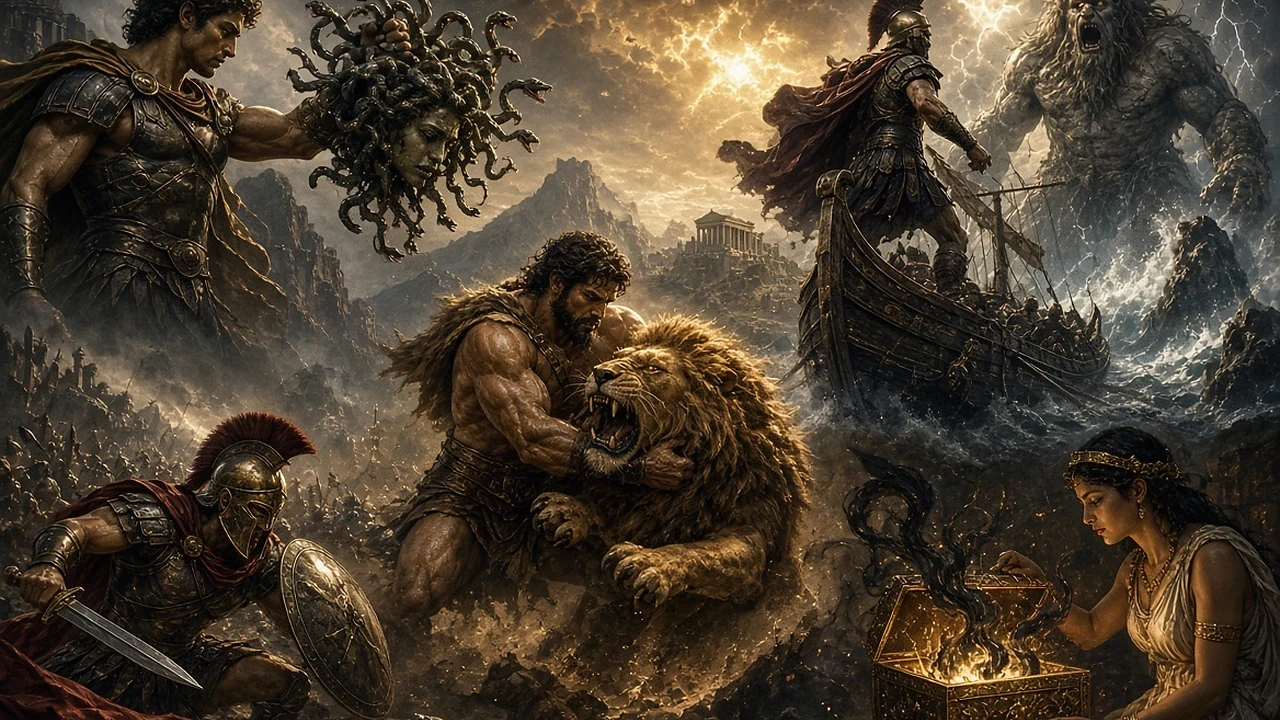
Greek mythology stories are packed with formidable gods, resourceful heroes, impossible tasks, dangerous journeys and choices that cannot be undone. But where should a beginner start? A good selection includes Perseus and Medusa, Heracles’ twelve labours, the Minotaur, the Trojan War, the Odyssey, Pandora, Prometheus, Orpheus and Icarus. Each belongs to a particular narrative tradition. This guide tells you what happens, why readers remember it and which ancient works are most useful for checking the details. These are traditional narratives, not verified accounts of supernatural events.
Why are there different versions of Greek mythological stories?
Unlike a modern novel with one author-approved plot, Greek myths circulated for generations before and after their surviving literary versions. Homer’s Iliad and Odyssey focus on heroic war and homecoming, while Hesiod’s Theogony emphasizes divine ancestry and struggles for power. Works and Days discusses the human condition through stories such as Pandora and Prometheus. Greek dramatists later explored familiar legends for their own audiences, and Roman authors such as Ovid and Virgil developed versions that became especially influential in art and schools.
That difference matters when people say a myth is “the real original.” The story of Medusa’s transformation into a snake-haired monster is much more explicit in Ovid’s later Roman poem than in Hesiod’s earlier account of a mortal Gorgon. The wooden horse is famous as the ending of the Trojan War, yet the Iliad does not tell that whole episode. These examples do not make a story worthless: they tell readers to notice its source. The most useful approach is to identify the characters, read the major sequence and then ask how an earlier and a later text differ.
1. Perseus and Medusa — facing the Gorgon without looking
Medusa is one of three Gorgon sisters, but unlike Stheno and Euryale she is mortal in Hesiod’s account. The hero Perseus is ordered to obtain her head. In the mythographer Apollodorus’s fuller version, Perseus receives supernatural help: Athena guides him, Hermes provides a weapon, and further equipment includes winged sandals, a cap that hides the wearer and a bag for carrying the head. Perseus avoids meeting Medusa’s dangerous gaze directly by viewing her reflection in a polished shield. After he beheads her, Pegasus and Chrysaor are born from her body in the myth.
Why it stays memorable: the victory depends on intelligence and help, not just strength. For source accuracy, distinguish the hero’s quest from the separate question of how Medusa acquired snake hair. Hesiod describes her as a Gorgon, whereas Ovid gives the later transformation account. A helpful next reading is the full Perseus story in Apollodorus, Library Book 2, which provides the quest’s sequence and equipment rather than leaving it as a single dramatic image.
2. Heracles and the twelve labours — strength with a cost
Heracles, more commonly called Hercules in Roman-influenced English, is a son of Zeus and Alcmene. His life is marked by extraordinary strength and serious suffering. Under the direction of Eurystheus he must complete a set of dangerous tasks. The familiar list includes defeating the Nemean Lion, the many-headed Hydra, capturing the Ceryneian Hind, the Erymanthian Boar, the Cretan Bull, Diomedes’ horses and Cerberus, as well as bringing back the golden apples of the Hesperides. Some tasks involve monsters; others require patience, cleverness, negotiation or endurance.
In Apollodorus, Eurystheus rejects the validity of two earlier undertakings, helping explain why the count reaches twelve. There is no need to claim that every source lists the tasks in exactly the same order. The stories mix heroic achievement with questions about fate, wrongdoing and redemption. A striking contrast is that the same hero who can fight a terrifying creature can still be vulnerable to divine hostility and family tragedy. The lion skin and club became his familiar visual signs.
3. Theseus and the Minotaur — escape from the labyrinth
On the island of Crete, King Minos keeps the Minotaur, a creature with a bull’s head and human body, inside a labyrinth associated with the craftsman Daedalus. In the famous account, Athens must send young people as tribute. The hero Theseus goes to Crete and volunteers to enter the maze. Ariadne, daughter of Minos, helps him find a way out by giving him a thread. He confronts and kills the creature, then follows the thread back toward the exit.
The labyrinth makes this more than a monster fight: survival also requires a reliable route and another person’s help. The details of Ariadne’s assistance and her later fate differ across texts. In some versions Theseus subsequently abandons her, complicating the picture of a straightforward heroic happy ending. The myth also connects with the story of Daedalus and Icarus, because the inventor associated with the maze later becomes the father who builds wings for escape.
4. The Trojan War — a legendary conflict larger than one poem
The Trojan War cycle begins, in the familiar tradition, with divine rivalry at the Judgment of Paris and the departure or abduction of Helen for Troy. Agamemnon leads a Greek expedition against the city. The epic Iliad enters this larger story during the war itself, focusing strongly on the anger of Achilles and his conflict with Agamemnon. Hector, prince of Troy, becomes a central defender, while Olympian gods support different sides. The poem reaches emotional intensity through loss, grief and the confrontation between Achilles and Hector.
Do not expect the Iliad to contain the complete siege, the wooden horse and the subsequent returns of all the Greek leaders. Other epic traditions and later authors preserve additional episodes; the Odyssey also remembers the horse. This is a prime example of how Greek mythology stories form an interconnected cycle rather than a single screenplay. The source distinction matters when writing a school project or answering which event appears in which poem.
5. The Odyssey — the long return of Odysseus
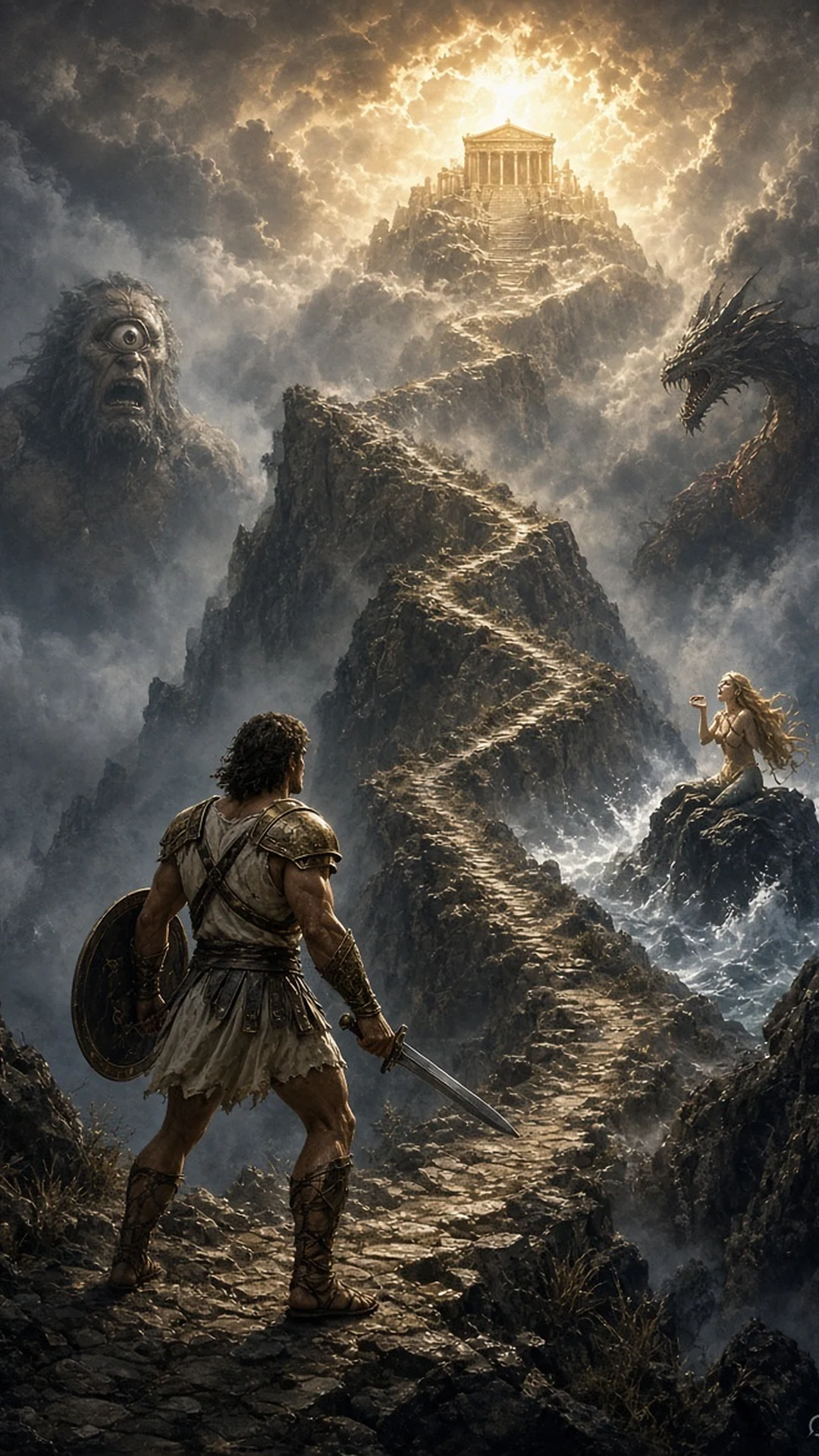
After the Trojan War, Odysseus struggles for years to reach his home, Ithaca, where Penelope and Telemachus await him. He encounters the Cyclops Polyphemus, the enchantress Circe, the Sirens and other dangers. Poseidon’s hostility makes the sea a repeated obstacle, while Athena often assists him. Not every part of the poem is told in simple chronological order: Odysseus recounts some adventures retrospectively, and the narrative also follows events at home.
The homecoming is only part of the challenge. Once he reaches Ithaca, he must reclaim his place from suitors who have consumed his household’s resources. The story raises questions about hospitality, identity, loyalty and the price of survival. It is possible to enjoy the monsters and shipwrecks while also noticing the poem’s attention to family and the consequences of long absence. For a complete version, consult Homer’s Odyssey rather than a compilation of disconnected sea-adventure scenes.
6. Pandora’s jar — what was left inside?
In Hesiod’s Works and Days, Pandora is created in connection with Zeus’s response to Prometheus’s actions. The famous container is a large storage jar, or pithos, not the modern small box suggested by the English expression “Pandora’s box.” When the container is opened, troubles spread among humanity while Elpis remains within. Elpis is usually translated as hope, but its meaning and whether its remaining is comforting or troubling are debated.
The myth is useful because a single word—box instead of jar—can change the image readers carry for centuries. A good retelling describes the traditional popular title and then explains the object used in the original account. It should not claim that the story offers a scientifically proven origin of disease or suffering. It is a literary explanation of the human condition inside an ancient worldview.
7. Prometheus — stolen fire and a severe punishment
Prometheus is a Titan who repeatedly challenges Zeus. In Hesiod, disputes over sacrifice and access to fire lead to his taking fire for humanity, famously carried in a fennel stalk. His punishment is to be bound while an eagle consumes his liver, which grows again. Heracles eventually kills the eagle and releases him in traditional accounts. This ordeal became a powerful image of endurance and the cost of defying divine authority.
Prometheus and Pandora should be read together because their myths are linked. Yet the simple slogan “fire equals modern technology” is an interpretation, not a line taken directly from the earliest poem. The significance of fire can include human survival, ritual life and the tension between humans and gods. Later dramatic works, including Prometheus Bound, explore the character from a different perspective. Naming that change of perspective is more useful than merging all retellings into one supposedly exact script.
8. Icarus — the warning ignored in flight
Daedalus builds wings using feathers and wax so he and his son Icarus can escape Crete. He warns Icarus to keep a middle course: too low and the sea threatens the wings, too high and the sun’s heat will loosen their bonds. In Ovid’s Metamorphoses Book 8, Icarus rises too far and falls into the sea. Daedalus witnesses the terrible result of his own invention. The story is often summarized as a lesson about overconfidence, but it also contains a painful story of a parent and child.
Be careful with claims that the longest familiar version is “from Homer.” The popular detailed account is preserved in a later Roman work by Ovid, though the figures were known in earlier traditions. The recurring image of a sunlit sky, damaged wings and an empty sea is powerful because it tells an entire arc in one scene. A poster of that moment should reflect the story without pretending to be an ancient photograph.
9. Orpheus and Eurydice — a look back that changes everything
Orpheus, a legendary musician, loses his wife Eurydice and descends to the underworld to bring her back. His music persuades the rulers of the dead to let her follow him toward the surface, provided that he does not look back before the journey is complete. He turns, and she is lost to him again. The tale survives in influential versions by Virgil and Ovid, not as a chapter of Homer’s Iliad. Its emotion lies in hope, uncertainty and a tiny irreversible decision.
In contrast to a story that rewards power in battle, this legend gives music and persuasion a central role. Later readers have offered many interpretations of why Orpheus looks back—fear, love, doubt or impatience—but the motives should be distinguished from what each ancient author actually says. This separation of text and interpretation makes the story richer, not less moving.
10. Sisyphus — a task that never ends
Sisyphus is punished in the underworld by pushing a great stone uphill, only to watch it roll down so that he must begin again. Homer’s Odyssey shows the punishment, while other traditions give different accounts of his trickery and attempts to cheat death. Modern discussions, especially through philosophy, often use the story as a metaphor for repetitive effort. Those interpretations are valuable but should not be attributed word-for-word to Homer.
Unlike the triumphal ending of a monster-slaying adventure, Sisyphus leaves readers with a troubling question: what makes an effort meaningful if it has no permanent completion? Greek mythology contains both sorts of stories, which is why it remains interesting beyond spectacles of thunder and war.
How to choose a Greek mythology story to read next
Choose by the question you want answered: Perseus for how a dangerous enemy is overcome; Heracles for a series of trials; Theseus for the labyrinth; the Trojan War for human conflict; the Odyssey for a long homecoming; Pandora for the origins of an idiom; Icarus for a tragedy about flight; Orpheus for love and loss; Sisyphus for an endless punishment. Always look for the title of the ancient work that supports the retelling. Avoid assigning a source from one story to another just because the characters share a god or location.
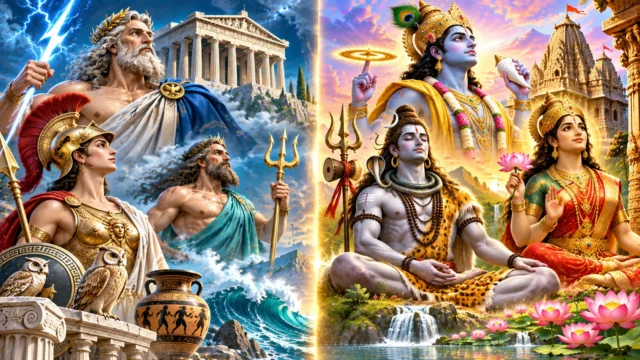
Interested in comparative traditions? Our Greek vs Hindu mythology explainer compares major themes carefully without claiming that Greek heroes and figures in Indian epics are the same persons. That distinction is essential to any responsible comparison.
Greek mythology stories: common questions
Which is the most famous Greek mythology story?
There is no official winner. The Trojan War, the Odyssey, Perseus and Medusa, and Heracles’ labours are among the most widely retold traditions.
Is the Trojan Horse told in the Iliad?
Not as the full famous episode. The Iliad focuses on part of the war; the horse appears in other surviving traditions, including mentions in the Odyssey.
Was Pandora’s object really a box?
In Hesiod’s account it was a large jar, called a pithos. “Pandora’s box” is the familiar later expression.
What does Achilles’ heel mean?
It means a point of vulnerability. The familiar heel-protection detail belongs to later tradition and should not be presented as a scene described in Homer’s Iliad.
Are Greek myths suitable for children?
Many can be retold for children, but original texts and some modern adaptations include war, death and sexual violence. Choose an age-appropriate edition and do not treat every retelling as an original translation.
Primary sources and closing note
Sources: Apollodorus, Library Book 2, Hesiod, Theogony, Ovid, Metamorphoses Book 8 and the Perseus Digital Library for Homer. These narratives are myths and literary traditions, not verified records of supernatural events. Updated 14 November 2026.











Share Your Opinion
Comments are closed on this post.