 Vista
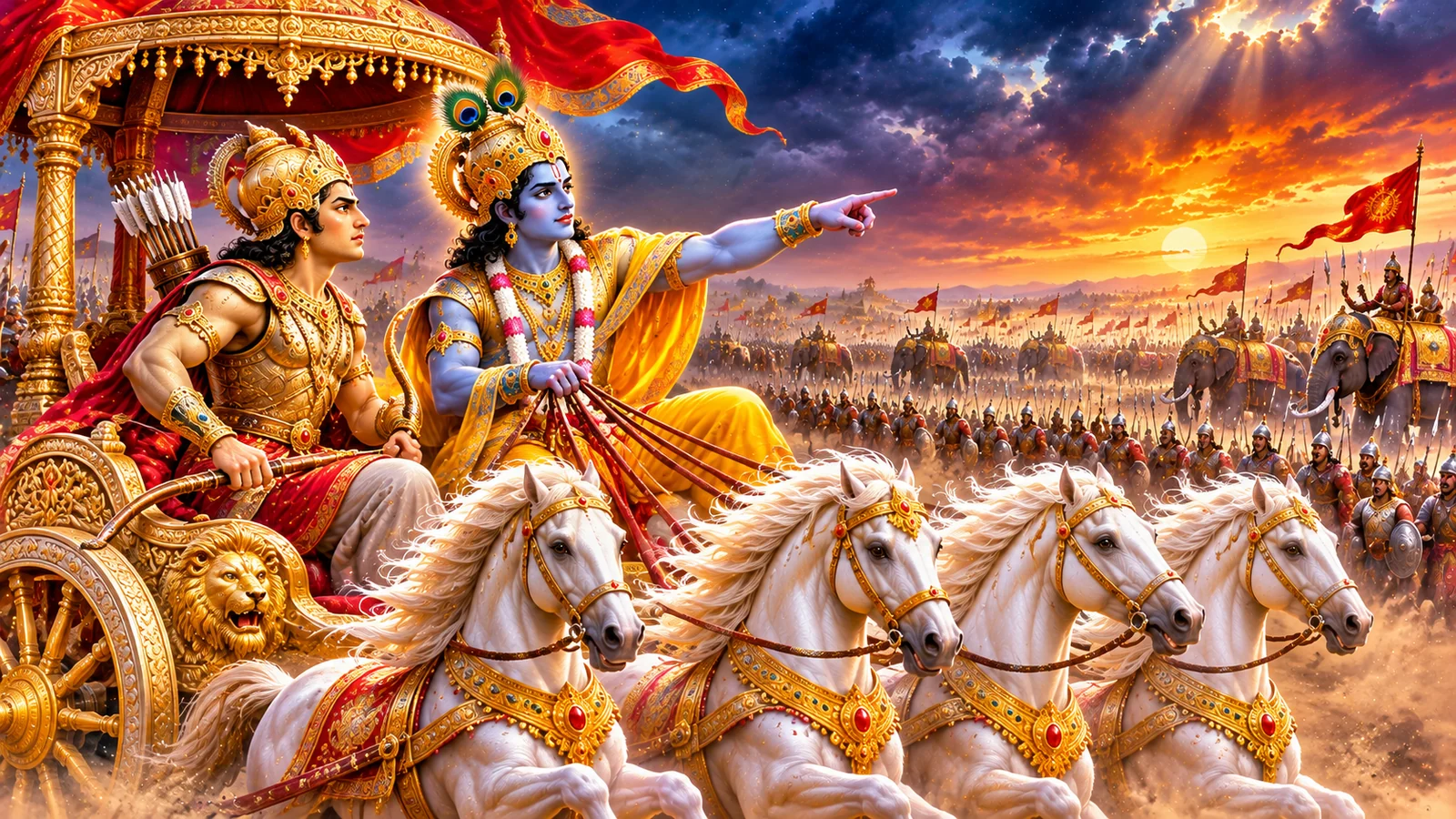
Quick answer: The Kurukshetra war in the Mahabharata lasts 18 days in the epic narrative. Before the battle, the opposing armies accept rules of combat: fight comparable opponents, announce an attack, spare people who surrender or have lost their weapons, and avoid deliberately attacking charioteers and other noncombatant support personnel. A customary distinction between daytime fighting and rest after sunset also appears in the war story, though important exceptions occur. The rules are not consistently followed. Abhimanyu’s death, the killing of Drona and Karna, Bhima’s final mace blow against Duryodhana, and Ashwatthama’s attack on sleeping warriors raise some of the epic’s hardest questions about dharma, duty and the cost of victory.
This guide distinguishes the rules described in the text from modern assumptions about warfare. It explains the conflict, the major commanders and the 18-day sequence without claiming that every television scene or circulating day-by-day chart appears identically in every manuscript. In traditional accounts, this is a morally devastating war between relatives, teachers, friends and former allies—not a simple celebration of one army destroying another.
What Was the Kurukshetra War and Why Did It Begin?
The conflict grows out of rivalry within the Kuru family. The five Pandava brothers and their Kaurava cousins dispute inheritance and sovereignty; the dice game, Draupadi’s humiliation, exile and the failure of negotiations deepen the breakdown. The blind king Dhritarashtra’s son Duryodhana refuses the settlement the Pandavas seek. Krishna’s efforts at mediation do not prevent war. The opposing forces assemble on the plain of Kurukshetra, traditionally associated with the region of modern Haryana in northern India.
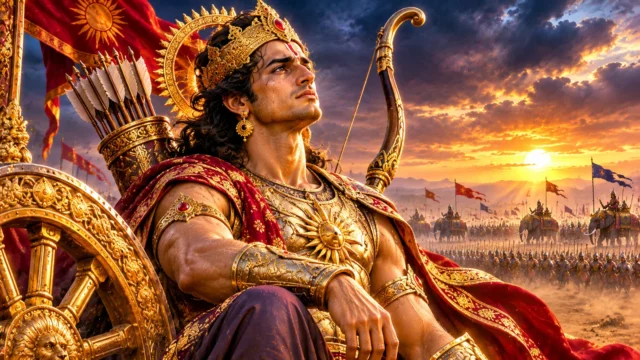
In the epic, the Pandavas are supported by Krishna, who chooses to be Arjuna’s charioteer rather than an armed combatant. The Kauravas receive support from respected figures including Bhishma, Drona and Karna. This is precisely what makes the moral problem disturbing: Arjuna is asked to confront elders and teachers he loves. Before the battle he hesitates, and Krishna’s counsel forms the Bhagavad Gita, embedded in the Bhishma Parva. The Gita should not be turned into a one-line authorization for violence; it is a layered religious discussion of duty, action, knowledge, devotion and attachment.
The war belongs to the epic’s narrative world. Its traditional duration and army numbers should be identified as textual descriptions, not independently established modern battlefield statistics. Archaeology and historical interpretation involve different questions from the meaning of an ancient literary and religious tradition.
What Were the Rules of the Kurukshetra War?
The opening of the Bhishma Parva describes agreements between the armies about how combat should be conducted. One important English translation is available through the public-domain Mahabharata, Book 6, Section I. It does not read like a modern signed treaty or a single complete military handbook. Instead, it presents norms of fair fighting within the epic. The most defensible summary is:
| Rule in the epic’s opening agreement | What it means in context |
|---|---|
| Fight an appropriately matched opponent | A chariot warrior faces a chariot warrior; mounted fighters and infantry face comparably placed fighters. |
| Give warning before striking | A combatant should not suddenly attack someone unprepared, terrified or unaware. |
| Spare someone withdrawing or surrendering | A fleeing, yielding or retreating person should not be killed. |
| Do not strike the disarmed or unprotected | Someone whose weapon has failed, who lacks armour or who is already engaged with another opponent should not be attacked. |
| Avoid attacking support personnel | Charioteers, weapon-carriers and those sounding battle instruments receive stated protections in the opening rules. |
| Respect the day’s limits where observed | The familiar expectation is to stop ordinary battle at sunset, though the narrative also records night combat. |
The first five points are expressed particularly clearly in Bhishma Parva 6.1. The day-and-night convention is described across the narrative and later retellings, rather than every modern version of this chart being a single quotation from the same opening passage. Readers should distinguish the epic’s ethics of a fair duel from contemporary humanitarian law. The two share some concerns about protecting vulnerable people but are not identical legal systems. Research published by the International Review of the Red Cross makes exactly this comparison while warning against flattening their differences.
Did warriors really stop fighting at sunset?
Daylight fighting and withdrawal after combat are recurring expectations in popular tellings, but it is misleading to say there was never a night battle. Following the events of day 14, fighting continues into the night, when Ghatotkacha’s role becomes decisive. Another nocturnal atrocity occurs after the main 18-day battle: Ashwatthama’s assault on the sleeping camp. The contrast between a declared ideal and actual conduct is a central feature of the narrative, not a minor inconsistency to erase.
Could several warriors attack one soldier?
The general ideal was a fair contest with an appropriately matched opponent, not opportunistic collective violence against a disadvantaged fighter. Abhimanyu’s death is the best-known example of a confrontation remembered as deeply unjust. However, scenes in the Sanskrit epic can be more complex than the simplified slogan “exactly seven broke exactly one rule.” Different retellings assign different detail to who struck which blow, and readers should follow the specified version rather than invent precision.
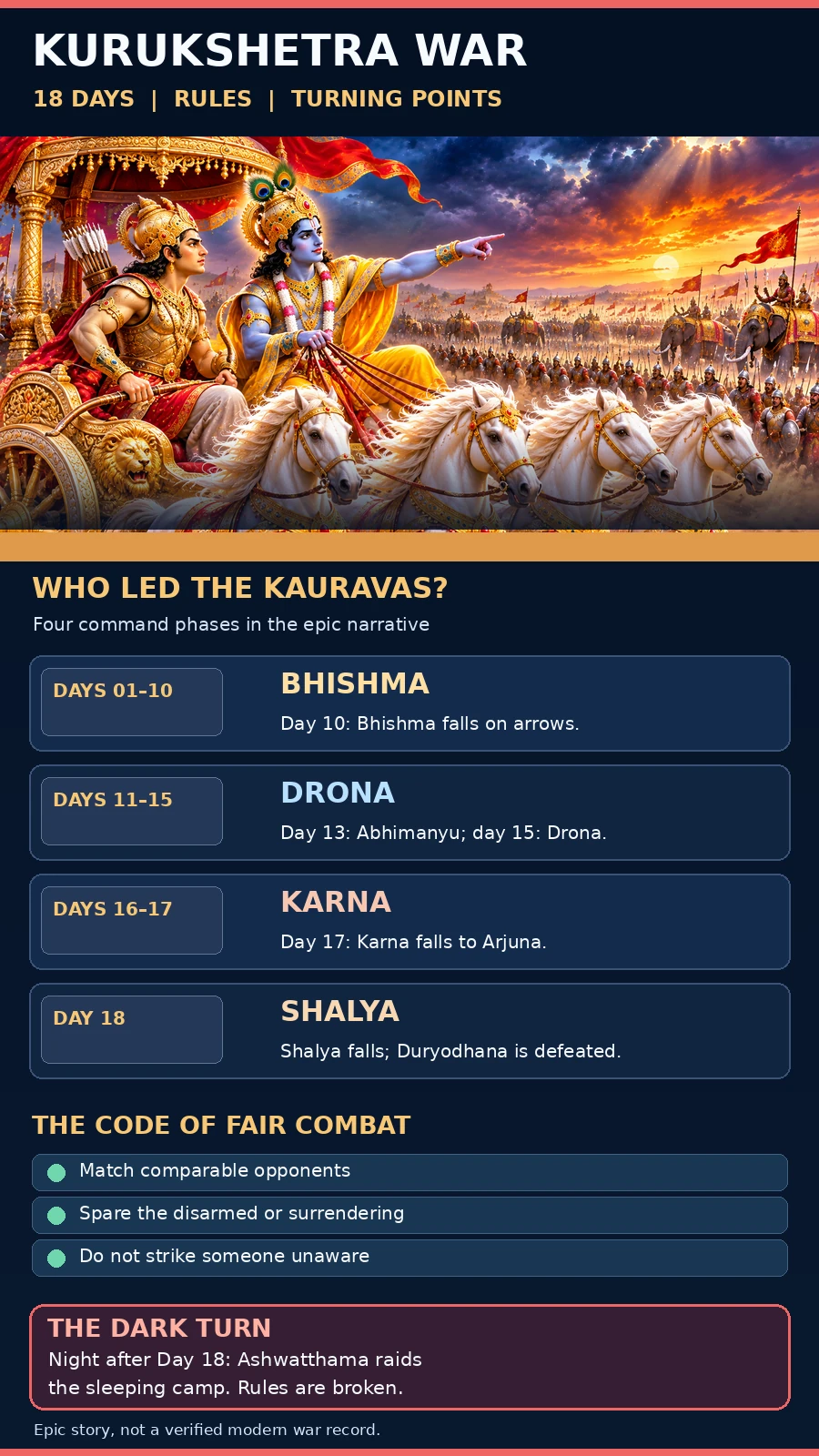
The 18-Day Kurukshetra War Timeline at a Glance
A reliable way to remember the war is through the succession of Kaurava commanders, rather than forcing a dramatic event onto every day when the source does not support an exact assignment.
| Days | Kaurava commander | Important events in the familiar sequence |
|---|---|---|
| 1–10 | Bhishma | Battle begins; Bhishma falls on a bed of arrows on day 10, with Shikhandi placed before Arjuna. |
| 11–15 | Drona | Chakravyuha and Abhimanyu’s death on day 13; Jayadratha’s death on day 14; Drona dies on day 15. |
| 16–17 | Karna | Karna leads the Kauravas; his fatal duel with Arjuna takes place on day 17. |
| 18 | Shalya | Shalya falls; the armies collapse; Bhima defeats Duryodhana in mace combat. |
| Night after the main battle | Ashwatthama and allies | Attack on sleeping people in the Pandava camp, narrated in the Sauptika Parva. |
The Pandavas’ commander-in-chief is Dhrishtadyumna. Traditional descriptions also speak of 18 akshauhinis of troops, often allocated as eleven for the Kauravas and seven for the Pandavas. These are narrative military units, not verified census figures. The same number 18 appears in the epic’s eighteen parvas (books), but the number of books and the number of days are different categories—they should not be confused.
Days 1–10: Bhishma Leads and Falls
The first phase puts Bhishma, revered elder of the Kuru dynasty, in command of the Kaurava forces. Arjuna’s reluctance is especially poignant because he faces Bhishma and Drona, figures linked to his upbringing and training. Bhishma is both a formidable fighter and someone bound by his own vows and loyalty to the Kuru throne. This tension makes him more than an unbeatable warrior in a power-ranking list.
Across these opening days, the armies clash in changing formations, while the Pandavas struggle with Bhishma’s prowess. Day-by-day summaries sometimes disagree on the precise sequence of smaller confrontations. The crucial shared milestone is day 10: Shikhandi stands before Arjuna, and Bhishma is brought down by Arjuna’s arrows. The famous bed of arrows is a scene of suffering and suspended death, not an instant death on that day. Bhishma continues to give counsel later in the epic. Articles that claim he “died on day 10” compress two different moments.
The method of his fall is morally contested. Bhishma’s refusal to attack Shikhandi becomes part of a tactical opening. The episode invites debate about whether an action can be tactically justified while remaining troubling to people who value direct, equal combat. Readers should describe Bhishma’s choices and the significance of Shikhandi without treating a complex character merely as a battlefield trick.
Days 11–15: Drona, Chakravyuha and Abhimanyu
After Bhishma’s fall, Drona takes command. The battlefield becomes increasingly shaped by tactical pressure, costly formations and decisions made to achieve goals that ordinary fighting has not accomplished. On day 13, the formation commonly called Chakravyuha becomes the setting for Abhimanyu’s death. Abhimanyu, Arjuna’s son, enters the formation and is isolated from the support he needs. His courage does not prevent him from being overwhelmed by several opponents. The event becomes a symbol of the collapse of the previously proclaimed ethics of war.
Day 14 is remembered for Arjuna’s vow to kill Jayadratha before sunset following Abhimanyu’s death. The battle intensifies and, in the familiar sequence, extends into night fighting. Ghatotkacha, Bhima’s son, plays a major role and is killed when Karna uses a powerful divine weapon. Different versions dramatize Krishna’s strategy in relation to Jayadratha in different ways. It is safer to explain the outcome and the vow than to present one television visual effect involving the sun as an uncontested statement of the earliest epic text.
On day 15, Drona hears a statement about “Ashwatthama” being dead. The narrative exploits the name shared by his son and an elephant. Drona puts down his arms and is killed by Dhrishtadyumna. This is among the text’s sharpest moral dilemmas: can deceiving a dangerous enemy ever be reconciled with truthfulness, especially when the opponent ceases to fight? Rather than giving readers a tidy verdict, the story foregrounds conflict between strategy and dharma.
Days 16–17: Karna Takes Command
Karna leads the Kaurava side after Drona. His friendship with Duryodhana, complicated family history and rivalry with Arjuna make him one of the epic’s most tragic and debated characters. Earlier choices, curses and promises shape the conditions of his final conflict. Presenting him only as a “villain” or an entirely innocent hero removes the contradictions that make his story compelling.
On day 17, Karna and Arjuna face one another in a decisive duel. In a familiar version, Karna’s chariot wheel becomes trapped, and he is struck when vulnerable. This moment echoes the earlier prohibitions on attacking a disadvantaged or disarmed opponent. Krishna calls attention to Karna’s earlier participation in serious wrongs; the scene brings claims about justice and retaliation into direct tension with the proclaimed code of fair combat. The ethical problem is the point: both a wrong action and the attempt to avenge wrongdoing can carry moral consequences.
Readers should avoid statements such as “all rules were followed until Karna died” or “Karna’s death proves there were no rules.” The earlier death of Abhimanyu already challenges any such simple timeline. The Mahabharata does not offer the comfort of a perfectly consistent army on one side and uniformly rule-breaking soldiers on the other.
Day 18 and the Night After: Shalya, Duryodhana and Ashwatthama
On the last day, Shalya commands the Kaurava army and is killed. The Kaurava position disintegrates, and Duryodhana confronts Bhima in a mace duel. Bhima strikes Duryodhana’s thigh, a blow repeatedly discussed as violating the convention that a mace fighter should not attack below the waist. The episode has a history involving earlier promises and humiliations, but that background does not make the ethical question disappear. The victory is thus shadowed by a breach of rules that the combatants themselves understand to matter.
The night after day 18 must be described carefully. Ashwatthama, accompanied in the narrative by Kripa and Kritavarman, attacks the Pandava camp while many occupants are sleeping. Important victims include Dhrishtadyumna and Draupadi’s sons. The massacre belongs to the Sauptika Parva, traditionally counted as the tenth book of the epic. Some popular simplified timelines fold it into “day 18,” but it is more precise to call it the night after the major field battle. The act starkly contradicts the protections for unarmed and unsuspecting persons. It also makes clear why the survivors’ story is not a cheerful victory parade.
Which Kurukshetra War Rules Were Broken—and Why Does That Matter?
Consider five incidents together: Abhimanyu is isolated and killed in an unequal contest; Drona dies after a deceptive announcement and laying down his arms; Karna is killed while vulnerable near his disabled chariot; Duryodhana is defeated by a strike to the thigh in mace fighting; and Ashwatthama attacks sleepers after the main battle. None of these scenes should be treated as interchangeable. Their circumstances differ, and the epic contains characters who defend or condemn different decisions for different reasons.
What unites them is a fundamental question: Does a righteous cause excuse an unrighteous method? The narrative rarely allows readers to avoid that problem. One fighter’s wrongdoing becomes another fighter’s justification. An oath made in anger constrains a later choice. An obligation to protect someone collides with a rule about personal combat. Scholars studying warfare in the epic argue that its rules are meaningful because they are invoked and contested even when people break them. They are not decorative regulations that disappear once fighting begins.
A sensible modern reading can respect the religious and literary importance of the Mahabharata without claiming that its conventions are today’s law. Modern international humanitarian law has its own definitions and obligations. The epic’s ideal of matched individual duels is not a simple substitute for those rules. Likewise, describing violence in a mythological narrative should never be used as an instruction for modern conflict.
Myth vs Fact: Common Mistakes About the 18-Day War
Myth: Every warrior followed every rule until the final day. The epic contains profound violations well before the conclusion. Myth: There was absolutely no night combat. The fourteenth day is followed by substantial fighting through the night, and a later attack occurs against sleepers. Myth: Bhishma died as soon as he fell on day ten. He remains alive after being brought down. Myth: The Bhagavad Gita was spoken after the fighting ended. It is placed before the battle, as Arjuna confronts his moral crisis. Myth: The battle’s reported army size is a verified modern statistic. Akshauhini descriptions belong to the epic’s narrative framework; they should be labelled as such.
Finally, the characters’ dilemmas do not always match a viral “18 unknown secrets” graphic. The strongest explanation starts with a named section of the text, indicates variation between editions or retellings and does not pretend modern historians know the exact minute at which every legendary duel occurred.
Frequently Asked Questions
How many days did the Kurukshetra war last?
The Mahabharata presents the main war as 18 days. The attack on the sleeping camp follows the main battlefield conflict.
Who commanded the Kaurava army for 18 days?
Bhishma led during days 1–10, Drona during days 11–15, Karna during days 16–17 and Shalya on day 18. Ashwatthama led the subsequent night raid.
What were the main rules of the Mahabharata war?
The opening agreement emphasizes fairly matched opponents, warning before attack and not striking people who surrender, retreat, lose weapons or lack armour. It also extends protection to certain support personnel.
Which rule was broken when Abhimanyu was killed?
His isolation and killing by several opponents are remembered as a serious breach of fair-combat principles, although narrative details differ between retellings.
Was there fighting after sunset in Kurukshetra?
Yes. An important episode of night fighting follows day 14. The postwar attack by Ashwatthama happens at night after the final main battle.
On which day did Karna die?
Karna dies in his confrontation with Arjuna on day 17 in the familiar epic chronology.
Was the Kurukshetra war historically proven to have occurred exactly as described?
The epic has immense religious and literary importance, but its exact chronology, troop figures and supernatural events are not independently verified historical facts. Literature, living tradition and archaeology require different methods of study.
Conclusion: The Meaning Behind the Rules
The most revealing part of the Kurukshetra war is not simply that it lasts eighteen days, but that both armies recognize moral limits while fighting a war that repeatedly strains and breaks them. The falls of Bhishma, Abhimanyu, Drona, Karna and Duryodhana show why dharma is difficult when loyalties collide. The aftermath makes victory inseparable from grief. Readers who keep the rules, timeline and narrative context together will understand the Mahabharata far better than readers offered isolated battles or sensational claims of historical certainty.
Sources and Reading Notes
- Mahabharata, Book 6 (Bhishma Parva), Section I — English translation on Wikisource. Opening covenants on fair combat.
- International Review of the Red Cross: Rules of Armed Conflict in Indian Sacred Texts. Comparison of epic war ethics and modern law.
- Lieber Institute at West Point: Dharma and Ancient Indian Military Laws in the Mahabharata. Scholarly discussion of rules and their violations.
- Oxford Academic: Mahabharata. Reference summary of the text and eighteen-day war.
- Mahabharata, Adi Parva 1.2 — translated passage on the army and commanders. Traditional counts and command durations.
Editorial note (12 November 2026): This article explains a traditional epic narrative and its ethical questions. Its reported battles and troop numbers are not presented as scientifically verified history. Interpretations and episode ordering can vary across manuscripts and retellings.












Share Your Opinion
Comments are closed on this post.