 Vista
Japanese mythology is the collection of creation stories, divine genealogies, folk legends and spirit beliefs that grew up in the Japanese islands and was written down in the early eighth century. It features sun goddess Amaterasu, storm god Susanoo, the creator couple Izanagi and Izanami, hundreds of kami, shape-shifting foxes, horned oni, water-dwelling kappa and dragons that rule the sea. This guide is one master reference for Japanese gods and goddesses, Japanese mythical creatures, famous Japanese mythology stories, sacred symbols and modern pop-culture links, with clear notes on where ancient myth ends and later folklore or fiction begins.
What Is Japanese Mythology?
Japanese mythology is the body of sacred narratives about how the world, the islands and the imperial line began, together with the later folklore of spirits, monsters and heroes. Its core is Shinto: a tradition that honours kami, the sacred powers present in the sun, mountains, rivers, ancestors and remarkable people. Around that core sit Buddhist stories, Chinese-influenced beliefs and centuries of village folktales.
Quick overview:
- Main sources: the Kojiki (712 CE) and the Nihon Shoki (720 CE).
- Central idea: the world is filled with kami; there is no single all-powerful creator.
- Top deity: Amaterasu, the sun goddess, from whom the imperial family traditionally claims descent.
- Creatures: yokai, oni, kitsune, tengu, kappa and many more, mostly from later folklore.
- Still alive: shrines such as Ise and Fushimi Inari continue these traditions today, so the material deserves respect, not mockery.
History and Origins of Japanese Mythology
Japanese mythology is not one book or one author. It is layered: oral traditions of local clans, court-edited chronicles, Buddhist and Chinese influences, then centuries of storytellers, artists and playwrights. Knowing which layer a story belongs to is the best way to avoid mixing up myth, folklore and fiction.
Kojiki: the Record of Ancient Matters
The Kojiki, presented to the court in 712 CE, is the oldest surviving Japanese chronicle. It opens with the birth of the first kami, follows the creation of the islands, and moves through the age of the gods to the legendary emperors. It is written in a blend of Chinese characters used for sound and meaning, and most of the stories people call Japanese mythology come from it.
Nihon Shoki: the Chronicles of Japan
The Nihon Shoki followed in 720 CE, written in classical Chinese and aimed partly at an international audience. It often gives several variant versions of the same myth, which is why details differ between sources: in one account a certain kami is a child of one parent, in another of someone else. Good guides say “in the Kojiki” or “in the Nihon Shoki” instead of presenting one tidy version.
Shinto traditions and the meaning of Kami
Japanese Kami are not “gods” in the Greek or Abrahamic sense. The word covers deities such as Amaterasu, but also spirits of a waterfall, a great tree, a clan ancestor or even a deified historical person. Kami are honoured at shrines through offerings, purification and festivals. In this article, Shinto gods and kami are used interchangeably for readability, with the caution that the Japanese idea is wider than the English word.
Buddhism and Japanese folklore
Buddhism reached Japan in the sixth century and blended with local belief for over a thousand years. Several popular deities, including most of the Seven Lucky Gods, came through Buddhism from India and China. Folklore of ghosts, hells and monsters expanded enormously in the Edo period (1603 to 1868), when printed books and kabuki theatre made Japanese folklore and Japanese legends mass entertainment. That is why many famous yokai are later than the Kojiki.
Japanese Creation Myth
The Japanese creation myth in the Kojiki begins with a formless world, from which a first group of kami appears and then withdraws from view. The younger kami Izanagi (the male who invites) and Izanami (the female who invites) are told to solidify the drifting land.
Izanagi and Izanami
Standing on the Floating Bridge of Heaven, the pair stir the ocean with a jeweled spear. Brine dripping from the tip piles up and forms the first island, Onogoro. They descend, marry around a heavenly pillar and begin to bear children. Their first child is born malformed, which the story blames on Izanami speaking first in the marriage rite; after consulting the heavenly kami, they repeat the ritual correctly.
Creation of the Japanese islands
The couple then give birth to the islands of the archipelago and a long list of kami of wind, trees, mountains, rivers and the sea. In effect, the myth explains the landscape as family: the land itself is born, not built from nothing by a distant creator.
Journey to Yomi
Izanami dies giving birth to Kagutsuchi, the fire kami. Grief-stricken, Izanagi follows her to Yomi, the land of the dead. She has already eaten food of that realm and cannot easily return; she asks him not to look at her. He breaks the promise, lights a comb tooth as a torch and sees her decaying body. Terrified, he flees with Yomi’s hags and thunder spirits behind him, throws objects that turn into food to delay them, and finally blocks the pass with a huge boulder. Across it, Izanami vows to kill a thousand people each day; Izanagi answers that he will cause fifteen hundred to be born. This exchange is the traditional explanation for the existence of death and the birth rate.
Birth of Amaterasu, Susanoo and Tsukuyomi
To cleanse himself of Yomi’s pollution, Izanagi bathes in a river. From the washing of his left eye comes Amaterasu, the sun goddess; from his right eye, Tsukuyomi, the moon kami; from his nose, Susanoo, the storm and sea god. He assigns them to rule the heavens, the night and the sea. These three are often called the “three precious children”. The scene also explains why purification (misogi) remains central in Shinto.
Japanese Gods and Goddesses
There are said to be “eight million kami”, a figure meant to suggest countless. Below are the major Japanese mythology gods most readers search for, each with a short, source-aware profile. Check the table for a fast reference.
| Deity | Role | Associated symbols and places |
|---|---|---|
| Amaterasu Omikami | Sun goddess, chief kami of Shinto | Sacred mirror, sun, Ise Grand Shrine |
| Susanoo | Storm and sea god, slayer of Yamata no Orochi | Kusanagi sword, Izumo region |
| Tsukuyomi | Moon kami | Moon, night, calendar |
| Izanagi and Izanami | Creator couple; Izanami becomes ruler of Yomi | Jeweled spear, Onogoro island, Yomi |
| Inari Okami | Rice, harvest, prosperity, commerce | Foxes, keys, rice, Fushimi Inari torii |
| Raijin | Thunder kami | Ring of drums |
| Fujin | Wind kami | Large wind bag |
| Hachiman | War, archery, protector of warriors | Bow, dove, Usa and Tsurugaoka Hachimangu |
| Benzaiten | Music, eloquence, water, fortune | Biwa lute, snake, Enoshima |
| Ebisu | Fishermen, trade, good luck | Fishing rod, sea bream |
| Ryujin | Dragon king of the sea, tides | Tide jewels, undersea palace Ryugu-jo |
Amaterasu: Japanese sun goddess
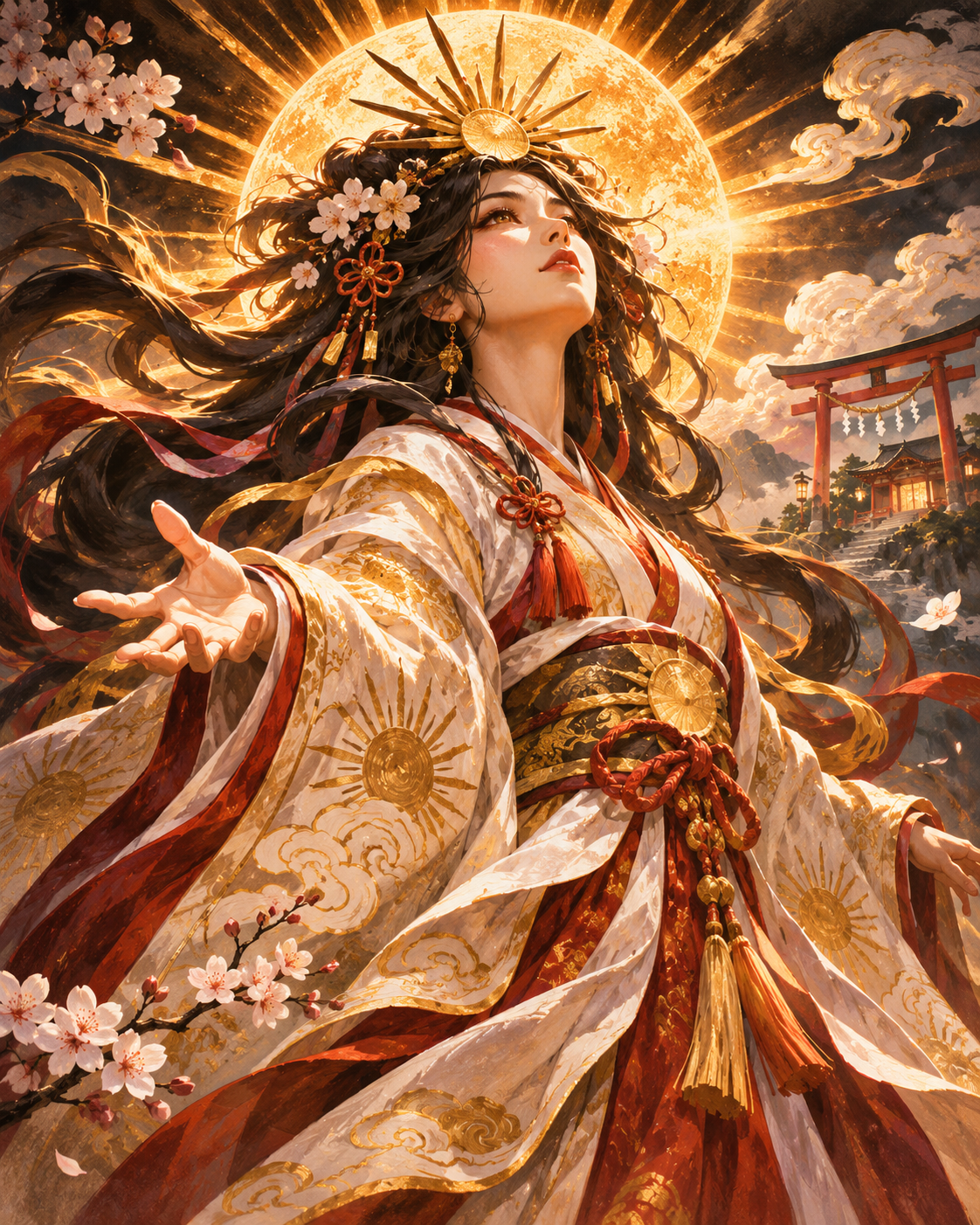
Amaterasu Omikami rules the High Plain of Heaven and is the central figure of Shinto. Her principal shrine is the Ise Grand Shrine in Mie Prefecture. The imperial house traditionally traces descent from her grandson Ninigi, which is why she is linked with kingship, rice cultivation and the sun on the Japanese flag. Her best-known story is the retreat into the heavenly cave, told below.
Susanoo: Japanese storm god
Susanoo is a stormy, unruly figure: weeping for his dead mother, quarreling with his sister, then banished from heaven. On earth he becomes a hero, killing the eight-headed serpent and marrying Kushinadahime. The same kami is both destroyer and civilizer, reflecting how storms can ruin harvests yet feed the rivers.
Tsukuyomi: Japanese moon god
Tsukuyomi has surprisingly few stories. In the Nihon Shoki he visits the food goddess Ukemochi, is disgusted by how she produces food, and kills her. Amaterasu, appalled, refuses to see him again, and that is why the sun and moon never appear together. The Kojiki does not include this episode, so treat it as one tradition among several.
Inari Okami: the fox deity
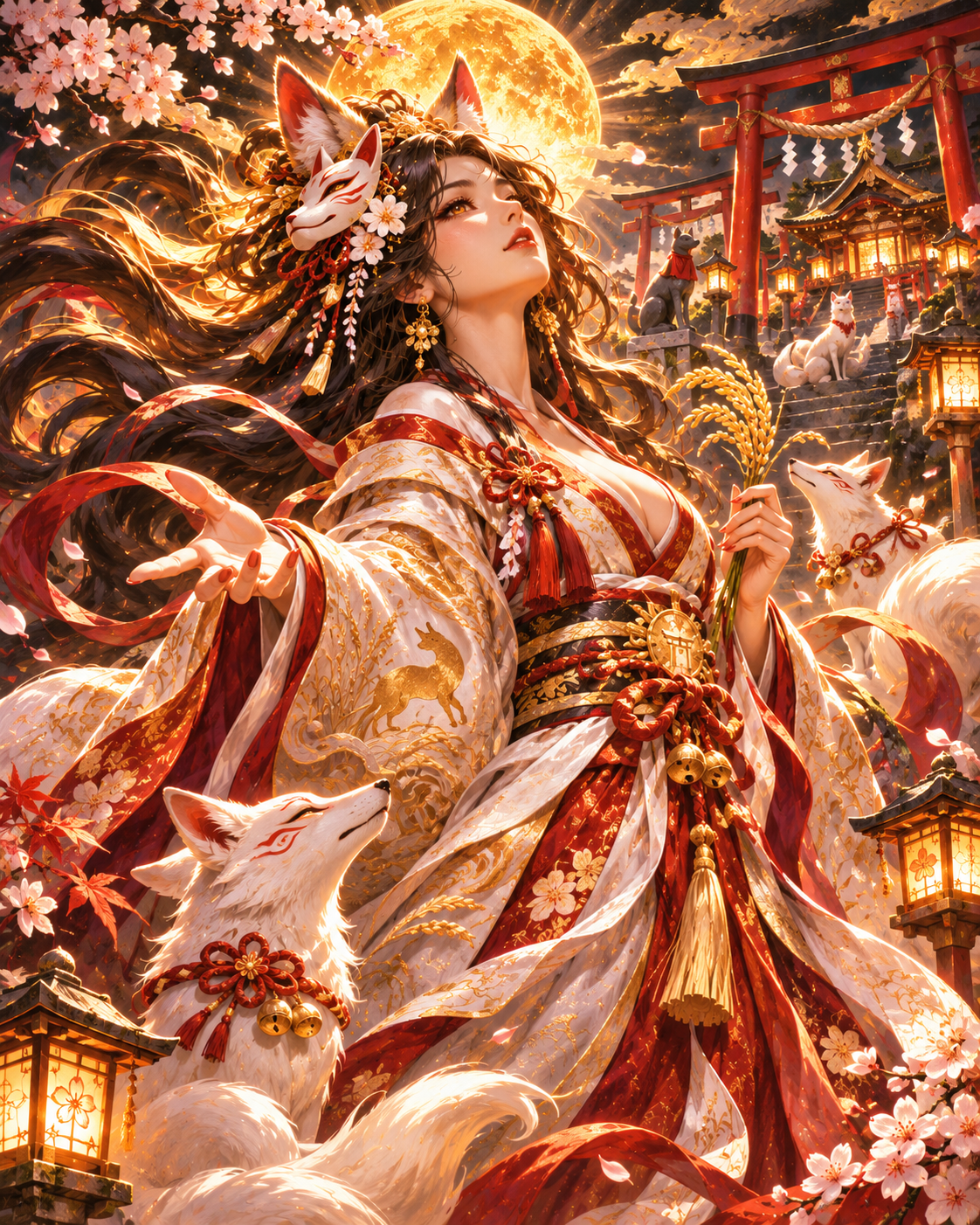
Inari is the kami of rice, fertility, prosperity and, later, business. Inari is shown in different forms, including a male, female or androgynous figure. Foxes are Inari’s messengers, not Inari itself, which clears up the common mix-up. Fushimi Inari Taisha in Kyoto, with its thousands of vermilion torii, is the most famous shrine.
Raijin and Fujin: thunder and wind
Raijin, the thunder kami, carries drums that he beats to make lightning roar; Fujin, the wind kami, carries a huge bag of winds. The pair are guardians at temple gates, including the Kaminarimon of Senso-ji in Tokyo, and appear in famed paintings and in thirteenth-century statues at Sanjusangen-do in Kyoto.
Hachiman: Japanese god of war
Hachiman is the kami of war and archery, long associated with the legendary Emperor Ojin and revered by the Minamoto warrior clan. Over time he was fused with Buddhism as “Great Bodhisattva Hachiman”. He remains one of the most widely worshipped kami, with shrines across Japan; the one at Kamakura (Tsurugaoka Hachimangu) is among the best known.
Benzaiten, Ebisu and Ryujin
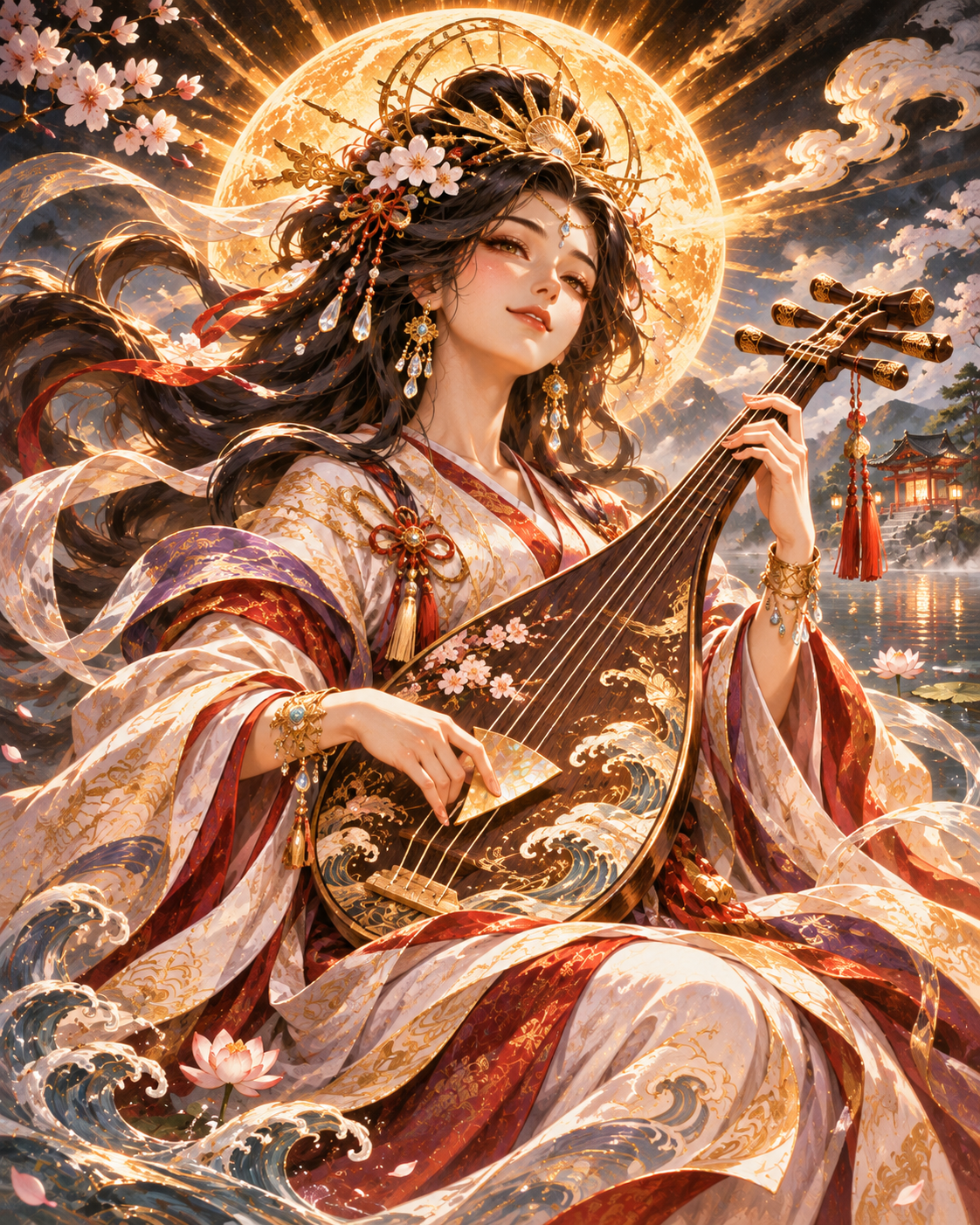
Benzaiten, patron of music, speech and water, grew from the Indian river goddess Sarasvati. Ebisu, the smiling fisherman kami of luck and commerce, is considered a native Japanese deity. Ryujin, the sea dragon king, is covered in the dragons section below. Benzaiten and Ebisu both appear in the Seven Lucky Gods.
Japanese Mythology Family Tree
A single universal Japanese mythology family tree does not exist, because the Kojiki, the Nihon Shoki and regional records disagree. What can be said safely is a general outline:
- First generation: a handful of primal “separate heavenly kami” who appear and hide.
- Second generation: Izanagi and Izanami, who bear the islands and many kami.
- Third generation: Amaterasu, Tsukuyomi and Susanoo, born from Izanagi’s purification, not from Izanami.
- Descendants: Susanoo’s line produces Okuninushi, the kami of the land of Izumo; Amaterasu’s grandson Ninigi descends to earth, and his great-grandson becomes Emperor Jimmu, the legendary first emperor.
Note the unusual detail: Amaterasu, Tsukuyomi and Susanoo are siblings by birth from Izanagi alone in the Kojiki. Other texts give different parentage, and even the order of the three varies. Present any chart as a simplified guide, not a settled genealogy.
Seven Lucky Gods of Japan
The Seven Lucky Gods of Japan (Shichifukujin) are a group of luck-bringing deities popular from around the Edo period. They are pictured aboard a treasure ship (takarabune) and visited at New Year, when many people tour shrines and temples that enshrine them. Their origins are mixed, which is why they show how Japanese belief absorbs foreign ideas:
| Lucky god | Blessing | Origin |
|---|---|---|
| Ebisu | Fishing, commerce, honest work | Japanese |
| Daikokuten | Wealth, harvest, the kitchen | Indian (Mahakala), merged with a Japanese kami |
| Bishamonten | Warriors, protection | Indian (Vaishravana, Kubera) |
| Benzaiten | Arts, knowledge, eloquence | Indian (Sarasvati) |
| Fukurokuju | Long life, wisdom | Chinese Taoist |
| Jurojin | Longevity | Chinese Taoist |
| Hotei | Contentment, abundance | Chinese Buddhist monk figure |
For Indian readers the table is a nice reminder of shared roots: three of the seven have Indian ancestry, though the Japanese versions have developed their own look and meaning.
What Are Yokai?
Yokai meaning: the word refers to strange apparitions, spirits and monsters in Japanese folklore. A Japanese Yokai list is endless because the category is deliberately broad. Artists such as Toriyama Sekien (whose picture catalogs of the 1700s gave many yokai a fixed look) and the twentieth-century manga artist Mizuki Shigeru shaped how people picture them today.
Types of Yokai
Yokai are usually grouped by form or behavior: animal shape-shifters (kitsune, tanuki, nekomata), human-like monsters (oni, tengu), water spirits (kappa), ghostly beings that look human (yuki-onna, rokurokubi), and objects that come alive (tsukumogami, such as an old umbrella that grows an eye and a tongue).
Yokai vs Kami vs Yurei vs Oni
| Term | Meaning | Typical nature |
|---|---|---|
| Kami | Sacred power or deity worshipped in Shinto | Honoured; can be benevolent or fierce |
| Yokai | Broad umbrella for strange creatures and phenomena | Mischievous, dangerous or neutral |
| Yurei | Ghost of a dead person, tied to an unfinished emotion | Sorrowful or vengeful |
| Oni | Horned ogre or demon, one kind of yokai | Fearsome, often punished or driven out |
The line is not rigid. Folklorists note that a neglected kami could be seen as a yokai, and a yokai could be enshrined and become a kami. The safest short answer is: kami are worshipped, yokai are told about, yurei are mourned and feared, oni are a specific kind of yokai.
Japanese Mythical Creatures and Monsters
These are the best-known Japanese mythical creatures. Most come from later folklore and Edo-period art rather than the Kojiki. For readers who like comparing traditions, our guides to Egyptian mythology monsters and Greek mythology cover similar ground.
Kitsune: the nine-tailed fox
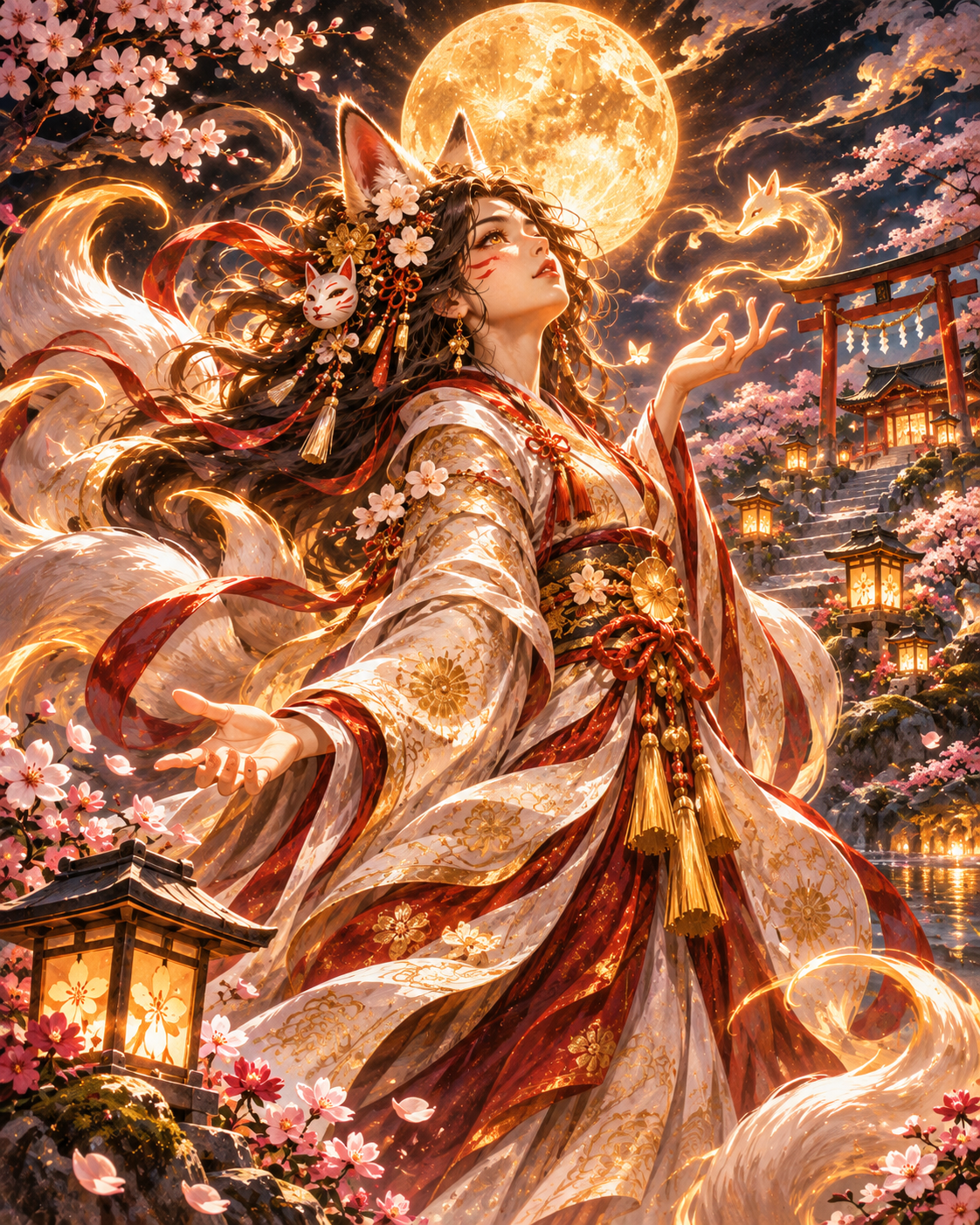
The Kitsune nine-tailed fox is a clever fox spirit that can take human form, often as a beautiful woman. In folklore, more tails mean more age and power, and nine is the highest. Some kitsune are benevolent messengers of Inari; others are tricksters or seductresses. The legend of Tamamo-no-Mae, a fox disguised as a court lady, is the best-known dark tale and is linked to the “Killing Stone” at Nasu.
Oni: Japanese demons
The Oni Japanese demon is a hulking, horned ogre with tiger-skin loincloth and an iron club, usually red or blue. Oni guard Buddhist hells in some art, but they also appear as raiders in folktales. At the Setsubun festival in early February, people throw roasted soybeans and shout to drive oni out and welcome fortune in.
Tengu: mountain goblins
Tengu in Japanese mythology began as meteor-like omens borrowed from Chinese belief and became mountain spirits with red faces and long noses, or birdlike beaks. Linked to ascetic mountain monks (yamabushi), they are proud, skilled in martial arts and can punish arrogance. Legend says the tengu of Mount Kurama trained the warrior Minamoto no Yoshitsune.
Kappa: river imp
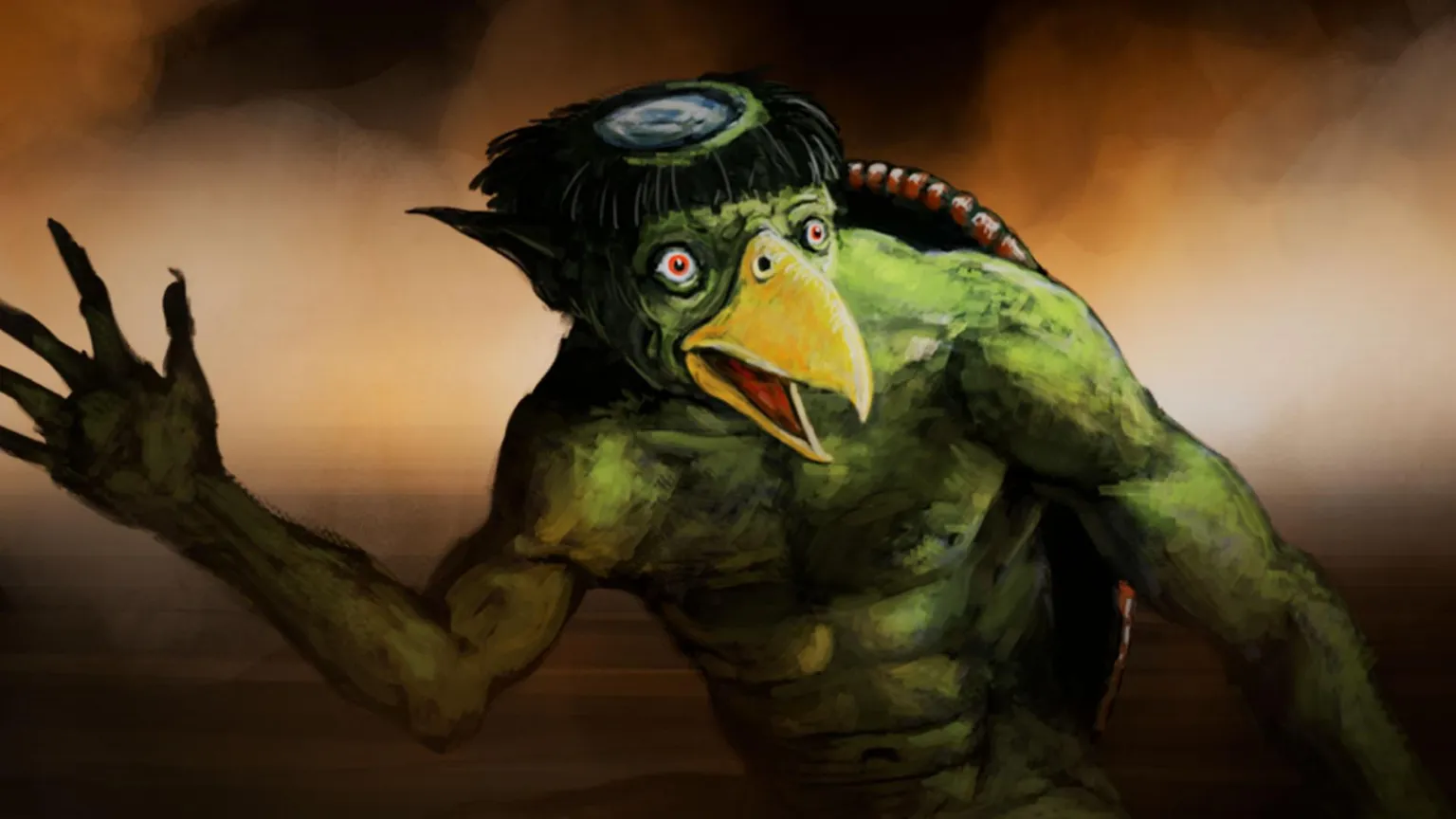
The Kappa Japanese folklore creature is a green, turtle-shelled water sprite with a water-filled dish on its head. It loves cucumbers, challenges people to sumo and is said to drag careless swimmers under. If you bow, the polite kappa bows back and spills its water, losing its strength. Parents once used the story to keep children away from deep rivers.
Yuki-onna: the snow woman
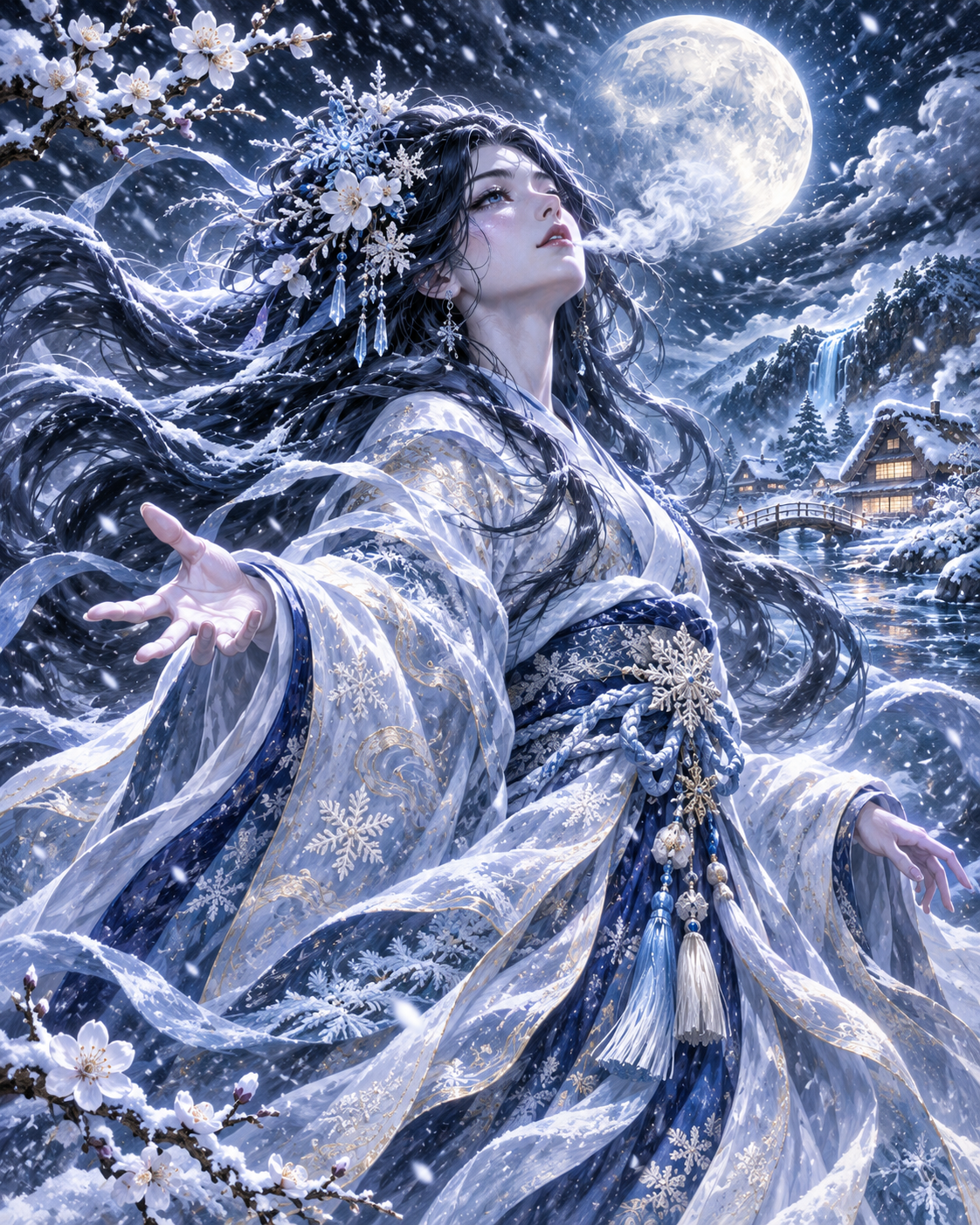
Yuki-onna is a pale woman in white who appears in blizzards. In many regional tales she freezes travelers with her breath. Lafcadio Hearn’s 1904 retelling in Kwaidan popularized the version where she spares a young man, later marries him, and leaves when he breaks his promise of silence. This is a literary favorite, not a single ancient text.
Gashadokuro: giant skeleton
Gashadokuro is a giant skeleton, formed (in modern retellings) from the bones of people who died unburied in battle or famine, that roams at night and bites its victims. Its fame is largely modern, built on an Edo-period print of a skeleton specter and later manga and games, so treat it as popular folklore rather than an ancient religious figure.
Jorogumo: the spider woman
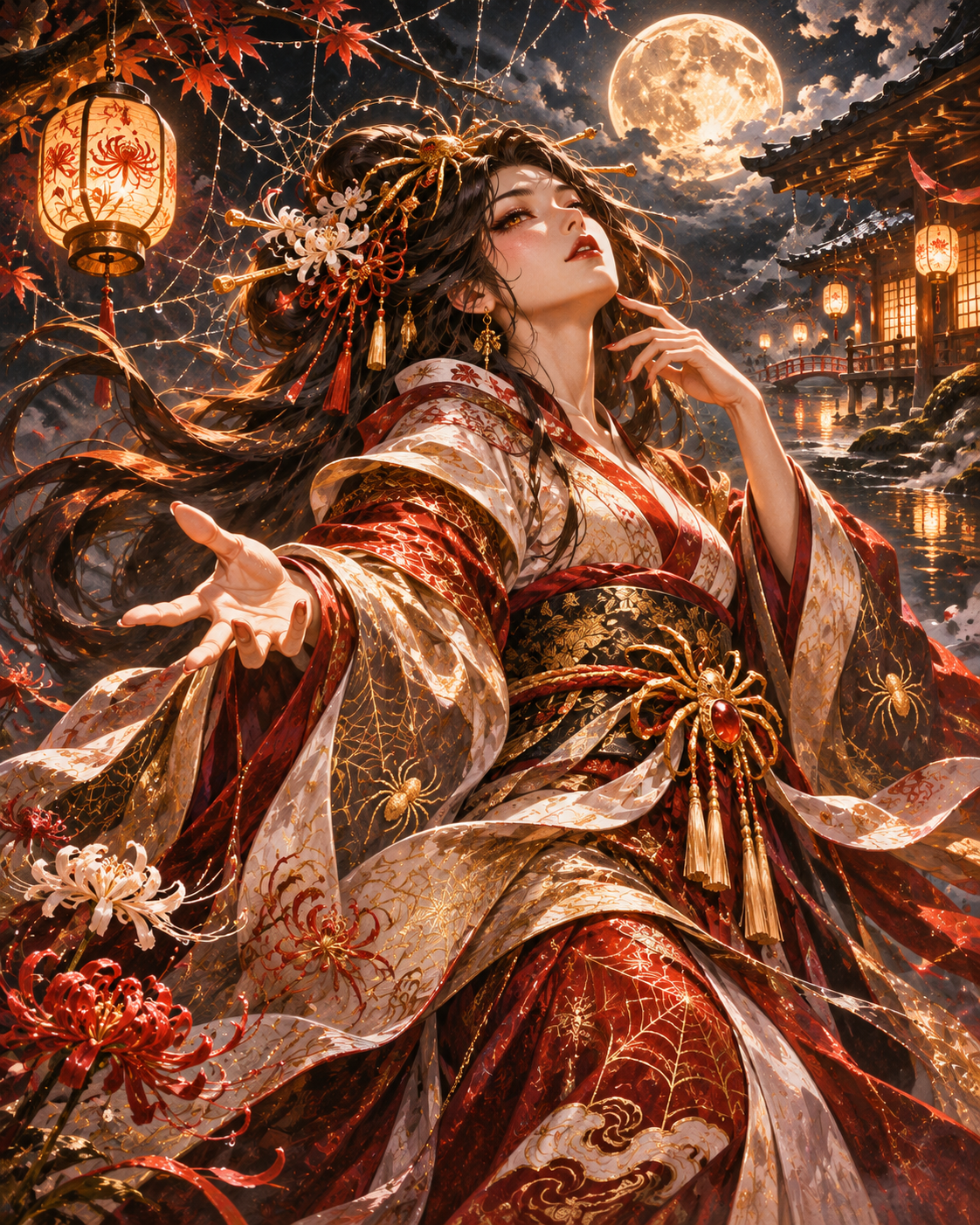
Jorogumo, “binding bride” or “prostitute spider”, is a spider that grows old enough to take the form of a beautiful woman and lure men into webs. Tales place her near waterfalls and in old houses. The creature appears in Edo-period collections and many modern games.
Nekomata: the cat spirit
The Nekomata Japanese cat spirit is a cat with a split tail that has lived long enough to gain magical abilities, sometimes raising the dead. Old cats could also be called bakeneko, “changed cats”. Folk belief that old cats can turn dangerous led some households to cut kittens’ tails short.
Tanuki: the raccoon dog
Tanuki Japanese folklore shows a jolly, belly-drumming shape-shifter who uses leaves as magic money and loves sake. The tanuki is a real animal, the Japanese raccoon dog, and statues of the mythic version stand outside many shops as a good-luck charm. In the tale of Bunbuku Chagama, a tanuki turns into a tea kettle.
Other notable yokai
- Nurikabe: an invisible “plastered wall” that blocks travelers at night; the story is associated with Fukuoka folklore and was popularized by Mizuki Shigeru.
- Rokurokubi: a person whose neck stretches at night, made famous in Hearn’s retellings.
- Baku: a dream-eating chimera, covered in the next section.
Japanese Dragons and Legendary Beasts
The Japanese dragon Ryu (also read “tatsu”) differs from the Western fire-breathing dragon: it is a wingless, serpentine water spirit, usually three-clawed in classic Japanese art, associated with rain, rivers and the sea. Chinese dragon lore influenced it, yet native snake and water deities are also part of the picture.
Ryujin: Japanese dragon god
Ryujin, the “dragon god” or sea king, lives in the palace Ryugu-jo beneath the waves and controls the tides with magic jewels. In the Kojiki a hero, Hoori, visits the sea palace, marries the sea king’s daughter Toyotama-hime and returns with tide jewels; their grandson is Emperor Jimmu. This ties the imperial line to the sea. The Urashima Taro story is also set in the dragon palace.
Yamata no Orochi: the eight-headed serpent
This huge serpent with eight heads and eight tails demanded a maiden each year in Izumo. Susanoo agreed to save the last daughter, Kushinadahime, if he could marry her. He set out eight vats of strong sake, the serpent’s heads drank and fell asleep, and he cut it apart. In one tail he found a sword, later called Kusanagi. Many scholars read the story as a memory of flooding rivers or conflict with local powers, though that is interpretation, not fact.
Baku: the dream-eating creature
The Baku dream-eating creature, usually pictured with an elephant’s trunk, a tiger’s paws and an ox’s body, came from Chinese tradition. In Japan people kept images of it to ward off nightmares, and a bedtime saying invites the baku to eat bad dreams. It is a charm and bedtime folklore, not a major Shinto deity.
Japanese Ghosts, Shinigami and the Underworld
Three different layers are often blended in online articles, so it helps to separate them: ancient myth (Yomi), later folklore (yurei) and modern popular culture (shinigami as seen in manga).
Yurei: Japanese ghosts
Yurei Japanese ghosts are spirits of the dead who could not move on, usually because of a violent death, betrayal or lack of proper funeral rites. The classic image of a pale figure in a white burial kimono with long black hair and no visible feet became standard in the Edo period through painting and kabuki. Famous stories include Oiwa (from the play Yotsuya Kaidan) and Okiku, the ghost of the plate-counting well.
Shinigami: Japanese death spirit
Shinigami Japanese mythology needs a careful answer. The word means “death god”, but shinigami are not prominent in the Kojiki or Nihon Shoki. The concept of spirits that tempt people toward death appears in later folklore and in Edo-period and Meiji-era theatre and storytelling, partly shaped by imported Western death-personification. Today most people know shinigami from manga and anime such as Death Note and Bleach, which use the idea creatively and differ from each other and from folklore. In Buddhism, the judge of the dead is Enma, the Japanese form of the Indian Yama, a link Indian readers will recognize.
Yomi: the Japanese underworld
In the myth, Yomi is a gloomy land of the dead beyond a sloping pass. It is defined by pollution and decay, not moral punishment: Izanami becomes its ruler, and eating its food ties one to it. The Japanese underworld mythology here is quite different from later Buddhist hells with judgment and torture. Compare the Egyptian afterlife in our guide to the Duat.
Famous Japanese Mythology Stories and Legends
These are the best-loved Japanese mythology stories and Japanese legends, with the source type noted.
Amaterasu and the heavenly cave
After Susanoo’s misbehavior in heaven, including wrecking rice paddies and throwing a flayed horse into her weaving hall, Amaterasu hides in a cave and the world goes dark. The kami gather outside. They hang a mirror and jewels on a tree, a rooster crows, and the goddess Ame-no-Uzume dances so wildly that the assembly roars with laughter. Curious, Amaterasu peeks out, sees her reflection in the mirror, and is pulled out by the strong kami Ame-no-Tajikarao. Light returns. The story is in both chronicles and explains the origin of the sacred mirror, ritual dance and the sun’s cycle. (Source: Kojiki and Nihon Shoki.)
Susanoo and Yamata no Orochi
Summarized above: the banished storm god kills the serpent with a sake trap and gains the sword Kusanagi. (Source: Kojiki and Nihon Shoki.)
Momotaro: the Peach Boy
An elderly couple find a giant peach and, inside, a baby boy. Grown up, Momotaro takes millet dumplings (kibi dango) and sets off to Onigashima, “Demon Island”. He wins a dog, a monkey and a pheasant as allies by sharing the dumplings, defeats the oni and returns with treasure. This is a folktale, in its familiar form mainly from the Edo and Meiji eras, with strong links to the Okayama region. It is a children’s folktale, not a Shinto myth.
Urashima Taro
A fisherman saves a turtle and is taken to the sea king’s palace. After what feels like a few days he returns home to find centuries passed. He opens the forbidden box (tamatebako) the princess gave him and ages instantly. A very early form of the story is already mentioned in eighth-century records, which makes it one of Japan’s oldest legends, though the familiar version is later.
Tale of the Bamboo Cutter and Princess Kaguya
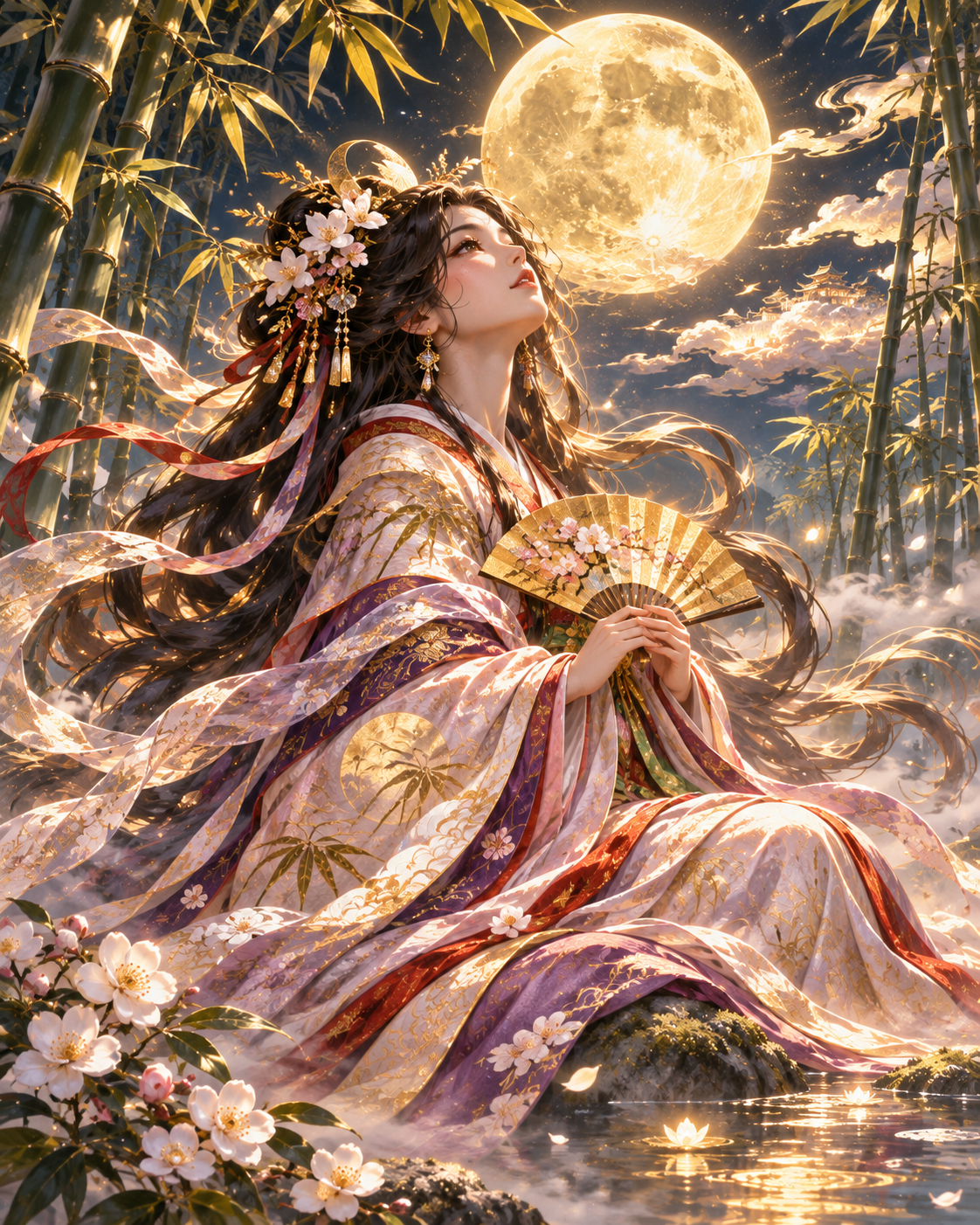
A bamboo cutter finds a tiny girl in a glowing stalk. She grows into a woman of unmatched beauty and sets impossible tasks for five noble suitors and even the emperor. On the full moon, people from the moon come to take her home, and she leaves behind an elixir of immortality. The Tale of the Bamboo Cutter (Taketori Monogatari, around the tenth century) is often called the oldest Japanese prose narrative, and was adapted in Studio Ghibli’s 2013 film The Tale of the Princess Kaguya.
Japanese Mythology Symbols and Their Meanings
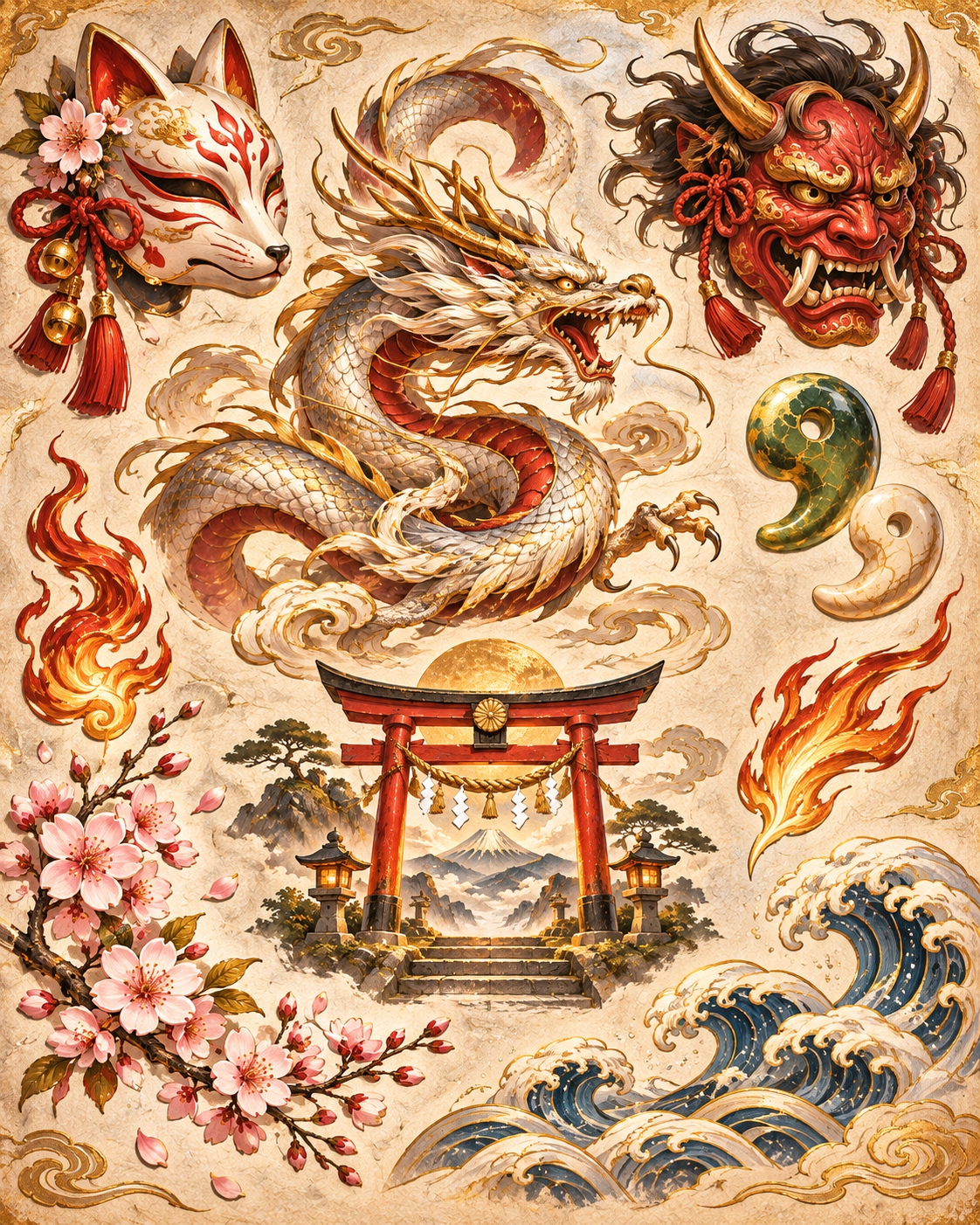
Not all symbols carry the same weight. Religious symbols belong to living Shinto practice, folklore motifs come from stories, and modern interpretations are fashion or fan art. The table separates them.
| Symbol | Meaning | Type |
|---|---|---|
| Torii gate | Marks the entrance to sacred space; passing through moves from ordinary to sacred ground | Religious |
| Magatama | Comma-shaped bead, ancient jewel, part of the Imperial Regalia | Religious and historical |
| Sacred mirror | Reflects the sun; honesty and the presence of the kami | Religious |
| Sacred sword | Authority and protection | Religious and historical |
| Kitsune mask | Fox of Inari, worn at festivals and sold at shrines | Folklore and festival |
| Oni mask | Evil to be driven away, used at Setsubun | Folklore and festival |
Torii gate meaning
The torii gate meaning is simple: it is a threshold. Most shrines have at least one, often in wood or stone, and Fushimi Inari’s thousands are donated by businesses and individuals. A torii does not itself depict a story, but it is the single most recognized sign of Shinto.
Magatama, mirrors and swords
Magatama are ancient curved beads found in burial mounds; the mirror and sword are the other two Imperial treasures discussed next. Together they are the best examples of Japanese mythology sacred symbols with a physical, historical presence.
Masks and family crests
Fox and oni masks are festival and folklore items. If you enjoy Japanese design, our guides to Japanese Kamon family crests and Sashiko stitch patterns show how nature and luck motifs spread into everyday craft.
Legendary Weapons and Sacred Treasures
The Three Sacred Treasures of Japan, also called the Imperial Regalia of Japan, are the mirror, the sword and the jewel. By tradition they were given to Ninigi when he descended to earth and passed down to the emperors.
- Yata no Kagami (the mirror): linked to the cave story and traditionally enshrined at Ise.
- Kusanagi no Tsurugi (the sword): the sword from the serpent’s tail; traditionally enshrined at Atsuta Shrine in Nagoya.
- Yasakani no Magatama (the jewel): a curved jewel traditionally kept at the Imperial Palace.
The treasures are not displayed to the public, and their exact physical forms are not publicly known, so the historical reality behind the legend can’t be verified. The sword’s name means “grass-cutting sword” and is explained in a later legend in which the hero Yamato Takeru used it to cut burning grass.
Japanese Mythology in Anime and Video Games
Modern creators borrow names and ideas freely. When searching Japanese mythology in anime, remember that the stories are adaptations and often rewrite the myth.
- Naruto: the Nine-Tailed Fox draws on kitsune lore, and abilities such as Amaterasu, Tsukuyomi, Susanoo and Izanagi borrow the kami names; the technique powers are fictional.
- Demon Slayer: its demons are in the spirit of oni, but the setting, rules and characters are original; sun imagery echoes the importance of the sun in Japanese culture.
- Jujutsu Kaisen: uses curses and spirits similar in feel to yokai; the villain Sukuna takes his name from a figure in the Nihon Shoki who is described as a two-faced man, though the manga story is invented.
- Games: Okami centers on a white wolf as Amaterasu and retells folklore; Nioh features yokai; Pokemon such as Ninetales are inspired by kitsune.
This section is not an episode guide or walkthrough; it only flags where fiction touches the myths.
Japanese Mythology Art, Tattoos and Wallpapers
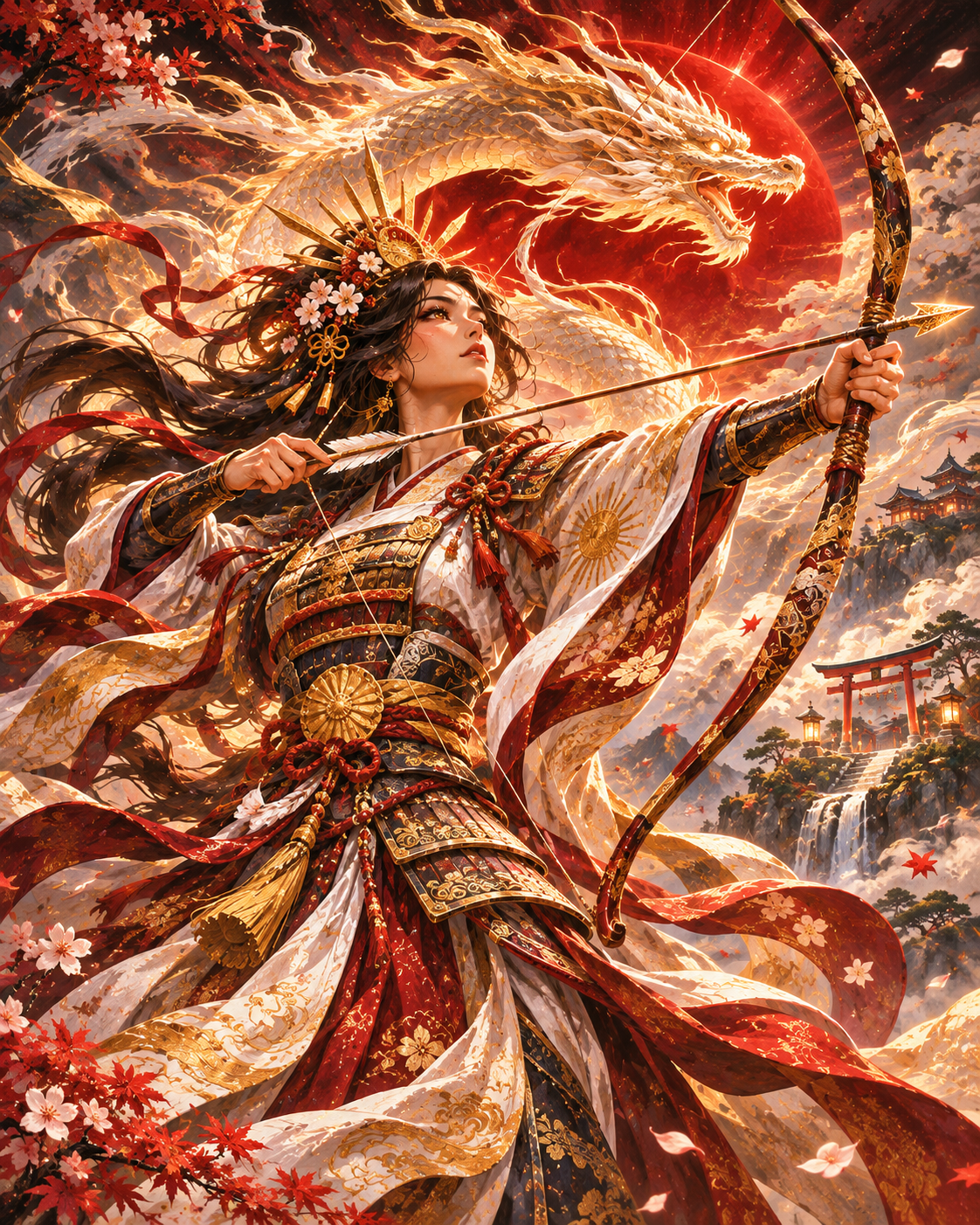
Japanese mythology art ranges from classic ukiyo-e woodblock prints, such as those of Utagawa Kuniyoshi and Katsushika Hokusai, to Noh masks, scroll paintings and modern illustration. Popular themes are the sun goddess in her cave, Susanoo against the serpent, kitsune under a torii, dragons among waves, and yokai parades.
Japanese Mythology Female Characters and Goddesses
Japanese goddess names: Amaterasu (sun), Izanami (creation and Yomi), Benzaiten (music and arts), Konohanasakuya-hime (blossoms and mountains), and Ame-no-Uzume (dance and the heavenly cave myth). Female Kitsune forms and Yuki-onna belong to folklore rather than a single pantheon of goddesses.
Amaterasu and Benzaiten are goddesses, while Yuki-onna and Jorogumo are female figures from Yokai folklore. Princess Kaguya is the heroine of the Tale of the Bamboo Cutter. The illustrations above are modern artistic interpretations; the female samurai fantasy artwork is not a documented portrait of an ancient goddess.
Japanese Mythology Tattoo Designs and Meanings
A Japanese dragon tattoo may evoke water, strength or protection. Kitsune mask tattoos draw on shape-shifting fox folklore. Oni masks and Hannya masks are distinct: Hannya represents a woman transformed by jealousy or anguish in Noh theatre. Koi fish tattoos may symbolize perseverance. Meanings vary by tradition, design and artist.
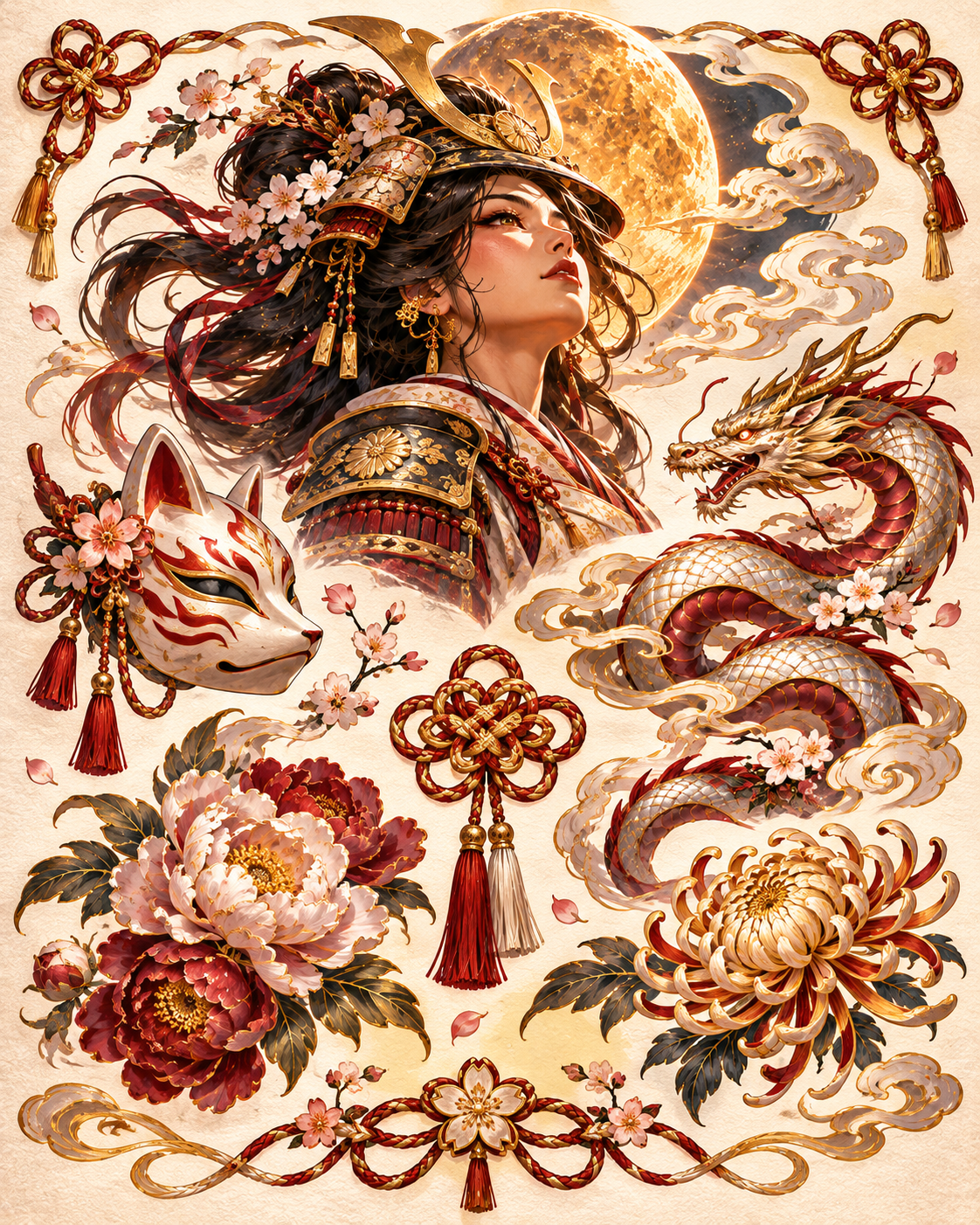
Japanese mythology tattoos commonly feature dragons, kitsune, oni and hannya (the jealous-woman Noh mask), tengu, koi and waves. Many designs follow the traditional irezumi style with bold outlines and background waves or clouds. If you plan one, research the meaning, because a motif can carry religious or cultural weight, and remember that tattoos can still be restricted in some Japanese public baths and gyms. For a similar look at another tradition, see our Egyptian mythology tattoo guide.
Japanese Mythology Art and Mobile Wallpapers
Japanese mythology wallpapers usually feature a moonlit torii, a nine-tailed fox, a dragon over the sea, Amaterasu with a radiant sun, or a yokai night procession. The original fantasy illustrations included in this guide can also be used as mobile wallpaper artwork.
Japanese Mythology vs Other Mythologies
Comparison helps, but similarity of themes does not mean a shared origin. Here are fair, concise contrasts.
| Tradition | Similar to Japanese | Different from Japanese |
|---|---|---|
| Greek | Sun, sea and storm deities; trips to an underworld | Greek gods are a fixed Olympian family; Japanese kami are countless and tied to places |
| Norse | Storm gods, giant slayers, a tie to fate | Norse myth ends in Ragnarok; Japanese myth has no comparable final apocalypse |
| Egyptian | Sun deity at the top, divine kingship | Egypt stresses a moral judgment in the afterlife; Yomi is about pollution and separation |
| Hindu | Multiple deities, ritual purity, shared deities through Buddhism | Shinto has no central scripture or avatar doctrine; Hindu texts developed on a different timeline |
The Buddhist route makes the Hindu comparison special: Sarasvati became Benzaiten, Kubera and Vaishravana became Bishamonten, and Yama became Enma. That is a documented transmission through Buddhism, not proof that the deities are identical. For more cross-tradition reading, see Egyptian vs Greek mythology and Egyptian vs Norse mythology, and our Norse mythology visual guide.
Explore the Greek mythology gods and monsters image guide and Norse mythology images and wallpapers for related visual traditions.
Frequently Asked Questions
What is Japanese mythology?
It is the set of creation stories, kami legends and folklore of Japan, preserved mainly in the Kojiki and Nihon Shoki and expanded by later folktales and art.
Who are the most important Japanese gods?
Amaterasu (sun), Susanoo (storm and sea), Tsukuyomi (moon), Izanagi and Izanami (creators), Inari (rice and prosperity) and Hachiman (war) are the best known.
Who is Amaterasu in Japanese mythology?
She is the sun goddess and chief kami of Shinto, enshrined at Ise, and the traditional ancestor of the imperial family.
What are Yokai in Japanese folklore?
Yokai are strange creatures, spirits and phenomena, from helpful to harmful, a broad category that includes kitsune, kappa, tengu and many others.
What is the most famous Japanese mythical creature?
There is no official ranking, but the kitsune, oni and dragon are probably the most widely recognized.
What is a nine-tailed Kitsune?
A very old, powerful fox spirit in folklore. More tails indicate greater age and power, and the nine-tailed fox is the highest rank.
What is the difference between Oni and Yokai?
Yokai is the large category; oni are one type, the horned ogres.
What is Shinigami in Japanese mythology?
A “death god” or death spirit from later folklore and popular culture, not a major figure in the ancient chronicles.
Who is the Japanese dragon god?
Ryujin, the dragon king of the sea, who lives in the palace Ryugu-jo and controls the tides.
What are the Three Sacred Treasures of Japan?
The mirror Yata no Kagami, the sword Kusanagi no Tsurugi and the jewel Yasakani no Magatama.
What are the Seven Lucky Gods of Japan?
Ebisu, Daikokuten, Bishamonten, Benzaiten, Fukurokuju, Jurojin and Hotei, popular luck-bringing deities.
Who created Japan according to Japanese mythology?
The kami Izanagi and Izanami, who stirred the sea with a jeweled spear and gave birth to the islands.
Is Japanese mythology the same as Shinto?
No. Shinto is a living religion; the myths are stories that Shinto draws on. Many folktales and yokai are outside Shinto or come from Buddhism and folk belief.
Which anime are inspired by Japanese mythology?
Naruto, Demon Slayer, Jujutsu Kaisen, Inuyasha and Studio Ghibli films such as Spirited Away and Princess Mononoke borrow ideas from kami and yokai lore, though they are fictional adaptations.
What are the most famous Japanese mythology stories?
Amaterasu and the heavenly cave, Susanoo and Yamata no Orochi, Izanagi’s journey to Yomi, Momotaro, Urashima Taro and the Tale of the Bamboo Cutter.
Conclusion
Japanese mythology is best read as layers: sacred chronicles about the sun goddess and the creation of the islands, Buddhist and Chinese additions, Edo-period monsters and ghosts, and modern anime and games. The strongest takeaway is that Japanese tradition sees the sacred in nature, from sunlight to rivers to old trees, and that Shinto and its stories are still part of daily life, shrine visits and festivals. Use the Kojiki and Nihon Shoki for the oldest myths, folklore collections for yokai, and popular culture for enjoyment, while keeping the three apart.
Reference sources: Kojiki and Nihon Shoki translations; Encyclopedia of Shinto (Kokugakuin University); Encyclopaedia Britannica; World History Encyclopedia; Mythopedia.













Share Your Opinion
Comments are closed on this post.