 Vista
Every region of India has its own handloom identity: silk weaves, ikat dyeing, zari borders and regional sarees. If you are looking for an Indian handloom map, traditional textiles of India state wise, or Indian saree types by state, this guide maps well-known handloom textiles to the regions where they are traditionally made, and answers which Indian state is famous for which textile. Many have Geographical Indication (GI) status, but a style is often woven in more than one place, so this is a representative list, not a complete or exclusive one.
What handloom and GI mean
A handloom is a loom operated by hand, without electric power. A GI tag links a product to its place of origin and recognised quality, indicating that its character comes from the region’s tradition and craft. Registered handloom GIs can be checked in the IP India GI registry and in the handloom compendium of the Development Commissioner (Handlooms). Note that “has a GI tag” and “woven on a handloom” are related but not identical claims, so check both when buying.
Handlooms of north and central India
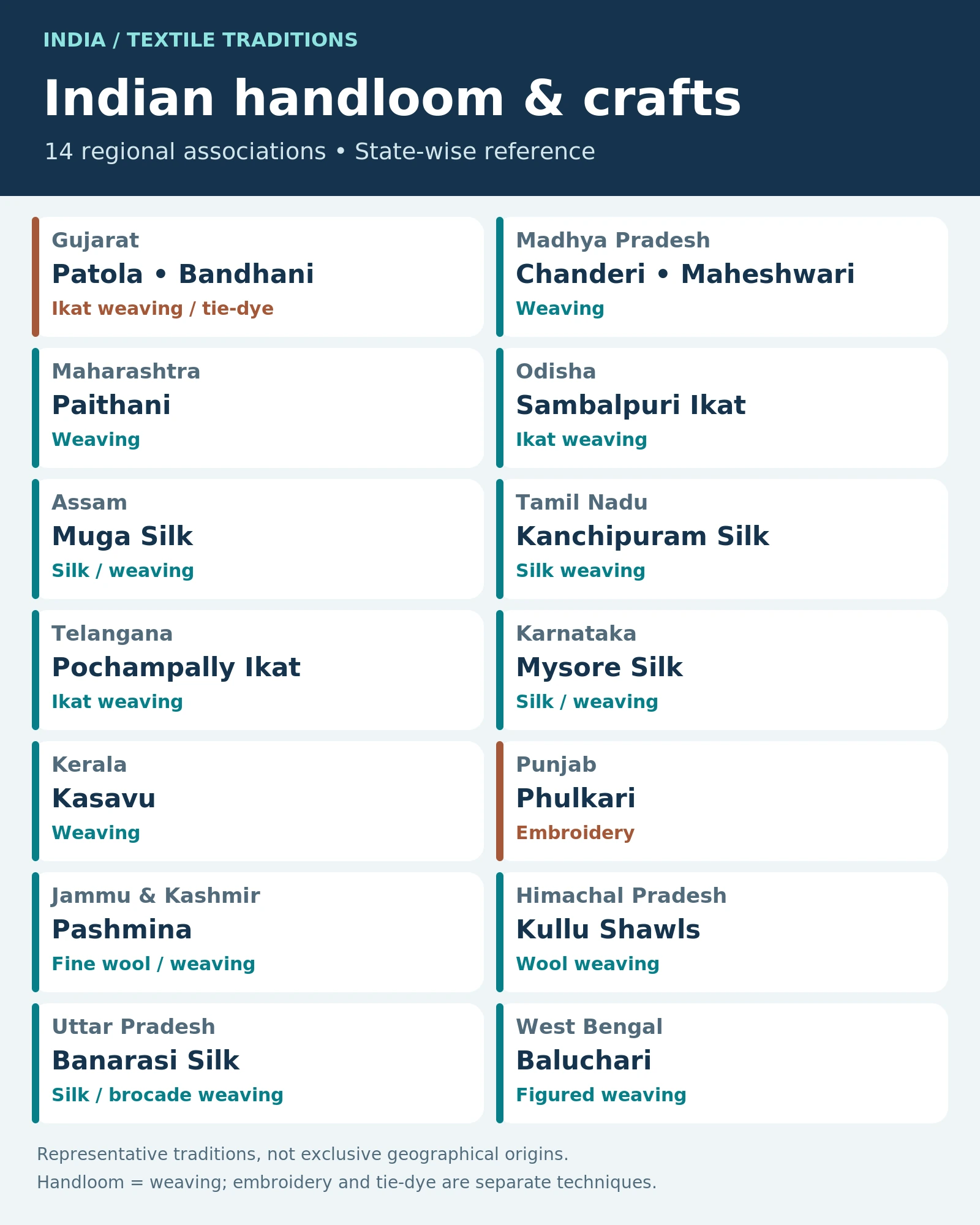
Banarasi, Chanderi and Maheshwar
- Banarasi silk: Uttar Pradesh, Varanasi region.
- Chanderi: Madhya Pradesh.
- Maheshwar (Maheshwari): Madhya Pradesh.
- Kota Doria: Rajasthan.
- Kullu shawl: Himachal Pradesh; Kani shawl: Jammu and Kashmir.
Eastern and north-eastern weaves
Muga, Bhagalpur and Odisha ikat
- Muga silk: Assam.
- Bhagalpur silk: Bihar.
- Sambalpuri Bandha, Bomkai, Khandua and Kotpad: Odisha.
Western India
Paithani and Solapur Chaddar
Maharashtra is known for Paithani silk sarees and the Solapur Chaddar, both listed among its GI handlooms. Gujarat and Rajasthan have many further regional weaving and printing traditions beyond this list.
Southern handlooms
Kanchipuram, Pochampally and more
- Kancheepuram silk: Tamil Nadu.
- Pochampally ikat and Gadwal: Telangana.
- Uppada Jamdani, Venkatagiri, Mangalagiri, Dharmavaram: Andhra Pradesh.
- Ilkal saree: Karnataka.
- Kuthampully, Chendamangalam, Balaramapuram: Kerala.
State-wise summary table
| Region / state | Representative handloom textiles |
|---|---|
| Uttar Pradesh | Banarasi silk |
| Madhya Pradesh | Chanderi, Maheshwar |
| Rajasthan | Kota Doria |
| Bihar | Bhagalpur silk |
| Assam | Muga silk |
| Odisha | Sambalpuri Bandha, Bomkai, Khandua, Kotpad |
| Maharashtra | Paithani, Solapur Chaddar |
| Tamil Nadu | Kancheepuram silk |
| Telangana | Pochampally ikat, Gadwal |
| Andhra Pradesh | Uppada Jamdani, Venkatagiri, Mangalagiri, Dharmavaram |
| Karnataka | Ilkal saree |
| Kerala | Kuthampully, Chendamangalam, Balaramapuram |
Treat this as a starter map. A style may also be made in neighbouring areas, and each state has many more handloom textiles than listed here.
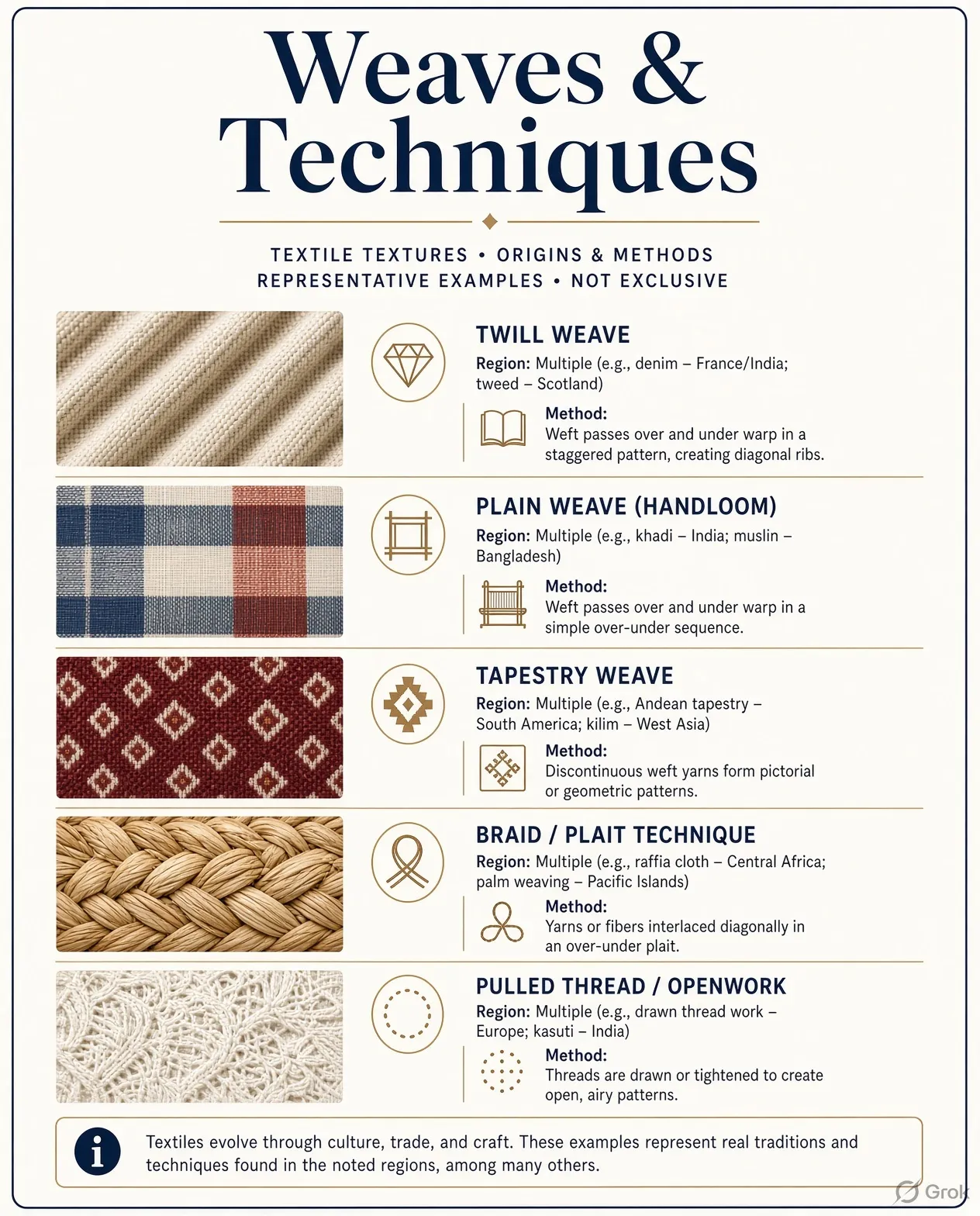
Weaving, printing and embroidery
| Technique | How it is made | Examples |
|---|---|---|
| Weaving | Cloth built from threads on a loom | Banarasi, Chanderi |
| Ikat | Threads are resist-dyed before weaving | Pochampally |
| Block printing | Patterns stamped on finished cloth | Bagru, Sanganeri |
| Embroidery | Thread stitched onto finished cloth | Sandur Lambani |
Worked examples, practical checks and limitations
When buying a handloom saree, ask for GI or handloom-mark proof and learn how to tell hand weaving from powerloom imitation. For example, if a saree is sold as “Pochampally”, ask whether it is true ikat (threads dyed before weaving) or merely a printed look-alike. The map here is representative: a style can be made in several places and the list is not exhaustive.
- Ask the seller to name the fabric, the fibre (silk or cotton) and the weaver or society on the bill.
- Be wary of very cheap “Banarasi” or “Chanderi”; machine imitations are common.
- Certified weaver societies and government handloom emporia are usually more reliable sources.
Common mistakes and when to seek expert confirmation
Calling every silk saree “Banarasi” or confusing printed cloth with woven cloth are common errors. For a costly purchase, confirm with a certified weaver, a cooperative society or a government handloom emporium.
Frequently asked questions
Which Indian state is famous for which textile?
For example Banarasi is Uttar Pradesh, Chanderi Madhya Pradesh, Paithani Maharashtra, Kancheepuram Tamil Nadu and Pochampally Telangana. See the table above.
What does a GI tag mean for a saree?
It legally ties the product name to its region and recognised qualities.
What is ikat?
A technique where threads are resist-dyed before they are woven.
How can I tell handloom from powerloom?
Slight irregularities can suggest hand weaving, but rely on certification or the handloom mark rather than looks alone.
Are block prints like Bagru and Sanganeri handloom weaves?
No. They are printing traditions applied to finished cloth, which is different from weaving.
Is each textile made in only one state?
Often not. Many styles are made in neighbouring areas too, so treat the list as representative, not exclusive.
Conclusion
Knowing the region, the technique and the GI status makes India’s handloom variety much easier to read, and to buy from with confidence while supporting genuine weavers.
Sources
- Handloom GI compendium (Development Commissioner, Handlooms / NIFT)
- IP India: Geographical Indications registry




















Share Your Opinion
Comments are closed on this post.