 Vista
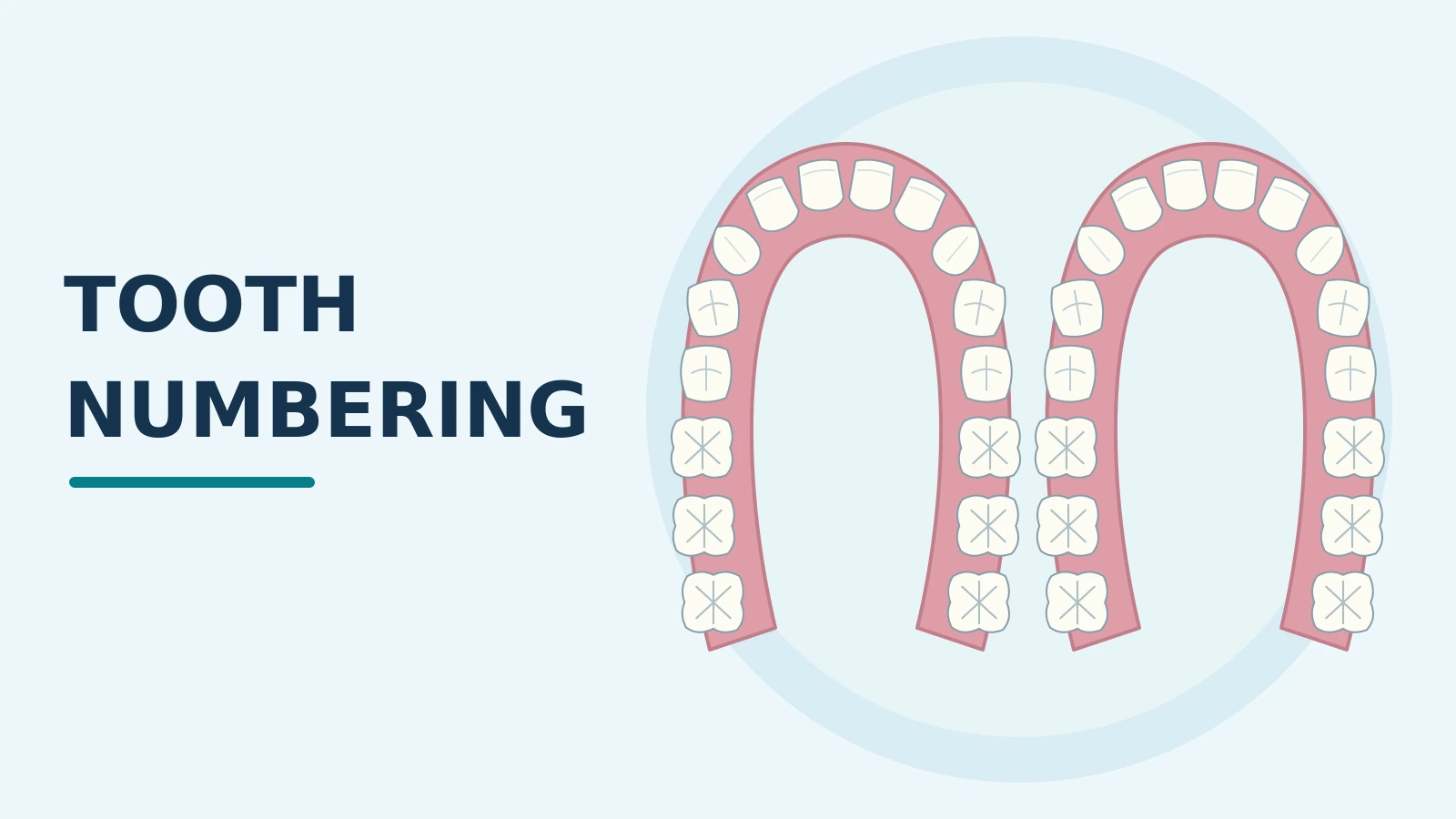
Dental notes and X-ray reports often refer to teeth by number, such as “tooth 36” or “tooth 18”. If you are looking for a human tooth numbering chart, an FDI vs Universal tooth numbering comparison, a Palmer notation dental chart or simply “what tooth number is my wisdom tooth”, this guide covers it. Three systems are in common use: FDI two-digit notation (ISO 3950), the Universal Numbering System and Palmer notation. The article shows how to convert between them for permanent teeth. It is educational only and does not diagnose anything: ask your dentist to confirm any tooth number on your own chart.
Adult teeth and dental quadrants
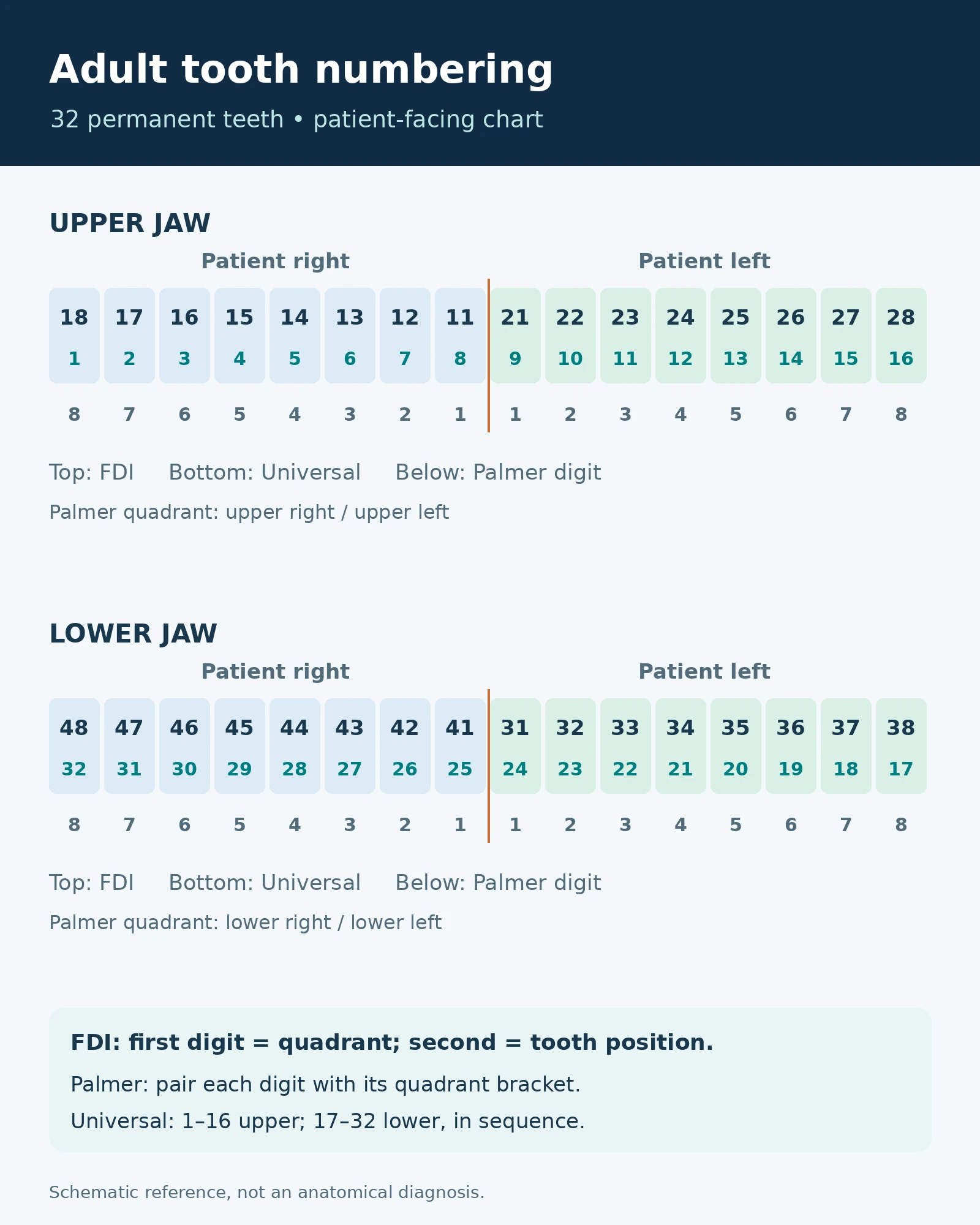
The mouth is divided into four quadrants: upper right, upper left, lower left and lower right, always from the patient’s point of view. Each quadrant has 8 permanent teeth, 32 in total. Charts are traditionally drawn from the dentist’s view, so the patient’s right is on the chart’s left, which is the most common source of confusion for first-time readers.
Incisors, canines, premolars and molars
| Position from midline (per quadrant) | Tooth |
|---|---|
| 1 | Central incisor |
| 2 | Lateral incisor |
| 3 | Canine |
| 4 | First premolar |
| 5 | Second premolar |
| 6 | First molar |
| 7 | Second molar |
| 8 | Third molar (wisdom tooth) |
Incisors and canines at the front cut and tear food, while premolars and molars at the back crush and grind. The same 1 to 8 count from the midline is the basis of all three numbering systems.
FDI two-digit tooth notation
FDI notation, also called ISO 3950, is the most widely used system in the world. It uses two digits: the first gives the quadrant and the second gives the tooth within that quadrant. Read the two digits separately, for example “three, six” rather than “thirty-six”.
Quadrant and tooth position
- Permanent teeth, first digit: 1 upper right, 2 upper left, 3 lower left, 4 lower right.
- Second digit: 1 to 8, counting back from the midline as in the table above.
- Examples: 36 is the lower left first molar; 11 is the upper right central incisor; 24 is the upper left first premolar.
Universal and Palmer numbering
The Universal Numbering System, used mainly in the United States, numbers permanent teeth 1 to 32 and primary teeth with letters A to T. Counting starts at the upper right third molar (1), runs along the upper arch to the upper left third molar (16), continues to the lower left third molar (17) and ends at the lower right third molar (32). Palmer notation writes a quadrant bracket symbol with the numbers 1 to 8 for permanent teeth and letters A to E for primary teeth. Because the bracket symbols do not display in plain text, this page writes Palmer positions in words. ADA’s own standard (No. 3950) describes the two-digit ISO system.
Adult versus primary teeth and orientation
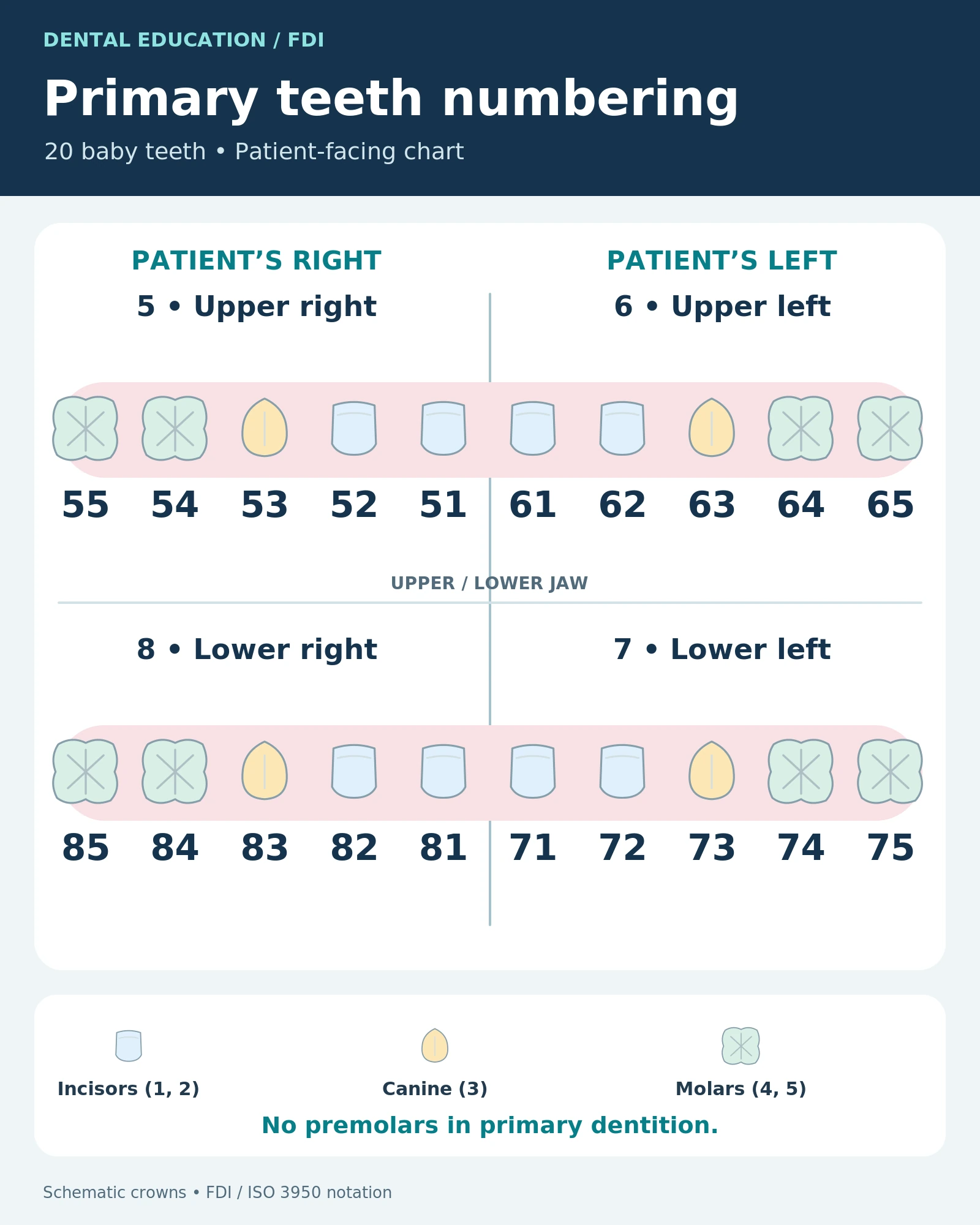
Children have 20 primary teeth. In FDI the primary quadrants are 5 (upper right), 6 (upper left), 7 (lower left) and 8 (lower right), each with teeth 1 to 5. In Universal they are A to T, and in Palmer A to E with the quadrant bracket.
| Primary tooth | FDI | Universal | Palmer (in words) |
|---|---|---|---|
| Upper right central incisor | 51 | E | Upper right A |
| Upper right second molar | 55 | A | Upper right E |
| Upper left second molar | 65 | J | Upper left E |
| Lower left second molar | 75 | K | Lower left E |
| Lower right second molar | 85 | T | Lower right E |
Converting dental tooth numbers
| Tooth (permanent) | FDI | Universal | Palmer (in words) |
|---|---|---|---|
| Upper right central incisor | 11 | 8 | Upper right 1 |
| Upper right first molar | 16 | 3 | Upper right 6 |
| Upper right wisdom tooth | 18 | 1 | Upper right 8 |
| Upper left wisdom tooth | 28 | 16 | Upper left 8 |
| Lower left wisdom tooth | 38 | 17 | Lower left 8 |
| Lower right wisdom tooth | 48 | 32 | Lower right 8 |
Wisdom tooth examples and clinician confirmation
Wisdom teeth are 18, 28, 38 and 48 in FDI, and 1, 16, 17 and 32 in Universal. Many people have fewer than four, or some that have not emerged, but the number identifies a position, not whether the tooth is present. Your dentist can confirm which tooth is which on your own X-ray.
Worked examples, practical checks and limitations
For permanent teeth, with d as the second FDI digit: quadrant 1 gives Universal = 9 − d; quadrant 2 gives 8 + d; quadrant 3 gives 25 − d; quadrant 4 gives 24 + d. Check: 48 → 24 + 8 = 32; 38 → 25 − 8 = 17; 16 → 9 − 6 = 3; 28 → 8 + 8 = 16. This rule is for permanent teeth only.
- Check which system a clinic uses before reading a number: Universal only runs from 1 to 32, so a two-digit number like 36 is FDI.
- Always read left and right from the patient’s side, not the chart’s side.
- Letters A to T or FDI quadrants 5 to 8 refer to primary (baby) teeth.
Common mistakes and when to seek expert confirmation
- Reading left and right from the chart’s view instead of the patient’s.
- Mixing Universal numbers with FDI numbers.
- Applying the permanent-tooth conversion to primary teeth.
This page cannot tell you whether a tooth has a problem. For pain, swelling or a loose tooth, see a dentist.
Frequently asked questions
What tooth number is my wisdom tooth?
FDI 18, 28, 38 or 48; Universal 1, 16, 17 or 32, depending on which one.
What is the difference between FDI and Universal tooth numbering?
FDI uses two digits (quadrant, then position) and is the most widely used internationally. Universal numbers permanent teeth 1 to 32 and is common in the United States.
How does Palmer notation work?
It uses a bracket symbol for the quadrant and the numbers 1 to 8 (or letters A to E for primary teeth) for the position within it.
How many teeth do adults and children have?
32 permanent teeth in adults and 20 primary teeth in children.
Why does the chart look reversed?
It is drawn from the dentist’s view, so the patient’s right appears on the chart’s left.
Can I use this chart to diagnose a problem?
No. It only helps you read tooth numbers. See a dentist for any symptoms.
Conclusion
Learn the quadrant and position and any tooth number becomes readable. Confirm anything about your own teeth with a dentist.
Sources
- ADA: Standard No. 3950, designation system for teeth
- FDI World Dental Federation notation (ISO 3950)
- Dental notation: comparison of FDI, Universal and Palmer























Share Your Opinion
Comments are closed on this post.