 Vista

Dictionaries show pronunciations such as /θɪŋk/ in the International Phonetic Alphabet (IPA), where each symbol stands for one speech sound regardless of spelling. If you are looking for an IPA mouth articulation chart, a phonetic vowel chart with mouth positions or a place and manner of articulation chart, this guide explains how those sounds are made: consonants by place, manner and voicing, and vowels by tongue height, backness and lip rounding. It also answers the practical question of how to pronounce IPA symbols. Pronunciation varies between accents, so treat the examples as a guide, not a single correct answer.
What the IPA is and why it helps
English spelling is inconsistent: the same letters can stand for different sounds, and the same sound can be spelled many ways. IPA gives one symbol per sound, which makes it useful for learners, teachers, singers and linguists. It is different from the NATO phonetic alphabet (Alpha, Bravo, Charlie), which is a spelling aid for radio and phone calls; see our NATO phonetic alphabet chart for that.
Parts of the mouth used in speech
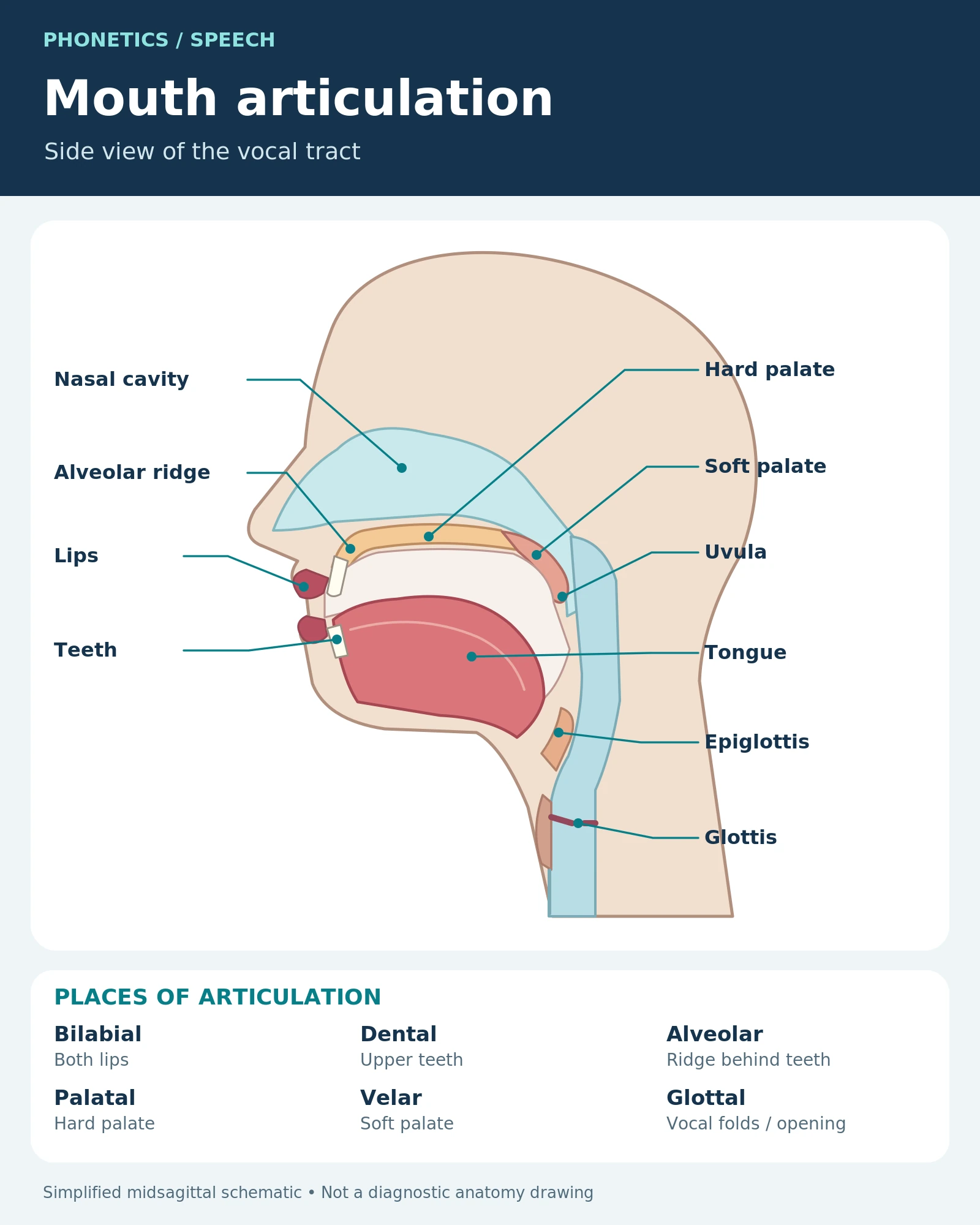
Lips, teeth, alveolar ridge, palate and tongue
The place of articulation is where the airflow is shaped: both lips (p, b, m), lip and teeth (f, v), tongue between the teeth (θ, ð), the ridge behind the upper teeth (t, d, s, z, n), the palate area (ʃ, ʒ, j) and the back of the mouth (k, g, ŋ). Say “t” and then “k” while paying attention to your tongue: for t the tongue tip touches the ridge behind your teeth, and for k the back of the tongue lifts to the soft palate.
Voiced and voiceless sounds
Touch your throat and say /s/ then /z/. You should feel vibration on /z/ (voiced) but not on /s/ (voiceless). Many English consonants come in such pairs: p and b, t and d, k and g, f and v, s and z. Each pair has the same place and manner and differs only in voicing.
Reading the consonant chart
| Place | Stops | Fricatives | Nasals |
|---|---|---|---|
| Both lips | p, b | – | m |
| Lip and teeth | – | f, v | – |
| Teeth | – | θ, ð | – |
| Alveolar ridge | t, d | s, z | n |
| Behind the ridge | – | ʃ, ʒ | – |
| Back of mouth | k, g | – | ŋ |
Place, manner and voicing
Each consonant is described by three features. For example, /b/ is a voiced bilabial stop: both lips, airflow blocked then released, vocal cords vibrating. And /ʃ/ is a voiceless post-alveolar fricative: the tongue near the area behind the ridge, air hissing through, no vocal cord vibration, as in the “sh” of ship. Stops block the air completely for a moment, fricatives squeeze it through a narrow gap, and nasals let it out through the nose.
Vowel height, backness and rounding
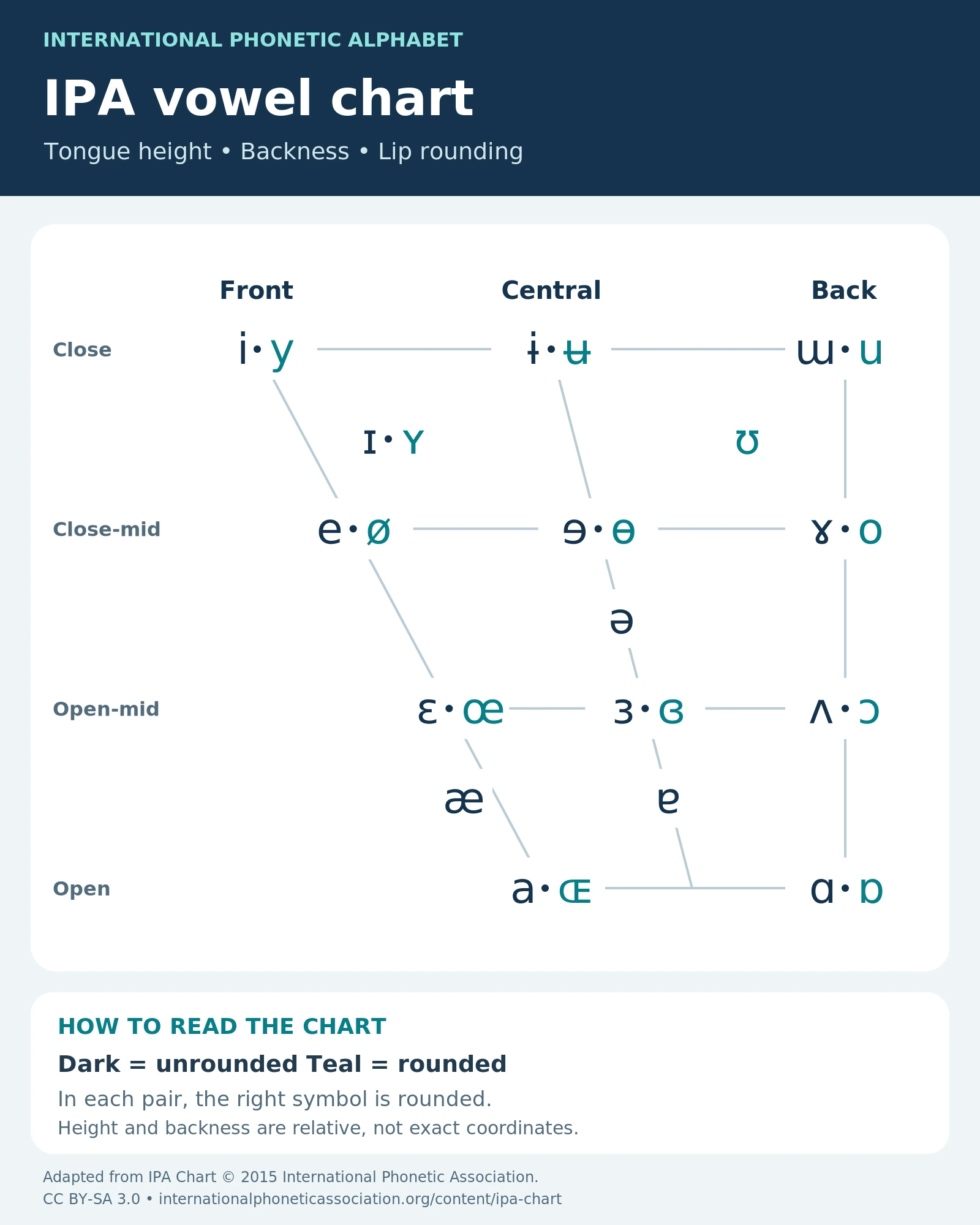
Vowels are described by how high the tongue is, how far forward or back it sits, and whether the lips are rounded. /i/ is high and front; /u/ is high, back and rounded; /ɑ/ is low with the jaw open. A vowel chart, often drawn as a trapezoid, places each vowel at the position of the tongue: top for high vowels, bottom for low vowels, left for front and right for back.
Tongue position and lip rounding
Say /i/ then /u/ slowly: you can feel the tongue move back and the lips round. Then say /ɑ/ and notice the jaw drop. This quick self-check makes the vowel chart concrete.
Worked examples, practical checks and limitations
| Word | Common IPA | Note |
|---|---|---|
| think | /θɪŋk/ | Tongue tip between the teeth for θ |
| ship | /ʃɪp/ | ʃ is the “sh” sound; short vowel |
| sheep | /ʃiːp/ | Longer vowel (ː marks length) |
| mop | /mɒp/ or /mɑp/ | Vowel differs by accent |
These are illustrative transcriptions. British, American and Indian English can differ, especially in vowels, so check a dictionary that matches the accent you want. The mark ː after a vowel means it is long.
Common mistakes and when to seek expert confirmation
Mapping a new sound onto the nearest sound in your first language (for example hearing θ as “t”) is the usual error. Ignoring vowel length, so that ship and sheep sound the same, is another. Listen to audio and, for persistent difficulty, work with a language teacher or speech-language professional.
Frequently asked questions
How do I pronounce IPA symbols?
Learn each symbol’s place, manner and voicing (or vowel height, backness, rounding), then practise with audio.
Is IPA the same as the NATO alphabet?
No. IPA represents speech sounds; the NATO alphabet is a list of code words for spelling.
Why do dictionaries show different IPA for one word?
Accents differ, and some dictionaries use broader or narrower transcription.
What does voiced mean?
The vocal cords vibrate during the sound, as in /z/ but not /s/.
What are place and manner of articulation?
Place is where in the mouth the sound is shaped; manner is how the air is released, such as a stop, fricative or nasal.
How do I read a vowel chart with mouth positions?
Read top to bottom for tongue height and left to right for front to back, with rounded vowels shown separately.
Conclusion
Understand where and how each sound is made and the IPA chart becomes a map rather than a list to memorise. Pair it with listening practice.
Sources
- Essentials of Linguistics: The International Phonetic Alphabet
- International Phonetic Alphabet (Wikipedia)
- Vowel diagram (Wikipedia)















Share Your Opinion
Comments are closed on this post.