 Vista

Good Hindi handwriting comes from short, regular practice on well-drawn guide lines. If you are searching for a Hindi handwriting practice PDF, a four-line Hindi writing sheet, or how to make a Hindi writing worksheet for kids, note that a four-line page helps a learner keep letter height, the top bar (shirorekha) and vowel signs consistent. Instead of hunting for a ready-made page, you can now build your own with the letters, words and tracing you need. This guide explains how Devanagari practice works, a sensible order from letters to words, how vowel signs attach, how to use tracing, and what to watch for when printing a PDF.
To make a sheet right away, open the free tool.
Why four lines and the shirorekha matter
Devanagari, the script used for Hindi, is written left to right, and its letters hang from a horizontal bar, the shirorekha, which joins the letters of a word. Four-line practice teaches a learner to keep letters between the baseline and the top bar and to size vowel signs (matras) correctly, including those that go above or below the letter. Start by getting basic letters to sit neatly between the lines, then add matras at the right height.
Checking proportion
Letters should stay within the lines, the top bar should be level and continuous across a word, and matras should be in proportion to the letter. The tool’s guide lines follow the font’s measured letter height; they are a practice aid and not an exact copybook standard, so follow your school’s notebook where one is prescribed. Note that many adults drop or break the top bar when writing fast; for a beginner, a clean continuous bar is still the better habit to learn first.

A practice order: vowels, consonants, matras, words
- Begin with vowels, writing each five or six times.
- Move to consonants with the top bar.
- Add short words with matras, such as कमल, किताब, फूल.
- Finish with short sentences, the learner’s name and everyday words.
Short daily sessions work better than one long one; tired hands produce messier writing.
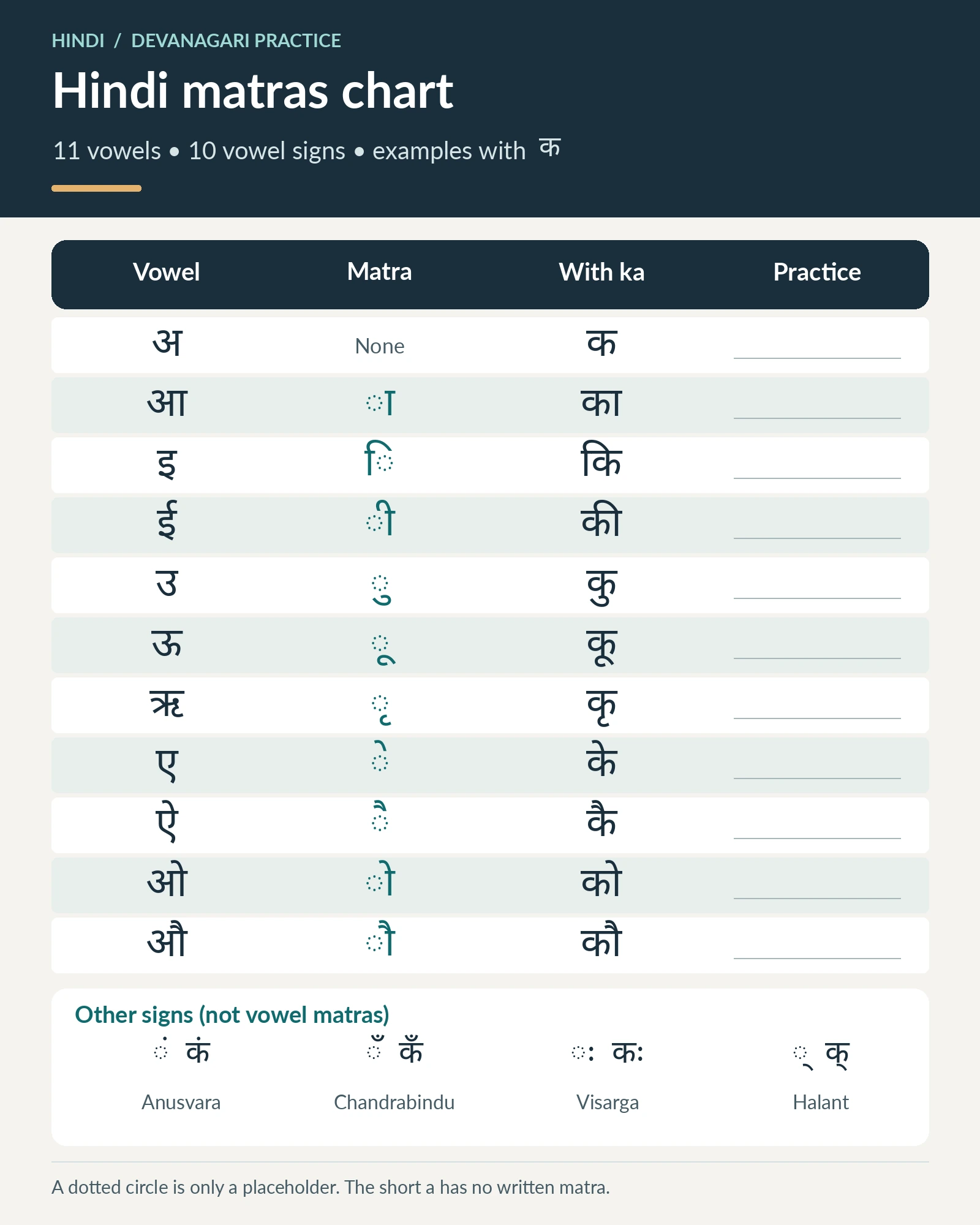
Vowel signs (matras) on a consonant
A consonant carries a built-in short “a” sound. To change it to another vowel, a matra (the dependent form of that vowel) is attached to the consonant. Practising one consonant with every matra is a quick way to learn the heights and positions.
| Vowel | Matra | With क | Where it goes |
|---|---|---|---|
| आ | ा | का | Right of the letter |
| इ | ि | कि | Left of the letter |
| ई | ी | की | Right of the letter |
| उ | ु | कु | Below |
| ऊ | ू | कू | Below |
| ए | े | के | Above |
| ऐ | ै | कै | Above |
| ओ | ो | को | Right, with a mark above |
| औ | ौ | कौ | Right, with marks above |
Note that the short इ matra is written to the left of the consonant even though it is pronounced after it. Once matras are comfortable, add common joined letters (conjuncts) such as क्ष, त्र, ज्ञ and श्र, one at a time.
Making your own sheet with the free tool
The free Hindi handwriting practice sheet generator lets you set the following:
| Option | What you can do |
|---|---|
| Sheet title and preset | Choose common words, vowels or consonants |
| Your own text | One letter or word per line, up to 600 characters |
| Font size | 16 to 90 px |
| Row height | 1.4 to 3.5 times the font size |
| Tracing darkness | 0 to 100% |
| Blank rows | 0 to 5 |
| Guide lines | Four-line or shirorekha only |
| Repeat across the row | Repeat the same word along the line |
You can preview the sheet, download a PDF or print it. The tool draws letters with your device’s Devanagari fonts and does not send your text to a server.
Using tracing well
Tracing means writing over lightly printed letters. Start with darker tracing so shapes are clear, then lower the darkness over time so the learner recalls the shape. Finish with blank rows for writing without any trace.
A sample first week (illustrative)
- Days 1 to 2: four vowels per day, tracing at about 80%, then two blank rows.
- Days 3 to 4: four consonants per day, tracing at about 60%.
- Days 5 to 6: one consonant with all matras, tracing at about 40%.
- Day 7: five short words, no tracing, and check the top bar.
This is only a suggested rhythm, not a guaranteed method; adjust it to the learner’s age and pace.
PDF and printing: what to know
- The PDF is A4 and can run to a maximum of 6 pages.
- Each page is stored as an image, so the text in the PDF cannot be selected or copied.
- Print at 100% scale, not “Fit to page”, or the line heights will change.
- If letters look broken, check that your device has a Devanagari font installed.
Common mistakes and limitations
- Giving too many letters at once; a few daily is better.
- Breaking the top bar in the middle of a word.
- Writing the इ matra on the wrong side of the letter.
- Treating the tool’s guide as an exact school copybook standard.
- This guide makes no promise about how fast handwriting will improve.
Frequently asked questions
How do I make a Hindi handwriting practice sheet?
Enter your letters or words in the tool, pick the guide lines and font size, then download the PDF or print.
Why use four-line paper for Hindi?
It helps keep letter height, the top bar and matra proportions consistent.
What is the shirorekha?
The horizontal bar at the top of most Devanagari letters; it joins the letters of a word.
What print scale should I use?
100%. “Fit to page” can change the line sizes.
Does the tool upload my text?
No. According to the tool, everything is generated on your device and nothing is sent to a server.
Conclusion
Handwriting is patient work. Proper guide lines, short daily practice and a clean 100% scale print are the three things that matter most.
Sources
- Indiana University: A Practical Guide to Hindi Script
- UNC: Introduction to the Hindi Writing System
- r12a: Devanagari and Hindi overview
- W3C: Devanagari layout requirements



















Share Your Opinion
Comments are closed on this post.