 Vista
The Lighthouse of Alexandria, also called the Pharos of Alexandria, was a giant stone tower built in Egypt around the third century BC to guide ships into Alexandria’s harbour. It stood roughly 100 metres tall, was counted among the Seven Wonders of the Ancient World, and collapsed after a series of earthquakes in the Middle Ages. Today it survives only as scattered blocks on the seabed and as a digital “twin” being built by archaeologists. This article separates what ancient and medieval sources tell us from what modern 3D reconstruction proposes, and explains why the claim of an “earthquake-proof” lighthouse needs careful handling.
What Was the Lighthouse of Alexandria?
The Lighthouse of Alexandria was the world’s first monumental lighthouse and, for many centuries, one of the tallest man-made structures on Earth. Ships approaching the Egyptian coast faced a low, featureless shoreline dotted with reefs and shallows, and Alexandria’s busy harbour was crowded with merchant, military and royal vessels. A tall, visible landmark with a fire at the top solved a real navigation problem, and it also advertised the power and wealth of Egypt’s Greek-speaking rulers.
The name “Pharos” comes from the small island where it stood. The word became so closely tied to lighthouses that several European languages still use a descendant of it, such as the French phare and the Spanish faro.
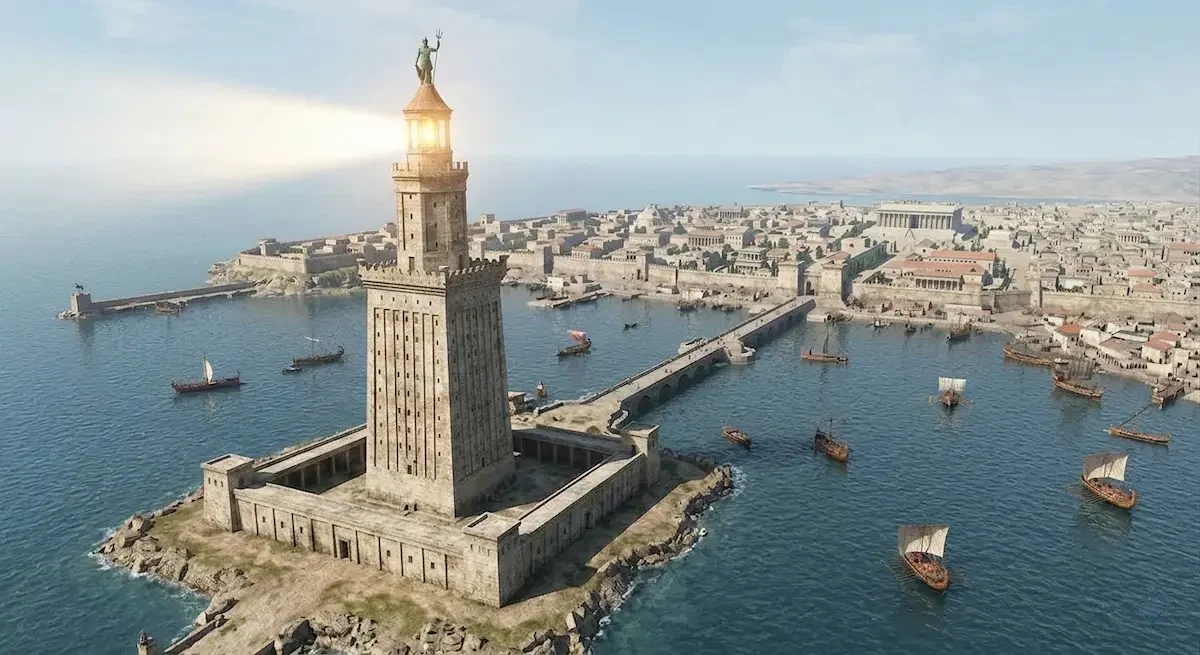
Lighthouse of Alexandria History and Location
Pharos Island
The tower stood on the eastern tip of Pharos Island, at the mouth of Alexandria’s harbour on Egypt’s Mediterranean coast. A man-made causeway later connected the island to the mainland, and over the centuries the island became a peninsula. The site lies at about 31.21°N, 29.89°E, which is today the area of Fort Qaitbay in modern Alexandria.
Ptolemaic Dynasty
After Alexander the Great’s death, Egypt came under the Ptolemaic Dynasty, a Greek-speaking royal house. Ptolemy I (who ruled 304–284 BC) began planning the lighthouse, and it was completed about fifteen years later under his son Ptolemy II. Standard references date construction to roughly 284–246 BC. Alexandria became a centre of trade, scholarship and the famous Library, and the Pharos became its emblem.
Sostratus of Cnidus
Ancient writers connect a man named Sostratus of Cnidus with the monument, either as architect or as the person who paid for or dedicated it. The details are debated, and historians treat the attribution as traditional rather than proven.
| Item | What sources say | Certainty |
|---|---|---|
| Built | Roughly 284–246 BC, Ptolemaic period | Well supported |
| Location | Eastern tip of Pharos Island, Alexandria | Well supported |
| Height | About 103–118 m in medieval Arab descriptions | Estimated |
| Base | Roughly 30 m × 30 m square | Estimated |
| Architect | Traditionally linked to Sostratus of Cnidus | Traditional, debated |
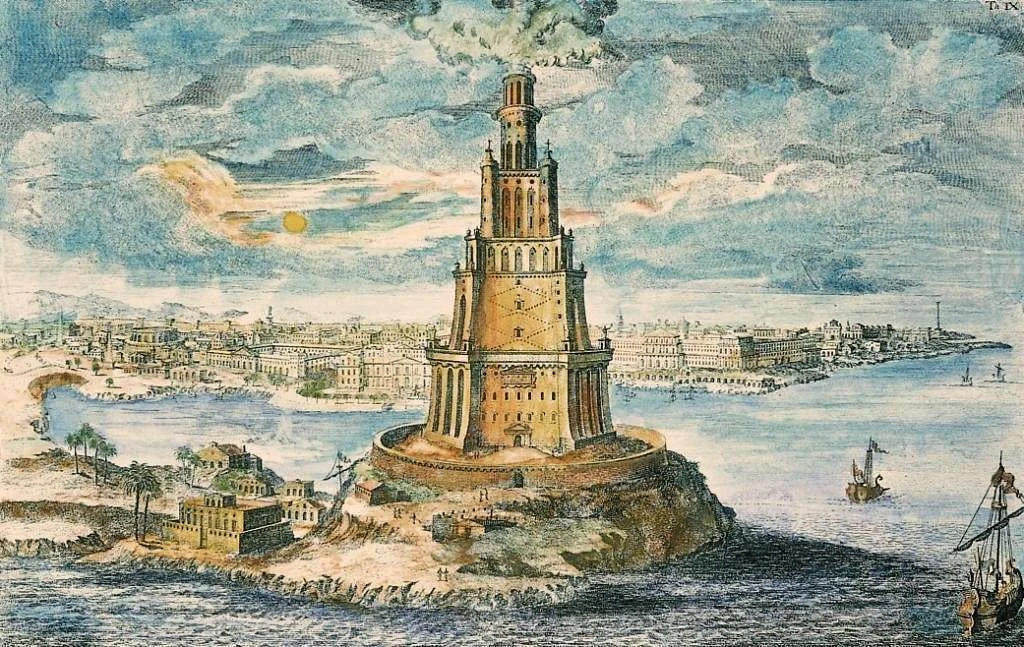
Lighthouse of Alexandria 3D Reconstruction
No complete drawing or building plan of the lighthouse survives. For centuries, artists imagined it from short written descriptions, coins and a few mosaics. The modern effort is different. An international research programme, led by French archaeologist Isabelle Hairy of the Centre d’Études Alexandrines (CEAlex) and the French research agency CNRS, aims to build a digital twin of the monument from the real fragments lying under the harbour water.
Digital Archaeological Reconstruction
The method relies on photogrammetry, which turns thousands of ordinary photographs into precise 3D models of each block. Researchers then test, on a computer, how the pieces fit together, without touching or damaging the original stones. Historians, archaeologists, architects and engineers work on the same model, so every proposed placement can be checked against the weight, dimensions and joint cuts of actual blocks. It is a hypothesis-driven process. The result is the best-supported reconstruction available, not a photograph of the past, and it will change as more pieces are mapped.
Readers searching for “lighthouse of Alexandria 3D model” or “lighthouse of Alexandria images” should keep one rule in mind: older illustrations are artistic impressions, while the newer models are tied to measured fragments but are still interpretations.
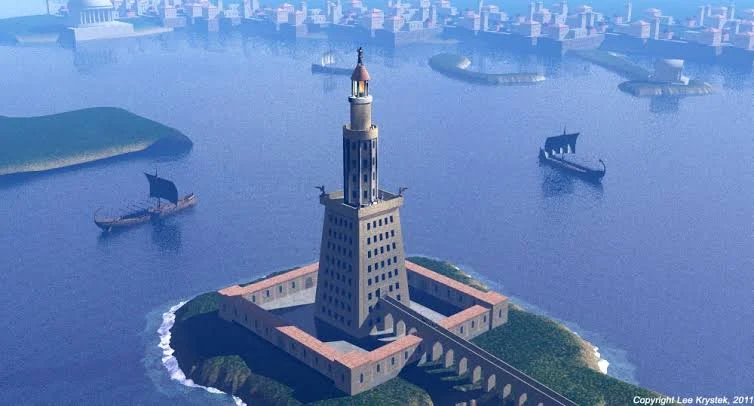
Ancient Architecture and Construction
Three-Tier Architectural Design
Medieval Arab travellers and ancient depictions describe a tower in three stages: a large square base, an eight-sided middle section and a round upper section topped by a lantern chamber. This stepped design reduced weight toward the top and gave the tower a stable profile against Mediterranean winds. Recent finds also point to a more complex entrance than earlier drawings showed, including a pylon-style doorway that mixes Egyptian and Greek building traditions.
Lighthouse Height and Construction Materials
Accounts give a height of about 103 to 118 metres on a square base roughly 30 metres wide, which is close to the height of a modern 30-storey building. The tower was built mostly of solid limestone and granite blocks, some of enormous size. Archaeologists have raised individual stones weighing up to about 80 tonnes from the harbour floor, including large fragments of the main doorway.
Ancient Lighthouse Lighting System
At night a fire burned at the top, and by day the visible column of smoke and the tower itself served as a landmark. Later writers mention a reflecting surface, often described as a mirror, that may have helped project the light further, though the exact device is not known. Sailors from far out at sea reportedly could see the beacon, but the stated distances in old texts are exaggerated by modern standards and should be treated cautiously.

For another example of ancient Egyptian architecture, explore the interiors of Egyptian pyramids.
Lighthouse of Alexandria Earthquake Proof Design: Fact vs Reconstruction
Headlines sometimes describe the Pharos as “earthquake-proof”. That is not accurate. The lighthouse suffered damage in several earthquakes and was repaired more than once, and in the end earthquakes brought it down. What research does show is that its builders used advanced techniques to join stone blocks. Metal clamps and tightly cut joints let the heavy blocks be fitted quickly, and archaeologist Isabelle Hairy has noted that this method helps explain how such a massive structure could be completed in about fifteen years, much faster than building with mortar.
| Claim | Evidence status |
|---|---|
| It survived many centuries in an earthquake-prone region | Supported: it stood for roughly 1,600 years |
| Builders used clamps and precise joints | Supported by recovered blocks |
| It was completely earthquake-proof | Not supported: it was damaged and finally collapsed |
| A specific “earthquake-resistant” engineering system was deliberately designed | Plausible but unproven; part of ongoing research |
The correct reading is that the design was strong and well built, but no ancient structure of this size can be called earthquake-proof.
Why Was the Lighthouse Destroyed?
Several earthquakes shook the Alexandria coast across the centuries, and accounts describe repairs after the damage. A powerful earthquake in 1303, associated with the eastern Mediterranean and a tsunami, left the tower in ruins, and later quakes completed its collapse. By the late 15th century, the Mamluk sultan Qaitbay used the site and its fallen stones to build a defensive fortress.
Fort Qaitbay
Fort Qaitbay still stands at the harbour entrance today, and many of the ancient blocks were reused in its walls. A visit there lets you stand at roughly the same spot as the lighthouse, though nothing of the original tower remains upright.
Underwater Archaeological Discoveries
Since the 1990s, divers and archaeologists have surveyed the harbour floor near Fort Qaitbay. The Pharos remains are scattered across an area of about 1.6 hectares beneath the Mediterranean. Finds include gigantic architectural blocks, sphinxes, statues and obelisk fragments from the ancient city. Sea level rise and earthquakes pushed much of ancient Alexandria below the waterline, which preserved items that might otherwise have been lost to quarrying.
- Blocks of up to roughly 80 tonnes, including parts of the main door.
- Evidence of metal clamps and precise stone joints.
- A previously unknown pylon-style entrance feature mixing Egyptian and Greek styles.
- Thousands of fragments recorded with photogrammetry for the digital model.
The project is still ongoing, so new discoveries may adjust the shape, height and decoration shown in current models.
Lighthouse of Alexandria Among the Seven Ancient Wonders
Greek writers compiled lists of the Seven Wonders of the Ancient World, and although the lists varied slightly, the Pharos usually appeared alongside the Great Pyramid of Giza, the Hanging Gardens of Babylon, the Temple of Artemis at Ephesus, the Statue of Zeus at Olympia, the Mausoleum at Halicarnassus and the Colossus of Rhodes. Only the Great Pyramid still stands. The lighthouse was unusual because it was both a monument and a working machine, serving sailors for well over a thousand years.
Frequently Asked Questions
1. Where was the Lighthouse of Alexandria located?
On the eastern tip of Pharos Island at the mouth of Alexandria’s harbour in Egypt, where Fort Qaitbay stands today.
2. How tall was the Lighthouse of Alexandria?
Medieval accounts give roughly 103 to 118 metres, though exact height is an estimate.
3. Who built the Lighthouse of Alexandria?
It was built under the Ptolemaic rulers Ptolemy I and Ptolemy II. Tradition links Sostratus of Cnidus to it, but the exact role is debated.
4. Was the Lighthouse of Alexandria really earthquake-proof?
No. It used strong joining methods but was damaged by earthquakes and ultimately destroyed by them.
5. Are any remains of the lighthouse left?
Yes, mainly underwater. Large blocks lie on the harbour floor, and some stones were reused in Fort Qaitbay.
6. Is the 3D model an exact copy of the lighthouse?
No. It is a scientific reconstruction based on measured fragments and written sources, and it can be revised.
7. Which Seven Wonders still exist?
Only the Great Pyramid of Giza survives.
Conclusion
The Lighthouse of Alexandria remains one of history’s great engineering achievements. Written sources give its outline, underwater archaeology gives its real stones, and 3D reconstruction connects the two. Keep the evidence and the interpretation separate, avoid the “earthquake-proof” myth, and expect the picture to sharpen as the research continues.
Sources consulted: Archaeology Magazine (Secrets of the Seven Wonders, 2025); research by the Centre d’Études Alexandrines (CEAlex); Live Science and other reports on the Pharos digital twin project.

















Share Your Opinion
Comments are closed on this post.