How to begin Navratri mantra chanting
A prepared puja plate does not always answer the question that comes next: which mantra should I chant today, and what if Sanskrit feels difficult? This Navratri mantra jaap for 9 days guide brings together nine short name mantras, reading help and a manageable home routine. It distinguishes a general devotional practice from a formal ritual with specific instructions.
The sequence used here is the Navdurga order widely followed in North India. Regional and sectarian traditions can differ. Respect the text and practice followed in your family, and consult your teacher if you have received instructions for a particular sadhana. An internet chart does not override those instructions.
The chart refers to worship days and lunar tithis. It is not a city-specific calendar. A tithi can be shorter or longer than a civil day, so check your local panchang rather than assuming that every calendar date corresponds to the next goddess. No annual dates or universal muhurat are prescribed here.
Navratri Mantra Jaap for 9 Days: daily reference chart
Day 1 / Pratipada — Shailputri: ॐ देवी शैलपुत्र्यै नमः॥
Reading help: Om Devi Shailaputryai Namah.
Day 2 / Dwitiya — Brahmacharini: ॐ देवी ब्रह्मचारिण्यै नमः॥
Reading help: Om Devi Brahmacharinyai Namah.
Day 3 / Tritiya — Chandraghanta: ॐ देवी चन्द्रघण्टायै नमः॥
Reading help: Om Devi Chandraghantayai Namah.
Day 4 / Chaturthi — Kushmanda: ॐ देवी कूष्माण्डायै नमः॥
Reading help: Om Devi Kushmandayai Namah.
Day 5 / Panchami — Skandamata: ॐ देवी स्कन्दमात्रे नमः॥
Reading help: Om Devi Skandamatre Namah.
Day 6 / Shashthi — Katyayani: ॐ देवी कात्यायन्यै नमः॥
Reading help: Om Devi Katyayanyai Namah.
Day 7 / Saptami — Kalaratri: ॐ देवी कालरात्र्यै नमः॥
Reading help: Om Devi Kalaratryai Namah.
Day 8 / Ashtami — Mahagauri: ॐ देवी महागौर्यै नमः॥
Reading help: Om Devi Mahagauryai Namah.
Day 9 / Navami — Siddhidatri: ॐ देवी सिद्धिदात्र्यै नमः॥
Reading help: Om Devi Siddhidatryai Namah.
The simple meaning of each line is a respectful salutation to the named goddess. “Namah” expresses reverence. These lines do not promise nine separate material benefits. Roman spelling is a reading aid, not a complete representation of Sanskrit sounds. For precise pronunciation, listen to a knowledgeable reader using the same text.
The fifth mantra follows the selected reference, which uses “Skandamatre.” The name of the goddess and the grammatical form within her mantra need not look identical. Keep the original wording intact instead of mechanically adding the same ending to every name.
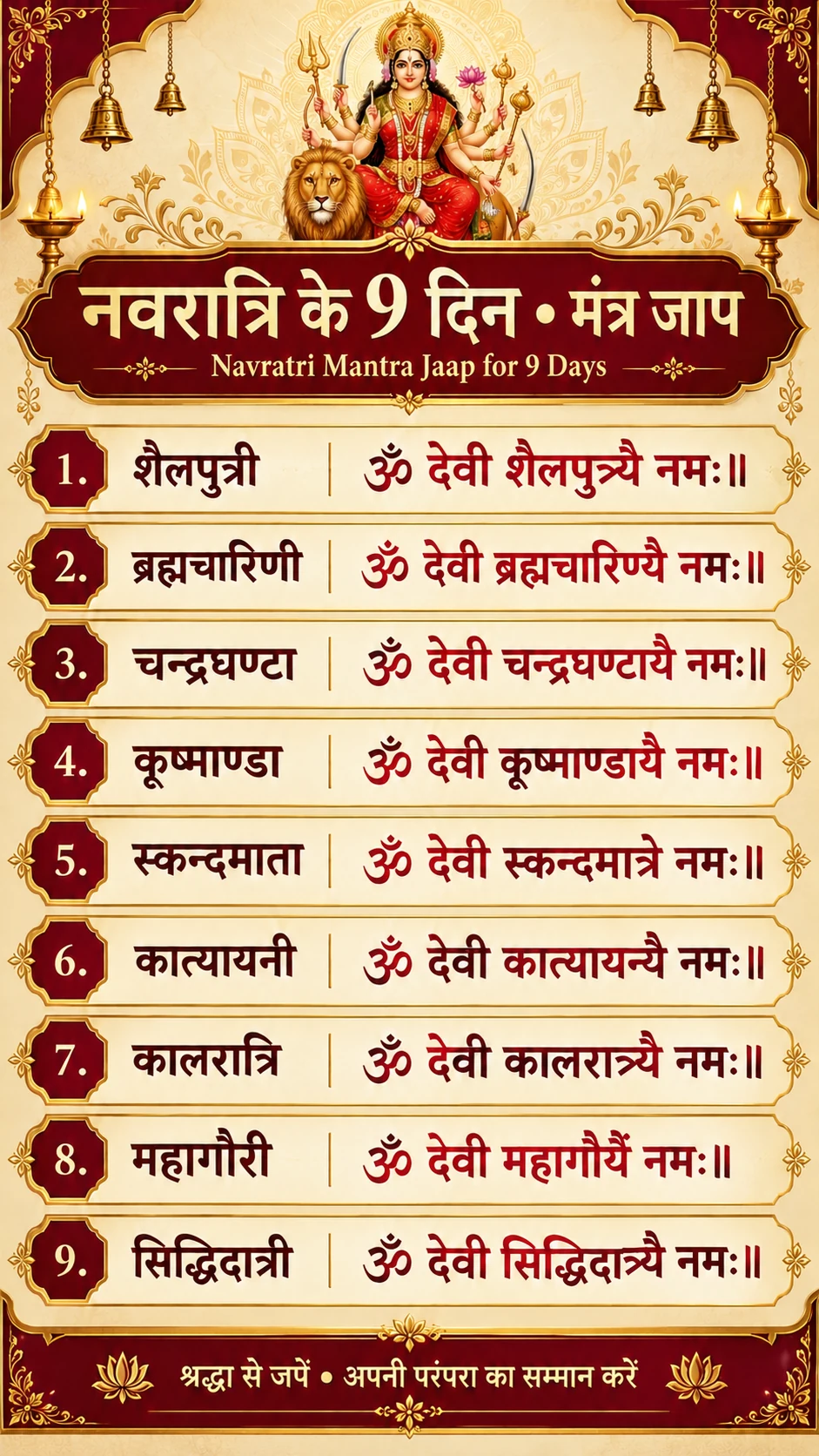
A practical home chanting routine
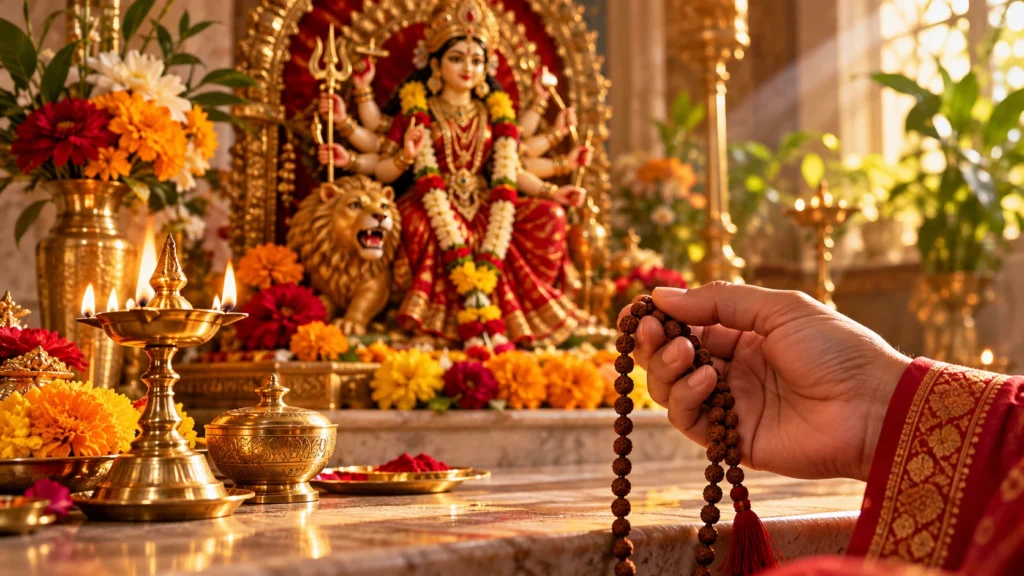
Choose a quiet time that fits your day. Keep the text nearby, silence avoidable notifications and sit comfortably. If sitting on the floor is painful, use a chair. A simple devotional routine should be manageable rather than a test of physical endurance.
Begin with a respectful greeting according to your tradition. Read the day’s line slowly a few times before repeating it. Keep the words clear rather than racing to reach a number. You may read from a printed page or screen; memorising every line is not a requirement of this guide.
Continue for the time or count you have chosen, then finish with a prayer or the aarti normally followed at home. A few calm minutes can be a practical starting routine. That suggestion is a personal scheduling aid, not a scriptural instruction binding every devotee.
If you light a diya, place it on a stable nonflammable surface away from fabric and children. Keep watch over an open flame. A well prepared home altar includes care for the people and surroundings using it.
FACT BOX: A short name mantra, a stotra, a bija mantra and the Durga Saptashati are different texts or practices. This article covers name mantras. It does not replace initiation, nyasa or instructions for a specific ritual.
Is chanting 108 times compulsory?
Many devotees use a 108-bead mala to count repetitions. That does not establish that every person must recite each Navdurga mantra exactly 108 times during every Navratri. A formal vow or teacher-guided practice may prescribe its own count.
For a general home routine without a prescribed count, choose a small practice that you can maintain. You can set aside a few minutes and read carefully. Do not treat a suggested number as a guaranteed formula for success, or as proof that a shorter prayer has no value.
Use a mala in the manner taught by your tradition if you have one. This guide does not require buying special beads. If you lose count, pause calmly rather than rushing through extra repetitions out of fear. Seek guidance if exact counting belongs to a formal practice you have undertaken.
Can you use the same Durga mantra on all nine days?
The nine name mantras provide one way to follow the daily forms of Navdurga. Families may also maintain a regular Durga prayer, aarti or Chalisa throughout the festival. There is no need to replace an established family practice merely because you encounter a new online chart.
If a teacher gave you a mantra or you undertook a specific sadhana, ask before changing it. These general name mantras should not automatically be presented as substitutes for another prescribed practice.
What if you miss a day or struggle with pronunciation?
Work, travel or illness can interrupt an ordinary routine. Resume at the next suitable opportunity without assuming that everything already done has become worthless. This article does not prescribe punishment, bad luck or a compulsory recovery ritual for a missed day.
If you are following a formal vow, consult the person who explained its conditions. Ordinary daily prayer and a fixed ritual may have different requirements. Do not sacrifice essential sleep, meals or medical needs just to catch up with an arbitrary count.
For pronunciation, practise the difficult word slowly before reading the whole line. Follow a reliable text and avoid adding syllables yourself. When using audio, check that it recites the same name mantra rather than a longer hymn. Roman transliteration can assist reading but cannot fully teach pronunciation on its own.
Advice
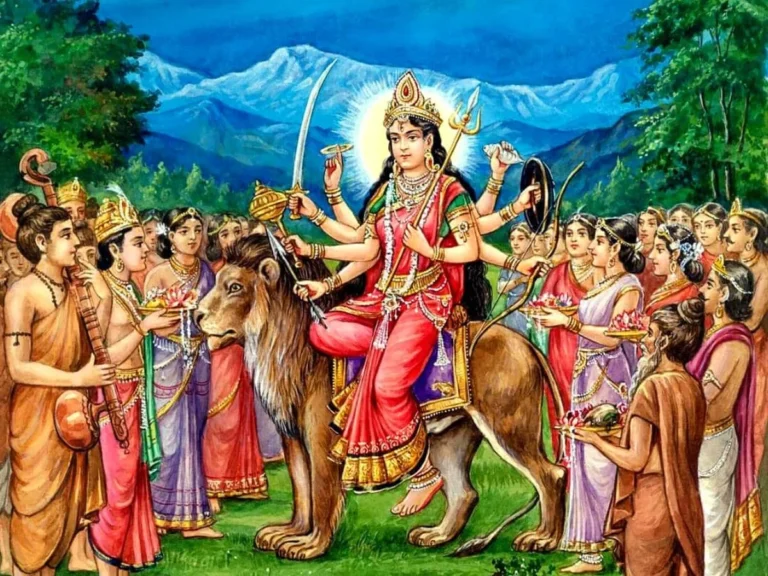
Keep the routine realistic across the festival. Use the poster as a reminder, keep a trusted text nearby and learn gradually. Devotion can coexist with family responsibilities and care for your health.
Do not attach guaranteed claims about wealth, employment, medical recovery or relationships to these mantras. Religious practice does not replace the practical steps or professional support needed for those problems. Participation should also remain respectful and voluntary for other family members.
FAQ — Navratri Mantra Jaap for 9 Days
Which mantra should I read each day?
Use the daily name mantras in the chart after checking the worship day in your local panchang and family tradition.
Must I chant only in the morning?
This general guide does not impose one time on everyone. Choose a quiet suitable time; follow a prescribed schedule if you have undertaken a specific practice.
Must I fast before reading these mantras?
This guide does not make fasting a condition for reading the name mantras. Fasting customs are separate, and health needs must be respected.
Can I chant without a mala?
A mala is not required equipment for the ordinary routine suggested here. A formal practice may have its own instructions.
Will chanting guarantee that a wish comes true?
No material outcome is guaranteed. The article presents a devotional and cultural practice.
Related reading in Hindi:
Navdurga names and worship order: https://vhoriginal.com/2026/10/navratri-9-devi-naam-din-2026.html
Nine name mantras: https://vhoriginal.com/2026/10/navdurga-9-mantra.html
Home puja guide: https://vhoriginal.com/2026/09/sampurna-navratri-puja-vidhi.html
Sources: Drik Panchang: Navratri traditions and worship order; Navdurga reference and individual mantra pages.
Disclaimer: This is general religious and cultural information. Practices differ by region, family and tradition. Consult a qualified guide for a particular ritual. Chanting does not guarantee results or replace medical care and other professional help.