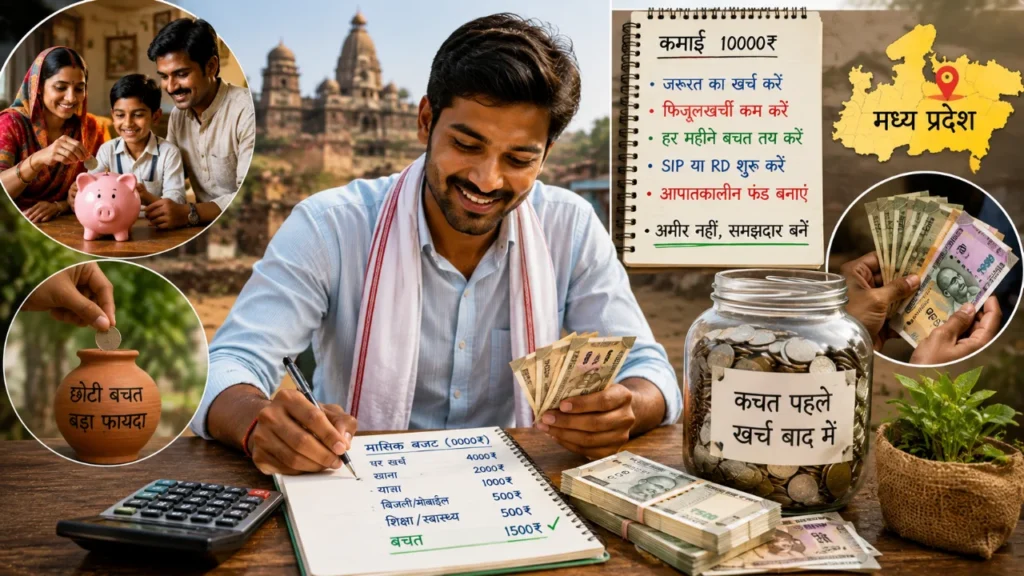
On the 30th of the month, when your pocket is empty and the low balance SMS hits your phone, all bookish financial advice feels completely useless. No one tells a person earning 10 thousand rupees where to find that first saved coin after clearing dues with the milkman, landlord, and tea vendor.
The Gap Between Bookish Advice and MP’s Ground Reality
Most financial advice available on the internet is written keeping big cities in mind. They tell you to manage house expenses with 50% of your income and invest 20% right away. But the truth is, this formula fails in the very first month on a 10 thousand salary.
When talking about small towns or townships in Madhya Pradesh, the situation is slightly different. Saving money on a low income does not mean torturing yourself; it means understanding the simple math of your daily needs. Until you plan according to your local expenses, every budget will fail.
Here, the issue is often less about the lack of money and more about invisible expenses that empty your pockets without notice. Whether it is credit at the local tea shop or small weekly fuel costs, they all add up to a big shock at the end of the month.
Set Your Fixed Deductions First
If you think you will save whatever is left at the end of the month in a piggy bank, trust me, you will end up with zero. The first rule of saving is to set aside your savings portion immediately when money comes in.
Saving a huge portion out of a 10 thousand salary is neither possible nor should you put that pressure on yourself. Start with just 500 rupees. As soon as the salary hits your bank account or you get cash, put 500 rupees somewhere from where it is not easy to withdraw.
Once you get into the habit of running the month on the remaining 9,500 rupees, your brain will automatically start curbing unnecessary expenses. This psychological method proves to be the most effective.
Small Town Budgeting Math: Where and How Much to Spend
Dividing 10 thousand rupees properly in an average town in MP is an art. Your priorities must be crystal clear so you don’t have to borrow from anyone.
- Room or House Rent: Try to keep this expense capped between 2,000 to 2,500 rupees. If possible, stay in a shared accommodation.
- Groceries and Food: Household groceries and basic food can easily be managed between 3,000 to 3,500 rupees.
- Travel and Bills: Set a budget of 1,500 rupees for electricity, mobile recharge, and petrol.
- Emergency Fund: Keep aside at least 500 rupees every month for medical or sudden unexpected expenses.
By following this math, you will have a margin of at least 1,000 to 1,500 rupees every month, which will become your real savings.
Identify the Invisible Pickpockets: Tea, Gutkha, and Recharges
Big purchases never ruin the budget of a poor or low-earning person. What ruins the budget are those tiny expenses that we don’t even count. Having tea outside twice a day, samosas with friends, or cigarette/gutkha expenses look like just 20-30 rupees a day.
However, if you add up 30 rupees daily, it comes to 900 rupees a month. That means a major chunk of your potential savings drains away in small daily habits. Controlling your habits is your biggest earning.
This doesn’t mean you should stop spending time with friends. Just set your limits and start keeping an eye on unnecessary expenses.
Strict Strategy to Avoid the Debt Trap
The biggest weakness of low-salary earners is the ‘store credit account’. From the grocer to the nearby general store, the habit of buying items on credit will never let you save. When salary arrives, half of the money goes towards clearing old dues.
Breaking this cycle is crucial. Build a habit of paying cash. Buy only as much as you have money in your pocket. Once you stop taking credit, you will know your real financial status and budget limits.
Stay completely away from online shopping or Pay-Later options. They seem easy at first but turn out to be a deep pit for low-income groups.
Where to Keep Your Savings Safe on a Low Income?
Now the question is, what should you do with the 500 or 1,000 rupees you save every month? Keeping it in a cupboard at home is the worst idea, because it won’t take long to spend from there.
The best method is to start a Recurring Deposit (RD) in a public sector bank or post office. In this, a fixed amount gets automatically deducted from your account every month. This maintains discipline and also earns you some interest.
If you prefer a digital approach, you can start a monthly Mutual Fund SIP of 500 rupees via a good app, but always begin from a safe option like an RD first.
Vivek Bhai’s Advice
Look brother, giving advice like ‘save money, get rich’ is very easy. But when the landlord stands at the door on a 10 thousand job and a grocery list comes from home, all financial theories fall apart. The truth is that saving from 10 thousand is no magic trick; it is a game of strict discipline and self-control.
If you are thinking that you will start saving when your salary increases next time, you are fooling yourself. When income increases, expenses expand at the same speed. Savings come from intention, not the amount. If you don’t build the habit of saving 500 rupees today, your pockets will remain empty tomorrow even if you earn 50 thousand.
Decide your needs according to your town. Don’t increase debt to show off or impress friends. Every single rupee you save today will become your biggest support in bad times tomorrow, because when times get tough, many give advice but no one gives money.
Frequently Asked Questions
How much should one save every month on a 10 thousand salary?
Do not set a huge target initially. Try to save 500 to 1,000 rupees every month. The most important thing is that this saving habit should continue every month without stopping.
Where is it safest to deposit small saved amounts?
A Recurring Deposit (RD) scheme in a bank or post office is safest. You can start a savings account with a small amount starting from 500 rupees every month.
Should one invest in the stock market or mutual funds on a low salary?
If you do not understand the market, stay away from the stock market initially. Build an emergency fund for at least 6 months in a regular bank account first, and only then consider SIPs.
What to do if an unexpected expense comes up at the end of the month?
To avoid this situation, keep an ‘Emergency Fund’ of 500 rupees in your budget. If a big expense arises, use this fund first instead of breaking your savings.
Disclaimer: The information provided in this article is for general awareness only.