 Vista
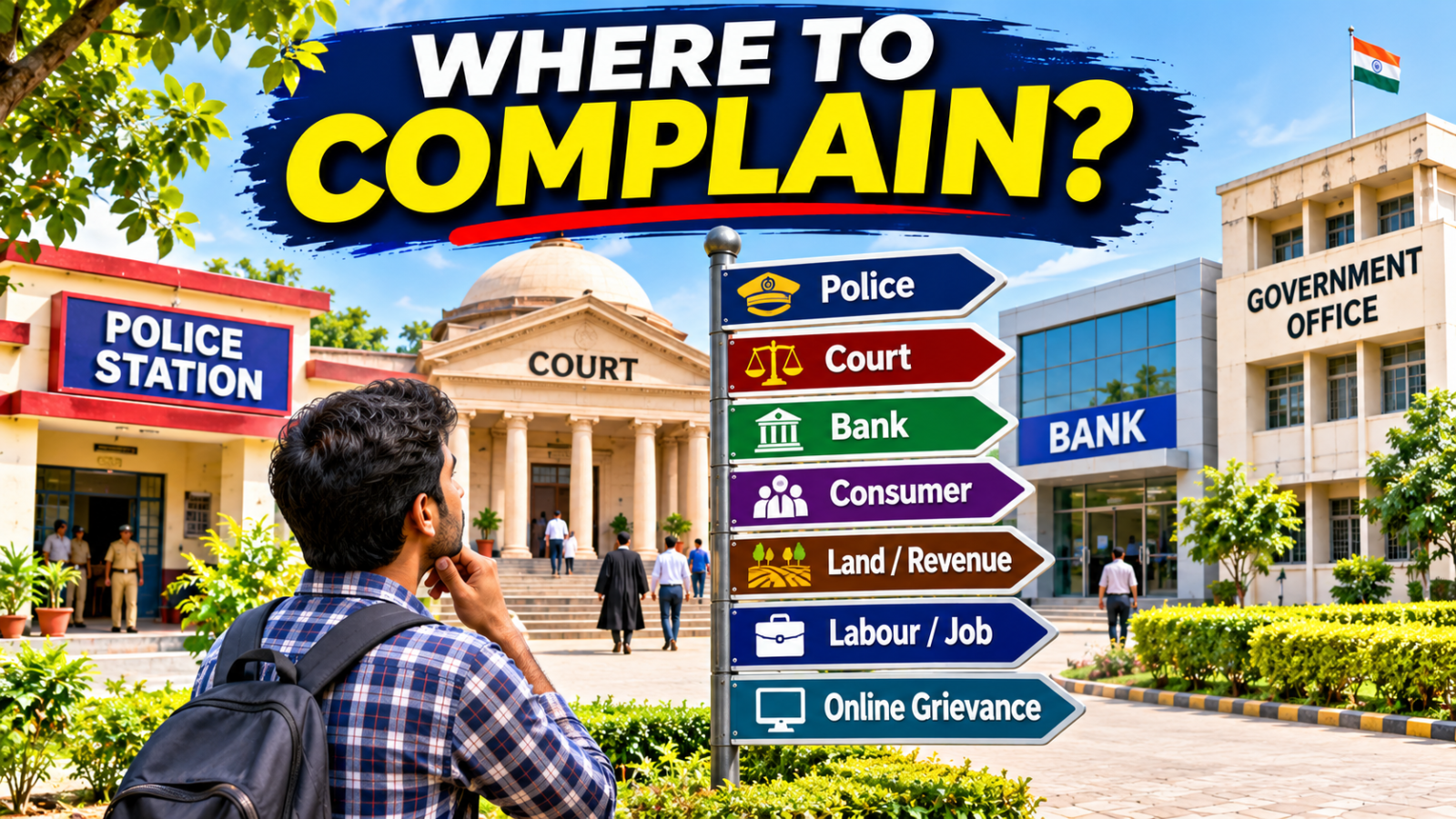
Where should you complain in India when something goes wrong? The answer depends on the problem. For immediate danger, call 112; for financial cyber fraud, report promptly through 1930; for consumer grievances, contact 1915; and for legal assistance, contact NALSA at 15100. Land records, ownership disputes, unpaid wages, banking problems and government service delays require different authorities. This master legal help directory explains the appropriate first step, the official complaint portals and when to consider a formal legal remedy. A complaint reference number is useful, but it is not necessarily a court case or an FIR.
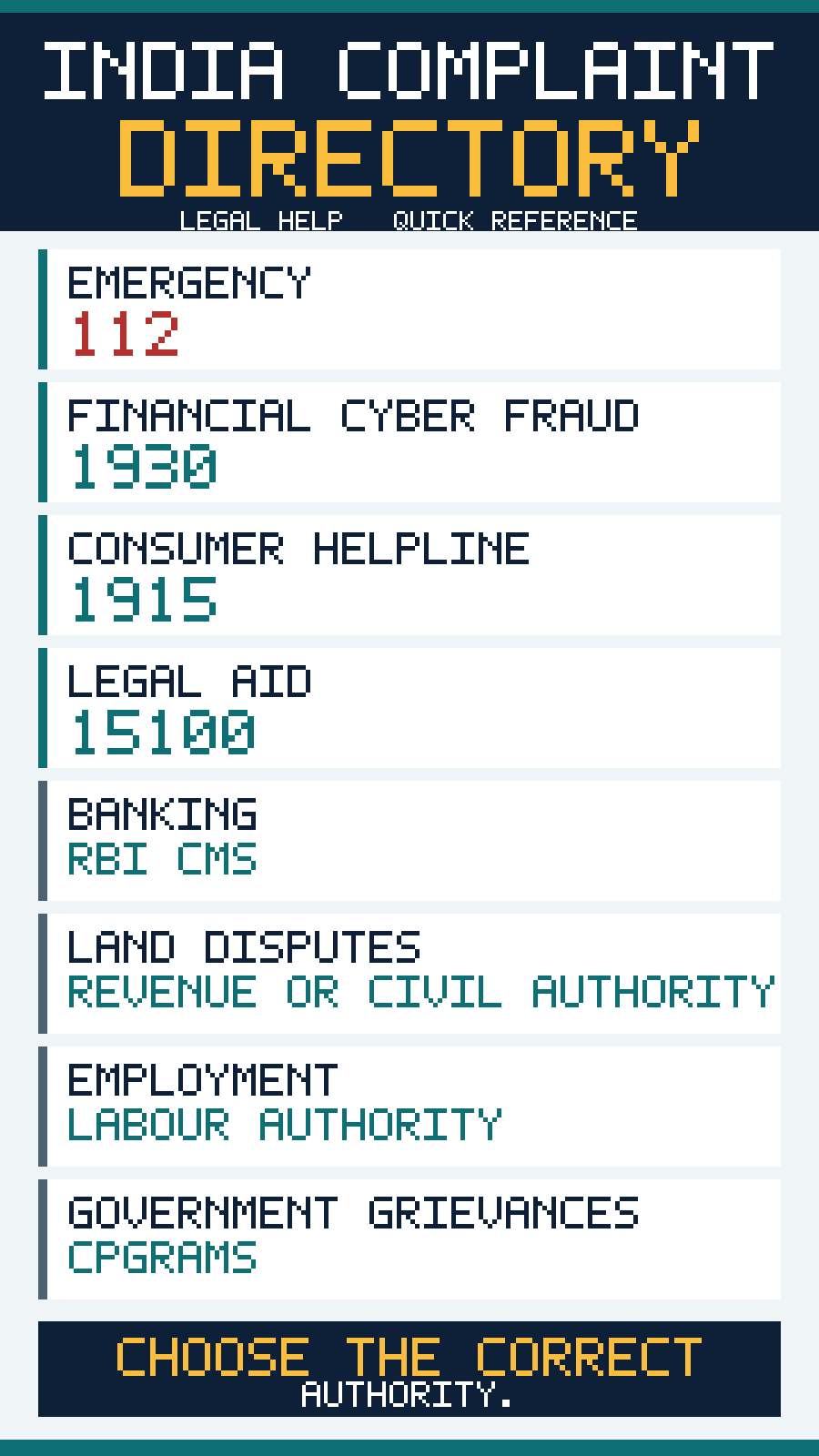
Official complaint channels and legal references reviewed: 24 November 2026 | India
1. India complaint directory: official helplines and portals
| Problem | Appropriate starting point |
|---|---|
| Immediate danger, violence or emergency | 112 — Emergency Response Support System |
| Financial cyber fraud | 1930, your bank and the National Cyber Crime Reporting Portal |
| Defective products, refund or service dispute | 1915 — National Consumer Helpline |
| Formal consumer commission complaint | e-Jagriti |
| Banking service deficiency | Regulated entity, then eligible complaints through RBI CMS |
| Land records, mutation or boundaries | Competent state revenue authority |
| Property title, tenancy or private debt | Competent civil court or specialised statutory forum |
| Unpaid wages or employment dispute | Labour authority, SAMADHAN States |
| Missing provident fund contributions | EPFiGMS |
| Government service grievance | Responsible department, CPGRAMS |
| Free legal assistance | 15100 — NALSA or DLSA |
| Court case status and hearing dates | eCourts Services |
These services are not interchangeable. The consumer helpline cannot register a police FIR merely because you call it, and the legal aid helpline is not an emergency response service. Select the channel according to the facts and the remedy you need.
2. Police complaints, FIRs and financial cybercrime
For suspected theft, assault, threats or fraud, provide police with an accurate account of what happened. Section 173 of the Bharatiya Nagarik Suraksha Sanhita (BNSS), 2023 allows information disclosing a cognizable offence to be given to a police station irrespective of the place where the offence occurred. Electronically submitted information must be signed within the prescribed three-day period. The recorded information is supplied free of charge to the informant or victim.
If the police refuse to record information disclosing a cognizable offence, section 173(4) provides a route through a written submission by post to the concerned Superintendent of Police and, where necessary, the Magistrate. Non-cognizable cases follow a separate procedure under section 174. Not every disagreement requires an FIR, but you should not hesitate to seek help when there is a credible danger.
For an unauthorised UPI, card or online banking transaction, notify your bank immediately and seek help preventing further unauthorised payments. Report financial cyber fraud through 1930 and complete the online complaint in accordance with the instructions received. Preserve transaction references, timestamps and relevant messages. Prompt reporting may improve the opportunity for intervention, but recovery is not guaranteed. Never transfer additional money or disclose a PIN or OTP to someone claiming they can recover the funds. Call 112 if immediate physical safety is at risk.
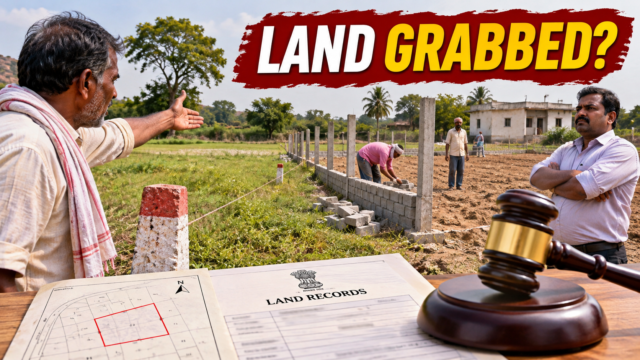
3. Land disputes: when to approach the revenue department or a court
For incorrect land records, inheritance mutation, boundary demarcation or public land encroachment, approach the relevant state revenue office. A Patwari, Lekhpal or other local official may assist with identifying the plot and obtaining records; the competent revenue authority decides applications under the applicable law. Preserve title deeds, survey records, maps, earlier orders and acknowledgements. Revenue jurisdiction and statutory procedures vary between states.
A mutation entry is primarily an administrative or revenue record and does not itself conclusively confer ownership. Where parties dispute title, inheritance shares, possession or a contractual property obligation, a competent court or specialised statutory authority may be needed. If there are additional allegations of forgery, assault or criminal intimidation, police remedies may also be relevant. Do not demolish another person’s construction or recover possession by force. Local civic authorities may separately address drainage, unauthorised construction and public nuisance within their powers.
4. Banking and consumer complaints: RBI CMS, 1915 and e-Jagriti
For a banking service deficiency, incorrect charges or disputed transactions, submit a written complaint to the bank or other relevant RBI-regulated entity first. The Reserve Bank Integrated Ombudsman Scheme, 2026 came into force on 1 July 2026. Eligible customers can approach RBI CMS after receiving an unsatisfactory response or, if no response is received, after thirty days or the longer applicable response period specified by RBI, NPCI or card network guidelines. Check coverage, exclusions and filing deadlines under the current scheme. The Ombudsman cannot automatically cancel a valid loan or overturn a court order.
For a defective product, unfulfilled commercial service or disputed refund, first contact the seller or service provider. The National Consumer Helpline offers pre-litigation grievance assistance through 1915 and its official website. If the matter requires formal adjudication, e-Jagriti is the online platform for filing eligible consumer commission complaints. Preserve invoices, warranties, advertisements and relevant correspondence. The helpline is not itself a binding judicial decision. Formal schooling, commercial coaching and medical services may have different consumer-law eligibility considerations.
5. Employment disputes and unpaid salary
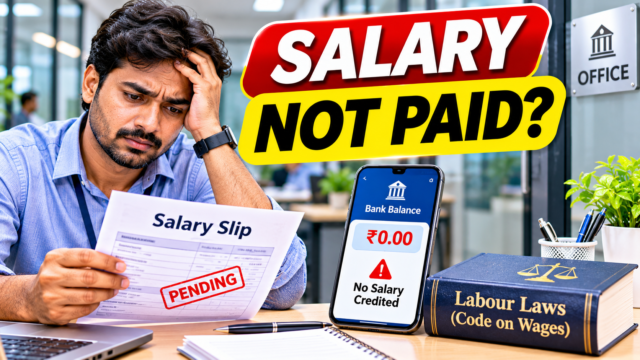
If your employer has withheld earned wages, prepare a month-by-month account of the amounts due and payments received. Send a written demand to payroll or HR and retain evidence of employment. Section 17 of the Code on Wages, 2019 ordinarily requires monthly wages to be paid by the seventh day of the following month. Section 45 provides a statutory claims mechanism before the competent authority. The applicable government, employment relationship and relevant limitation rules determine the appropriate procedure.
Contact the state labour department or central labour administration as applicable. The SAMADHAN States platform offers claim and grievance services for participating jurisdictions. Confirm the correct filing route. For missing PF contributions, use EPFiGMS and provide relevant UAN, passbook and salary records. A complaint about provident fund deposits is different from an unpaid salary claim. Final settlement, notice pay, gratuity and termination compensation can also require distinct assessments. Ordinary wage disputes should not automatically be treated as criminal offences.
6. Government grievances: how to use CPGRAMS
The Centralised Public Grievance Redress and Monitoring System is a platform for complaints about government service delivery. Register on the official website, identify the responsible department, explain the problem and provide relevant supporting documents. Save the registration number to track progress. If the response is unsatisfactory, use the applicable feedback and appeal mechanism available through the portal.
CPGRAMS does not adjudicate private property rights, overturn judicial orders or replace a statutory appeal. Its official website excludes RTI matters, court-related or sub judice matters and religious matters, with restrictions also applying to specified government employee service grievances. A request for government information under RTI is different from asking an authority to correct a service problem. Filing a general grievance does not automatically stop or extend the deadline for a court proceeding or statutory appeal.
7. Civil versus criminal cases, legal aid and court case status
Civil proceedings generally concern private rights, property, contracts, payment obligations or compensation. Criminal proceedings concern conduct defined as an offence by law. The same events may involve both types of proceedings. For example, failure to repay a private loan may primarily concern civil recovery, while evidence of dishonest inducement from the outset may raise separate criminal issues. The facts and applicable statutory elements matter.
If you cannot afford legal representation, contact NALSA at 15100 or visit the District Legal Services Authority. Eligibility depends on statutory categories, income criteria where relevant and the merits of the matter. To check a pending district court case, visit eCourts Services and use the CNR or available case number and party-name search. Confirm important hearing dates with the court or your lawyer. An ordinary online case status or downloaded document is not necessarily a certified court record.
8. General complaint application format
To: The competent authority, ___. Subject: Complaint concerning ___. My name is ___ and the relevant incident occurred on ___ at/through ___. The facts are ___. The application, transaction or case reference is ___. Copies of available supporting documents are attached. My earlier complaint reference, if any, is ___. Please examine the matter, take appropriate action under applicable rules and provide a written response. Name, safe contact details, date and signature.
Request a specific remedy instead of making vague allegations. Keep originals and submit relevant copies securely. Check the official domain before uploading sensitive information. Where a statutory filing requires a prescribed form, use that form instead of this general sample.
Frequently asked questions
Is there one number for every legal complaint in India?
No. Emergency response, cyber fraud, consumer assistance and legal aid have different channels.
Can I complain without a lawyer?
Many administrative complaints can be submitted directly. Professional advice may be important for formal or complex proceedings.
Does an online complaint guarantee immediate action?
No. The response depends on jurisdiction and applicable procedure. Seek emergency assistance when necessary.
What if an authority does not respond?
Use the complaint reference to follow up and identify the competent escalation or appeal route.
Conclusion and official references
Identify the remedy you need, preserve evidence and approach the authority with the relevant legal power. Consult India Code, the RBI Ombudsman FAQs for 2026, NALSA FAQs and the official portals listed above. This is general legal information, not individual legal advice. State laws, special statutes and case circumstances may affect the available remedies.
Legal help by topic: all guides
Police, cybercrime and safety
- My Phone Was Stolen in India: What to Do, FIR and CEIR IMEI Block Guide
- Online Fraud in India: How to Report on 1930 and Recover Lost Money
- How to Check and Report Fake SIM Cards Registered in Your Name in India
- Private Photo Blackmail in India: What to Do About Sextortion and Deepfakes
- Police Coming to Arrest You in India? Know Your Arrest and Bail Rights
- Death Threats or Stalking in India: How to Report and Seek Protection
Land, housing and inheritance
- Someone Occupied My Land in India: Legal Steps to Remove Illegal Possession
- Land Mutation and Demarcation in India: Application and Survey Process
- Land Token Money Not Returned or Property Sold Twice? Legal Remedies in India
- Neighbour Causing Water Leakage, Noise or CCTV Privacy Problems in India?
- Property Transfer After Death in India: Legal Heir, Succession Certificate and Probate
- No Rent Agreement in India? Tenant Rights Against Eviction, Rent Increase and Lockout
Money, banking and debt
- Friend Not Returning Borrowed Money in India? Legal Recovery Guide
- Loan Guarantor Liability in India: What If the Borrower Stops Paying?
Consumers, hospitals, education and electricity
- How to File a Consumer Court Complaint Online in India: e-Jagriti Guide
- Hospital Overbilling or Medical Negligence in India: Complaint Guide
- School or Coaching Centre Refusing Fee Refund in India? What to Do
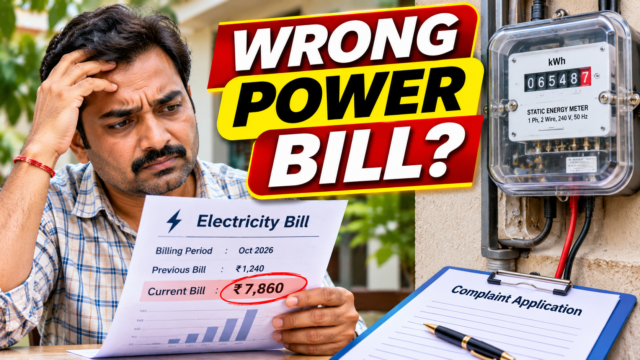
- Wrong Electricity Bill or Disconnection in India? CGRF and Ombudsman Guide
Employment, PF and wages
- Company Holding Your Original Documents? Employment Bond Rights in India
- Employer Not Depositing PF or Paying Wages in India? Complaint Options
- Company Not Paying Salary in India? Labour Complaint and Wage Recovery Guide
Family and children
- Domestic Violence in India: How to Get Legal Protection and Support
- Child Custody After Divorce in India: Who Gets Custody and Visitation Rights?
Vehicles and road accidents
- Sold Your Vehicle but RC Not Transferred in India? What to Do
- Hit-and-Run Accident in India: Police Report, Insurance and Compensation
- Police Seized Your Vehicle in India? Release and Superdari Procedure

















Share Your Opinion
Comments are closed on this post.