 Vista
Need a mirror symmetry school project, printable tangram template or an interactive Venn diagram model? This guide offers three related mathematics posters: line symmetry, a traditional seven-piece tangram and a two-set Venn diagram. Students in approximately Classes 4–9 can adapt them into A4 charts, paper puzzles or interactive cardboard displays. Each teaches a different concept: reflection and geometric transformations, arranging pieces without changing their area, and describing set membership and overlap. **Reflection symmetry is not identical to rotational symmetry**, and the overlapping part of a Venn diagram contains only elements belonging to both sets. All images keep the site’s established 15-second advertisement-supported download experience.
How are these three maths projects different?
Symmetry describes a figure’s correspondence under certain transformations. A line of reflection can match points on opposite sides of a figure, whereas a rotation turns a shape around a centre. Tangram is a geometric puzzle using seven fixed pieces to form silhouettes. A Venn diagram shows how groups or sets overlap and differ. These are not three names for one rule, although they can all be represented visually. A finished school board should give each topic its own heading and one correct example. Mixing set diagrams into a geometry proof without explanation will confuse learners rather than help.
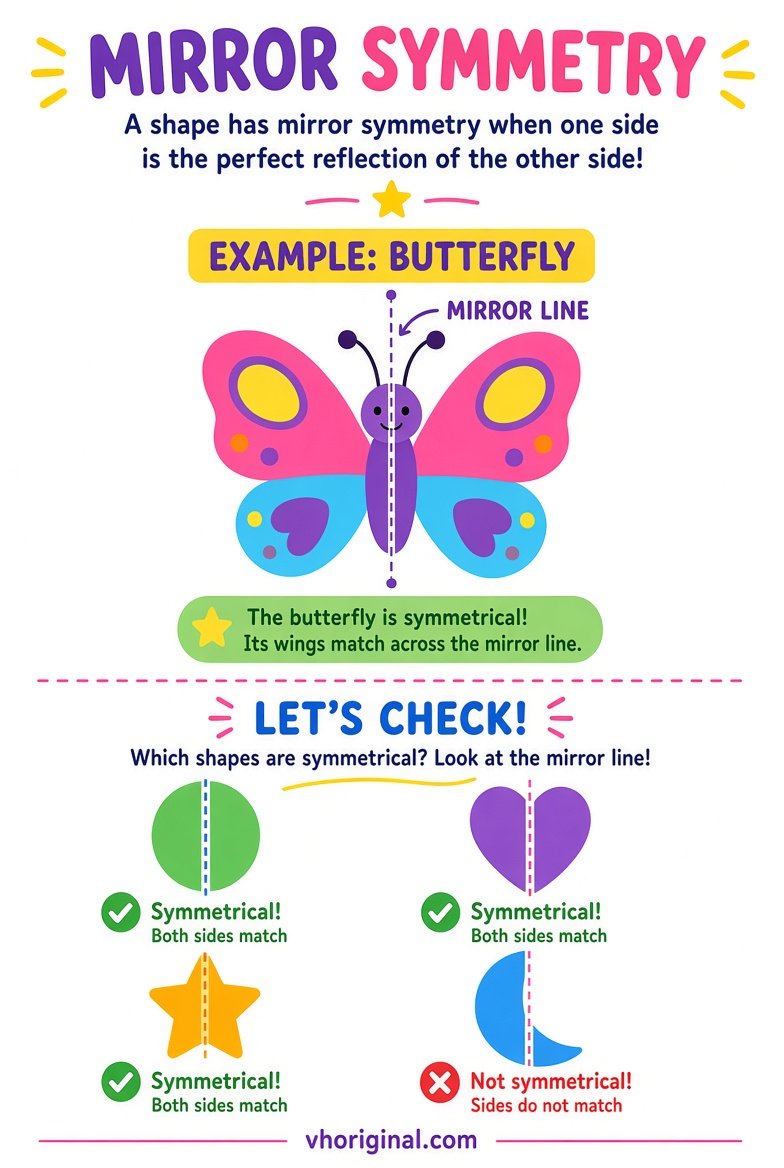
Picture 1: Mirror Symmetry Chart
In a line-symmetric figure, a reflected point lies the same perpendicular distance from the axis as its partner. A non-square rectangle typically has two reflection lines, while a square has four. A scalene triangle has no reflection symmetry. Folding a paper outline along a proposed line can test whether the two halves coincide. A line through the centre is not automatically a valid mirror axis. Some figures possess rotational symmetry without having any line of reflection symmetry. Check all marked axes on a generated poster rather than assuming every coloured dividing line is mathematically correct.
View / Download after 15-second wait
Picture 2: Seven-Piece Tangram Template
A standard tangram contains seven pieces: five triangles, one square and one parallelogram. The triangles are commonly two large, one medium and two small isosceles right triangles. The pieces can be translated, rotated and, when needed, flipped to form many target outlines. In a classic complete tangram challenge, every piece is used and the pieces do not overlap. A school template must actually contain seven distinct pieces. Printing at an inconsistent scale may distort their shapes, so check lengths and angles after printing. Students should also identify the difference between a triangle and a parallelogram.

View / Download after 15-second wait
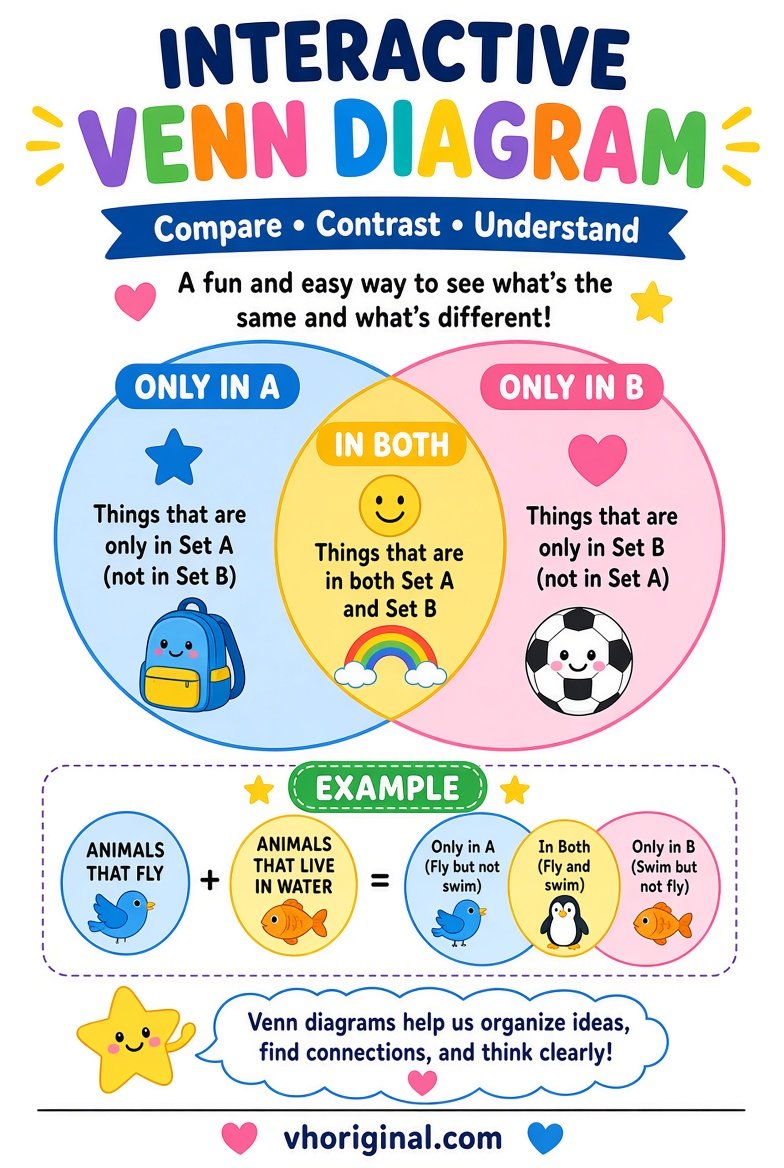
Picture 3: Interactive Venn Diagram
A two-set Venn diagram usually uses circles A and B. The intersection A ∩ B contains elements that belong to both sets, while the union A ∪ B contains elements belonging to at least one set. The A-only and B-only regions show members not shared with the other set. Elements in neither set can be shown inside a surrounding universal-set rectangle. If the sets are disjoint, the intersection is empty. Do not duplicate one shared item in separate nonoverlap areas. The visual sizes of the circles need not be proportional to the number of elements unless the diagram was deliberately designed that way.
View / Download after 15-second wait
Reflection versus rotational symmetry
Reflection matches points across an axis; rotational symmetry matches a figure after turning it through an angle. A square has both, but they are different transformations. Test reflection with folding and rotation with a marked arrow.
What can tangram teach about area?
Rearranging the same seven tangram pieces without stretching or cutting preserves their combined area. Different silhouettes may therefore share total piece area. Identify triangles and the parallelogram, and check printing scale before cutting.
A simple Venn diagram word problem
Suppose set A contains students who play cricket and set B contains those who play football. Students who play both sports belong in the intersection. Those who play only one game go in its corresponding nonoverlapping region. Students playing neither can appear outside both circles within the universal set. Use fictional names or letters rather than publishing classmates’ personal preferences without permission. A question may provide the number in each category, but do not invent statistics for a real class. Set operations can be shown with shading and symbols once membership is correctly identified.
Materials and step-by-step model making
Use clean paper, pencil, ruler, colour pens, cardboard, glue and safe scissors. For symmetry, draw a clear geometric figure and test proposed axes by folding. For the tangram, start from a validated seven-piece template and cut along all intended edges. Arrange the pieces to match one silhouette without overlap. For the Venn model, draw two circles and place clearly labelled fictional tokens into shared and separate regions. Older students can add union and intersection symbols. Adult supervision is appropriate for sharp cutters, and a printed poster should be treated as a reference if a teacher requires handmade work.
Class viva, download route and errors
A square has four reflection axes; a tangram has seven pieces; intersection means shared set members. Check labels and Venn overlap. All posters use the original 15-second advertisement-supported download page, with no direct-file bypass.
Frequently asked questions
How many lines of reflection symmetry does a square have?
Four.
How many pieces are in a traditional tangram?
Seven: five triangles, a square and a parallelogram.
What is an intersection in a Venn diagram?
The elements shared by both sets.
Is reflection symmetry the same as rotational symmetry?
No. They describe different transformations.
Conclusion and references
Clear mirror axes, accurately cut tangram pieces and correct set membership make these three mathematics projects useful and engaging.
Related school projects: Arch and Truss Bridge · School File Decoration
References: Math is Fun — Reflection Symmetry; Math is Fun — Tangrams; Math is Fun — Venn Diagrams.
Explore more: 44 school project models, charts and pictures








Share Your Opinion
Comments are closed on this post.