 Vista
Need a Pythagoras theorem school project model or 3D geometric shapes and nets chart? This guide includes three full-size teaching posters: a Pythagorean area model, a technical right-triangle diagram and a chart of solids and their flat nets. Students in approximately Classes 6–10 can build an A4 geometry display or lightweight cardboard models from these resources. The essential mathematical boundary is simple: **a² + b² = c² applies to right-angled triangles**, with c representing the hypotenuse opposite the right angle. A net, by contrast, is a flat arrangement that can fold into a three-dimensional shape. All pictures retain Vista Hub’s existing 15-second timed image-download page.
What does the Pythagorean theorem state?
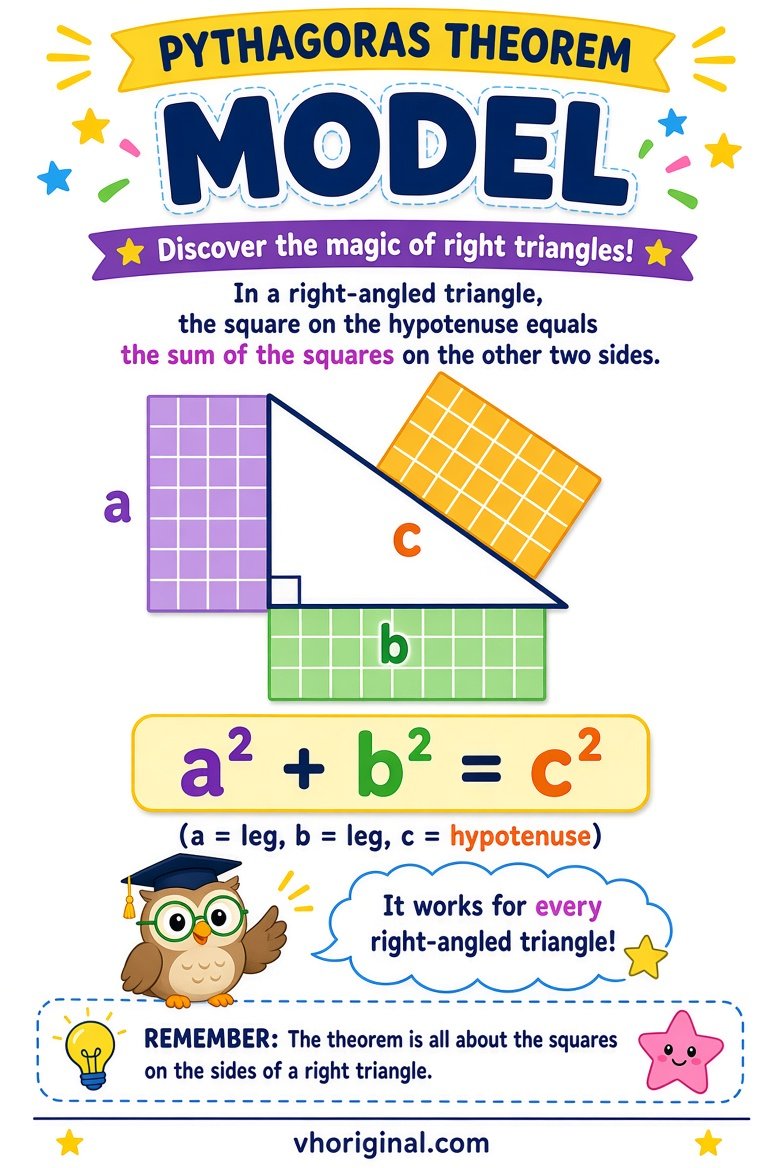
In a right triangle, the side opposite the right angle is the hypotenuse, commonly labelled c. The other two sides may be labelled a and b. The relationship is a² + b² = c², meaning that the areas of squares built on the shorter sides add to the area of the square built on the hypotenuse. A 3–4–5 triangle is a familiar example: 9 + 16 = 25. The theorem is not a universal formula for all triangles. Check that the model actually includes a right angle before using the equation to calculate an unknown side. Units must remain consistent throughout a calculation.
Picture 1: Pythagoras Geometry Area Model
The first picture can show a square constructed on each side of a right triangle. For legs of 3 cm and 4 cm, the squares have areas 9 and 16 square centimetres, while a 5 cm hypotenuse gives an area of 25 square centimetres. The areas, not merely the drawn colours, demonstrate the relation. The hypotenuse must be the longest side of a nondegenerate right triangle. If an illustrated model places a short side opposite the right angle, correct the labels. A classroom drawing may not be to scale, so include a note when proportions are simplified.
View / Download after 15-second wait
Picture 2: Technical Formula and Worked Example
The notation c² means c multiplied by itself, not twice c. For instance, if a=5 cm and b=12 cm, then c²=25+144=169 cm² and the hypotenuse is 13 cm. The square on the side has area measured in square units, while the resulting side length is measured in ordinary length units. For a missing leg, rearrange the equation appropriately and confirm that c is the hypotenuse. Do not apply the relation blindly to a triangle that has no right angle. A correctly labelled drawing should identify the right-angle marker and show which side each symbol represents.

View / Download after 15-second wait
Picture 3: 3D Geometric Solids and Nets
A net is a flat collection of faces arranged to fold into a three-dimensional solid. A cube has six equal square faces. A cuboid has six rectangular faces, though particular dimensions may produce some square faces. A cylinder can be represented using a rectangle for its curved surface and two circles for its ends. A cone uses a circular sector and a base circle. A smooth sphere has no exact distortion-free flat net, although approximate paper panels can create a sphere-like craft. Ensure the labels distinguish faces, edges and vertices where appropriate. Glue tabs are assembly aids rather than actual faces of the mathematical solid.

View / Download after 15-second wait
How are Pythagoras and solid nets connected?
The projects are distinct but can reinforce geometric reasoning. Pythagoras relates side lengths within a right triangle; a net helps visualise which flat pieces form a three-dimensional object. In some solids, a diagonal across a rectangular face can be calculated using the theorem. That does not mean every length in any 3D figure follows the same right-triangle setup without additional geometric steps. Ask students to identify the relevant two-dimensional right triangle before calculating a face diagonal. When constructing a net, the dimensions and positions of adjacent faces must agree for the solid to close correctly.
Materials for an inexpensive maths display
Prepare squared paper, cardboard, pencil, ruler, set square, optional protractor, glue and safe scissors. For the Pythagorean model, draw one right triangle and construct squares along its three sides. Colour the squares separately and label their areas. For the solid-net display, choose a validated cube or cuboid net from a textbook; not every arrangement of six squares folds into a cube. Mark fold edges before cutting. Children should have adult help with sharp cutting tools. These assignments can also be completed as static A4 charts without powered components or large three-dimensional structures.
Step-by-step: fold a cube or cuboid net
Draw six equal squares in a layout known to be a valid cube net. Cut around the outer boundary, keeping suitable glue tabs if required. Fold along the shared edges and check that no two faces overlap unexpectedly. Count six faces when assembled. For a cuboid, corresponding opposite faces must have matching dimensions. A cylinder uses a rectangle whose relevant side length matches the circumference of its circular base. A mismatch can leave a gap or cause overlap. Test with scrap paper before cutting the final coloured card. Accuracy of dimensions is more important than the number of decorative stickers.
Viva questions and sample calculations
Explain why a right angle is required and what the hypotenuse represents. Legs 6 cm and 8 cm give a 10 cm hypotenuse. A cube has six faces. A sphere has no exact distortion-free planar net. Check units and calculations.
Poster download and final checks
Use the existing 15-second ad-supported page for all images. Before printing nets, check dimensions and folding validity. Label c as hypotenuse and add square units for area. Use pictures as references when school requires original drawings.
Frequently asked questions
When does the Pythagorean theorem apply?
For right-angled triangles.
Which side is c in a²+b²=c²?
The hypotenuse, opposite the right angle.
How many faces are in a cube?
Six equal square faces.
Can a smooth sphere have an exact flat net?
Not without distortion or stretching of its curved surface.
Conclusion and sources
Pythagorean area models and 3D nets build separate but complementary skills in measurement, reasoning and geometric construction.
Related school projects: Arch and Truss Bridge · Solar System 3D Model
References: Math is Fun — Pythagoras; Math is Fun — Geometric Nets.
Explore more: 44 school project models, charts and pictures








Share Your Opinion
Comments are closed on this post.