 Vista
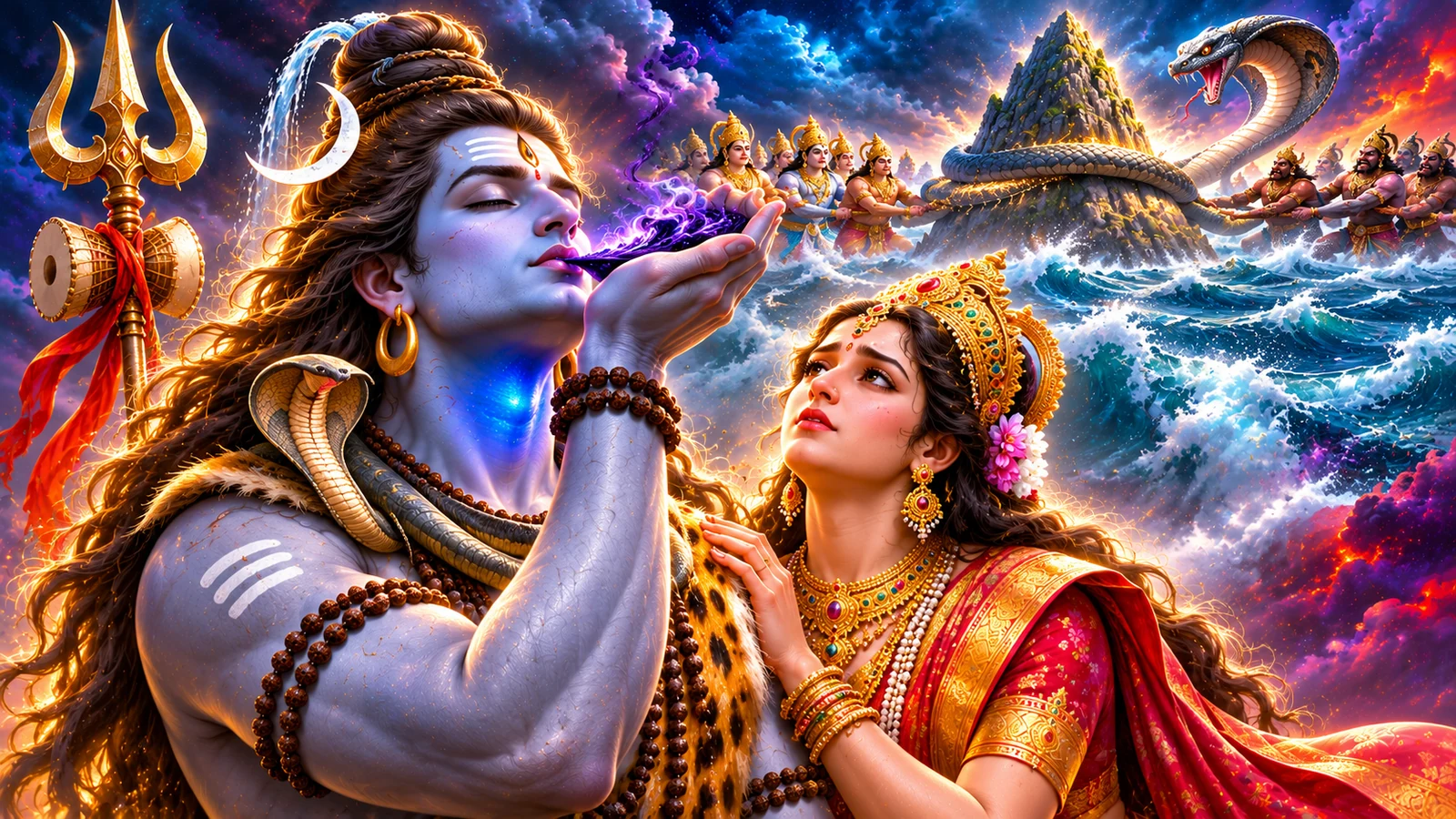
Quick answer: According to the Samudra Manthan narrative, Lord Shiva drank the dangerous Halahala (also called Kalakuta) poison because it threatened living beings after emerging from the cosmic ocean. The gods sought his help, and he intervened out of compassion. The poison marked his throat blue, giving him the name Neelkanth, or “the blue-throated one.” The Bhagavata Purana, Canto 8, Chapter 7 gives an especially clear account. Some familiar details—such as Parvati physically holding Shiva’s throat—belong to certain retellings rather than every version of the story.
What Is Samudra Manthan, and Why Was the Ocean Churned?
Samudra Manthan means the “churning of the ocean.” In a widely told Hindu mythological narrative, the Devas and Asuras temporarily cooperate to obtain amrita, the nectar associated with immortality. Their alliance is remarkable because the two groups often oppose one another. The enormous undertaking requires both sides to work toward the same prize, even when they disagree about who should receive it. The story therefore begins with a tension: a great reward is being pursued through cooperation that could break down at any moment.
The churning rod is Mount Mandara, and Vasuki, king of serpents, acts as the rope wrapped around it. In an important version, the mountain begins to sink, and Vishnu takes the form of Kurma, the tortoise avatar, to support it. The Devas and Asuras pull opposite ends of Vasuki, setting the mountain in motion. The scene is celebrated in temple art, devotional storytelling and illustrations because it brings a whole mythic cosmos into one dramatic picture: a mountain, serpent, ocean, gods, rivals and a divine rescue.
The Bhagavata Purana places the poison episode in this wider process, rather than presenting Shiva’s action as an isolated miracle. Before the participants gain the desired nectar, the ocean produces something terrifying. The story moves from collective ambition to an unexpected emergency. That sequence is central to understanding why Shiva drank poison: the whole enterprise has created a danger that nobody involved can manage alone.
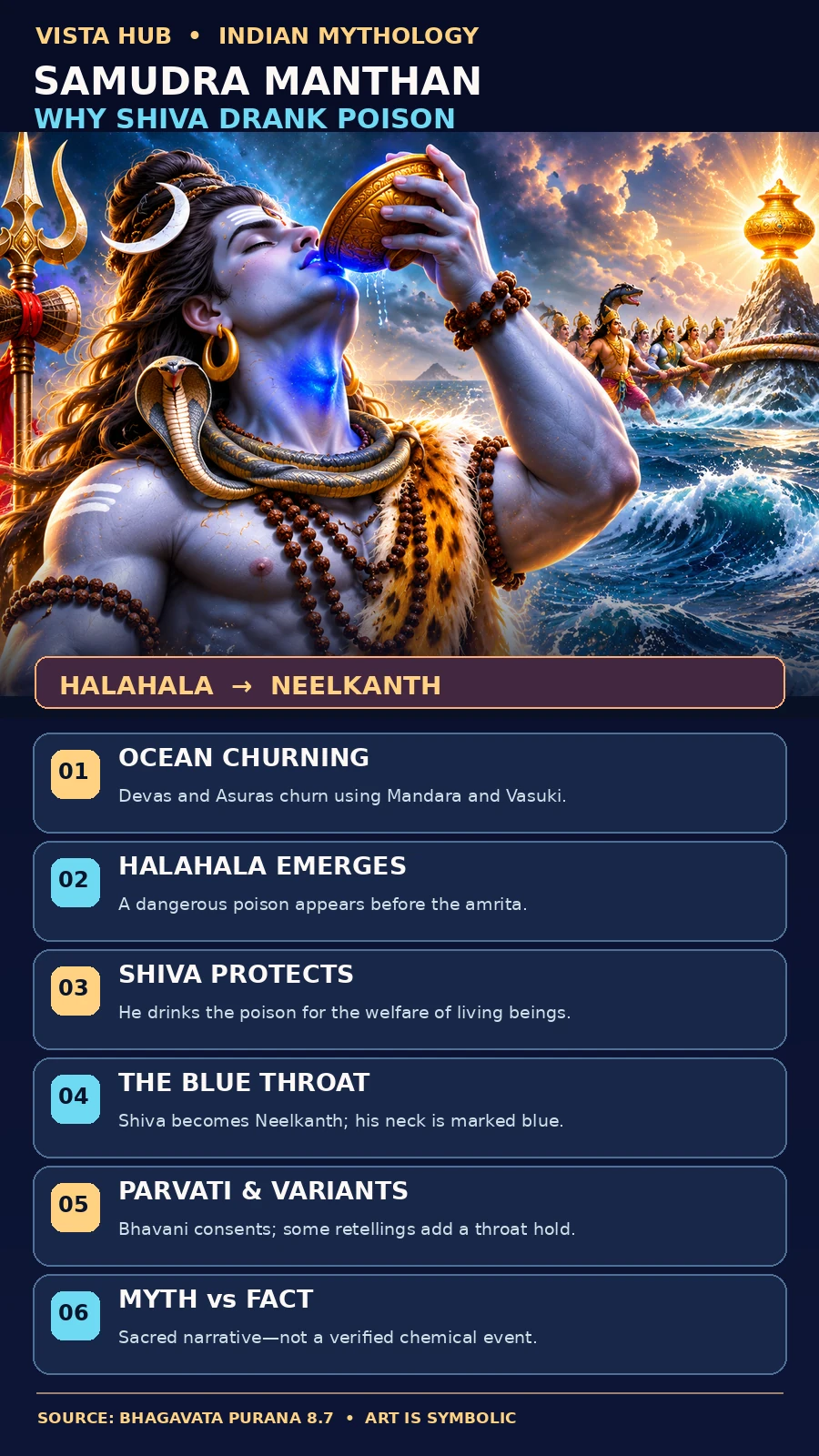
The Story in Order: From Ocean Churning to the Blue Throat
The broad sequence is easier to follow when divided into stages, although texts and local retellings differ in emphasis.
First, the alliance forms. The Devas seek to regain strength, and cooperation with the Asuras becomes part of the plan to obtain amrita. Vishnu’s guidance is prominent in several versions, especially in explaining how the difficult undertaking can happen.
Second, the mountain and serpent become the tools. Mandara is used as the rod, Vasuki becomes the rope and Kurma provides support from beneath. These details matter because every apparent victory depends upon a hidden foundation. The tortoise avatar may be visually less dramatic than the later treasures, yet the churning would fail without that support.
Third, Halahala appears. The ocean does not immediately deliver its hoped-for reward. Instead, a poisonous, spreading force threatens beings throughout the cosmos. The danger changes the priority from competition for amrita to collective survival.
Fourth, Shiva is approached. The frightened Devas and other beings seek the protection of Mahadeva. In the Bhagavata Purana account, Shiva is on Kailasa with Bhavani and is approached with prayers. He recognizes the seriousness of the danger and the need to protect living beings.
Fifth, Shiva accepts the poison. The Bhagavata Purana describes his decision to act from compassion; Bhavani gives her consent, and Shiva takes the poison into his hand and drinks it. The poison leaves a blue mark upon his neck. That mark becomes a sign of his sacrifice rather than a blemish to be hidden.
Finally, the larger churning narrative continues. Other extraordinary beings and gifts arise, and the competition over the nectar becomes important. Shiva’s intervention is a decisive turning point, but it is not the end of Samudra Manthan.
What Was Halahala Poison? Was It the Same as Kalakuta?
Halahala is the name most frequently used in English-language explanations of the episode. Kalakuta, sometimes spelled Kalakoot, is also associated with the poison in traditional accounts. Naming and description vary across Sanskrit texts, translations and local retellings. It is safer to describe the two as related names in the mythology than to claim that a modern laboratory has identified one exact ancient chemical under both labels.
The poison is described as terrifying because of its sweeping effects. In the Bhagavata Purana 8.7, it appears before the desired nectar and spreads so dangerously that beings seek refuge. The narrative conveys danger through an immense cosmic scale. Some popular illustrations show purple smoke, black liquid, luminous vapour or waves of fire. Those are modern visual interpretations; a painting does not establish the physical composition of a substance.
A question sometimes asked online is whether Halahala was a toxic gas, radioactive material or an industrial chemical. None of those claims has been demonstrated by archaeological or scientific evidence. The episode is a sacred mythological narrative, not a documented industrial accident. It can still carry a compelling insight: an ambitious project may produce harmful consequences before anyone enjoys the intended benefits. That modern analogy is a reader’s interpretation, not a claim that the Puranas predicted chemistry.
Why Did Shiva Drink the Poison Instead of Destroying It?
Shiva’s intervention is meaningful because he accepts responsibility for a danger affecting others. In the Bhagavata Purana telling, he responds to distress rather than seeking the prestige of being first to receive amrita. The Devas have been working toward a prize; when an unwanted consequence appears, their goals suddenly look secondary. Shiva sees the danger to living beings and acts.
This is one reason the story is often used to discuss compassion, courage and the welfare of the world. He does not treat suffering as somebody else’s problem. His power is portrayed through willingness to protect vulnerable beings, not merely through the ability to defeat an adversary. The poison is deadly within the narrative, and the fact that he survives is attributed to his divine character.
It would be a mistake to turn this act into advice for human beings to swallow harmful things or sacrifice their health. Never ingest poison, chemicals or unknown substances. Real exposure requires immediate appropriate medical or poison-control help. The narrative describes a divine event within religious literature; it is not a health technique. The responsible moral reading is about thoughtful protection, not imitation of a dangerous act.
Readers sometimes argue that Shiva should have used another power to make the poison vanish. Mythic stories do not work like technical puzzles in which every possible alternative must be exhausted. This narrative emphasizes that Shiva’s compassion becomes visible through the act of containment. The sign left on his throat allows worshippers to remember the protective choice.
Why Is Lord Shiva Called Neelkanth?
The name Neelkanth (also written Nilakantha or Neelkantha) combines ideas meaning blue and throat or neck. Shiva receives this title because the Halahala poison leaves his neck dark blue. The name is widely recognized in devotional songs, temples and visual art. When a painting shows Shiva with bluish skin, it may emphasize many forms of his iconography; when the throat specifically glows blue, it usually points to the poison episode.
A useful textual detail appears in Bhagavata Purana 8.7.43: the poison marks Shiva’s neck, and the mark becomes an ornament associated with his extraordinary act. This is more precise than a simplified online claim that all Hindu texts give exactly the same mechanism by which poison stopped at the throat. The core account is about drinking the poison and receiving the blue-throat mark. Later story traditions add further dramatic explanation.
This is also why Neelkanth does not mean that Shiva was a victim of a normal chemical burn. The colour is part of a religious sign and a naming tradition. Trying to equate it with a modern medical condition misrepresents both mythology and medicine. The image is symbolic and devotional, not a record of physical poisoning in a verifiable historical individual.
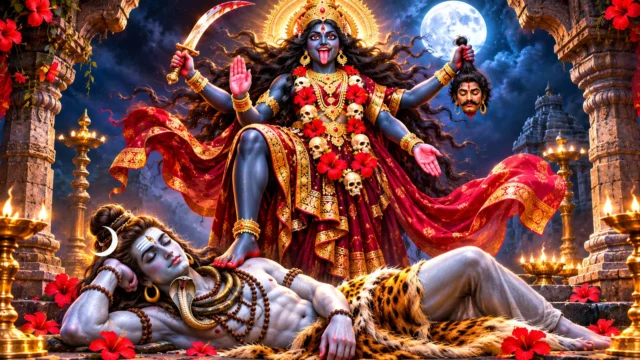
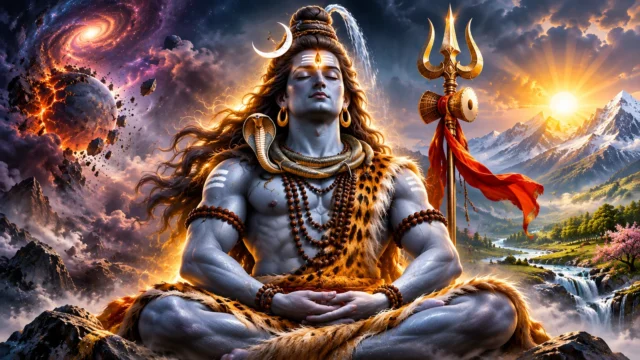
The blue throat also changes how the viewer reads the deity known popularly as the destroyer. Shiva is not only associated with dissolution. Here he protects the world from destruction. The same deity can be depicted as an ascetic, family figure, cosmic dancer and compassionate guardian without contradiction.
Did Parvati Stop the Poison in Shiva’s Throat?
This detail deserves particular care because it often appears in viral videos and illustrated summaries. A popular retelling says Parvati places her hand around Shiva’s neck to prevent the poison from passing further into his body. The gesture is moving, and it highlights the couple’s partnership. However, it should not be presented as the exact wording of every scriptural account.
In Bhagavata Purana 8.7.36–43, Shiva speaks about the danger to living beings. Bhavani is present and gives her consent to his decision, after which he drinks the poison and his neck turns blue. That passage does not need the additional hand-on-throat episode to explain the blue mark. Other regional or later devotional tellings may add it. The responsible way to write about the story is to say “In some retellings…” rather than asserting a single uniform version.
Variation is not necessarily a flaw in Indian mythology. The Puranas, epic traditions, regional performance, folk narration and contemporary visual media transmit stories with different emphases. A devotional narrator might focus on Parvati’s love and protection; a theological commentary might focus on Shiva’s compassion; an artist may focus on the striking blue throat. These approaches can coexist when readers know which is being presented.
For anyone producing an illustration or school project, a caption such as “Parvati beside Shiva during Samudra Manthan; interpretations vary” is more accurate than claiming a specific gesture is historically confirmed.
Who Helped in Samudra Manthan? Vishnu, Vasuki, Mandara and Shiva
The narrative involves several central figures whose roles should not be mixed up. Vishnu as Kurma helps stabilize Mount Mandara. Vasuki is the living rope used during the churning, with the Devas and Asuras as the teams pulling from different sides. Shiva responds when poison emerges. Later, Dhanvantari is associated with the vessel of amrita in many famous versions. It is therefore inaccurate to say that Shiva personally churned the ocean to obtain nectar for himself.
The cooperative effort is filled with tension. The groups joining together are rivals, and their shared labour does not erase their competing aims. A fascinating aspect of the episode is that the desired treasure cannot be reached by simple force. The mountain needs support, the rope creates risks and the process reveals danger before success.
The roles are sometimes flattened in short social-media reels: Vishnu is shown as the hero of one clip, Shiva of another and the Devas or Asuras barely appear. The text is more interesting. Several characters contribute different forms of support, intervention and judgment. This is why the story works so well as a poster or timeline rather than only a portrait of one deity.
When comparing versions, look for which Purana or epic passage is cited. A detailed order of events in one translation may differ from another, including how the resulting treasures are listed. Treat such differences as something to investigate rather than quickly declaring one tradition “fake.”
What Else Emerged from the Ocean Before Amrita?
The churning narrative does not end when Halahala is contained. Stories describe the arrival of remarkable beings, objects and blessings. Depending on the source, these include Lakshmi, Dhanvantari, Airavata, Uchchaihshravas, Kaustubha and other celebrated figures or treasures. Popular lists often present fourteen ratnas, but the exact roster and order vary with the text and tradition being followed.
The contrast between poison and treasure gives the narrative much of its power. The participants seek an extraordinary reward; instead, a catastrophe threatens everyone. Only after that crisis does the story proceed toward the blessings they hoped to receive. It is tempting to describe this as an ancient theory that all technological breakthroughs necessarily create toxic waste, but that would be an unsupported scientific claim. The better description is literary and ethical: the road to a desired outcome can involve unforeseen costs.
The presence of Dhanvantari also makes the episode familiar in discussions of Ayurveda and devotional customs. It does not prove that a physical elixir granting immortality existed. Readers can respectfully distinguish the religious meaning of amrita from modern medicine’s understanding of health, ageing and disease.
Some illustrated timelines jump from the blue throat directly to the amrita vessel, because those are the two most recognizable images. A fuller article should remind readers that the intermediate treasures are part of a broad and varied mythic tradition.
Life Lessons: Protection, Responsibility and the Limits of Metaphor
One thoughtful reading of this story concerns the difference between seeking a reward and accepting responsibility. Devas and Asuras are focused on amrita, while Shiva becomes central when danger appears. That contrast raises an uncomfortable question: who takes responsibility for the harmful consequences of an undertaking after everyone has hoped to benefit from it?
Another lesson is the value of unseen support. Mount Mandara depends upon Kurma, and the churning requires effort from multiple sides. A project may celebrate those who receive the prize while forgetting the people who hold the system together. The story suggests that preservation and rescue can be as important as victory.
Yet metaphors need boundaries. The Neelkanth story should never be used to tell someone that they must absorb abuse, tolerate a dangerous workplace, refuse medical care or “swallow poison” in a literal sense. Compassion also involves preventing harm, asking for assistance and respecting one’s own safety. Hindu devotional literature can inspire reflection without replacing professional advice.
A helpful way to read the episode is to separate three layers: what the scripture narrates, what different communities teach from it, and what an individual draws from the story today. The first layer requires source accuracy. The second requires respect for tradition. The third invites personal reflection without dressing interpretation up as historical proof.
Myth vs Fact: Four Claims About Shiva Drinking Poison
Claim: Archaeologists have found the original Halahala. There is no credible scientific evidence establishing the mythological poison as an excavated chemical substance. Sacred storytelling and material verification are different kinds of knowledge.
Claim: The Bhagavata Purana says Parvati forcibly held Shiva’s throat. The passage in Canto 8, Chapter 7 describes Bhavani’s consent and the subsequent blue mark. The hand-on-throat version should be attributed to particular retellings, not generalized to every text.
Claim: Samudra Manthan is only Shiva’s story. The wider narrative includes Vishnu’s Kurma avatar, Vasuki, Mandara, Devas, Asuras and later Dhanvantari, among other figures. Shiva’s intervention is crucial but part of a larger episode.
Claim: Neelkanth means Shiva was permanently injured by a known poison. In the story, the blue neck becomes a revered sign. It is not a documented modern diagnosis or a recipe for surviving toxicity.
Frequently Asked Questions
Why did Lord Shiva drink poison during Samudra Manthan?
He did so in the mythological narrative to protect living beings when Halahala threatened the world. The Bhagavata Purana 8.7 emphasizes his compassionate decision.
What is the name of the poison Shiva drank?
It is usually called Halahala; Kalakuta/Kalakoot is another name associated with it in traditional accounts and translations.
Why is Shiva called Neelkanth?
His throat is marked blue after he drinks the poison. Neelkanth means “blue-throated.”
Did Goddess Parvati prevent the poison from going into Shiva’s stomach?
That is a well-known detail in some retellings. The Bhagavata Purana passage states that Bhavani consented to his decision and that the poison marked his neck blue.
What was the purpose of Samudra Manthan?
The Devas and Asuras churned the cosmic ocean in pursuit of amrita, the nectar associated with immortality.
Was Halahala a real chemical or radioactive poison?
No scientifically verified identification of Halahala as such a substance exists. It should be described as part of religious mythology.
Which avatar of Vishnu appears during the churning?
Kurma, the tortoise avatar, supports Mount Mandara in widely known versions of the narrative.
Conclusion: What the Blue Throat Really Reminds Us Of
The Neelkanth episode is not merely a spectacular image of Shiva drinking something dangerous. It is a story about responding to distress when the search for reward has created a wider crisis. The churning requires collective effort, but the unexpected poison forces a deeper question about responsibility. Shiva’s compassionate intervention and blue throat become the central memory of that moment. Read with attention to scripture and variation, the legend is richer than a sensational headline: it joins devotion, symbolism, storytelling and ethical reflection without pretending to be a laboratory report.
Source and interpretation note (reviewed 12 November 2026): Primary passage consulted: Srimad Bhagavatam, Canto 8, Chapter 7, especially verses 18–21 and 36–43. For a parallel English presentation see Srimadbhagavatam.org, Chapter 7. This article describes religious narratives; it does not claim the events have been independently established as history or science. Never ingest poisonous substances.















Share Your Opinion
Comments are closed on this post.