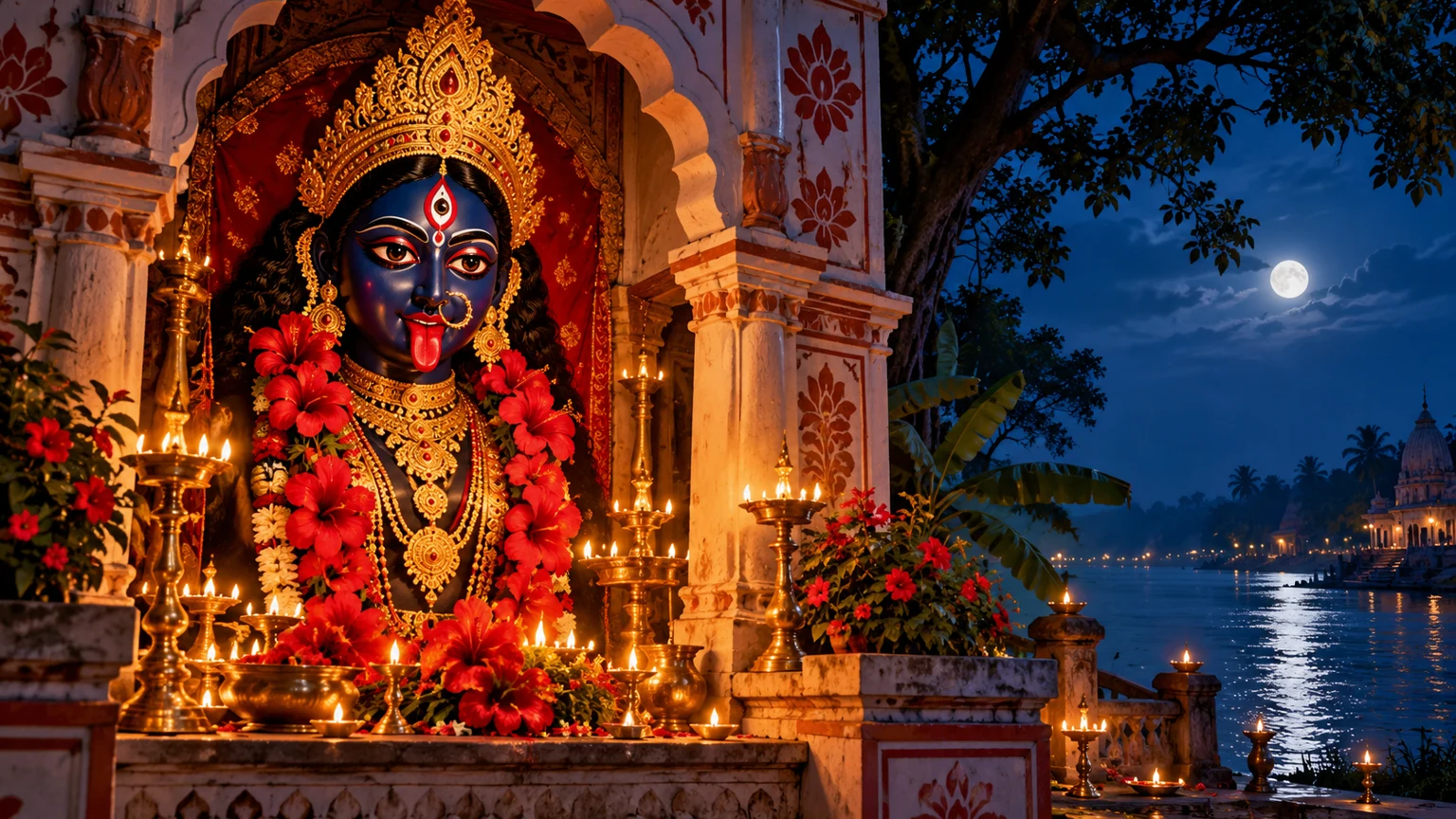
The Connection Between Diwali and Kali Puja Night
Diwali, the festival of lights, is celebrated across India with diverse regional variations in its observances. While many families perform Lakshmi Puja, in regions like Bengal and other Eastern traditions, Kali Puja holds particular significance during this festive period. The presence of different forms of deity worship during a single festival highlights the rich diversity of Indian traditions. It’s important not to view one family’s Lakshmi Puja as a counterpoint to Kali Puja, nor should every Kali worship be automatically labelled as “black magic.” Public pandals, temple aartis, home devotion, and specific initiated sadhanas all represent different contexts. The mere fact that a puja occurs at night does not inherently make it mysterious or harmful. This article does not provide specific dates for temple events in any given year; always check official announcements from the relevant temple for visiting or participating in pujas.
Understanding Goddess Kali’s Connection to the Crematorium
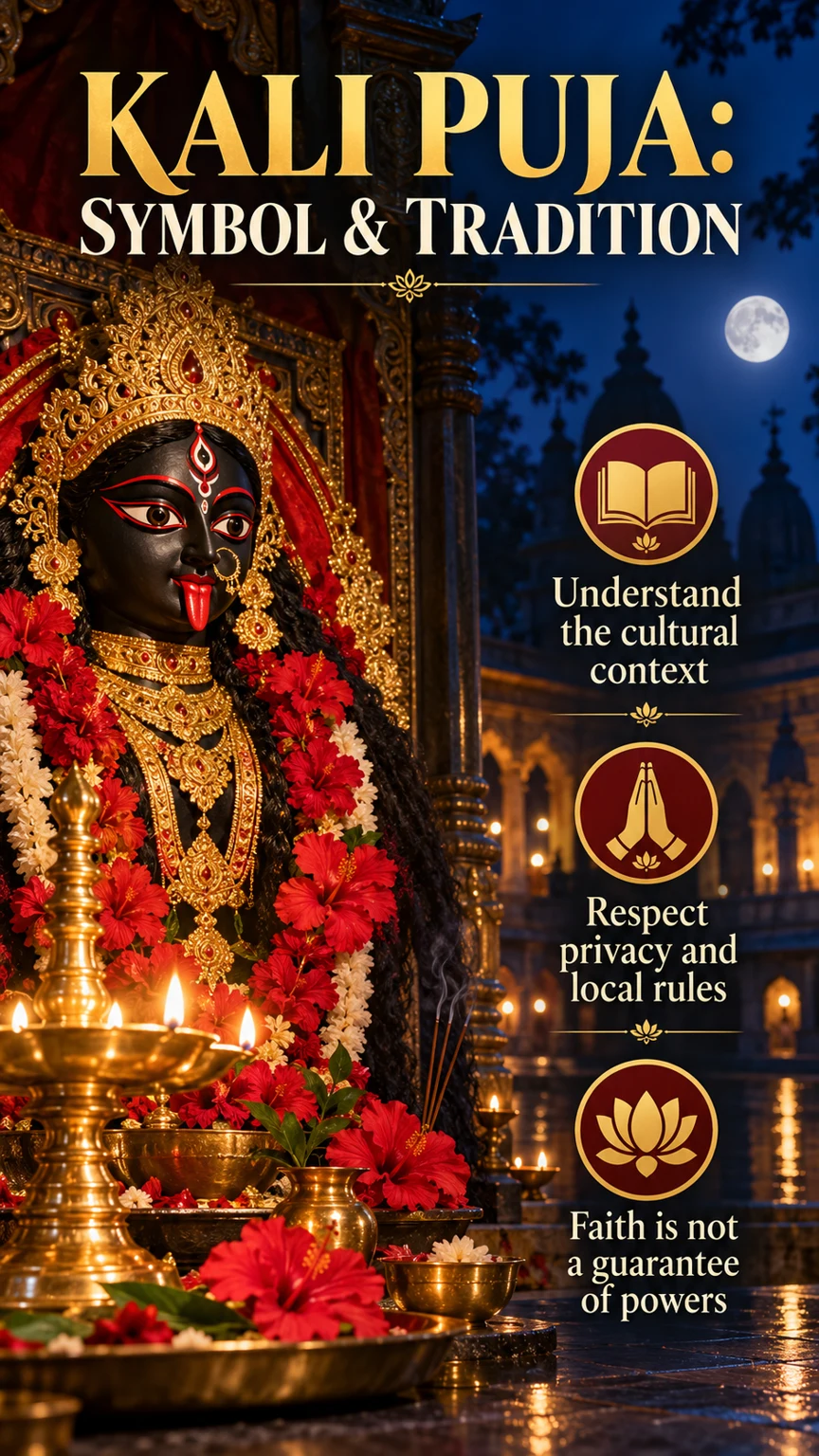
In religious art and Shakta interpretations, Kali is often associated with time, death, and the impermanence of life. The crematorium (shmashan) serves as a stark reminder that the physical body and worldly possessions are transient. Some interpretations suggest that confronting fear and ego is part of this context. However, it’s not essential to consider this the sole universal meaning. Articles discussing Kali’s iconography, such as those found in the British Museum, explore the cultural link between Kali and the crematorium. Such museum content provides a basis for understanding art and religious symbolism, but it is not proof of actual “siddhis” (supernatural powers) or an individual’s capabilities. Transforming symbolic meaning into literal miracles is a separate claim. One should not judge a devotee’s character or intentions based solely on the fierce artistic representation of the deity. For a devotee, that same form can evoke feelings of protection, motherhood, or liberation from fear. Reducing a religious image to mere frightening entertainment strips it of its cultural context.
Tarapith, Kali, and Distinct Sadhana Traditions
Tarapith, located near Rampurhat in Birbhum, West Bengal, is a renowned pilgrimage site. Information from West Bengal Tourism mentions its tantric temple and its proximity to a crematorium, illustrating the existence of such traditions in specific locations. However, not every detail can be applied to all Kali temples. Maa Tara, the presiding deity of Tarapith, and Goddess Kali can be seen in related contexts within the broader Shakti tradition, but equating both names and every worship method entirely is inaccurate. Practices can vary based on region, sect, temple, and guru lineage. Information from religious organizations like Belur Math also demonstrates the presence of diverse ideas and practices in deity worship. Therefore, stating “this is how it happens throughout Bengal” based on a single viral visual would be a flawed generalization. For most viewers, a general temple visit and public puja are the relevant experiences. Artistic depictions are often devotional and not necessarily photographs of actual events or locations.
Why ‘Tantra’ Doesn’t Solely Mean Black Magic
The term ‘tantra’ encompasses a wide range of religious traditions, scriptures, methods, and philosophical ideas. Labeling it solely as magic intended to harm someone is an incomplete interpretation. Similarly, just because something is named “tantra” does not automatically make every claim authentic or effective. It is useful to avoid both extremes. A general reader should inquire about the source, the context of the speaker, and the limitations of the claim. Statements like “this is believed in a certain tradition” and “this can definitely control another person” are entirely different. The first might be a cultural description; the second requires credible evidence. Personal experiences of symbols, meditation, or devotion do not guarantee an effect on others. Be cautious if you are assured that problems like illness, financial hardship, or relationship issues can be resolved solely through secret practices. Respectful spiritual guidance may leave room for questions.
Navigating Viral Crematorium Videos
When viewing viral videos of crematorium rituals, first check the stated location and date. Old footage can be presented with a new date, and a video from one place might be shared as being from another. If the original source is unknown, do not consider it proof of a current event. What is outside the frame, where editing occurred, and whether audio was added later are also significant factors. Smoke, low light, music, and sudden cuts can make an ordinary scene appear frightening. This does not automatically prove the video is fake, but it also doesn’t lead to conclusions of miracles. Sharing close-ups of a funeral, grieving individuals, or practitioners without their consent raises privacy concerns. Curiosity about culture and making entertainment out of someone’s sensitive situation are different matters. If in doubt, ask for context rather than forwarding the video.
Should the Average Devotee Visit a Crematorium for Puja?
Visiting a crematorium is not mandatory for regular home worship. Prayers, recitations, chanting, or temple visits can be performed at home according to one’s family tradition. There is no need to enter restricted areas out of curiosity or to arrive at a sensitive location with a camera. If attending a recognized religious event, follow the permission and arrangements of the organizers and local management. During a funeral, the space and privacy of the grieving family are paramount. Blocking pathways, crowding for photos, or touching puja materials is inappropriate. Do not plan solitary night experiments based on social media content. The physical conditions of the location, darkness, proximity to a river or bank, and the activities of real people can pose risks. Demonstrating danger is not necessary for learning about religious history.
What to Do If Asked for Money or Personal Information Under Threat
Messages like “If the remedy is not performed tonight, your family will face a crisis” can be tactics to create pressure. If there are demands for immediate payment, confidentiality, and escalating amounts, pause your decision. Share the message with a trusted person and discuss the situation. Do not provide One-Time Passwords (OTPs), bank PINs, identification documents, or personal photos to unknown individuals under the guise of rituals. Threatening to retaliate against someone’s claims is not a solution. Keep records of conversations and seek official assistance for actual fraud or threats. Accusing an entire community of being fraudulent is also incorrect. Focus questions on an individual’s behavior and verifiable claims: what did they ask for, what did they promise, and what is their basis?
Frequently Asked Questions
Why are there crematorium rituals on Diwali night?
In some Shakta and Tantric traditions, the crematorium is associated with death, impermanence, and specific contexts of deity worship. This is not a rule for all households.
Is every Kali Puja a tantric practice?
No. Home devotion, public pujas, temple events, and specific sadhanas are distinct contexts. Do not draw conclusions solely from the time of night or the deity’s form.
Is there proof of gaining powers from crematorium sadhana?
The existence of a tradition is not independent proof of supernatural claims associated with it. Do not accept guarantees of specific siddhis or control over others.
Are the rituals at Tarapith and all Kali temples the same?
No. The form of the deity, the temple, and the guru lineage can lead to different practices. Do not apply information from one site to all others.
Is it necessary to go to a crematorium for home puja?
No. Regular puja can be performed at home or in a temple according to family tradition. Visiting sensitive locations is not obligatory.
What should I do if someone demands money by instilling fear?
Stop payment and talk to a trusted person. Do not share personal financial information. For actual fraud or threats, seek official assistance.
Advice: Maintain Curiosity, Context, and Respect
Approach the subject of Kali Puja and crematorium rituals as a cultural, artistic, and philosophical topic rather than a frightening mystery. Respect the devotion to the Goddess, do not treat miraculous claims as facts, and be mindful of the privacy of those involved in funeral rites. It is not necessary to perform unknown experiments or succumb to financial pressure for learning.



आपकी राय क्या है?
इस पोस्ट पर राय अभी बंद हैं।