 Vista

A death in the family is a very hard time. In the middle of grief, it is often unclear where to begin with the paperwork and legal formalities. But some tasks need to be done on time, or you may get stuck later with banks, insurers or property.
This post is a simple checklist of what to do after a death, and in what order. Procedures vary a little by state and district, so confirm with the local office where needed.
The checklist at a glance
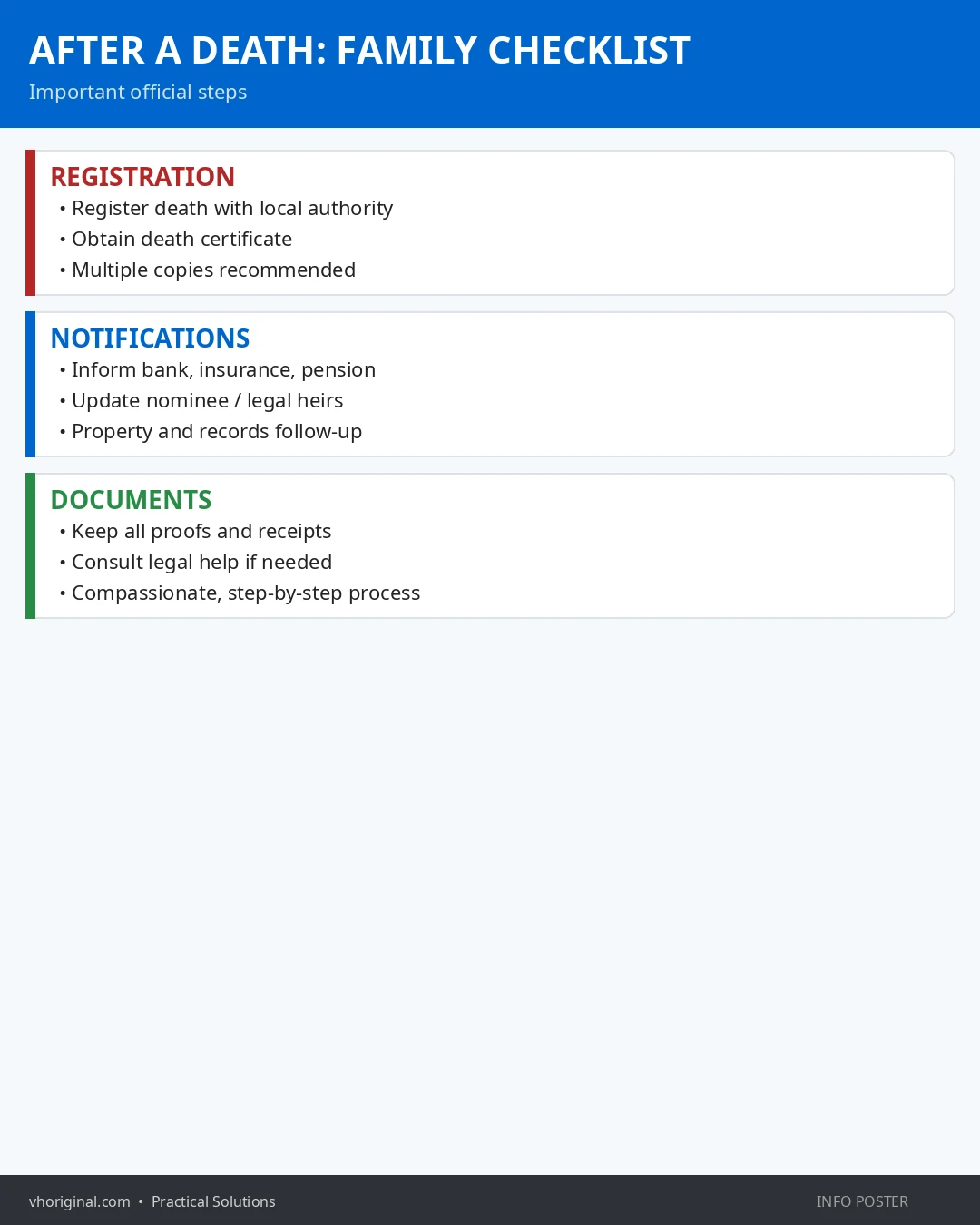
| Step | Task | When |
|---|---|---|
| 1 | Register the death and get the death certificate | Within 21 days (free) |
| 2 | Get several certified copies | Along with registration |
| 3 | List bank accounts and lockers | First few weeks |
| 4 | Inform insurers and file claims | Without delay, claim deadlines exist |
| 5 | Trace investments, pension and provident fund | First few weeks |
| 6 | Legal heir certificate, if needed | For property or large claims |
| 7 | Property mutation | Once papers are ready |
1. The death certificate comes first
Almost nothing else can move without a death certificate. Under the law, every death must be registered within 21 days, and registration in this period is free. If the death happened at home, a family member must inform the local registrar (municipal body, panchayat or health office).
After 21 days, late registration rules apply, with late fees and permissions that differ by state. So register as early as you can. The certificate usually takes from a few days to two weeks. Commonly needed papers are the hospital’s death summary or a doctor’s report, the deceased’s ID such as Aadhaar, and the applicant’s ID.
2. Keep several copies
Banks, insurers, pension offices, the tax department and property work all ask for the certificate. Get several certified copies at the start and keep digital scans too.
3. Bank accounts and lockers
Make a list of every bank account, fixed deposit and locker. Then inform each branch with the death certificate and an application. Even with a nominee, banks sometimes create hurdles. For that situation, read our guide what to do when a nominee is not getting the money.
Tip: until the account is settled, do not share account details with strangers and do not use the deceased’s cards or UPI.
4. Insurance policies and claims
If the person had life, health or accident insurance, contact the insurer without delay. Many insurers have time limits for intimation, and late claims can be rejected. If the policy papers are missing, premium debits in bank statements can show which insurer it was.
5. Investments, pension and provident fund
Gather details of shares, mutual funds, PPF, NPS, EPF and pension. Where a nominee is registered, the amount can be transferred to the nominee or heir after the required documents. For government pension, the department must be informed so the next steps can start.
6. When do you need a legal heir certificate?
When there is no nominee, there are many heirs, or the amount is large, a legal heir certificate may be needed. It is usually issued by the tehsil or sub-divisional magistrate’s office, and the process varies by state.
7. Transferring property
To put land or a house in the heirs’ names, a mutation process is followed. It needs the legal heir certificate, death certificate and property papers. The full process is in our guide on property transfer after death in India.
8. Identity and digital accounts
- Keep Aadhaar, PAN and voter ID details safe and ask the concerned departments how to prevent misuse.
- Watch the mobile number, email and social accounts, since bank alerts and OTPs come there.
- Before closing a number, check which accounts are linked to it.
Beware of fraudsters
Some fraudsters exploit such moments. If anyone asks for money in the name of an insurance claim, bank amount or government help, be careful. Genuine processes run through the bank, insurer or a government office, not through OTPs or links on the phone.
Make one file of papers
- Certified copies of the death certificate
- ID proofs of the deceased and heirs
- Bank passbooks, FD and locker details
- Insurance policy papers
- Property papers and will, if any
- Nominee details
Frequently asked questions (FAQ)
Within how many days must a death be registered?
Within 21 days. Registration in this period is free.
How long does a death certificate take?
Usually a few days up to two weeks, depending on the state.
What is needed to withdraw money from the bank?
Death certificate, ID of the nominee or heir and the bank’s claim form. A legal heir certificate may be needed for large amounts.
What if an insurance claim is delayed?
Many insurers have time limits, so late intimation can lead to rejection.
Where is a legal heir certificate made?
Usually at the tehsil or sub-divisional magistrate’s office. Rules vary by state.
Also read: Will vs Nominee in India: Who Really Owns the Money and Property After Death? | Can You Write a Valid Will Without a Lawyer in India? Section 63, Two Witnesses and Registration Explained
Sources
- Patrika: legal and financial tasks after a death in the family
- Prabhat Khabar: 10 urgent tasks after a death
- Aditya Birla Capital: death certificate process and timelines
- Outlook Money: Documentation of a Death
- Registration of Births and Deaths Act, 1969, and your state rules


























Share Your Opinion
Comments are closed on this post.