 Vista

Your phone buzzes with a message saying a few thousand rupees were credited to your bank account, though you were not expecting any money. Instead of joy you feel uneasy. And soon an unknown number may call you to say, “The money went to your account by mistake, please send it back.”
Rushing is the biggest mistake in this situation. In this guide we explain, in simple words, what to do first when unknown money arrives, what not to do, how this can turn into a scam and what the legal risks are.
First 5 steps (short version)
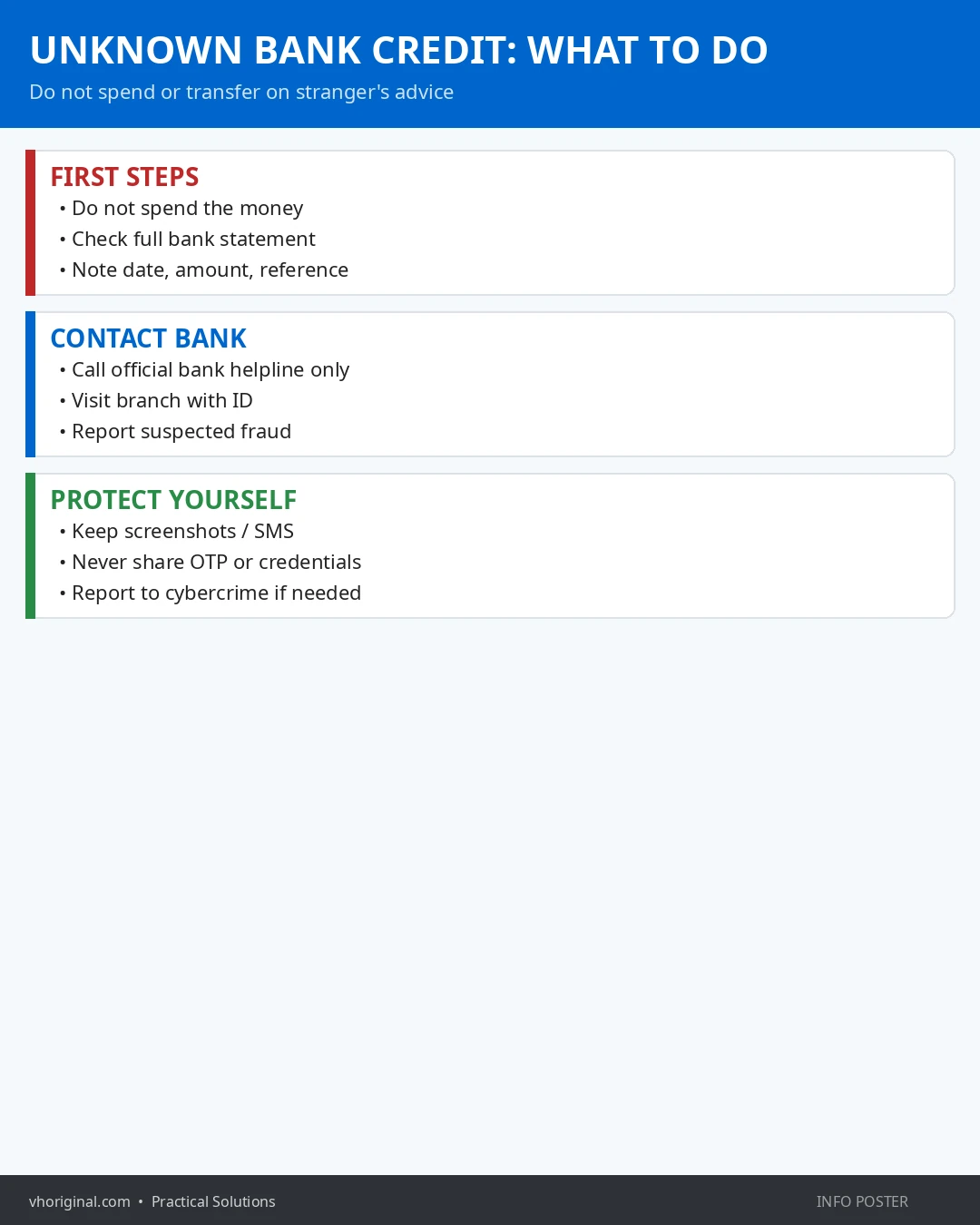
- Do not spend the money and do not transfer it onward.
- Check your bank statement or app to see who sent it and how (UPI, NEFT, IMPS).
- Do not send money straight back to a stranger, and do not click links, install apps or share an OTP because someone asks.
- Inform your bank in writing through your branch, helpline or official app.
- Keep all details and screenshots safe.
Three different situations
| Situation | What may be happening | What to do |
|---|---|---|
| Someone typed a wrong account number | A sender’s mistake put money in your account | Do not touch it and tell your bank |
| Bank or technical error | A system fault credited the amount | Inform the bank, which can reverse it |
| A fraudster sent it on purpose | A trap to get you to “return” the money | Do not return it directly; report to cyber crime |
Why spending it is risky
According to the RBI, providing correct beneficiary details is the responsibility of the person sending the payment. That does not mean the person who received the money by mistake may use it. Knowingly spending someone else’s money can amount to dishonest misappropriation, which can lead to legal action. So until the matter is clear, leave the money untouched in your account.
There is another risk. If the money is the proceeds of a fraud and you send it onward, your account can come under suspicion in the investigation, and the account may even be frozen.
How the scam that follows unknown money works
This is a common pattern in cyber fraud. A fraudster first puts some money into someone’s account. Then he calls or messages saying it was a mistake and asks you to send it back to a UPI ID or account number he gives. His real aim is different. Sometimes he wants to launder money taken from elsewhere through your account. Sometimes he wants you to open a link or install an app that gives access to your banking details.
In many frauds people are made to install an APK app. Never install an app or open a link at a stranger’s request. Our APK incident response wizard shows what to do step by step if you have installed one by mistake.
What not to do if a stranger asks for the money
- Do not return the money to the UPI ID or number they give.
- Do not open any link or install any app.
- Do not share an OTP, PIN, card number or allow screen sharing.
- Do not decide under pressure from threats or urgency.
How to inform your bank
- Visit your branch and give the branch manager a written application, or lodge a complaint through the bank’s official helpline or app.
- State the date, amount and transaction ID of the credit and say you do not recognise it.
- Attach a screenshot of the statement and the SMS.
- Get the acknowledgement or complaint number and keep it safe.
- Ask the bank how it will return the amount to the right account.
The right route is for the bank itself to investigate and send the money to the correct account. It also gives you proof that you did not keep the money yourself.
If the mistake is yours (you sent money to a wrong account)
This is the other side of the situation. If your money went to a wrong account, inform your bank immediately with full transaction details. The bank contacts the receiving bank. If the bank does not resolve it, you can file an online complaint on the RBI Banking Ombudsman portal (bankingombudsman.rbi.org.in), giving transaction details, the bank name and details of your earlier complaint.
RBI is also introducing a facility to show the beneficiary’s name in NEFT and RTGS before sending, so such mistakes become less common. UPI already shows the name, so always match it before paying.
Where to report a suspected scam
- Call the cyber crime helpline 1930 immediately, especially if money has already been deducted.
- File an online complaint on the national cyber crime portal cybercrime.gov.in.
- Inform your bank at the same time.
- You can also report to your nearest police station.
How to avoid this in future
- Check any unknown transaction alert as soon as you see it.
- Keep your bank’s SMS alerts switched on.
- Never share your UPI PIN or OTP, even with someone who claims to be from the bank.
- Do not trust calls about a “refund” or a “wrong transfer”.
Frequently asked questions (FAQ)
What should I do if unknown money reaches my account?
Do not spend or transfer it, inform your bank in writing and keep the details and screenshots.
Can I spend money that came by mistake?
No. Knowingly spending someone else’s money can lead to legal trouble.
A stranger calls asking me to return it. Should I?
Not to the account or UPI ID they give. Complete the process through your bank, since it can be a scam.
What if I sent money to the wrong account?
Tell your bank immediately. If it is not resolved, complain on the RBI Banking Ombudsman portal.
Where do I report a scam?
Call the cyber crime helpline 1930 or use cybercrime.gov.in.
Can the bank reverse the amount itself?
If the credit came from a bank or system error, the bank can reverse it through its own process, which is why you should inform it.
Also read: Money Deducted From Your Bank Account Without Notice? Reasons, How to Check and Where to Complain | How to Spot a Fake UPI Payment Screenshot: 6 Checks Every Shopkeeper Needs
Sources
- Kotak Mahindra Bank: Recover Money Sent to Wrong Account
- Outlook Money: What To Do If You Transfer Money To A Wrong Account
- Prabhat Khabar: getting money back after a wrong UPI payment
- Zee Business: how to get back money sent to a wrong account
- Patrika: UPI wrong transaction and RBI’s new initiative
- RBI Banking Ombudsman portal (bankingombudsman.rbi.org.in)
- National Cyber Crime Reporting Portal (cybercrime.gov.in)






















Share Your Opinion
Comments are closed on this post.