 Vista

When you book a train ticket in India, the screen often shows something like GNWL 12, RLWL 5 or RAC 20. Most people treat all of these as the same “waiting” status and move on. But each code means something different, and the code decides how likely your ticket is to get confirmed and whether you should line up a backup plan.
In this guide you will learn, in simple words, what GNWL, PQWL, RLWL, TQWL, RSWL, RQWL and RAC mean, how to read them in your PNR status, what happens if your ticket is still waitlisted when the chart is prepared, and how to improve your chances.
Railway waiting list codes at a glance (chart)
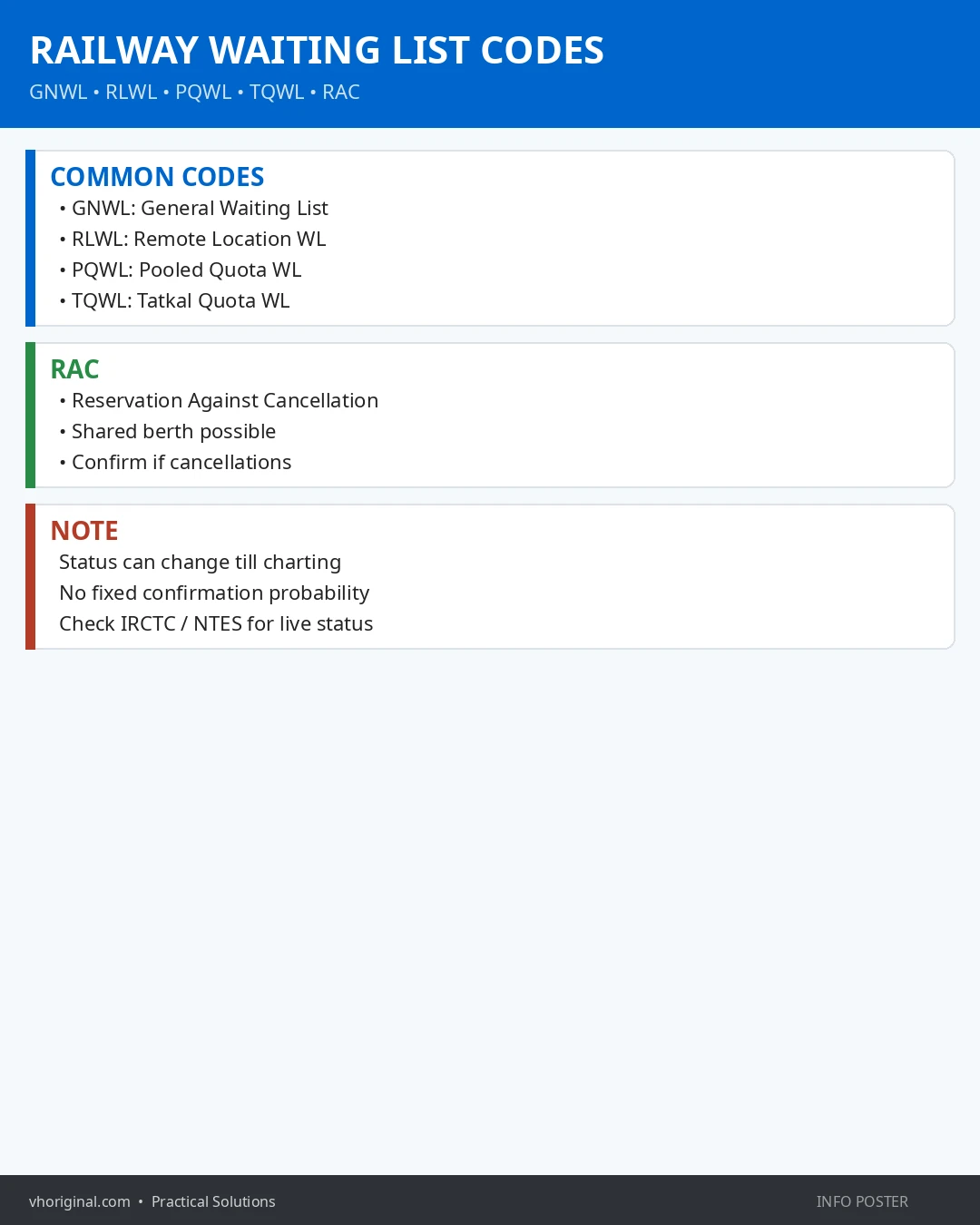
| Code | Full form | Meaning | Confirmation chance |
|---|---|---|---|
| GNWL | General Waiting List | Journey starts at or near the train’s originating station | Highest |
| PQWL | Pooled Quota Waiting List | Shared quota of several small intermediate stations | Lower than GNWL |
| RLWL | Remote Location Waiting List | Separate quota for a specific intermediate station | Low |
| TQWL | Tatkal Waiting List | Waitlist after the Tatkal quota is full | Usually lowest |
| RSWL | Roadside Station Waiting List | Waitlist for small roadside stations | Low |
| RQWL | Request Waiting List | Not tied to any quota | Very low |
| RAC | Reservation Against Cancellation | You can travel, but the berth is shared | Confirmed before any waitlist |
Note: these are general estimates, not guarantees. The real outcome depends on the train, route, class, date and season.
What is a waiting list (WL)?
Every coach has a limited number of seats and berths. Once all seats in a class are sold, the railways places further passengers on a waiting list. Your ticket is booked, but no seat has been assigned to you yet. When a passenger with a confirmed ticket cancels, that seat goes to the passenger at the top of the waiting list.
So the fate of a waitlisted ticket depends on how many people are ahead of you and how many confirmed tickets get cancelled. That is why different codes matter: each code draws from a different cancellation pool.
What does GNWL mean?
GNWL stands for General Waiting List. It starts once the general quota seats are full. It is the most common type of waitlist, and you usually get it when you board at the train’s starting station or a station close to it.
GNWL generally has the best confirmation chances among waitlists, because it is linked to the train’s largest quota. Whenever a confirmed or RAC ticket from the general quota is cancelled, GNWL passengers benefit first.
What does PQWL mean?
PQWL stands for Pooled Quota Waiting List. A long-distance train stops at many small stations. For these stations the railways creates one shared pool of seats. When that pool is full, PQWL tickets are issued.
A PQWL ticket moves up only when a confirmed ticket from that same pool is cancelled. The pool is small and its priority comes after GNWL, so the chances are usually lower than GNWL.
What does RLWL mean?
RLWL stands for Remote Location Waiting List. It is given to passengers who board at an intermediate station that has its own separate quota. Your chances depend on how many seats the railways has set aside for that station and how many of them get cancelled.
When the quota is small, even a low waiting number may not move. So do not treat RLWL 10 and GNWL 10 as equal. On the same train, GNWL 22 may get confirmed while RLWL 8 stays exactly where it was.
TQWL, RSWL and RQWL explained
TQWL (Tatkal Waiting List)
TQWL is issued when the Tatkal quota is full. One special feature: if a Tatkal waitlisted ticket moves up, it is confirmed directly and does not pass through RAC. However, Tatkal seats fill very quickly and there are few cancellations, so TQWL is usually considered to have the lowest chances.
RSWL (Roadside Station Waiting List)
This waitlist is for small stations along the route. The quota is very limited, so the chance of confirmation is low.
RQWL (Request Waiting List)
RQWL does not belong to any fixed quota. The chance of confirmation is very low, so do not plan your trip around it.
What is RAC, and can you travel on it?
RAC stands for Reservation Against Cancellation. It is one step above the waiting list. With an RAC ticket you are allowed to board and travel, but you do not get a full berth. A side lower berth is shared between two RAC passengers, who sit or take turns lying down.
If a confirmed passenger cancels or does not travel, RAC passengers get a full berth. When cancellations happen, RAC is confirmed first and waitlisted tickets come after. You cannot travel on a waitlisted ticket unless it gets confirmed.
WL vs RAC at a glance
- RAC: you can travel, the berth is shared, and it is confirmed before the waitlist.
- WL: you cannot travel unless it is confirmed, and an e-ticket is cancelled automatically if it stays waitlisted.
How to read waitlist status in your PNR
Your PNR status can show two parts, for example WL 12 / GNWL 12 or later WL 5 / GNWL 12. The first part is the booking status, showing your number when you booked. The second part is the current status, showing how far you have moved up.
If the current number keeps falling, your ticket is moving. If it stays the same, there are no cancellations in your quota. So do not decide on the number alone; look at the code next to it (GNWL, RLWL, PQWL) too.
What if the ticket is still waitlisted when the chart is prepared?
Before the train departs, the railways prepares the reservation chart. That chart decides who gets a seat and who stays waitlisted.
- IRCTC e-ticket: if it is still waitlisted when the chart is prepared, it is cancelled automatically and a refund is issued as per the rules. You cannot board the train on this ticket.
- Counter ticket: the rules are different, so ask at the station about a waitlisted counter ticket.
- RAC ticket: you can travel, even though the berth is shared.
Refund and TDR rules after chart preparation keep changing, so check the latest rules on IRCTC before claiming a refund.
How to improve your waitlist confirmation chances
- Check the code and the number. GNWL 10 and RLWL 10 are not the same.
- Check the probability on IRCTC. The IRCTC website and app show a confirmation probability; treat it as an estimate.
- Try a nearby boarding station. On the same train, a different boarding station can change your waitlist type, and sometimes you get GNWL.
- Keep a backup. Look at another train, another class or a bus in advance.
- Book early. Waitlists grow fast during festivals and holidays, so earlier booking gives you better odds of a confirmed seat.
- Do not rely on a very long waitlist. If your number is very high, do not plan the trip assuming it will clear.
How season and route affect your waitlist
The same waitlist number can have very different results on different trains. On busy routes, during festivals, wedding season or summer holidays, fewer people cancel and waitlists stay long. On a less crowded train, even a larger waitlist number can clear quickly.
So do not treat a friend’s experience as a rule. “My WL 30 got confirmed” does not apply to every train and every date. Decide based on your own train, your date and your code.
Common mistakes when booking a waitlisted ticket
- Assuming every “WL” is the same, when the code changes your chances.
- Relying fully on low-chance waitlists such as RQWL or TQWL.
- Waiting until the chart is prepared and then looking for alternatives when other tickets are already expensive.
- Cancelling without checking the cancellation rules, which can mean a bigger deduction.
If you need to cancel a waitlisted ticket
Cancellation rules change over time, so it helps to estimate the deduction first. You can use our IRCTC ticket cancellation refund calculator. Always confirm the final rules on IRCTC or the official railways website.
Frequently asked questions (FAQ)
Which is better, GNWL or RLWL?
GNWL is generally better because it is linked to the train’s largest quota. RLWL depends on the small quota of a specific intermediate station.
What is the difference between WL and RAC?
With RAC you can travel, but the berth is shared between two passengers. With WL you cannot travel unless the ticket is confirmed.
What is the full form of PQWL?
PQWL stands for Pooled Quota Waiting List, a shared waiting quota for several small stations.
Does a waitlisted ticket get cancelled automatically?
For IRCTC e-tickets, if the ticket is still waitlisted when the chart is prepared, it is cancelled automatically and refunded.
What are the chances of a Tatkal waitlist (TQWL) ticket?
Usually low, because Tatkal seats fill quickly and there are fewer cancellations.
Can I travel on a waitlisted ticket?
No. You can travel only if the ticket is confirmed or RAC. An e-ticket that stays waitlisted is cancelled automatically.
Where can I check my confirmation probability?
On the IRCTC website or app. Treat it as an estimate, not a guarantee.
Also read: Train Seat Number to Berth Chart: How to Find Lower, Middle, Upper and Side Berths (SL, 3A, 2A)
Sources
- IndiaRailInfo: waiting list terms used in IRCTC
- RedBus Railways guide: WL, PQWL and RLWL
- HDFC Bank PayZapp learning centre: what GNWL and RLWL mean
- Republic World: IRCTC ticket types (GNWL, PQWL, RLWL)
- EaseMyTrip: why an IRCTC waitlist is not clearing
- IRCTC and Indian Railways official websites for the latest rules
























Share Your Opinion
Comments are closed on this post.