 Vista

Road signs are the most common topic in the learner’s licence test. The test is taken on a computer, and each question shows a sign with three or four options. The good news is that you do not need to memorise every sign if you understand the shape and colour rules.
In this guide we explain the three types of signs, their shapes and colours, the meanings of common signs and easy ways to prepare. You can save this page as a PDF with your browser’s print option (Ctrl+P) or print the charts for revision.
First: signs come in three types
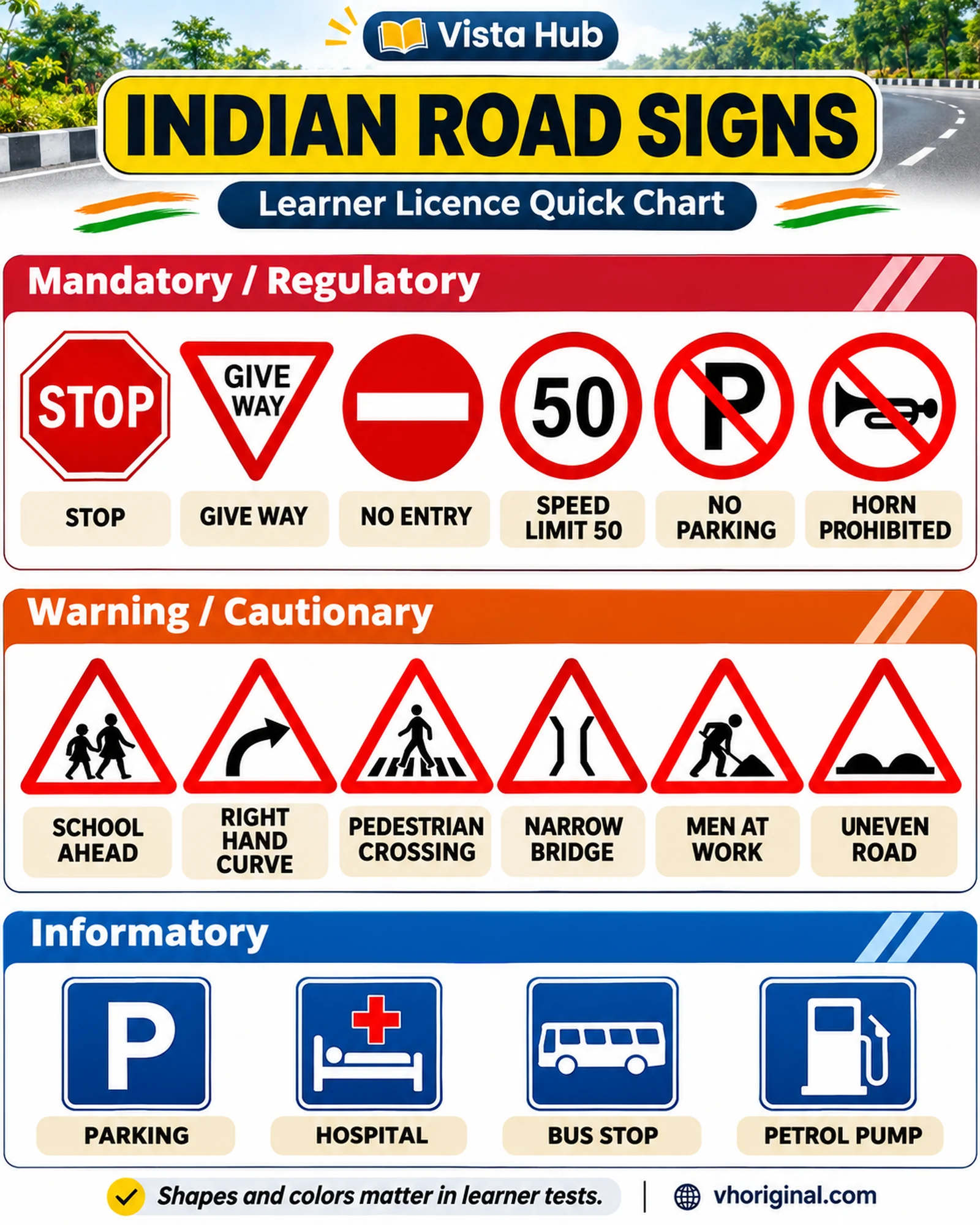
| Type | Shape and colour | What it tells you |
|---|---|---|
| Mandatory / regulatory | Mostly circular, with a red border (prohibition) or blue (must do) | Rules you must obey by law |
| Cautionary / warning | Triangle with a red border | A hazard or special situation ahead |
| Informatory | Blue rectangle or square | Information on places, services or direction |
An easy way to remember: circle = command, triangle = be careful, blue rectangle = information.
1. Mandatory signs and their meaning
These signs tell you what you must or must not do. Breaking them can lead to a fine. In India the STOP sign is a red octagon and it is the only eight-sided sign, so it is easy to recognise.
| Sign | Meaning |
|---|---|
| STOP (red octagon) | Come to a full stop, then proceed |
| GIVE WAY (inverted triangle, red border) | Let vehicles on the main road go first |
| NO ENTRY (red circle with white bar) | Entry is prohibited |
| ONE WAY | Traffic moves in one direction only |
| NO PARKING | Parking is prohibited here |
| NO STOPPING | Even stopping is prohibited here |
| SPEED LIMIT (number in red circle) | Maximum permitted speed |
| HORN PROHIBITED | Do not sound the horn here |
| Blue circle with arrow (Compulsory) | You must go in the direction of the arrow |
2. Cautionary signs and their meaning
These triangular signs with red borders warn you about a hazard or special condition ahead, so you can slow down and stay alert.
| Sign | Meaning |
|---|---|
| Left / right turn ahead | The road bends ahead |
| Hairpin bend | A very sharp bend ahead, reduce speed |
| School ahead | A school is near; children may cross |
| Pedestrian crossing | Pedestrians cross the road here |
| Men at work | Road work is going on, drive slowly |
| Slippery road | The surface may be slippery |
| Cattle | Animals may be on the road |
| Railway crossing | A level crossing or railway track is ahead |
| Steep ascent / descent | A steep climb or slope ahead |
| Narrow bridge | The bridge is narrow; two vehicles cannot pass together |
3. Informatory signs and their meaning
These are blue rectangular or square signs. They carry no order or warning, only information about places and facilities.
| Sign | Meaning |
|---|---|
| Hospital (H) | A hospital is ahead |
| Petrol pump | Fuel is available ahead |
| First aid | First aid facility available |
| Parking | Parking is permitted here |
| Telephone / eating place / rest house | Shows where these facilities are |
Note: the exact signs and the number of questions can differ by state question bank. Please also check your state transport department’s handbook and the sample questions on the Parivahan website.
What the learner’s licence test looks like
The learner’s licence test is usually a computer-based multiple-choice test covering road signs, traffic rules and safe driving. The number of questions varies by state, typically between 10 and 20, and each question has limited time, so practice helps.
On rules, the minimum age for a motorcycle with gear and for light motor vehicles such as cars is 18 years. Under the Motor Vehicles Act you also need a valid learner’s licence to learn to drive on public roads. Applications usually go through the Parivahan and Sarathi portals, but the process and fees vary by state, so check your RTO’s website for current details.
Easy ways to memorise signs
- Start with the shape: decide whether the sign is a circle, a triangle or a rectangle. This eliminates half the options at once.
- Look at the colour: a red border signals prohibition or danger; blue signals an instruction or information.
- Think about the picture: a pedestrian means a pedestrian crossing, children mean a school.
- Ten signs a day: learn ten signs daily instead of cramming the whole chart in one day.
- Take mock tests: test-style practice builds the habit of answering in time.
Common mistakes in the test
- Treating “No Parking” and “No Stopping” as the same.
- Confusing blue and red circular signs.
- Choosing an answer in a hurry without studying the full picture.
- Studying only signs and ignoring traffic rules and speed limits.
Frequently asked questions (FAQ)
How many types of road signs are there?
Three: mandatory (regulatory), cautionary and informatory signs.
What shape is the STOP sign?
A red octagon with eight sides. It is the only eight-sided sign.
What shape are cautionary signs?
Triangles with red borders.
What colour are informatory signs?
Blue rectangles or squares.
How many questions come in the learner’s licence test?
It differs by state, typically 10 to 20 questions.
What is the minimum age for a learner’s licence?
18 years for a motorcycle with gear and for light motor vehicles such as cars.
Also read: Wrong E-Challan Issued? How to Challenge It Online in India (Step-by-Step) | What Happens If You Do Not Pay a Traffic E-Challan in India? Virtual Court, Summons and Vehicle Services
Sources
- Cars24: Essential Traffic Signs to Know for Driving Licence Test
- BankBazaar: Driving Licence Test Questions and Traffic Signs and Rules in India
- Spinny: Complete Guide to Learners Driving Test Questions in India
- Paytm: Passing the Learner’s Licence Test
- Drively: Cautionary Road Signs in India
- Parivahan and Sarathi portals, and your state transport department handbook




















Share Your Opinion
Comments are closed on this post.