 Vista
Most people open an electricity bill, look at the total at the bottom, pay it and move on. But the bill is full of columns and abbreviations, and without understanding them you cannot tell whether the bill is right or wrong. When the bill suddenly jumps, this knowledge is exactly what helps you.
In this guide we explain, in simple words, what every column on an Indian electricity bill means, how units are counted, which charges get added, what to check when the bill is higher than usual, and where to complain.
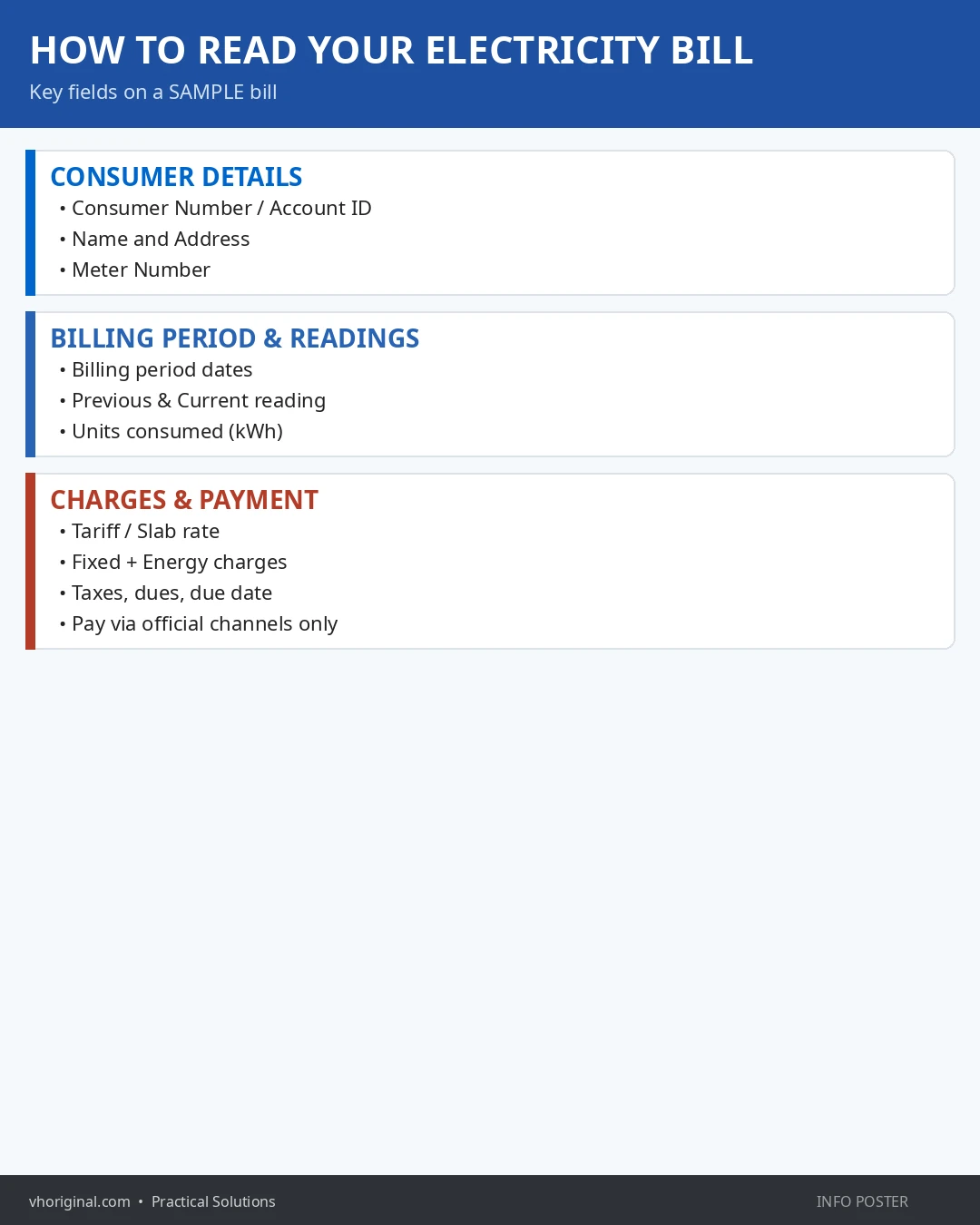
Key terms on your electricity bill (chart)
| Term | Meaning |
|---|---|
| Consumer number / account number | Your connection’s ID. It is needed for complaints and online payment. |
| Meter number | The ID of the meter at your home. |
| Previous / current reading | The meter figure at the previous bill and at this bill. |
| Consumption (units) | Current reading minus previous reading. |
| Energy charge | The price of the units you used. |
| Fixed / demand charge | A fixed charge based on your sanctioned load. |
| Meter rent | A charge for using the meter. |
| Electricity duty | A state government tax, usually charged on part of the bill. |
| FPPPA | An adjustment for changes in fuel and power purchase cost. The name varies by state. |
| Surcharge / late fee | An extra charge for paying late. |
| Arrears | The unpaid amount from earlier bills. |
Note: rates and charge names differ by state and by distribution company (DISCOM). This guide explains the general meaning only.
First, what is a unit?
One unit of electricity is one kilowatt-hour (kWh). A 1,000-watt appliance running for one hour uses one unit. A 100-watt fan running for about ten hours also uses one unit.
The meter reading is recorded when the bill is prepared. The calculation is simple: current reading − previous reading = units consumed. If the previous reading was 4,200 and this time it is 4,350, this bill counts 150 units.
The top section: identity details
The top of the bill shows your name, address, consumer number, meter number and connection type. Check these first. If the name, address or meter number is wrong, the bill may belong to another connection or the records may be mixed up. Also check the connection type (domestic, commercial and so on), because the tariff depends on it.
You will also see the “sanctioned load”, the maximum power your connection is approved for. The fixed charge usually depends on it.
The meter reading section
This section shows the previous reading, the current reading and the units consumed. It often also shows the reading type, such as “actual” or “estimated”.
If the meter cannot be read for some reason, the company issues an estimated bill based on past records, which can be higher than your real usage. It is a good habit to photograph your meter and compare it with the reading printed on the bill.
The charges section: where the money comes from
Energy charge
This is the price of the units you used. In most states domestic tariffs are slab-based: the first units cost less and later units cost more. That is why a small rise in usage can push the bill up more than you expect.
Fixed or demand charge
This is charged on your sanctioned load whether you use little or a lot of power. It is why some bills show a fixed amount even with low consumption.
Meter rent
Some bills add a separate rent for the meter. The amount is usually small, but the line should be visible on your bill.
Electricity duty
This is a tax levied by the state government, usually as a percentage of part of the bill. The rate differs from state to state.
FPPPA or fuel adjustment charge
The price at which a distribution company buys power changes over time. An adjustment charge covers that change. Depending on the state it may be called FPPPA, FPPAS or something else. If your usage did not rise but your bill did, look at this line first.
Surcharge and arrears
If you did not pay the previous bill on time, a late fee (surcharge) can apply, and any unpaid amount is carried forward as arrears. People often think they used more power when the bill simply includes old dues.
The bottom section: total payable and due date
At the bottom you will find the total payable, the last date for payment and information on rebates or late fees. Many companies give a small rebate for timely or online payment. After the due date a different amount may apply, so always check the date.
If your bill is higher than usual, check these 6 things
- Check the reading: read your own meter and compare it with the current reading on the bill. A recording mistake can also raise the bill.
- Check the reading type: see whether the bill is “estimated”.
- Compare with earlier bills: compare units with the last two or three months, and with the same month last year, since summer and winter usage differ.
- Check arrears and surcharge: see whether old dues or a late fee were added.
- Read the adjustments: look at FPPPA and other adjustment lines separately.
- Check your appliances: ACs, heaters, geysers and old refrigerators draw a lot of power. Check how long they run.
Why a smart meter can change your bill
A smart meter records usage every hour or every day and leaves less room for manual reading errors. In some places the billing method or period changes when it is installed, which makes before-and-after bills hard to compare. If your bill changed suddenly, match the meter replacement date and that day’s reading against the bill.
Estimate your bill yourself
You can estimate your bill with our MP electricity bill calculator or the UP electricity bill calculator. The result is an estimate, so always confirm the final rates on your distribution company’s website or on your bill.
How to complain about a wrong bill
- Keep your consumer number, meter number and a copy of the bill ready.
- Lodge a complaint on your DISCOM’s portal or app, on its helpline, or at the nearest office.
- Attach photos of the meter and the bill.
- If you believe the meter reads wrongly, ask for a meter test.
- Keep the complaint receipt or number safe.
Rules on how much to pay while a bill is disputed vary by state and company, so ask what amount must be paid during the dispute when you file the complaint.
Common mistakes when reading a bill
- Looking only at the total and paying.
- Treating an estimated bill as an actual one.
- Not keeping a photo of the meter reading.
- Not checking whether past dues were added.
- Delaying the complaint, so the next bill repeats the same mistake.
Frequently asked questions (FAQ)
How much is one unit of electricity?
One unit is one kilowatt-hour (1 kWh). A 1,000-watt appliance running for an hour uses one unit.
How are units calculated on the bill?
Subtract the previous meter reading from the current reading to get the units used.
What is a fixed charge?
It is a charge based on your sanctioned load that applies whether you use little or a lot of electricity.
What is an estimated bill?
When the meter cannot be read, the company bills an estimate based on past records.
Why did my bill rise without higher usage?
Possible causes are a reading error, an estimated bill, arrears, a surcharge, the fixed charge or an adjustment such as FPPPA.
Where do I complain about a wrong bill?
With your distribution company through its portal, app, helpline or nearest office, with your consumer number and a meter photo.
Also read: Electricity Meter Running Fast? How to Check at Home, Request a Meter Test and Get a Refund | Electricity Theft Notice in India: Section 135 vs Section 126 and What to Do
Sources
- Patrika: how to identify hidden charges in an electricity bill
- Aaj Tak: why your electricity bill may be higher and how to check the meter reading
- Patrika: wrong bill correction, online complaint and meter test guide
- Shriram Finance: Understanding Your Electricity Bill
- HDFC Bank PayZapp: how to calculate your electricity bill
- Your DISCOM’s official website for the latest tariffs




















Share Your Opinion
Comments are closed on this post.