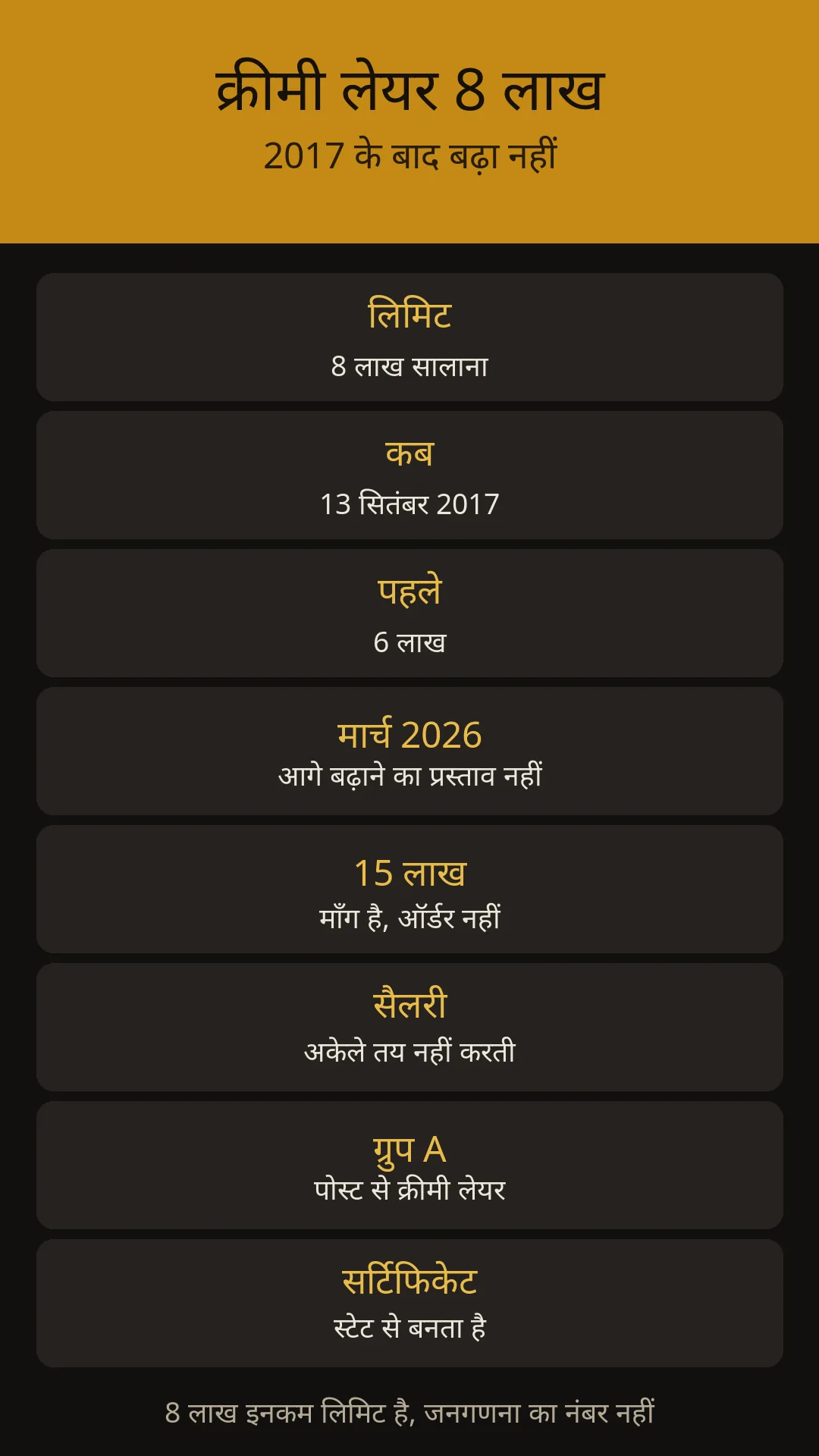
The OBC creamy layer income limit is 8 lakh rupees a year. OBC means Other Backward Classes. On 13 September 2017 the personnel department raised it from 6 lakh to 8 lakh. Children of families above that income are kept out of the Centre’s 27 percent OBC reservation. In March 2026 the government wrote that there is no proposal to raise it further. The talk of 15 lakh is a demand. Not an order.
This is the position on 3 October 2026. The limit is about income. Not a census population number. The non-creamy-layer certificate is issued by the state.
What 8 lakh is
The creamy layer is the OBC family kept out of this reservation. The name can be on the OBC list. The child still does not get the 27 percent if the family has entered the creamy layer. Telegraph printed B L Verma’s written reply on 15 March 2026. He is minister of state for social justice. He said the last order is of 13 September 2017, from 6 lakh to 8 lakh. There is no proposal now for a further revision.
On 10 March 2026 BJP MP Bhim Singh asked for 15 lakh in Zero Hour in the Rajya Sabha. He said it should be revised once in three years, and that it has been stuck for nine years. The National Commission for Backward Classes had recommended 15 lakh, from 6 lakh, in October 2015. The recommendation and the MP’s demand did not become the order. The order is at 8 lakh.
Salary alone does not decide it
People treat the salary slip as the whole limit. The rule is not that straight. On the DoPT path, salary and farm income are kept out of the income test. Other income is counted. The post is also seen. If a parent is a Group A officer, the creamy layer can apply from the post, separate from the salary number.
Reports of a Supreme Court order of 11 March 2026 carry this line. The case is given as Union of India versus Rohith Nathan. The bench was Justices P S Narasimha and R Mahadevan. The reports say salary alone cannot decide the creamy layer. As in the 1993 order, the status of the parent’s post comes first. Group A and B on one side, Group C and D on the other. That is a report. Your own case will run on your certificate form.
The three-year count
While making the certificate, the three previous financial years are looked at. If even one year went over the limit, non-creamy layer may not come. That is the usual line on the form. Say the other income of three years is 7.2, 8.5 and 7.9 lakh. The middle year is over 8 lakh. The certificate can stall on that year. This is an example. The tehsil form will decide.
The state issues the certificate. A central job also needs the central OBC list. A name on the state list and not on the central list does not get the 27 in SSC or UPSC. Match both lists.
This does not change the 27 percent
8 lakh is not the quota. 8 lakh is the limit on who enters the 27. At the Centre OBC reservation is 27 percent. The creamy layer sits outside it. The EWS 10 percent is not OBC. Adding 8 and 27 does not make a new percent. The 87:13 held recruitment in Madhya Pradesh is another story. The letter there comes on a department order.
The separate census column is also a separate demand. A column counts population. The creamy layer looks at one family’s income and post. A column being added will not turn 8 lakh into 15 lakh by itself. The 6 October block and Chalo Delhi on 1 November are column demands. Not an order changing the limit.
A simple example
A family is on the OBC list. The father is in a private job. The salary slip shows 9 lakh, but the rule keeps salary out of the income test. Shop or rent income is 3 lakh. In this case the slip is over, the counted income is not. The reverse also happens. Salary is 5 lakh, the shop is 9 lakh. Then the income test can cross. A third case is the post. The father is Group A. Then the post is seen before the number. In all three, the certificate does not make itself.
Pages in the same line: how much the reservation is, the separate census column and 27 percent in Madhya Pradesh.
The numbers here are the numbers in the reports. 8 lakh, 13 September 2017, 6 lakh before that. No proposal in March 2026. 15 lakh is a demand and a 2015 recommendation. A population percent is not on this page.
An old certificate does not run by itself on a new form. For the year you are filling, check that year’s non-creamy-layer certificate. Validity is written on the form.
Where the certificate is made
The non-creamy-layer paper is made at the tehsil or the state revenue office. Many states have an online portal. The paper has columns for income and for the post. In a central exam this paper is not enough. The caste also has to be on the central OBC list. That is a separate check. A state job reads the state list. One paper does not open both lists.
Forwards often mix this 8 lakh with the EWS limit. The EWS 8 lakh is a separate rule, for the general category. The OBC creamy layer is also read at 8 lakh, but the count of salary and farm income is different. The two forms are not one. An EWS certificate does not work inside the OBC 27 percent.
Advice:
The plain point is this. The OBC creamy layer limit is 8 lakh a year. In 2017 it went from 6 to 8. In March 2026 the government said there is no proposal to raise it further. 15 lakh is a demand, not an order. Salary alone does not decide it. The post is also seen. The non-creamy-layer certificate comes from the state. For a central job, match the central list too. If WhatsApp says the limit is now 15 lakh, do not take it as a DoPT order. This limit is not an appointment letter.