 Vista

Egyptian mythology for kids is the collection of stories that people in ancient Egypt told about their gods, the creation of the world and life after death. The stories explain big questions in a simple way: Why does the sun rise every morning? Why does the Nile flood? What happens when someone dies? Many of these tales are more than 3,000 years old, and we know them from temple walls, tomb paintings and papyrus scrolls.

This illustrated guide is written for students, parents and teachers. It covers the most important gods, five easy-to-read myths, the meaning of famous symbols, why gods had animal heads, what mummies really were, and ideas for a school project. Each story is told in plain English, and we always say clearly what comes from ancient sources and what is only a modern guess or a movie invention.
Quick Fact Box: Egyptian Mythology in 60 Seconds
| Question | Short answer |
|---|---|
| Where did these myths come from? | Ancient Egypt, along the Nile River in north-eastern Africa |
| How old are they? | The earliest written religious texts, the Pyramid Texts, are about 4,300 years old |
| How many gods were there? | The Egypt Exploration Society says Egyptians worshipped more than 1,400 gods and goddesses |
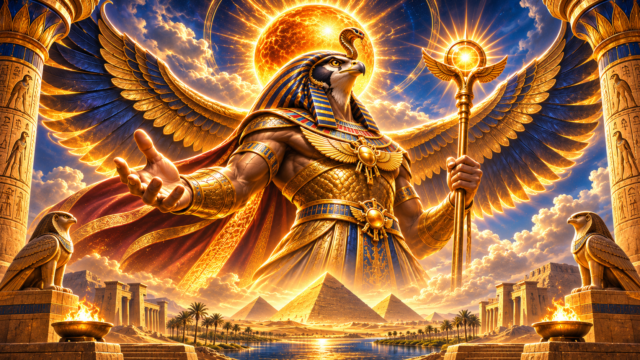
| Who was the sun god? | Ra (also written Re) |
| Who was the god of the dead? | Osiris ruled the dead; Anubis guided them and protected mummies |
| Who is the best-known goddess? | Isis, goddess of magic, healing and motherhood |
| Do people still worship them? | The ancient religion ended many centuries ago, though a few modern groups follow revived forms |
Why Did the Egyptians Have So Many Gods?
The Egyptians believed that gods were hidden inside nature and daily life. There was a god of the sky, a goddess of the sun’s eye, a god of the flood, a goddess of writing and even a god of household protection. If something was powerful, mysterious or important, it could have a divine name and a story.
The gods were not all the same in every city. Local towns honoured their own favourites, and over time priests combined gods into new forms. A famous example is Amun-Ra, the joining of the hidden god Amun and the sun god Ra. That is why you may find two or three versions of the same myth. Egyptologists treat them as different traditions rather than mistakes.
Meet the Main Egyptian Gods and Goddesses
| God or goddess | Looks like | Job |
|---|---|---|
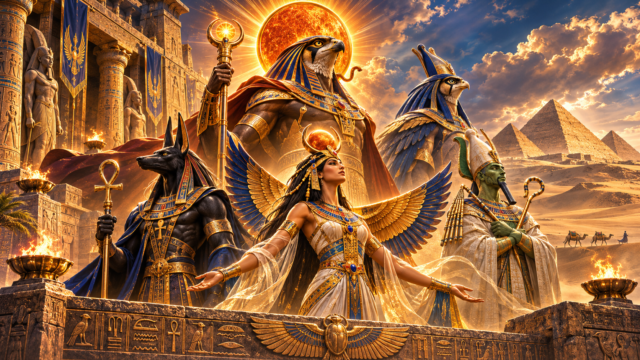
| Ra | Man with a falcon head and a sun disk | Sun god; sails the sky by boat |
| Osiris | Mummy-wrapped king with green or black skin | King of the dead and symbol of rebirth |
| Isis | Woman with a throne on her head, sometimes winged | Magic, healing, motherhood |
| Horus | Falcon or falcon-headed man | Sky god and protector of kings |
| Set | Man with an animal head that scholars cannot match to a real animal | Desert, storms and chaos |
| Anubis | Jackal or man with a jackal head | Embalming and guiding the dead |
| Thoth | Ibis bird or baboon | Writing, wisdom and the moon |
| Bastet | Cat or woman with a cat head | Protection of homes, cats and families |
| Hathor | Woman with cow horns and a sun disk | Music, joy, love and motherhood |
| Ma’at | Woman with an ostrich feather | Truth, fairness and balance |
| Sekhmet | Woman with a lioness head | War and healing |
Story 1: How the World Began
At the temple city of Heliopolis, priests told that before anything existed there was only dark, still water called Nun. Out of Nun rose a mound of earth, and on it appeared the creator god Atum. Atum made two children: Shu, the god of air, and Tefnut, the goddess of moisture. Shu and Tefnut had two children of their own, Geb the earth and Nut the sky.
Nut stretched over Geb like a starry arch, and Shu held her up so that there was space for living things between them. Nut and Geb then had four children: Osiris, Isis, Set and Nephthys. Together with Atum, these nine gods are called the Ennead, which means “the Nine”.
Story box: Egyptians watched the Nile flood retreat and a small hill of mud appear first, with life growing on it. Many scholars think this yearly event inspired the idea of a first mound rising from the waters. Other cities told different creation stories. At Memphis, priests said the god Ptah created the world by thinking and speaking, and at Hermopolis eight primeval gods called the Ogdoad were honoured.
Story 2: Ra, the Night Boat and the Giant Snake
Ra crossed the sky every day in a boat. At sunset, he entered the underworld, which Egyptians called the Duat, and sailed through twelve hours of night. In the dark waited Apep (also called Apophis), a giant snake who wanted to swallow the sun so that the world would never see morning again.
Each night the gods on Ra’s boat fought back. In several texts, Set stands at the front of the boat and drives the serpent away, while Isis, Thoth and other gods protect Ra with spells. Every dawn the sun rose again, which showed that order had beaten chaos for one more day. Priests even performed rituals in which the serpent was symbolically defeated to keep the world safe.
Story 3: Osiris, Isis, Set and Horus
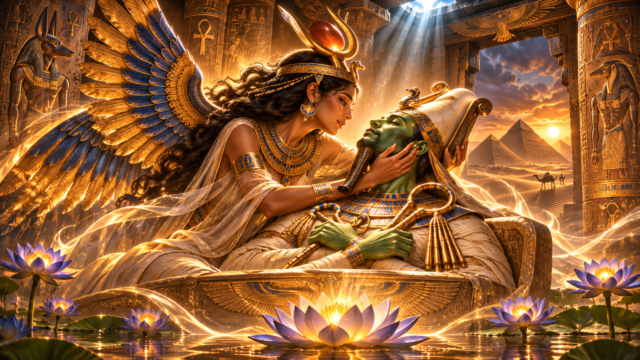
This is the best-known Egyptian myth. Osiris was a wise and kind king who taught people farming and laws. His brother Set was jealous and wanted the throne. According to the version retold by the Greek writer Plutarch around 100 CE, Set tricked Osiris into lying inside a beautiful chest, shut it and threw it into the Nile.
Isis searched for her husband everywhere and finally found the chest far away at the city of Byblos. With help from her sister Nephthys and the god Anubis, she brought Osiris back as a ruler of the dead. Isis then raised her son Horus in secret. When Horus grew up, he challenged Set for the throne of Egypt in a long contest told in an Egyptian text from about 1150 BCE. In one fight Set damaged Horus’s eye, and the god Thoth healed it. In the end the gods decided that Horus should be king, and Set became the god of storms and the desert.
Story box: No complete Egyptian-language version of this myth survives. Scholars piece it together from tomb spells, hymns, short stories and Plutarch. That is why different books tell small details differently. A responsible guide, like this one, labels which parts come from which source.
Story 4: Isis and the Secret Name of Ra
In a New Kingdom tale, Ra grew old and wise, but Isis wanted more power to help her family. She knew that a secret name held great magic, and Ra’s true name was hidden even from the gods. Isis collected a drop of the old god’s spit, mixed it with earth and shaped a snake. When the snake bit Ra, no god could heal him.
Isis offered to cure him if he told her his hidden name. Ra finally agreed, and Isis healed him with her spell. The story shows how Egyptians thought of names as powerful and of Isis as the greatest magician. It also explains why writing a person’s name was so important, a theme you will see again with cartouches below.
Story 5: Sekhmet and the Red Beer
A text called the Book of the Heavenly Cow, found in royal tombs including the shrines of Tutankhamun, tells that humans once plotted against the aging Ra. Ra sent his fierce Eye, who took the form of the lioness goddess Sekhmet, to punish them. She became so wild that she began to destroy everyone.
Ra changed his mind and wanted to save the rest of humanity. During the night, servants poured seven thousand jars of beer coloured red with ochre onto the fields. At dawn Sekhmet saw the red liquid, mistook it for blood, drank it and fell asleep. She woke up calm and transformed into the gentle goddess Hathor. The myth was linked to a festival of drinking and music, and it shows the double nature of the goddess: dangerous and kind.
Why Did Egyptian Gods Have Animal Heads?
Animal heads were a kind of picture code. Egyptians admired animals for their special abilities, such as the falcon’s sharp eyesight, the cat’s protection of grain stores and the jackal’s presence around graveyards. An artist could show these qualities by giving the god an animal’s head on a human body.
It is important to know that Egyptians did not believe their gods were simply animals. The same god could appear in several forms: Horus could be a falcon, a falcon-headed man or a child. Sacred animals such as the Apis bull were treated as living homes or signs of a god, which is different from worshipping every animal.
Egyptian Symbols Kids Should Know
| Symbol | What it looks like | What it meant |
|---|---|---|
| Ankh | A cross with a loop on top | Life |
| Eye of Horus (wedjat) | A human eye with falcon-style markings | Protection, healing and wholeness |
| Scarab beetle | A dung beetle | Rebirth and the rising sun, linked to the god Khepri |
| Feather of Ma’at | A single tall feather | Truth and justice |
| Djed pillar | A column with four bars at the top | Stability, linked to Osiris |
| Cartouche | A rope loop around a royal name | Protection of a pharaoh’s name |
What Is a Mummy? A Kid-Friendly Explanation
A mummy is a body that has been preserved so it does not rot. Egyptians believed a person needed a body in the next world, so skilled workers called embalmers dried the body with a natural salt called natron and wrapped it in linen strips. The process took about 70 days. The heart was normally left in place because it was thought to be the centre of thought and feeling, while organs such as the liver and lungs were preserved separately in canopic jars guarded by the four sons of Horus.
Mummies were once real people, so museums handle them with respect. Many are displayed with care, and some museums now limit photography or use sensitive displays. Teachers can use the word “ancient person” to remind students that this is history about real families.
The Weighing of the Heart: A Test After Death
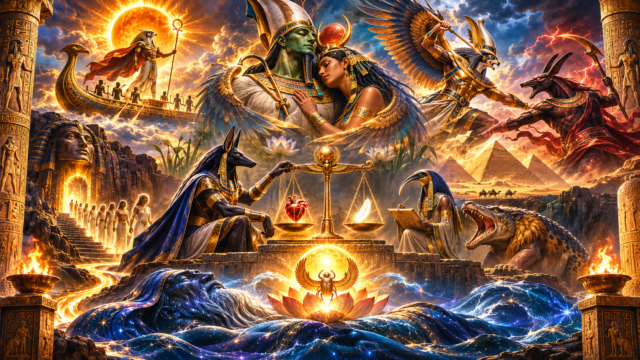
Egyptians believed that after death a person entered the Duat and came before a court. The heart was placed on a scale against the feather of Ma’at. Anubis checked the scale and Thoth wrote down the result. If the heart was balanced, the person could enter a peaceful land often called the Field of Reeds. If it was heavy with wrongdoing, the monster Ammit, who had a crocodile head, a lion’s front and a hippo’s back, could eat it. The story taught that honesty and kindness mattered.
Myth vs Fact for Students
| Common claim | What the evidence shows |
|---|---|
| “Egyptian gods were real animals.” | No. Animal heads were symbols of qualities, and one god could have many forms. |
| “Everyone in Egypt worshipped the same gods.” | No. Local towns favoured different gods, and beliefs changed over 3,000 years. |
| “Slaves built the pyramids.” | Evidence from workers’ towns and cemeteries near Giza points to organised Egyptian labour teams that were fed and housed. |
| “Mummies walk and curse people.” | No. That idea comes from films and novels. |
| “Egyptian myths are exactly like Greek myths.” | Greek writers did link Egyptian and Greek gods, but the stories and ideas are different. |
Fun Facts About Egyptian Mythology
- Cats were so respected that killing one was a serious crime, and archaeologists have found large cemeteries of cat mummies.
- Thoth was the patron of scribes, so students who learned to write might ask him for help.
- The goddess Nut was drawn as a woman covered in stars, and the sun was said to travel through her body at night.
- Bes was a protective dwarf-like god shown with a lion’s features. People kept images of him in homes to guard families, especially children.
- For about 1,400 years nobody could read hieroglyphs, until the Rosetta Stone helped Jean-François Champollion decode them in 1822.
- Egyptians painted gods with symbolic colours: green and black for rebirth and fertile soil, red for the desert and danger, gold for the flesh of the gods.
School Project Ideas
- Write your name in hieroglyphs. Use the sound signs of the hieroglyphic alphabet, and remember that hieroglyphs record sounds, not English spelling.
- Make a cartouche. Draw an oval loop with a line at one end and write your name inside it, just as kings did for protection.
- Build a god family tree. Start with Atum, then add Shu, Tefnut, Geb, Nut and their four children.
- Weigh the heart. Make a paper scale and a feather, then write good choices on small paper hearts to see which side is heavier.
- Create a god trading card. Include the name, animal, symbol, powers and one myth, and mention the source.
- Map the Nile. Mark the Delta, Memphis, Thebes and the pyramids at Giza.
Glossary: Words to Learn
| Word | Meaning |
|---|---|
| Pharaoh | The king of ancient Egypt, seen as a link between gods and people |
| Duat | The Egyptian underworld |
| Ma’at | Truth, order and balance, also a goddess |
| Papyrus | Paper-like material made from a river plant |
| Hieroglyph | A picture sign used in Egyptian writing |
| Natron | A natural salt used to dry bodies for mummification |
| Ennead | A group of nine gods from Heliopolis |
| Canopic jar | A jar that held preserved organs |
Tips for Parents and Teachers
Present myths as stories that ancient people believed and used to explain the world, not as facts about nature. Ask children questions such as “What did this story explain?” and “How do we know it?” Point out that some stories, like the Osiris myth, were retold by later writers, so details can differ. Pair this guide with a visit to a museum collection or a trusted school resource, and always encourage respect for the beliefs and remains of ancient people.
Frequently Asked Questions About Egyptian Mythology for Kids
What is Egyptian mythology in simple words?
It is the set of stories ancient Egyptians told about gods, creation, the sun, the Nile and life after death. The stories helped explain nature and gave people rules for living honestly.
Who is the most important Egyptian god for kids to learn first?
Start with Ra the sun god, Osiris the king of the dead, Isis the magical mother and Horus the falcon god. Their stories connect to most other myths.
Why did Egyptian gods have animal heads?
The animal heads showed special qualities, such as a falcon’s sight or a jackal’s link with graves. They were symbols, not proof that gods were ordinary animals.
Who was the god of the dead in Egypt?
Osiris was the ruler of the dead. Anubis was the god who helped with embalming and led the dead to judgment.
What was the Egyptian creation story?
In the Heliopolis version, the god Atum rose from the dark waters of Nun and created Shu and Tefnut, who became the parents of Geb and Nut. Other cities, such as Memphis, told different versions.
What is the Eye of Horus?
It is a protective symbol linked with the story of Horus losing and recovering his eye. Egyptians used it as an amulet for health and safety.
Why did Egyptians make mummies?
They believed a person’s body was needed in the afterlife, so they preserved it with natron and linen. The wealthy had the most elaborate burials.
Are Egyptian myths true?
They are religious stories, not scientific or historical records. They tell us what ancient Egyptians believed, while archaeology tells us what they actually built and did.
Which Egyptian myth is best for a school project?
The Osiris, Isis and Horus story is a good choice because it has clear characters and a beginning, middle and end. The weighing of the heart is another popular choice with a hands-on activity.
How do I write my name in Egyptian hieroglyphs?
Break your name into sounds, then match each sound to a hieroglyph from an alphabet chart. Skip silent English letters, and put the result inside a cartouche if you like.
Sources and Further Reading
Last updated: 25 November 2026. Myth summaries follow the sources below; where versions differ, this article says so.
- Egypt Exploration Society, “Gods of Egypt” learning resource: ees.ac.uk
- World History Encyclopedia, “Ancient Egyptian Mythology”: worldhistory.org
- World History Encyclopedia, “Osiris”: worldhistory.org
- British Museum, ancient Egypt learning resources for ages 7 to 11: britishmuseum.org
- The Metropolitan Museum of Art, “Divine Egypt” exhibition: metmuseum.org
- National Geographic Kids, “How to make a mummy”: natgeokids.com
Related guides: Egyptian Mythology: Ancient Gods, Creation Stories, Symbols and the Afterlife · Egyptian Gods Coloring Pages: Free Printable Designs for Kids














Share Your Opinion
Comments are closed on this post.