 Vista
Need an algebra balance scale school project or coordinate grid string art model? This guide presents two educational pictures suitable for roughly Classes 6–9. A balance scale illustrates why both sides of an equation must be treated equally when solving for an unknown value. A coordinate plane uses ordered pairs, labelled axes and plotted points to create a geometric pattern. The poster images use Vista Hub’s established 15-second advertisement-supported View/Download page. Be careful with two common mistakes: solving x+3=7 by changing only one side, and confusing (2,3) with (3,2). Both ideas can be taught using safe cardboard and paper without electronic gadgets or sharp nails.
What is the difference between algebra and coordinates?
Algebra expresses relationships among numbers using variables and operations. An equation such as x+3=7 states that two expressions have the same value. Coordinate geometry locates points using numbers placed on intersecting axes. An ordered pair (x,y) conventionally identifies the horizontal position first and the vertical position second. The school projects share the idea of following mathematical rules, but they describe different concepts. Arrange the balance-scale model in one panel and string art in another. Ask students to describe one actual equation and one plotted point before discussing decorative patterns.
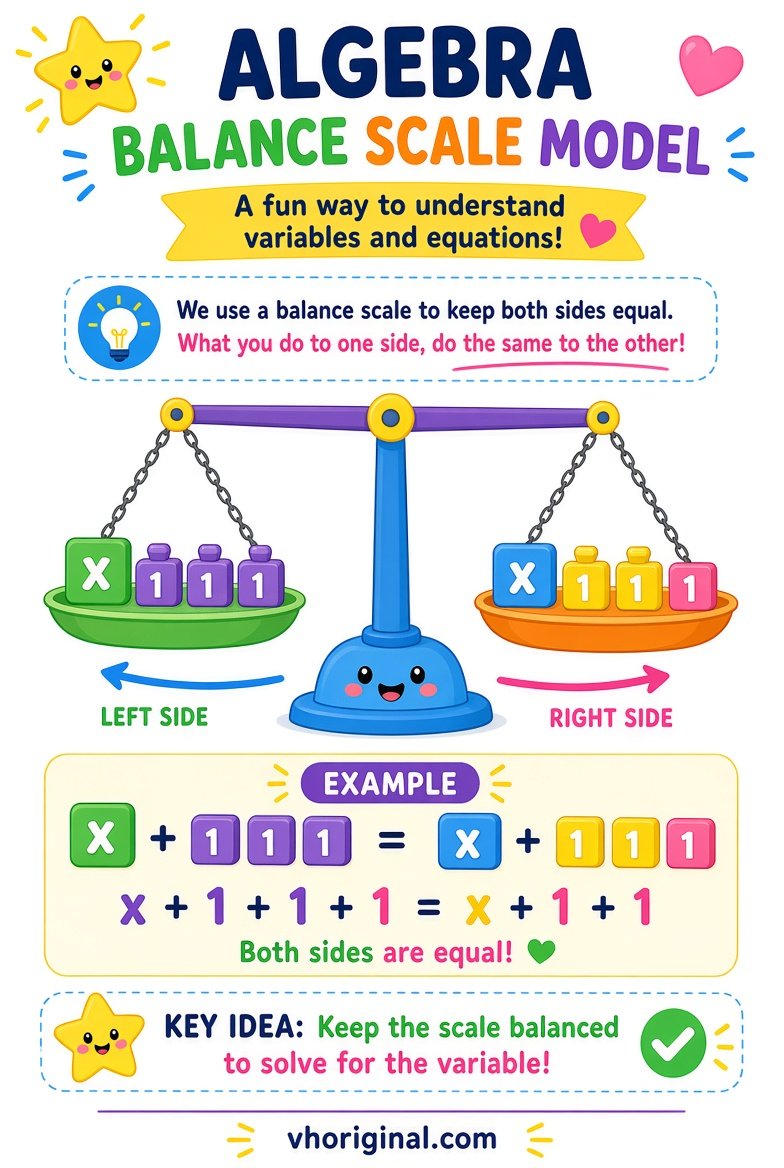
Picture 1: Algebra Balance Scale Model
A balance scale is an analogy for equality. If the left pan represents an unknown x plus three equal units and the right pan represents seven units, the equation is x+3=7. Removing three units from both sides leaves x=4. This works because the same operation preserves equality on both sides. Paper tokens need not have actual identical mass if the chart is explicitly symbolic, but their labels must be clear. A generated diagram that removes three blocks from one side only would be mathematically misleading. Students should check every illustrated step with the corresponding written equation.
View / Download after 15-second wait
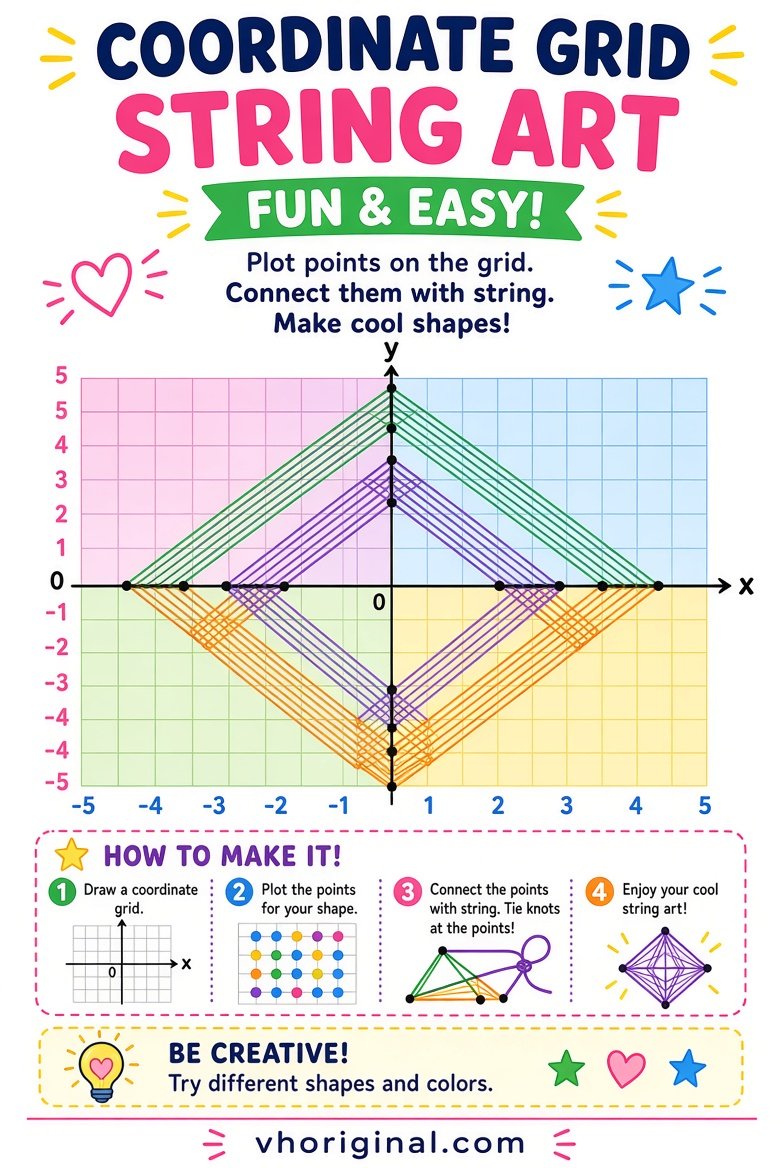
Picture 2: Coordinate Grid String Art
A coordinate plane has a horizontal x-axis and vertical y-axis meeting at the origin (0,0). In the usual convention, positive x values lie to the right and positive y values above the origin. To plot (2,3), move two units right and three units up. The point (3,2) is normally elsewhere, so switching the order matters. For a string-art diagram, select a sequence of points, mark them on graph paper and join them in the chosen order. The art can be colourful, but labels, units and point locations should remain accurate and readable.
View / Download after 15-second wait
Why equal operations solve equations
Consider x+3=7. Subtract three from each side to isolate x, giving x=4. For 2x=10, divide each side by two to obtain x=5. If only the left side changes, the original equality is usually not preserved. A classroom balance model makes this rule visual: removing equal quantities from matching pans maintains equilibrium. Ask students to substitute the result back into the original expression. The value x=4 checks because 4+3=7. This is a useful general habit for linear equations. Avoid division by zero and do not confuse changing a term’s sign with carrying out an operation on both sides.
Coordinate quadrants and signed numbers
Under standard Cartesian conventions, the four quadrants have sign combinations (+,+), (-,+), (-,-) and (+,-). Begin with positive points for younger students, then demonstrate a point such as (-2,1) or (2,-1). Keep the horizontal and vertical scales clearly labelled. A square on graph paper may represent one unit, or the teacher may choose another consistent scale. Plotting mistakes happen when students read the vertical coordinate first or forget negative signs. A correct string-art model needs points in the right places, not just a pattern that looks close to the reference drawing.
How to build a paper algebra balance
Use cardboard, paper strips, ruler and coloured blocks. Draw an equal-arm beam with a pan at each end. Show x and three unit blocks on one side and seven unit blocks on the other. Beneath it, write x+3=7. In the next row show three units removed from each side, leaving x=4. Small labelled circles or counters make it clear that the units represent abstract numbers. An actual heavy physical balance is unnecessary, and young pupils should not handle sharp wire hooks or suspended weights. Each illustration should include its corresponding algebraic statement.
Step-by-step coordinate string art
Draw the x and y axes on a large sheet of graph paper, mark the origin and label the scale. Write a list of selected ordered pairs in a table. Plot every point carefully before joining any of them. Use colouring pens or strips of thread fixed with safe tape; nails and pins are not required. One simple rectangle example uses P(1,2), Q(4,2), R(4,5) and S(1,5). Join P to Q to R to S and back to P. Have the student verify the length of each side by counting grid units. A colourful shape should never substitute for checking actual coordinates.
Full-size image access and final safety checks
Both pictures open through the existing 15-second advertisement-supported View/Download page. Do not provide a direct media-file shortcut around that mechanism. Before printing, verify all equations, axis labels and ordered-pair positions. If a teacher requires hand-drawn work, use the pictures as references. Paper models can avoid sharp pins and heavy suspended objects. Students should display their name, class and one solved example beneath each model. The purpose is to demonstrate accurate mathematical reasoning using accessible materials and safe construction.
Frequently asked questions
What is the solution of x+3=7?
x=4, after subtracting three from both sides.
Which coordinate is written first?
The horizontal x value, then the vertical y value.
What are the coordinates of the origin?
(0,0).
Can we change only one side and preserve an equation?
Not generally. Equal operations on both sides preserve equality.
Conclusion and references
Together, a balance model and coordinate artwork show that mathematical representations work only when their rules are followed accurately.
Related published guides: Simple Machines School Project · School Project Front Page
References: OpenStax — Solving Equations; Math Is Fun — Cartesian Coordinates.
Explore more: 44 school project models, charts and pictures









Share Your Opinion
Comments are closed on this post.