 Vista

Hermes in Greek mythology is the messenger and herald of the gods, but his identity goes much further. He is linked with travelers, roads, trade, cleverness, thieves, boundaries and the guidance of souls. His familiar equipment includes a herald’s staff called the caduceus, a traveler’s cap or petasos and, in later popular imagery, winged sandals. Hermes is the son of Zeus and Maia. According to the Homeric Hymn to Hermes, he invents a musical instrument using a tortoise shell and steals Apollo’s cattle while still a newborn, creating a hilarious divine dispute. In other myths he helps Odysseus resist Circe and guides people across dangerous thresholds. His Roman counterpart is commonly Mercury.
Who was Hermes, the Greek messenger god?
Hermes is one of the most active and versatile Olympian deities. His role as a herald means that he carries messages and instructions between gods, heroes and realms that ordinary people cannot easily reach. But in ancient Greek life, movement involves more than communication. Roads, boundaries, markets, negotiations and trade all require crossing from one person or place to another. Hermes becomes associated with those transitions. He may travel swiftly, negotiate cleverly or escort a person who needs protection on an uncertain route.
A modern movie often gives Hermes a special pair of magical running shoes and little more. That image captures a recognizable attribute but misses his moral complexity. In the early hymn he is so cunning that even as a baby he steals livestock and argues about what happened. He is both a protector of travelers and a figure connected to thieves. Those domains are not unrelated: both the honest merchant and the robber operate along roads and outside the stable protection of the home. The myths explore skill and deception in those shared spaces.
Who were Hermes’s parents, Zeus and Maia?
The Homeric Hymn to Hermes identifies his parents as Zeus and the nymph Maia, a daughter of the Titan Atlas in well-known genealogies. The hymn places his birth in a cave on Mount Cyllene in the region of Arcadia. Maia lives away from the busy assemblies of Olympus, and the poem delights in presenting an extraordinarily clever child in a hidden mountain dwelling. This setting provides contrast between his apparent helplessness as a newborn and the sophisticated tricks he begins to perform almost immediately.
Hermes is therefore a son of Zeus but not the twin of Apollo. Apollo’s parents are Zeus and Leto, and his twin is Artemis. Zeus has many children in Greek traditions, which makes it easy to confuse their mothers and birthplaces in simplified lists. Names matter because the children’s first adventures establish their separate roles: Apollo’s connection with music and prophecy develops very differently from Hermes’s birth-and-cattle-theft narrative.
How did newborn Hermes invent the lyre?
At the beginning of the hymn, Hermes emerges from the cave and finds a tortoise. He is fascinated by the shell, which he turns into a resonating body for a lyre, adding strings so that it can produce music. This is a foundational story explaining the special relationship between Hermes and Apollo’s instrument. The scene portrays the newborn god as inventive, quick to see possibilities in a familiar animal and capable of making something new. It is myth, not evidence that a historical infant constructed the first real string instrument.
Readers often assume that Apollo must have invented the lyre because Apollo is the most famous god associated with it. In the Homeric Hymn to Hermes, the order is more interesting: Hermes makes the instrument, and it eventually becomes part of an exchange with Apollo. This shows how the two gods’ domains can be connected without being identical. Hermes represents clever invention and negotiation, while Apollo becomes associated with music at the highest level of divine artistry.
Why did Hermes steal Apollo’s cattle?
Hermes, only newly born, goes out to steal Apollo’s cattle. The hymn describes his clever efforts to hide the animals’ tracks and avoid being identified. In some accounts he reverses their direction or uses unusual coverings to confuse pursuit. He then returns to his cradle and acts like a helpless infant. The comic effect comes from the contrast between the child who insists he cannot possibly be guilty and the extraordinary feat the audience has just watched him perform.
Apollo discovers the loss and follows clues to Maia’s cave. Hermes denies the theft with elaborate verbal tricks, but the matter reaches their father Zeus. The king of the gods recognizes the young trickster’s capabilities and requires a resolution. Eventually Hermes restores the cattle and uses the beautiful lyre as part of reconciliation with Apollo. The exchange helps explain how two divine siblings develop a working relationship rather than remain permanent enemies after a single quarrel.
How did Apollo and Hermes become friends?
When Apollo hears the instrument Hermes has made, he is captivated by its sound. The two gods negotiate and exchange gifts, so the cattle dispute changes into a relationship involving music and pastoral knowledge. Some versions also mention a reed or shepherd’s pipe and a staff as later items of exchange. Exact sequences should be attributed to the Homeric Hymn or to the shorter account in Apollodorus rather than described as a universally fixed series of trades.
Hermes’s trick demonstrates that cleverness can create conflict, but his ability to negotiate can also repair it. Apollo’s acceptance of the lyre helps explain why Apollo, rather than Hermes, appears with the instrument so frequently in later art. The episode is a practical lesson in how a single object can move between divine domains and acquire new meaning. It also avoids a false impression that all Greek gods obtained their symbols at birth without any stories attached.
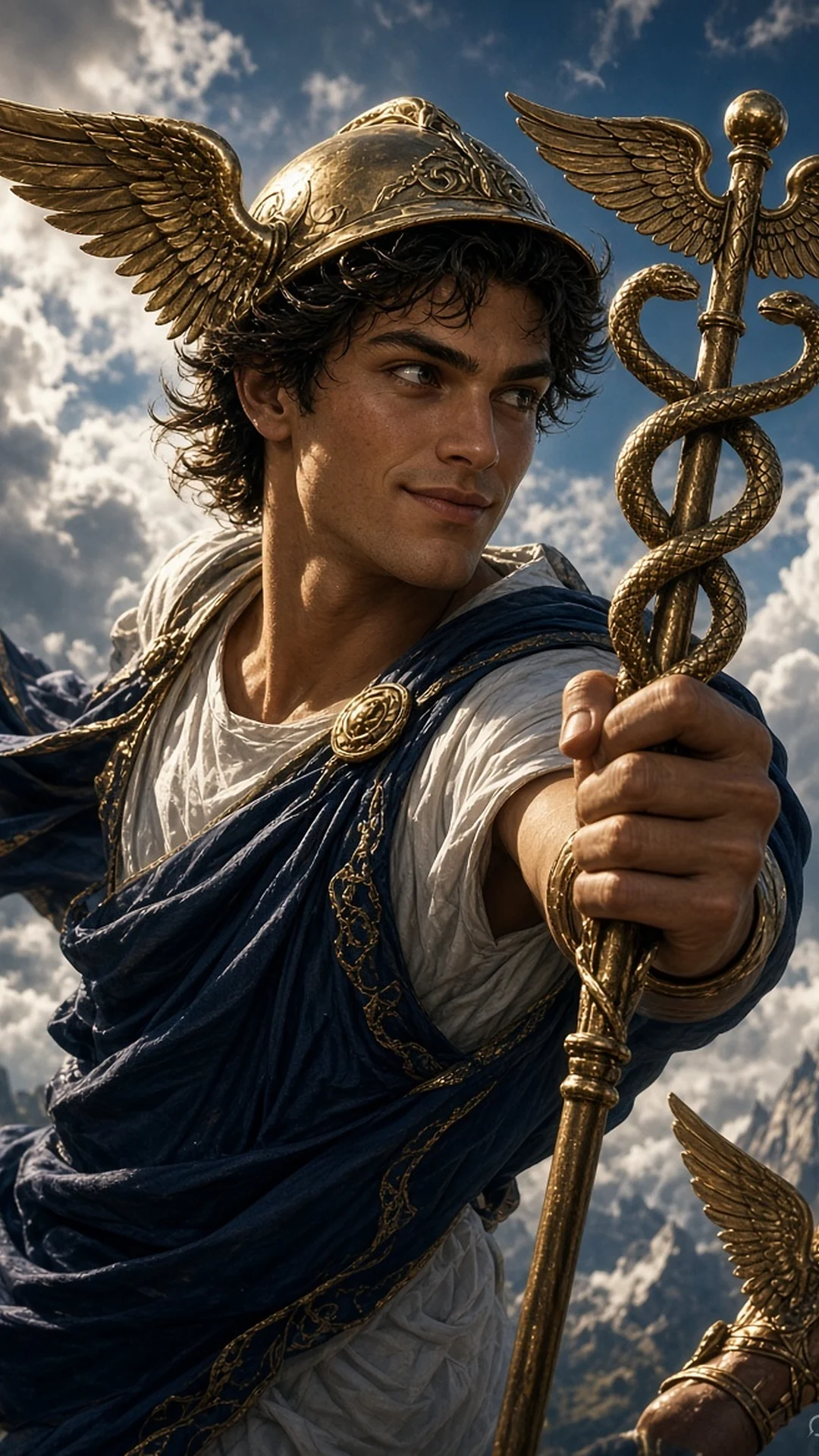
What does the caduceus symbolize? Hermes versus Asclepius
The caduceus, a herald’s staff often illustrated with two entwined serpents and sometimes wings, is one of Hermes’s most widely recognized symbols. It expresses his status as a mediator and messenger. This is not the same as the Rod of Asclepius, conventionally shown with a single serpent and associated with the Greek god of healing. Confusing the two symbols has become common in modern institutional imagery, but their mythic origins and traditional associations are distinct.
Hermes also carries a traveler’s hat called the petasos, and artistic traditions depict him with winged sandals or winged headgear. These attributes allow readers to identify him in paintings, sculpture and modern illustrations. However, the exact size and placement of wings changed across periods. A clean educational ALT description should identify the god, staff and context rather than imply that every Greek vase depicts the same standardized comic-book costume.
Why did travelers, merchants and even thieves honor Hermes?
Hermes is associated with roads, travel, commerce, exchange, negotiation and luck. In Greek communities, roadside markers and pillars called herms marked places or boundaries and could have religious significance. Their connection with Hermes reflects his care for movement and thresholds. For merchants, successful exchange might depend on communication, fair or clever bargaining and safe travel. For travelers, unknown routes and encounters with strangers introduced risks that invited divine protection.
His connection with thieves may seem surprising next to his role as protector. But the newborn cattle theft displays precisely the power of disguise, planning and crossing boundaries that lawful trade also requires in a different form. The god does not provide a modern legal endorsement of stealing; a divine trickster is a literary and religious character. His stories allow ancient audiences to explore the ambiguity of clever behavior rather than dividing every action into a simple hero or villain category.
Hermes as psychopomp: how did he guide souls?
One of Hermes’s most important roles is that of psychopomp, a Greek-derived term meaning a guide of souls. In literary and artistic traditions he escorts the spirits of the deceased toward the underworld. He is not identical to Hades, the ruler of that realm, nor is he the personification of death Thanatos. Hermes crosses and mediates the boundary; the other figures have different offices within the mythic universe.
In Homer’s Odyssey Book 24, Hermes guides the souls of the dead suitors to the region of the departed. This scene shows his role more clearly than a generic statement that he is able to run fast. It connects his everyday association with roads to a journey that no mortal can avoid permanently. The idea of a divine guide offers a poetic structure for thinking about death, but it is not proof of a scientifically verified route souls follow after life.
How did Hermes help Odysseus and other heroes?
In Odyssey Book 10, Odysseus encounters the sorceress Circe, who turns some of his companions into animals. Hermes meets the hero and gives him the plant known as moly, helping protect him from her enchantment. Hermes also provides tactical advice about the encounter. Here he is a helper and adviser, not merely a courier delivering a written order. His role enables a hero to confront danger through information and preparation.
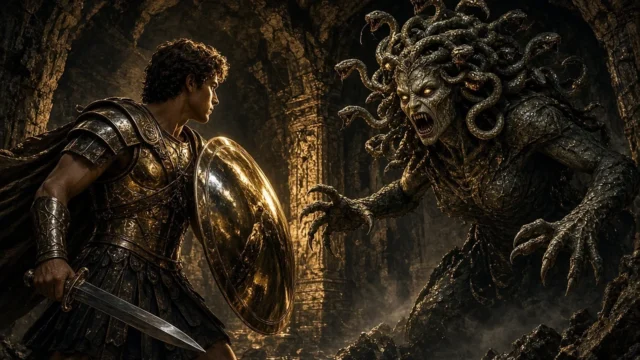
In the Iliad Book 24, Hermes helps the aged Trojan king Priam reach Achilles and seek the return of Hector’s body. This scene displays the god’s relationship to safe passage through a dangerous zone and his ability to protect a traveler who is vulnerable. In the Perseus cycle Hermes also contributes guidance or equipment in some accounts of the Gorgon quest. These stories share the idea of crossing obstacles without making Hermes the main warrior who completes every mission.
Hermes and Argus: how did he rescue Io?
In another celebrated story, Zeus’s involvement with Io leads to her being guarded by Argus Panoptes, a figure associated with many eyes. Hermes is sent to free her and defeats or kills the watchman in the tradition, earning the title Argeiphontes, commonly interpreted as “slayer of Argus.” Later poetic versions, including Ovid’s, elaborate the scene with music and storytelling to distract the guardian.
Io’s suffering and the divine power struggles are important to the broader Hera–Zeus cycle. They also show Hermes as an operative in difficult negotiations between gods, not necessarily an impartial postman. The narrative includes coercion and pursuit, which should not be romanticized or treated as a historical account. Its details and motivations vary; a source-based article distinguishes an ancient epic epithet from a later, highly visual retelling.
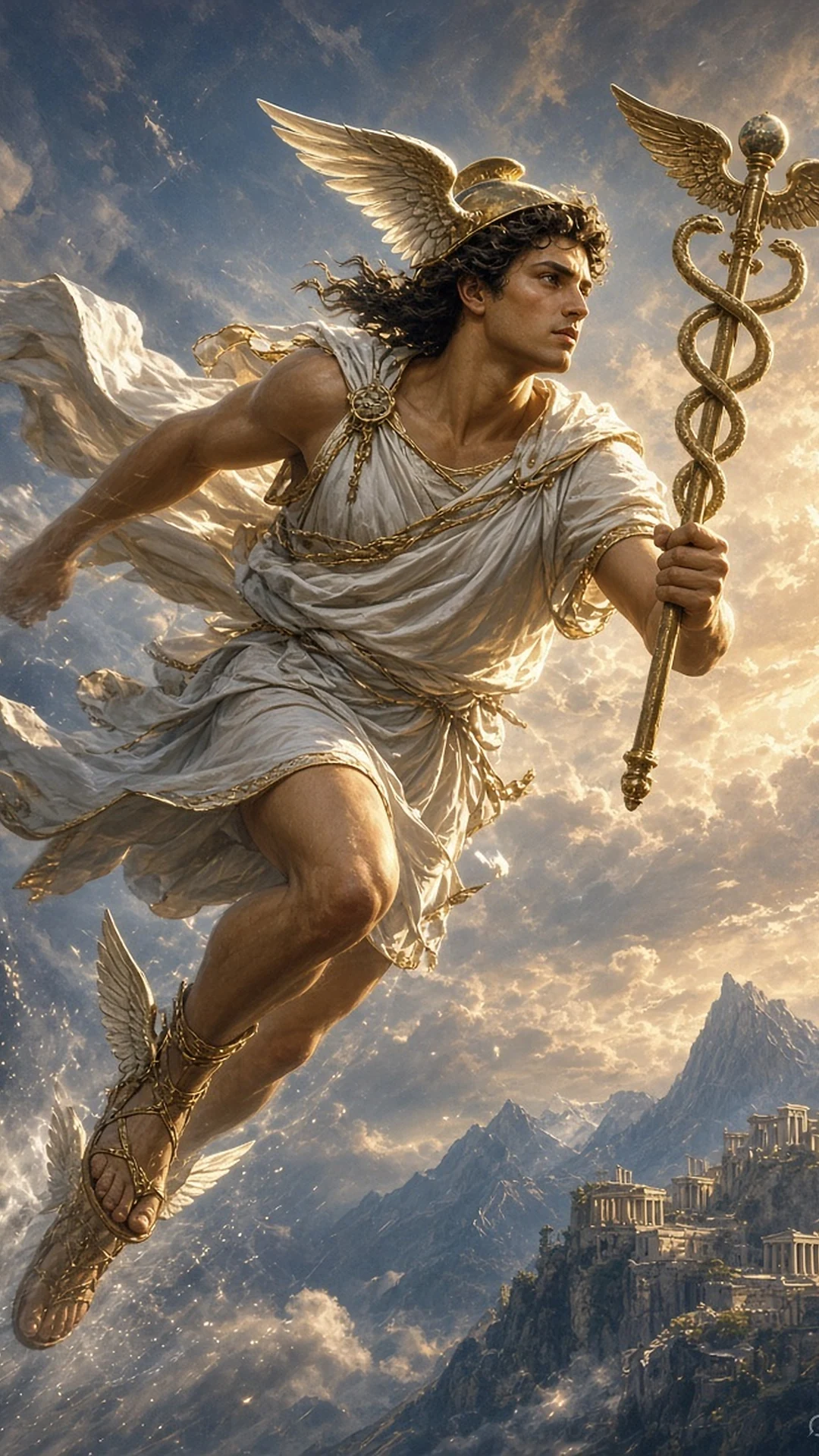
Greek Hermes versus Roman Mercury
Mercury is the familiar Roman counterpart to Greek Hermes, and the names are commonly used for similar functions of commerce and messages. However, Roman worship of Mercury and the earlier Greek histories of Hermes have their own religious contexts. The planet Mercury and the chemical element with the same English name have different naming histories, and identifying Hermes with every modern use of the word “mercury” would be anachronistic.
Hermes’s appearance in Roman art often emphasizes the traveler’s hat, a staff and winged shoes; some of those features are familiar from Greek depictions as well. The comparison is useful, but it should not hide the original humorous Homeric Hymn that gives his childhood adventures such depth. Similarly, comparisons with messenger figures from Indian or other traditions are thematic rather than proof that the gods are historically the same person.
Hermes mythology quick-reference chart
| Topic | Answer | Early source |
|---|---|---|
| Parents | Zeus and Maia | Homeric Hymn 4 |
| Infant adventure | Steals Apollo’s cattle | Homeric Hymn 4 |
| Invention | Tortoise-shell lyre | Homeric Hymn 4 |
| Messenger identity | Herald and intermediary | Hymns and epic |
| Odysseus | Provides moly against Circe | Odyssey Book 10 |
| Souls | Guides shades | Odyssey Book 24 |
| Roman name | Mercury | Roman tradition |
Five FAQs about Hermes
Who were Hermes’s parents?
Zeus and Maia; the Homeric Hymn places his birth in a cave on Mount Cyllene.
Why did Hermes steal Apollo’s cattle?
The newborn trickster demonstrates his cunning through the theft; the dispute leads to a gift exchange involving the lyre.
What is Hermes’s main symbol?
The caduceus, a herald’s staff, along with winged sandals or headgear in familiar artwork.
Did Hermes guide dead souls?
Yes. As psychopomp, he escorts souls toward the underworld, including the suitors in Odyssey Book 24.
What is the Roman name of Hermes?
Mercury, whose Roman traditions overlap with but are not identical to Greek Hermes worship.
Primary sources and conclusion
The birth, lyre and theft are in Homeric Hymn 4 to Hermes. For Odysseus and Circe see Odyssey Book 10; for the guide of souls consult Odyssey Book 24; and for classical passages and art see Theoi Hermes. Conclusion: Hermes is the boundary-crossing messenger, brilliant trickster and guide whose skills connect gods, heroes, merchants and the dead. Updated 14 November 2026. Images are artistic depictions.


























Share Your Opinion
Comments are closed on this post.