 Vista
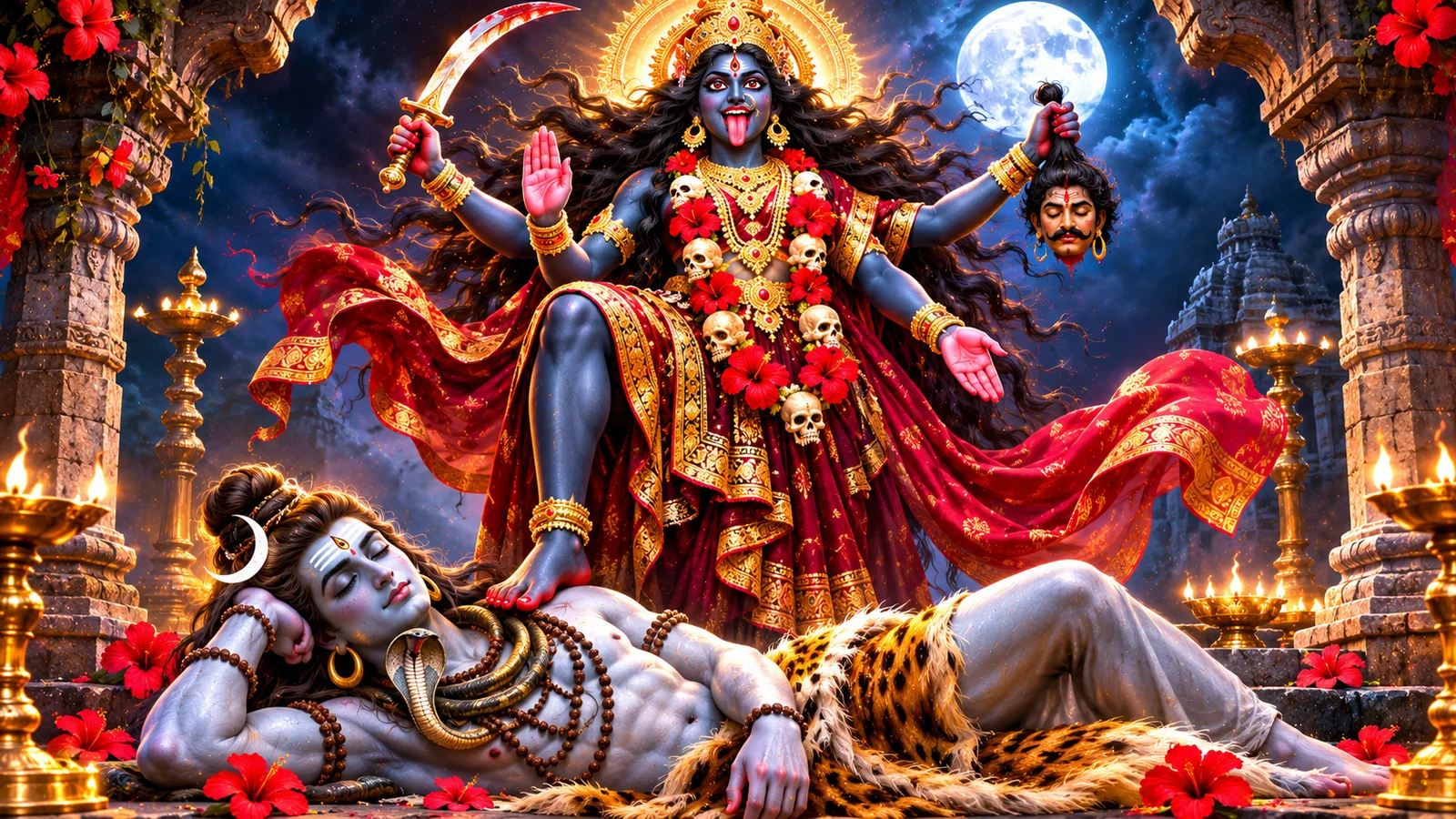
Quick answer: Goddess Kali is shown standing on Lord Shiva because a popular Hindu narrative says Shiva lay beneath her feet to bring her fierce, unstoppable dance to a halt. When Kali recognized him, her movement stopped. Another important interpretation, especially in Shakta and Tantric thought, sees Kali as Shakti, dynamic divine energy, and Shiva as the stillness of consciousness. The image portrays their relationship, not a sporting contest to decide which deity is more powerful. Different communities explain Kali’s extended tongue and Shiva’s reclining form differently. Looking at the story, philosophy, and historical art together gives a fuller answer.
The Famous Story: Why Kali Stepped on Shiva
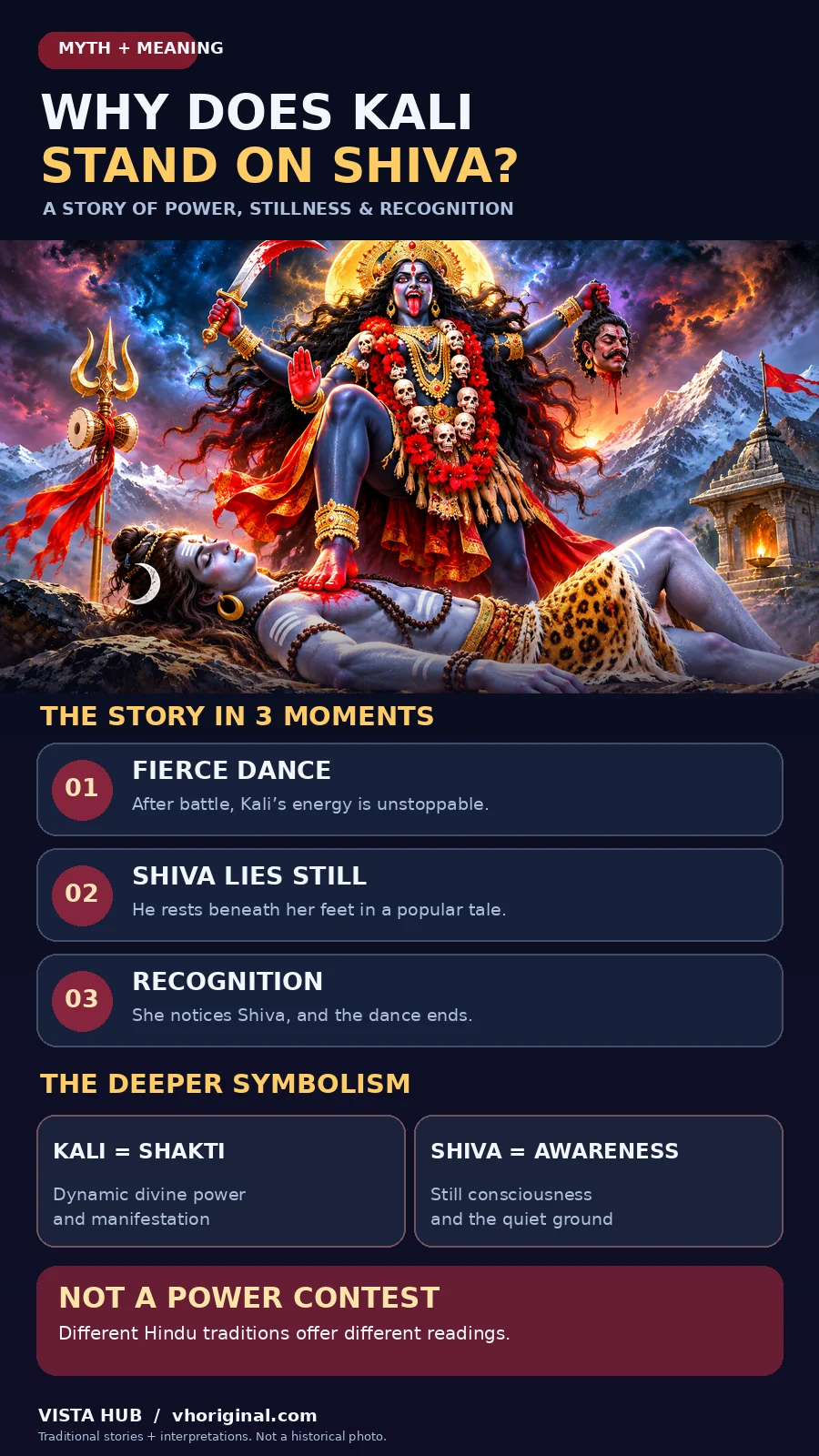
The best-known explanation begins after a fierce battle. Kali has confronted destructive forces, but her energy does not immediately settle when the fighting ends. In widely told versions, she moves across the battlefield in a dance so forceful that the surrounding world is threatened. Other gods cannot easily interrupt her. Shiva then lies motionless in her path. Kali puts a foot on his chest, recognizes the person beneath her, and stops. The encounter restores balance, and the moment becomes a famous subject of paintings, sculptures, festival images, and devotional prints.
This is a popular devotional retelling, not an eyewitness report or a single episode told identically in every Hindu text. Some narrations emphasize the goddess’s recognition of her husband; some emphasize Shiva’s voluntary and compassionate intervention; others interpret the arrangement philosophically from the beginning. The Metropolitan Museum of Art discusses the icon in the context of Indian prints and stories of Kali’s battlefield dance. Its account helps establish why modern viewers regularly see the same dramatic arrangement. But the picture’s significance does not end with the short story.
Notice the posture of the two figures. Kali is active, upright, moving and charged with energy. Shiva is horizontal, composed, and apparently untroubled. Artists create a tension between motion and stillness that a one-line explanation cannot capture. This contrast invites readers to explore what each figure expresses in Hindu thought.
What Happened Before Kali’s Fierce Dance?
Stories about Kali’s battle often intersect with the larger mythology of the Goddess. A frequently recounted episode concerns Raktabija, an asura whose spilled blood generates more opponents. Kali helps overcome this seemingly multiplying danger. Modern summaries sometimes move directly from that battle to the scene in which Shiva lies beneath Kali. It is better to treat that linkage as a composite of popular retellings, not claim that every scripture presents exactly the same unbroken sequence.
The Devi Mahatmya, part of the Markandeya Purana, provides influential battle narratives involving fierce forms of the Goddess. Kali also appears in later Shakta and regional traditions with their own ritual and theological settings. The exact arrangement of Raktabija, the dance, Shiva’s intervention, and the tongue must therefore be attributed carefully whenever someone claims to cite an ancient verse. A responsible article can explain the familiar scene without inventing chapter numbers or presenting a television adaptation as an original scripture.
The important dramatic question remains: What happens when a protective power becomes so intense that it must be brought into balance? Hindu religious imagination explores that question through Kali’s terrifying but ultimately protective presence. The Goddess fights threats to cosmic and moral order; the imagery of fierce energy does not make her a villain.
Why Did Shiva Lie Under Kali’s Feet?
In the popular story, Shiva lies down deliberately so the goddess will notice him and bring her movement to rest. There is no need to portray the act as defeat or humiliation. On this reading, Shiva’s stillness is an intervention that does not involve a second violent confrontation. The surprise of recognition changes the scene. Devotional retellings may call it compassion, wisdom or the restoration of equilibrium.
There is another, deeper reading. Shiva is not simply someone who happens to be present on the battlefield. In several philosophical explanations, the still body beneath Kali represents consciousness; the goddess above him represents power, activity or manifestation. Without their relationship, the symbolism would be incomplete. British Museum interpretation of an old Kali image explains this as an interaction between Shakti as creative force and Shiva as pure consciousness. The idea belongs to a particular Tantric framework and should not be asserted as the only Hindu explanation.
It is also worth observing that Shiva is sometimes depicted as shava, a body without visible motion. The visual pun between Shiva and shava is used in some traditional interpretations to illustrate the importance of Shakti. It is a theological metaphor, not a medical description of a dead god.
Why Does Goddess Kali Stick Out Her Tongue?
One of the first questions readers ask about Kali’s image is why her tongue extends so prominently. The familiar answer is that she recognizes Shiva beneath her foot and expresses surprise, shame or sudden realization. This interpretation is common in several Bengali popular accounts and in museum descriptions of the Shiva–Kali scene. Yet it is not the only meaning of Kali’s tongue.
In other descriptions, the protruding tongue belongs to Kali’s fierce battlefield iconography. It can signal terrifying power, appetite, or her role in a mythic confrontation with dangerous beings. Later devotional art can also read the gesture as the instant when fierce action yields to recognition. The precise meaning depends on which image, community and source is being discussed. A picture with an extended red tongue cannot, by itself, prove that the artist meant only modesty or only anger.
The Cleveland Museum of Art describes historical Kalighat images of Kali in which frightening and compassionate elements coexist. Her hands can simultaneously hold weapons and display protection or blessing. That combination is important: an outwardly fearsome deity may be revered as a deeply protective mother. The tongue should be read as part of a larger iconographic language rather than as an isolated expression.
Shiva and Shakti: Consciousness and Divine Energy
The word Shakti broadly means power or energy, and in many Hindu theological traditions it refers to divine power represented by the Goddess. Shiva is associated with stillness, awareness, and, in several Shaiva and Tantric teachings, consciousness itself. In this reading, Kali above Shiva is not a hierarchy of winner and loser. The two principles belong together. Activity without awareness may become chaotic; awareness without manifestation remains unexpressed. The image makes their inseparability visible through contrast.
The philosophical picture is more nuanced than a slogan that says “woman equals energy, man equals passivity.” The theological figures cannot simply be translated into biological claims about ordinary women and men. Shiva, Kali and Shakti have complex identities that change across lineages. Some Shakta traditions regard Devi as ultimate reality; other schools put Shiva at the center; nondual approaches emphasize that the apparent opposition is itself provisional.
The composition invites a useful thought experiment: imagine a flame without something to illuminate, or stillness without any activity that can be noticed. Neither comparison reproduces Hindu metaphysics exactly, but each helps newcomers appreciate why the same work of art can show a figure standing and another resting without declaring one defeated.
Is Kali More Powerful Than Shiva?
There is no single answer accepted by every Hindu tradition. In Shakta approaches, the Goddess can be understood as supreme divine reality and the power through which the universe is revealed. In Shaiva teachings, Shiva may occupy that supreme role, with Shakti understood through his inseparable power. In other approaches, neither is meaningfully ranked above the other because the image represents a unity that cannot be reduced to a power contest.
Internet comparisons sometimes isolate one scene to claim that Kali defeated Shiva or that Shiva completely controlled Kali. Neither statement captures the different devotional and philosophical purposes of the image. The scene may be told as Kali’s recognition of Shiva; it may be interpreted as Shiva’s compassionate restraint; it may also symbolize the Goddess as active creative force supported by consciousness.
A better question is: According to which tradition, scripture, teacher or artwork? That small question improves almost every discussion of Hindu mythology. It prevents a single regional retelling from being presented as a rule for millions of people whose religious practices and philosophical positions differ.
What Do Kali’s Sword, Garland and Dark Color Mean?
Many images show Kali with a curved sword, a severed head, a garland of heads or skulls, unbound hair, and a dark blue or black complexion. These are not random decorations. They help convey a deity who faces mortality, danger, ego and the instability of worldly forms. Traditional explanations vary. The sword is sometimes read as the cutting of ignorance; the severed head may be read as conquered ego or the defeat of an asura. The garland may evoke mortality, speech or the Sanskrit letters in particular interpretive lineages.
Kali’s dark complexion has also been connected with time, the unknowable, and a reality that exceeds ordinary distinctions. None of these ideas should be presented as the only meaning across all temples and scriptures. A historical painter may emphasize the drama of battle, while a devotee sees maternal protection or liberation from fear. Fierce appearance and benevolent intent can coexist within the same image.
An outstretched hand frequently indicates abhaya, a gesture of fearlessness, while another can signify the granting of boons. The figure then becomes especially compelling: weapons express force against danger, while open palms express care for worshippers. Not every form of Kali has the same number of arms or identical attributes. The individual icon matters.
Why Are Kali and Shiva Shown Together in Bengali Art?
Kali worship is particularly visible in Bengal, although devotion to the Goddess extends far beyond any one region. Kalighat paintings, nineteenth-century religious prints, household worship and Kali Puja imagery helped make the standing-Kali and reclining-Shiva composition widely recognizable. Artistic reproduction allowed these images to circulate through cities, villages and eventually the global diaspora. A visitor may recognize the icon from a calendar or phone wallpaper before learning the history of the painting style.
The Cleveland Museum of Art records a late-nineteenth-century Kalighat album leaf with Kali and Shiva. The Metropolitan Museum of Art discusses nineteenth- and early-twentieth-century lithographs showing Kali as a wrathful protector. These objects demonstrate that the composition is not merely an internet invention. At the same time, the existence of historical artworks does not verify a physical battlefield event. Art history establishes that people created, used and valued the images in particular places and periods.
This distinction is useful for educational writing. A painting can be historically real while the scene it illustrates belongs to sacred narrative. Describing the two levels honestly protects the dignity of both scholarship and devotion.
Is the Story About Fear, Shame or Protection?
It can be discussed through all three themes, but only with context. Kali’s battlefield appearance confronts what frightens ordinary observers. Her sudden recognition of Shiva can express a pause in uncontrolled momentum. The protection of the world is the central concern of several popular retellings. In devotional life, however, worshippers do not usually approach Kali merely as a figure of fear. Many address her as Maa Kali, a loving mother who protects those who turn to her.
The story also offers a challenge to simplistic expectations about gender and power. A goddess stands at the visual center, while Shiva lies beneath her. Rather than smoothing away that surprising image, readers can ask why artists and devotees have continued to find it spiritually meaningful. Shakta traditions have sophisticated views of female divine power that deserve explanation on their own terms.
It is tempting to turn every detail into a modern self-help rule: the sword is “cut toxicity,” the tongue is “control anger,” and so on. Such comparisons can be thoughtful personal reflections, but they are not substitutes for actual textual and regional knowledge. Distinguish what a source says from what a modern reader finds meaningful.
Myth vs Fact: Four Common Misunderstandings
Myth 1: Kali standing on Shiva proves Shiva lost a literal fight. The familiar narrative tells of recognition and restored balance; philosophical accounts point to the relationship between Shakti and consciousness. A contest is not the necessary meaning.
Myth 2: Kali is an evil goddess because she looks fierce. Kali is revered as protective and compassionate in major devotional traditions. Weapons and severe imagery communicate power against danger, not simply malice.
Myth 3: Her tongue has exactly one meaning. Some popular tellings emphasize surprise or shame, while other artistic and textual contexts connect it with fierceness. Both context and chronology matter.
Myth 4: Every depiction comes directly from one verse of the Devi Mahatmya. Kali’s iconography developed through multiple textual, ritual and artistic traditions. Do not invent exact chapter citations to make a modern image look more ancient.
How to Understand an Image of Kali Without Misreading It
First identify the specific form of the Goddess: look at her arms, attributes, posture, companions and surrounding figures. Next ask whether the description is a familiar story, a theological reading, or a museum’s analysis of an artwork. These are related forms of explanation but not interchangeable. Then note the place and time. A print from Kolkata in the nineteenth century cannot automatically be treated as evidence for what every Hindu worshipper believed a thousand years earlier.
For accessible visual reference, see the Metropolitan Museum of Art’s discussion of Kali’s lithographs, the British Museum’s exhibition guide on Tantra and the Cleveland Museum’s Kalighat album page. None of those sources eliminates the need to listen to living devotional traditions. Instead, they provide a firmer historical and interpretive foundation than anonymous viral posts that claim a single secret answer.
Finally, remember that respectful interpretation does not require pretending a mythological scene was photographed. An original illustration, like the images accompanying this article, is a contemporary visualization inspired by traditional motifs. It should be captioned as such.
Frequently Asked Questions
Why does Kali stand on Lord Shiva’s chest?
A popular story says Shiva lay down to calm Kali’s fierce dance and that she stopped when she recognized him. Another interpretation sees Kali as dynamic Shakti standing above Shiva as still consciousness.
Why does Kali stick out her tongue?
In a familiar retelling the gesture expresses surprise or recognition after stepping on Shiva. In other iconographic contexts it belongs to Kali’s fearsome battlefield appearance; explanations differ.
Does Kali defeating Shiva mean she is stronger?
The scene does not require a literal defeat. Hindu traditions hold different views about divine supremacy, while several philosophical readings emphasize the unity of Shiva and Shakti.
Is Goddess Kali evil or dangerous to devotees?
Kali is widely revered as a protective mother and divine power. Fierce images emphasize her ability to confront threats; they do not simply label her evil.
Is Kali the same as Durga or Parvati?
They are closely related in many Shakta traditions, but their identities, narratives and forms are interpreted differently across communities and texts. Treating every name as completely interchangeable obscures that richness.
Is the Kali-on-Shiva scene in the Devi Mahatmya?
The Devi Mahatmya is an important source for fierce Goddess narratives, but the exact familiar standing-on-Shiva scene should not automatically be assigned to a particular verse without a verified textual reference. Regional and later traditions matter.
What does Kali represent in Tantra?
In some Tantric and Shakta interpretations she embodies divine Shakti, active power and manifestation, while Shiva is pure consciousness. Traditions differ, so this is one important reading rather than a universal definition.
Conclusion: Power, Stillness and Recognition
Kali standing on Shiva is memorable because it refuses a simple answer. The beloved story describes a fierce dance halted by recognition. The philosophical image places active divine power over still consciousness. Art history shows how generations of painters and worshippers have made the composition meaningful in their own circumstances. None of these layers needs to erase the others. A reader who asks about the source, region and interpretation will understand much more than one who treats the scene as a battle to declare a winner.
Source notes and further reading: Metropolitan Museum of Art — Seeing Kali Clearly · British Museum — Tantra: Enlightenment to Revolution (exhibition guide) · Cleveland Museum of Art — Kali Standing on Shiva · University of Western Australia — The Goddess Kali.
Editorial note (12 November 2026): This article distinguishes traditional stories, theological interpretations and historical artworks. The illustrations are modern artistic representations, not documentary images of a literal event.
Related reading
- Shiva as the Destroyer and the third eye
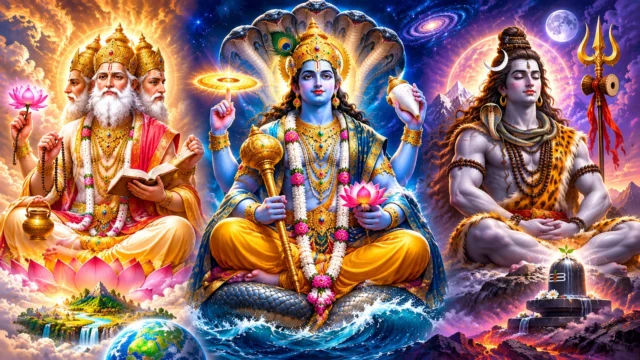
- Brahma, Vishnu and Shiva in the Trimurti
- Kali Ji HD wallpaper collection
- Hindu cosmology and the cycles of creation
















Share Your Opinion
Comments are closed on this post.