 Vista
Understanding Osho’s Profound Ideas for a Transformed Life
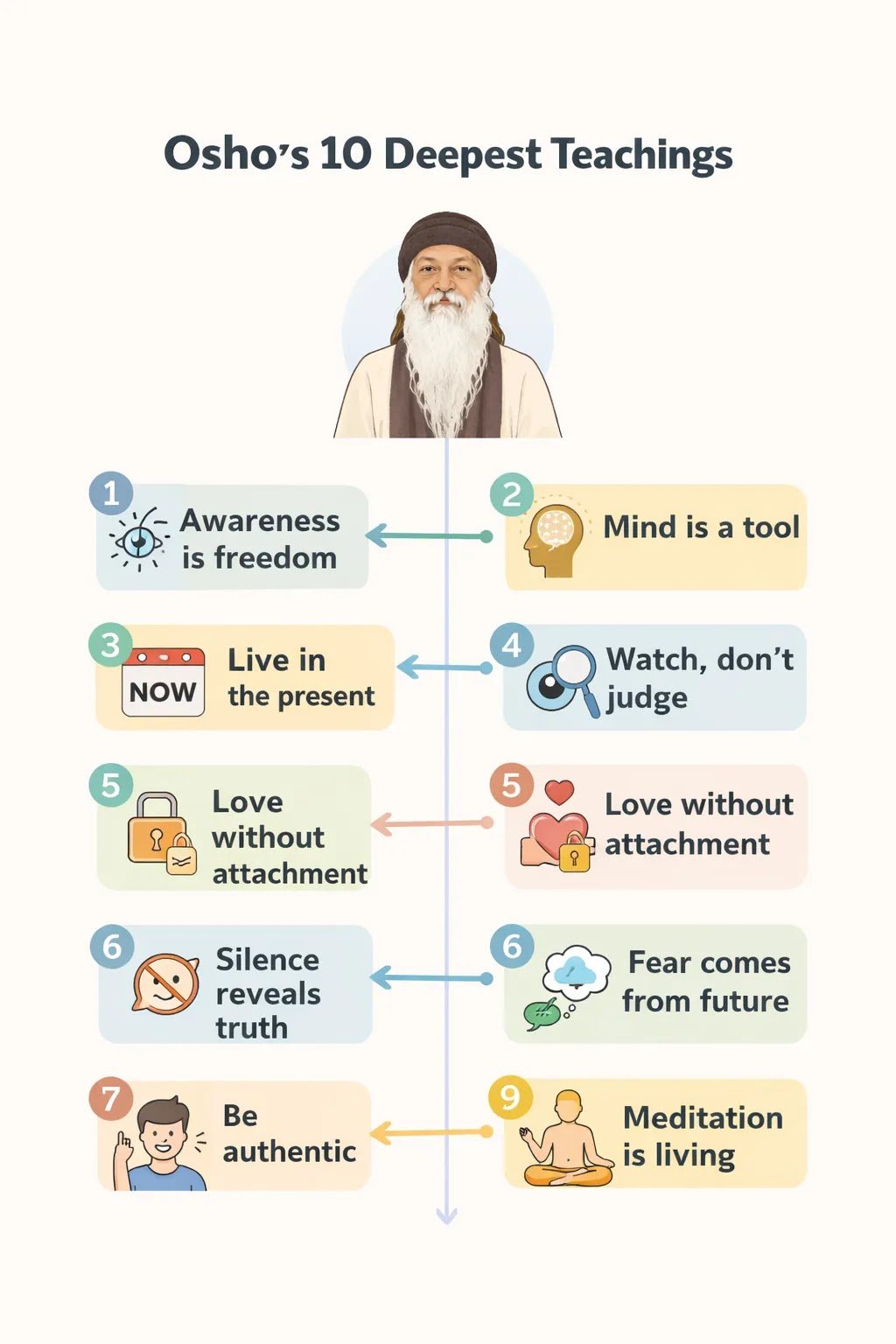
Osho Rajneesh, revered as a mystic, guru, and philosopher, left an indelible mark on millions worldwide. His teachings, spanning themes like love, meditation, freedom, and existence, often appear simple on the surface but conceal an ocean of depth and wisdom. While the digital world is awash with information, truly grasping Osho’s core philosophies can be challenging. This article aims to illuminate 10 of his most profound ideas, offering a clear understanding of their meaning and practical application in today’s world, guiding you toward a new direction in life.
1. Awareness is True Freedom
At the heart of Osho’s philosophy lies the concept that awareness is the ultimate freedom. We often perceive external constraints as the enemies of freedom, but Osho argues that true bondage resides within us – in our unconscious thoughts, ingrained habits, automatic reactions, and deeply held prejudices. Until we consciously observe these internal patterns, we operate like automatons, driven by past programming. Awareness, in Osho’s view, is the practice of observing our thoughts, emotions, and actions as a detached witness, without judgment or attachment. This act of ‘seeing’ liberates us from self-imposed limitations. When awareness dawns, we reclaim ownership of our responses, leading to genuine freedom – the freedom to remain serene and centered, irrespective of external circumstances.
2. The Mind: A Tool, Not a Master
The mind is humanity’s most potent instrument, enabling us to think, plan, recall, and solve problems. However, Osho cautions that when this tool usurms the role of master, it becomes our greatest impediment. The mind constantly oscillates between the past and the future, breeding anxiety and pulling us away from the present moment. Osho teaches us to use the mind as a servant: employ it when needed and allow it to be still when not. Allowing the mind to dominate means becoming enslaved by its thoughts and emotions. Recognizing it as a tool ushers in profound inner peace and clarity, allowing us to connect with our true consciousness beyond the mind’s chatter.
3. Living in the Present is Meditation
Meditation is often confined to specific postures or practices, but Osho redefines it as a way of living. For him, meditation means being fully present, ‘here and now.’ When you eat, just eat; when you walk, just walk; when you listen, just listen. Our minds are frequently lost in past memories or future worries, causing us to miss the most beautiful moments of life – the present. Living in the present is, in itself, a deep meditation, connecting us to the very essence of life. It allows us to experience completeness and joy in every moment, without reliance on external validation.
4. Observe, Don’t Judge
A common human tendency is to immediately judge people and situations, categorizing them as good or bad, right or wrong. Osho identifies this judgmental attitude as a malady of the mind. When we judge, we view reality through the lens of our preconceived notions and biases, rather than as it truly is. In contrast, ‘observation’ is a passive, non-judgmental process. By observing without judgment, we gain a holistic understanding of things. This fosters greater empathy towards others and helps us better comprehend our own internal conflicts. Judgment creates distance, while pure observation cultivates understanding and acceptance.
5. Love is Not Attachment
Distinguishing between love and attachment is a crucial aspect of Osho’s teachings, as society often conflates the two. Osho explains that true love liberates; it provides space for the other person to grow and flourish. It is unconditional, without expectations or bindings. Attachment, conversely, stems from fear, possessiveness, and insecurity. It seeks to control and mold the other person according to one’s desires. Attachment invariably leads to suffering because it is rooted in the fear of loss. Love is like a flowing river, nourishing all, while attachment is like a clenched fist, unable to hold anything.
6. Life is a Celebration
Osho’s perspective on life was one of perpetual celebration. He advocated for living life not as a duty, a burden, or a penance, but as a grand festival. Every moment, whether joyous or sorrowful, is an experience to be lived fully. Life’s challenges should be approached like a game, offering opportunities for learning and growth. Celebration means embracing all facets of life, integrating dance, music, and laughter into its fabric. This outlook helps us transcend despair and melancholy, fostering a positive and grateful attitude towards existence.
7. Death is Not an End, but a New Beginning
Death is a subject most people shy away from, yet Osho regards it as an essential and beautiful part of life. He posits that death is not an end but a transformation—a shedding of an old form and a transition to a new one. Our bodies perish, but our consciousness, our essence, is immortal. The fear of death arises from our excessive identification with our physical bodies and ego. When we understand and accept death, we begin to live life more profoundly. Confronting mortality inspires us to live each moment fully, knowing that nothing is permanent.
8. Truth is Within, Not Without
Osho consistently emphasized seeking truth within oneself rather than relying on external sources like scriptures, gurus, or established beliefs. He asserted that truth is not something acquired externally but an inner experience of our being. All answers and knowledge reside within us; we simply need to become calm and aware to discover them. This idea empowers us to trust our own experiences and intuition, rather than blindly adhering to external authorities. Embarking on our inner journey allows us to understand our true nature and our connection to the universe.
9. Religion is Personal Experience, Not Organized Structure
Osho was a vocal critic of organized religions, often identifying them as sources of control, conflict, and division. For him, ‘religion’ was not an institution, a sect, or a dogma, but a personal ‘religiosity’—an inner experience, a way of living. Religiosity means living with love, compassion, awareness, and truth. It doesn’t come from visiting temples, mosques, or churches, but from connecting with one’s inner consciousness. Osho encouraged people to discover truth through their own experiences, not by following rules dictated by others.
10. Change is the Only Law of Life
Everything in this universe is in constant flux: nature, seasons, our bodies, our thoughts, our emotions. Osho stated that change is the only constant law of life, and those who resist this truth suffer. We often try to hold onto things—relationships, circumstances, even our identities—as they are. This resistance, however, breeds only pain. When we embrace change, we learn to flow with life’s currents, becoming more adaptable, resilient, and peaceful. Accepting change helps us understand that life is a continuous journey, and every ending presents an opportunity for a new beginning.
Applying Osho’s Wisdom: A Practical Approach
Osho’s teachings are not meant for mere contemplation but for integration into daily life. The key is to approach them gradually. Instead of trying to adopt all ten ideas at once, select one concept, such as ‘living in the present.’ Dedicate time to practicing it fully for a day—fully engage in the task at hand, minimize distractions, and gently guide your mind back when it wanders. Even a few minutes of successful practice is a victory. As one concept settles, move on to the next. The goal isn’t to become Osho overnight but to cultivate a more mindful and fulfilling life through small, consistent changes.
Frequently Asked Questions
What is the core message of Osho’s teachings?
The core message of Osho’s teachings revolves around self-awareness, living fully in the present moment, and understanding the nature of the mind and ego. He emphasized personal experience and inner transformation over dogma and external authority.
How can I apply Osho’s concept of ‘awareness’ in my daily life?
To apply awareness, practice observing your thoughts, feelings, and actions without judgment. When you are eating, simply focus on eating. When you are talking, be fully present in the conversation. This mindful observation helps detach you from automatic reactions and fosters inner freedom.
What is the difference between love and attachment according to Osho?
Osho distinguishes love as a liberating force that gives freedom and space for growth, devoid of conditions or possessiveness. Attachment, conversely, is rooted in fear, insecurity, and the desire to control, leading to suffering.
Is Osho’s philosophy suitable for everyone?
Osho’s philosophy is universal in its appeal, addressing fundamental human experiences. However, his unconventional approach and direct style may resonate differently with individuals. The emphasis on personal exploration means individuals can engage with his ideas at their own pace and in a way that feels authentic to them.
How does Osho view organized religion?
Osho was critical of organized religions, viewing them as potential sources of dogma, control, and conflict. He promoted ‘religiosity’ as a personal, inner experience of truth, love, and consciousness, distinct from institutionalized religious practices.
By integrating these profound insights, one can move towards a life characterized by greater clarity, inner peace, and purpose.






















Share Your Opinion
Comments are closed on this post.