What is the Real Difference Between Active and Passive Voice?
When the doer of the action (the Subject) is primary and comes first in the sentence, it’s called Active Voice. For example, ‘Rahul wrote a letter.’ Here, the focus is entirely on Rahul. However, when our attention shifts from the doer to the action or its result (the Object), it becomes Passive Voice. For instance, ‘A letter was written by Rahul.’ Both voices have their importance in daily conversation and formal writing. Active voice is correct when we want to state ‘who did it.’ But when the doer is unknown, or the result of the action is more important (like ‘The road has been built’ or ‘The thief has been caught’), passive voice sounds most natural.
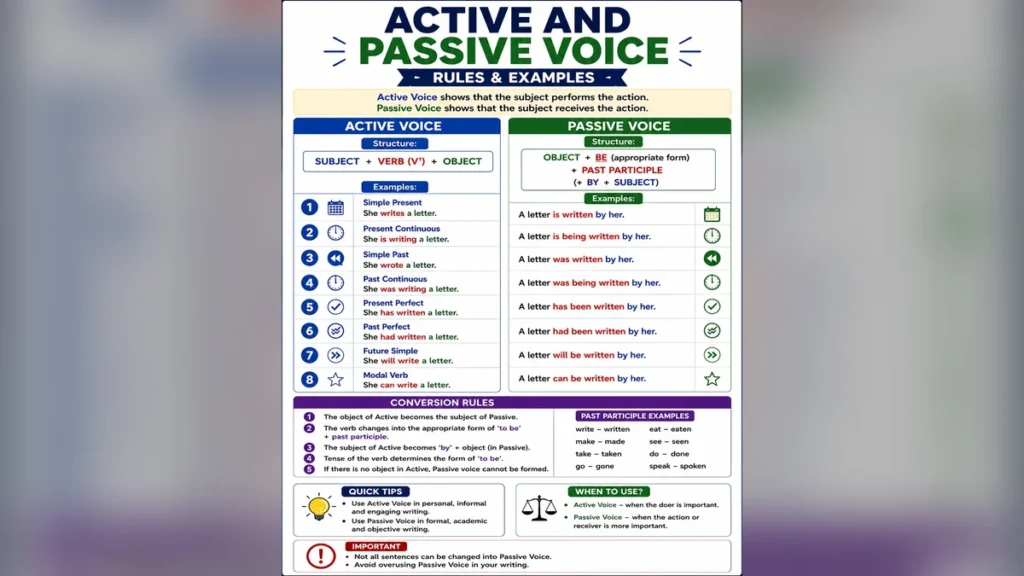
The basic English sentence structure of Subject + Verb + Object changes in passive voice to Object + Helping Verb + V3 (Past Participle) + by + Subject. Understanding this basic structure makes the entire conversion process much easier.
5 Golden Rules for Converting Active to Passive Voice
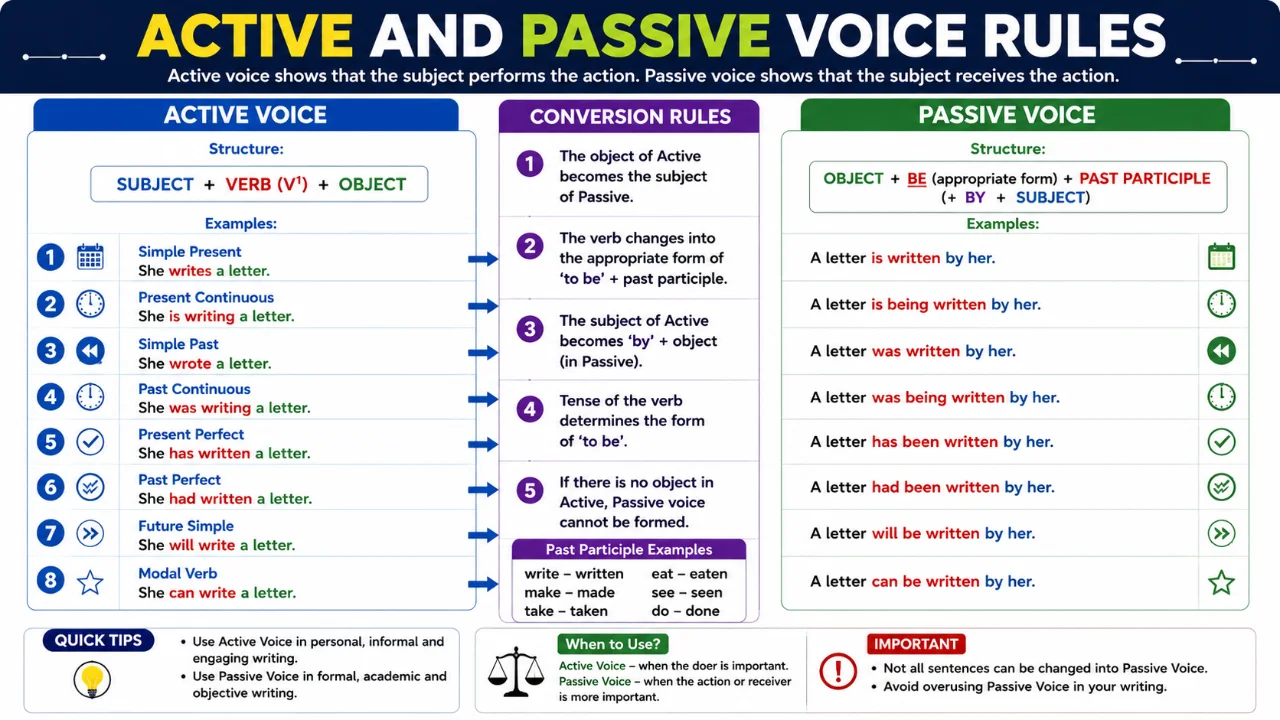
When changing any sentence, you only need to consider these 5 fundamental points. Following these steps sequentially will eliminate the possibility of errors:
- Make the Object the Subject: The object of the active sentence becomes the new subject of the passive sentence.
- Choose the Helping Verb According to Tense: Select the correct auxiliary verb based on whether the new subject is singular or plural and the original tense.
- Always Use the Verb’s 3rd Form (V3): This is the most crucial rule of passive voice – the main verb must always be in its V3 form.
- Use the Preposition ‘by’: Generally, ‘by’ is added before the new object (the original subject) (except for certain specific verbs).
- Make the Subject the Object: Convert the original subject into its objective case and place it at the end of the sentence.
These 5 steps apply to every sentence containing a Transitive Verb (a verb that takes an object). Sentences without an object typically cannot be converted into the passive voice.
Pronoun Conversion Table: How Do Pronouns Change?
People often make mistakes with pronoun cases when changing voice. When the subject moves to the end, it takes its objective form, and when the object comes to the front, it changes to its nominative form. Remembering this is quite simple. Understand how each pronoun changes using the table below:
| Active Subject | Passive Object | Example |
| I | me | He helps me → I am helped by him |
| We | us | |
| You | you | She knows him → He is known to her |
| He | him | |
| She | her | They saw her → She was seen by them |
| They | them | |
| It | it | |
| Who | Whom | Who wrote this? → By whom was this written? |
Note that ‘You’ and ‘It’ remain the same in both positions. Also, a person’s name (like Rohan, Priya) does not change; it is written as is.
Tense-wise Active and Passive Voice Formula Chart
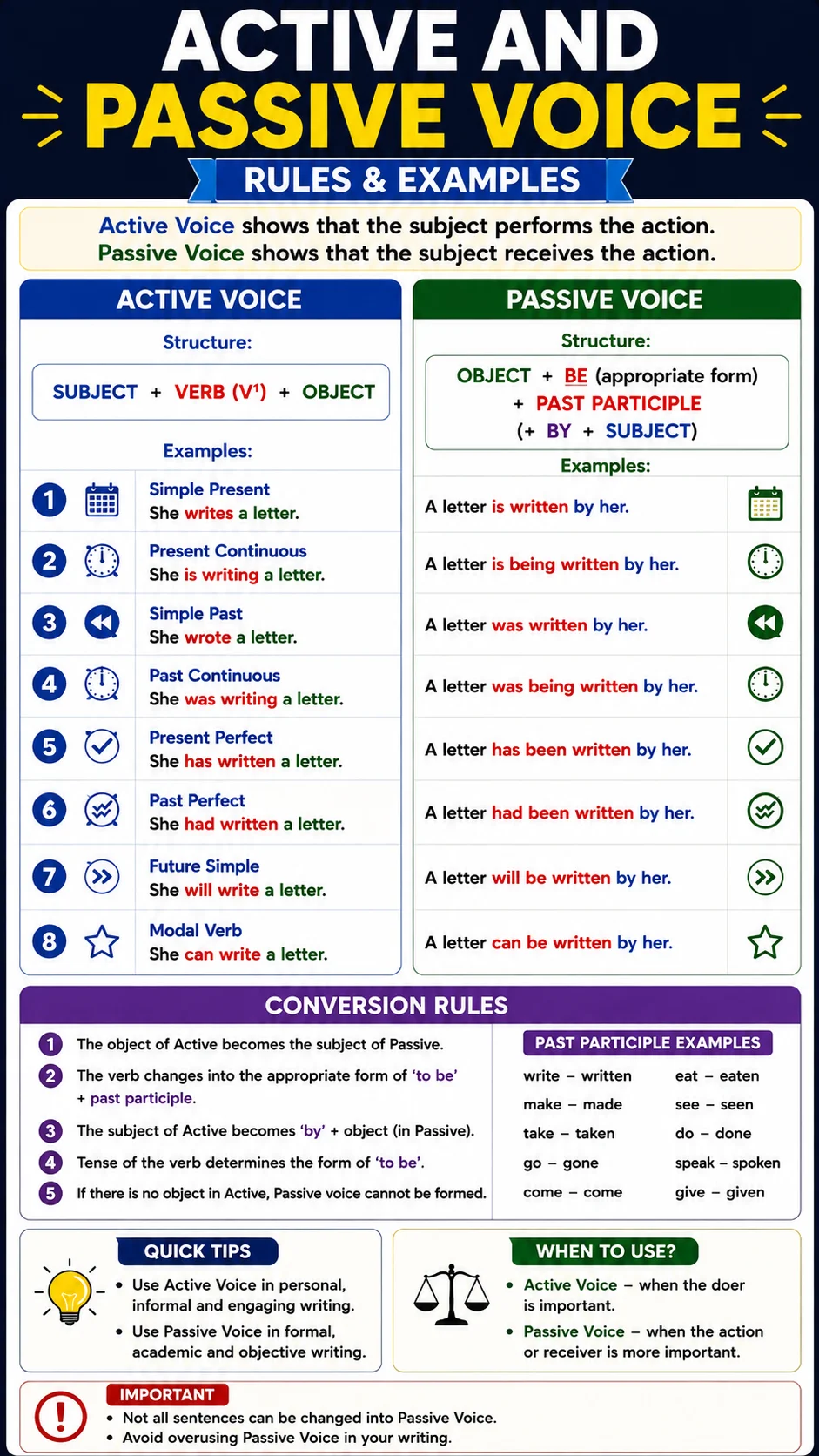
Out of all 12 tenses, passive voice conversion is possible for only 8. Here are the active and passive formulas for all important tenses:
1. Present Tense Rules
- Simple Present: Sub + V1/V5 + Obj → Obj + is/am/are + V3 + by + Sub
- Present Continuous: Sub + is/am/are + V4 + Obj → Obj + is/am/are + being + V3 + by + Sub
- Present Perfect: Sub + has/have + V3 + Obj → Obj + has/have + been + V3 + by + Sub
2. Past Tense Rules
- Simple Past: Sub + V2 + Obj → Obj + was/were + V3 + by + Sub
- Past Continuous: Sub + was/were + V4 + Obj → Obj + was/were + being + V3 + by + Sub
- Past Perfect: Sub + had + V3 + Obj → Obj + had + been + V3 + by + Sub
3. Future Tense Rules
- Simple Future: Sub + will/shall + V1 + Obj → Obj + will/shall + be + V3 + by + Sub
- Future Perfect: Sub + will have + V3 + Obj → Obj + will have been + V3 + by + Sub
The best part about these formulas is that ‘being’ is always added in Continuous tenses, and ‘been’ is always added in Perfect tenses. FACT: In English grammar, only 8 tenses have a passive voice form. The Future Continuous and all three Perfect Continuous tenses are not formed in passive voice under standard grammar rules.
Special Rules for Modal Verbs and Imperative Sentences
Besides the general tenses, exams often include sentences with Modal Verbs (Can, Could, May, Might, Should, Must) and Imperative sentences (commands, advice, requests). Their rules are slightly different but very clear.
- For Modal Verbs: When a modal auxiliary appears in the sentence, passive voice is formed by adding ‘be’ right after the modal, followed by V3. Structure: Modal + be + V3. Example: ‘You must do this work’ becomes ‘This work must be done by you.’
- Imperative Sentences (Commands/Advice):
- Order/Command: Let + Object + be + V3 (e.g., ‘Shut the door’ → ‘Let the door be shut’)
- Advice/Moral Duty: Object + should + be + V3 (e.g., ‘Help the poor’ → ‘The poor should be helped’)
- Request: Start the sentence with ‘You are requested to + V1…’ (e.g., ‘Please sit down’ → ‘You are requested to sit down’)
With a little practice of these rules, even sentences that appear complex can be solved in moments.
How to Download the Active and Passive Voice Rules Chart?
If you want to keep all these rules, tense formulas, exceptional cases, and practice questions together on your mobile or laptop, downloading the Active and Passive Voice Rules Chart is the best option. A printable PDF chart for revision should be on your study table so you can quickly clear any confusion at a glance. For competitive exams like SSC, Banking, Patwari, and board exams, this quick reference sheet saves time. After downloading the chart, print it out or save it in your digital notes. Just glancing at these formulas for 5-10 minutes daily will embed them in your subconscious mind, reducing the risk of errors in exams to zero.
Vivek Bhai’s Advice
Often, students try to memorize grammar rules like math formulas, which proves to be a big mistake. Until you understand the essence of a sentence, you will keep getting stuck on small exceptions like ‘by whom’ or ‘to whom.’ The real purpose of passive voice in English is to hide the doer or emphasize the impact of the action. When newspapers write ‘Road was repaired,’ the repair of the road is more important than the workers who did it. Thinking with this practical approach will make the rules understandable on their own. 💡 Grammar is not about memorization; it’s about grasping the structure. Understand the logic of ‘being’ in continuous and ‘been’ in perfect tenses, and half of the voice concepts will be clear. My straightforward advice is to convert at least 10 sentences for each tense from active to passive yourself. When your pen moves, the rules get cemented in your mind. Simply saving any chart on your phone won’t improve your scores; only 5 minutes of daily practice will make you perfect.
Frequently Asked Questions
Which Tenses Cannot Be Converted to Passive Voice?
A total of 4 tenses cannot be converted to passive voice: Present Perfect Continuous, Past Perfect Continuous, Future Continuous, and Future Perfect Continuous Tense.
Why Can’t Intransitive Verbs Have Passive Voice?
Intransitive verbs (verbs that do not take an object) do not have an object. Since making the object the new subject is essential for forming passive voice, sentences without an object cannot be converted.
When is V3 Used in Active Passive Voice?
In every passive voice sentence, the Third Form (V3 / Past Participle) of the verb is always used, regardless of the original tense of the sentence.
Are There Prepositions Other Than ‘by’ Used in Passive Voice?
Yes, with certain specific verbs, other prepositions are used instead of ‘by.’ For example, ‘to’ is used with Know and Marry, ‘at’ with Surprised and Shocked, and ‘with’ with Satisfied.
Disclaimer: The information provided in this article is for general awareness only.