 Vista
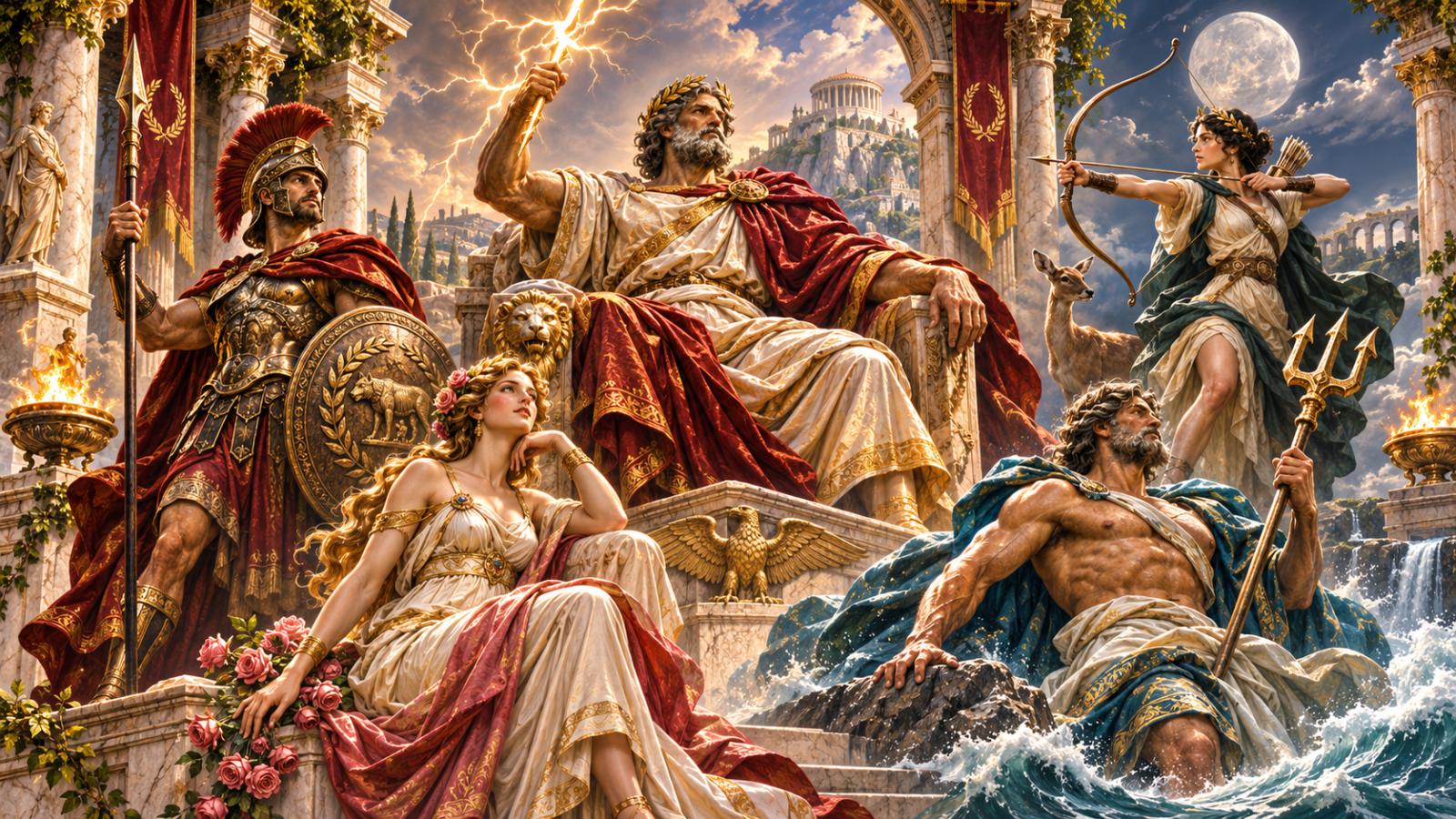
Roman mythology is the body of myths, legends and religious beliefs of ancient Rome, from the founding stories of Romulus and Remus to the great gods Jupiter, Juno, Mars, Venus and Minerva. It is often described as “Greek mythology with new names”, but that is only half true. Romans did borrow heavily from Greek stories, yet they also had older Italian gods, household spirits, state rituals and founding legends that Greece never had. This guide is one master reference for Roman gods and goddesses, Roman gods vs Greek gods, Roman goddess names, the planets named after Roman gods, mythical creatures, symbols, tattoos and the most famous Roman legends.
What Is Roman Mythology?
Roman mythology is the traditional stories about the gods, heroes and origins of Rome. Unlike a scripture, it was never written down in one book. It survives mainly through Latin writers such as Virgil, Ovid, Livy and Apuleius, plus temples, coins, wall paintings and sculpture. Roman religion was also very practical: it was about performing the right rituals to keep the gods friendly toward the city, more than about believing in a detailed set of stories.
Quick overview:
- Period: from early Rome (traditionally 8th century BCE) through the Republic and the Empire, with Christian Rome ending state worship in the 4th century CE.
- Main sources: Virgil’s Aeneid, Ovid’s Metamorphoses and Fasti, Livy’s history of Rome, Apuleius’ Golden Ass.
- Key feature: state religion, household gods and founding legends matter as much as stories.
- Biggest confusion: Roman gods are not simply Greek gods with new names.
Ancient Rome and the Origins of Roman Mythology
Early Roman religion
Early Roman religion centred on numina, spirits or divine powers tied to places, objects and actions, such as the spirit of a doorway or a field. Priests, called colleges, and magistrates performed rites for the state. Many of these early powers had no detailed stories at all, which is one reason Rome later borrowed so many narratives from Greece.
Etruscan influence
The Etruscans, who lived north of Rome, shaped early Roman religion. The great temple of Jupiter on the Capitoline Hill is traditionally linked to the Etruscan kings of Rome, and the goddess Minerva is often connected with the Etruscan goddess Menrva. Roman priests also used Etruscan methods of divination, such as reading animal livers.
Greek influence
From the later Republic, Greek culture flooded Rome through Greek colonies in southern Italy and later conquests. Romans matched their gods with Greek ones, a practice modern scholars call interpretatio Romana, and adopted Greek myths wholesale in poetry and art. Even so, Roman cult practice stayed Roman: its festivals, priesthoods and prayers did not become Greek.
Roman identity and the state
Roman myths were closely tied to Roman identity. Stories of Aeneas, Romulus and the early kings explained why Rome was destined to rule, and emperors later claimed divine ancestry. That political purpose is a major difference from many Greek myths.
Roman Gods and Goddesses List
The poet Ennius, around 200 BCE, listed twelve major gods, often called the Dii Consentes or the 12 major Roman gods: Jupiter, Juno, Neptune, Minerva, Mars, Venus, Apollo, Diana, Vulcan, Vesta, Mercury and Ceres. This Roman gods and goddesses list adds other important figures too. A single fixed “twelve” is a literary grouping, not an official church-style rule.
| Roman god | Domain | Main symbols |
|---|---|---|
| Jupiter | Sky, thunder, king of the gods | Eagle, thunderbolt, oak |
| Juno | Marriage, women, queen of the gods | Peacock, diadem |
| Neptune | Sea | Trident, horse, dolphin |
| Minerva | Wisdom, crafts, strategy | Owl, helmet, shield |
| Mars | War, ancestor of Rome’s founders | Spear, shield, wolf, woodpecker |
| Venus | Love, beauty, fertility | Dove, rose, myrtle, shell |
| Apollo | Music, prophecy, healing, light | Lyre, laurel, bow |
| Diana | Hunt, wild animals, moon | Bow, deer, crescent |
| Vulcan | Fire, forge, volcanoes | Hammer, anvil |
| Vesta | Hearth and the city’s sacred fire | Eternal flame |
| Mercury | Messenger, trade, travel | Winged sandals, caduceus |
| Ceres | Grain, agriculture | Wheat, cornucopia |
| Pluto (Dis Pater) | Underworld and wealth under the earth | Helmet, Cerberus |
| Saturn | Agriculture, time, golden age | Sickle |
| Janus | Doorways, beginnings, endings | Two faces, keys |
Jupiter: Roman god of the sky
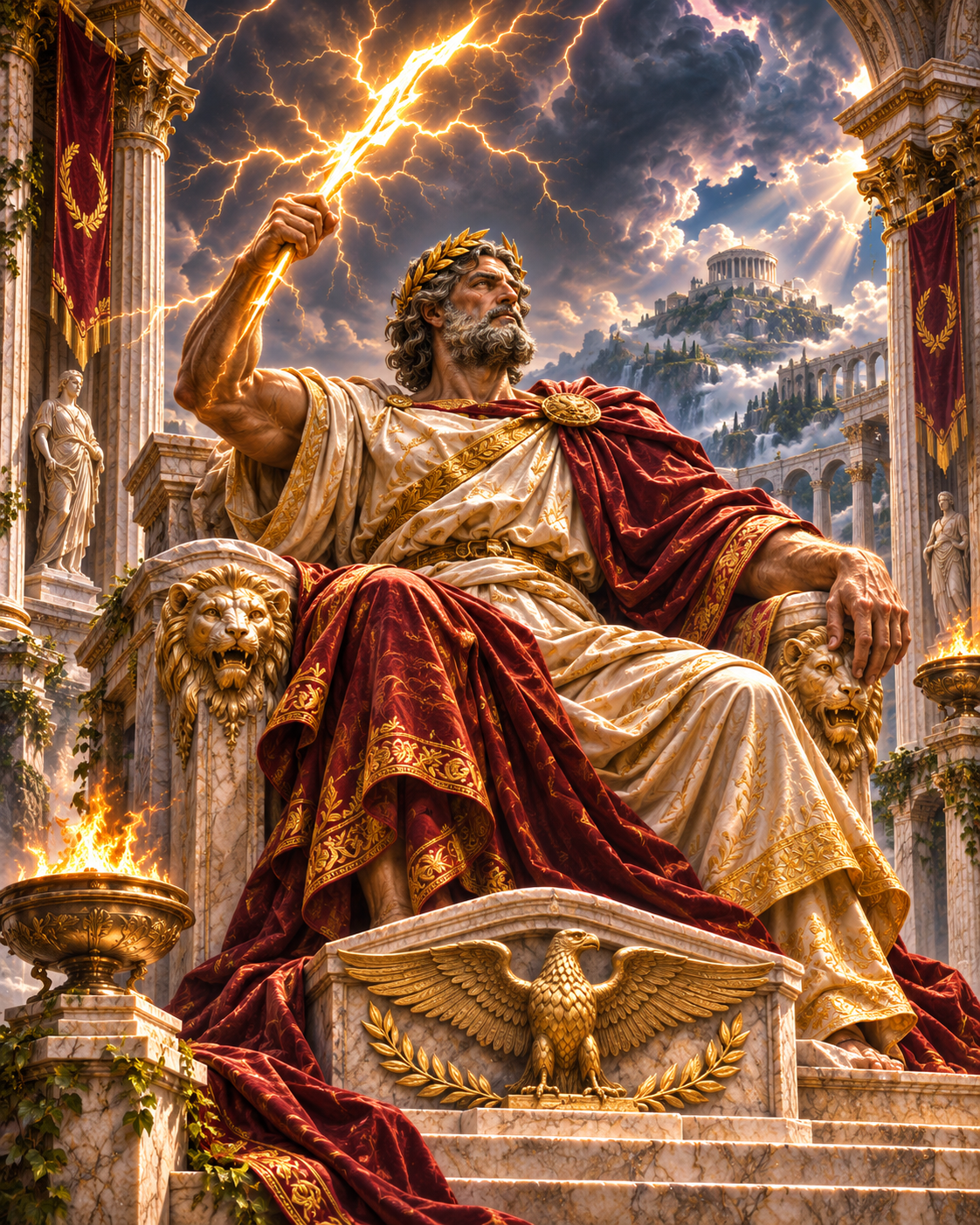
Jupiter (Jove) is the king of the gods, ruler of the sky and thunder, and the protector of Rome and its oaths. His official title was Jupiter Optimus Maximus, “best and greatest”, and his main temple stood on the Capitoline Hill. He is the counterpart of the Greek Zeus, but he was also the formal patron of the Roman state and of generals who celebrated triumphs.
Mars: Roman god of war
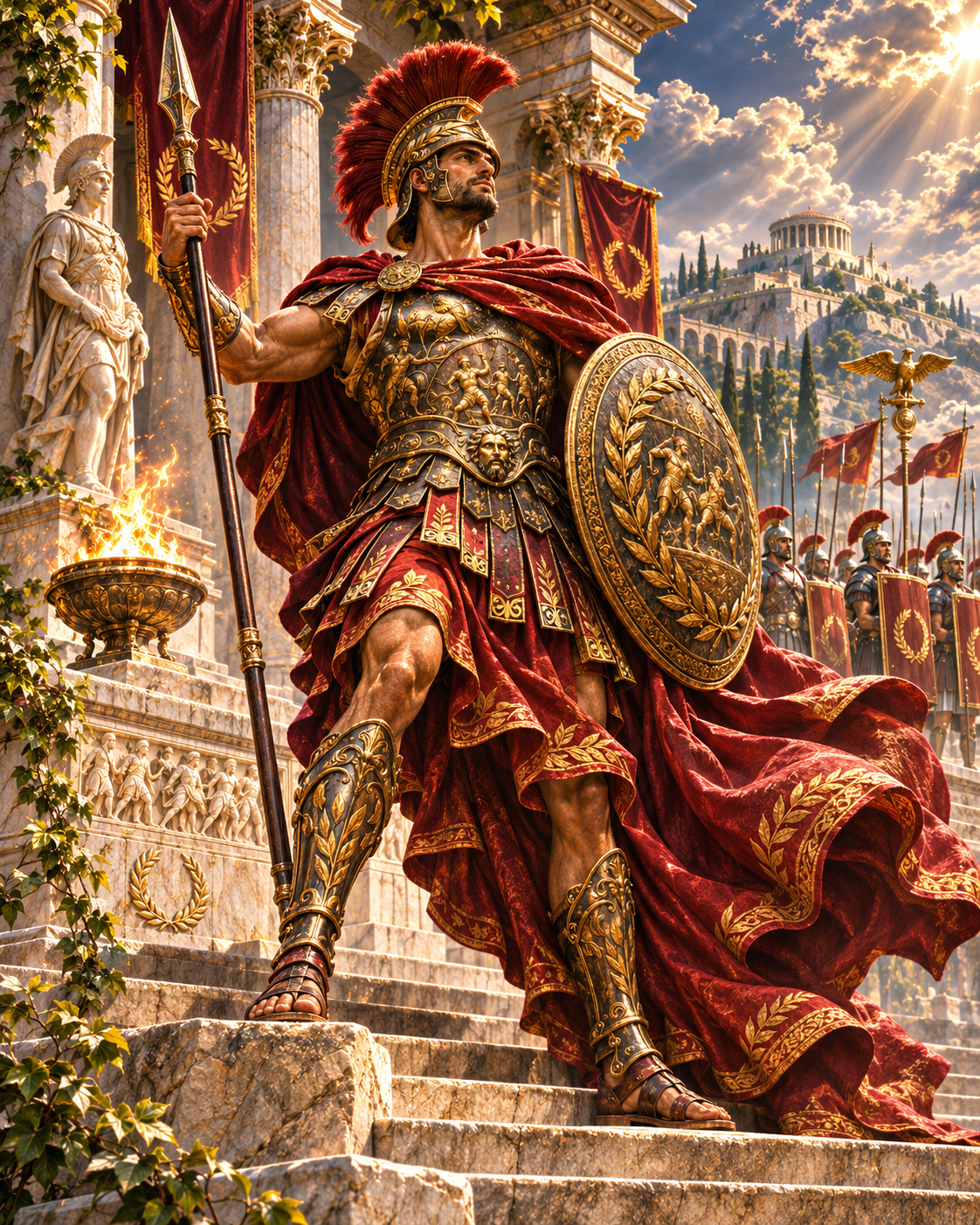
Mars was one of Rome’s most important gods, not just a battlefield figure. He guarded the state, farmland and young men, and in legend he is the father of Romulus and Remus. The month of March and the Campus Martius (“Field of Mars”) are named for him. This is a clear case where the Roman god mattered more in daily Roman religion than the Greek Ares did in Greece. See our Ares and Mars guide.
Neptune: Roman god of the sea
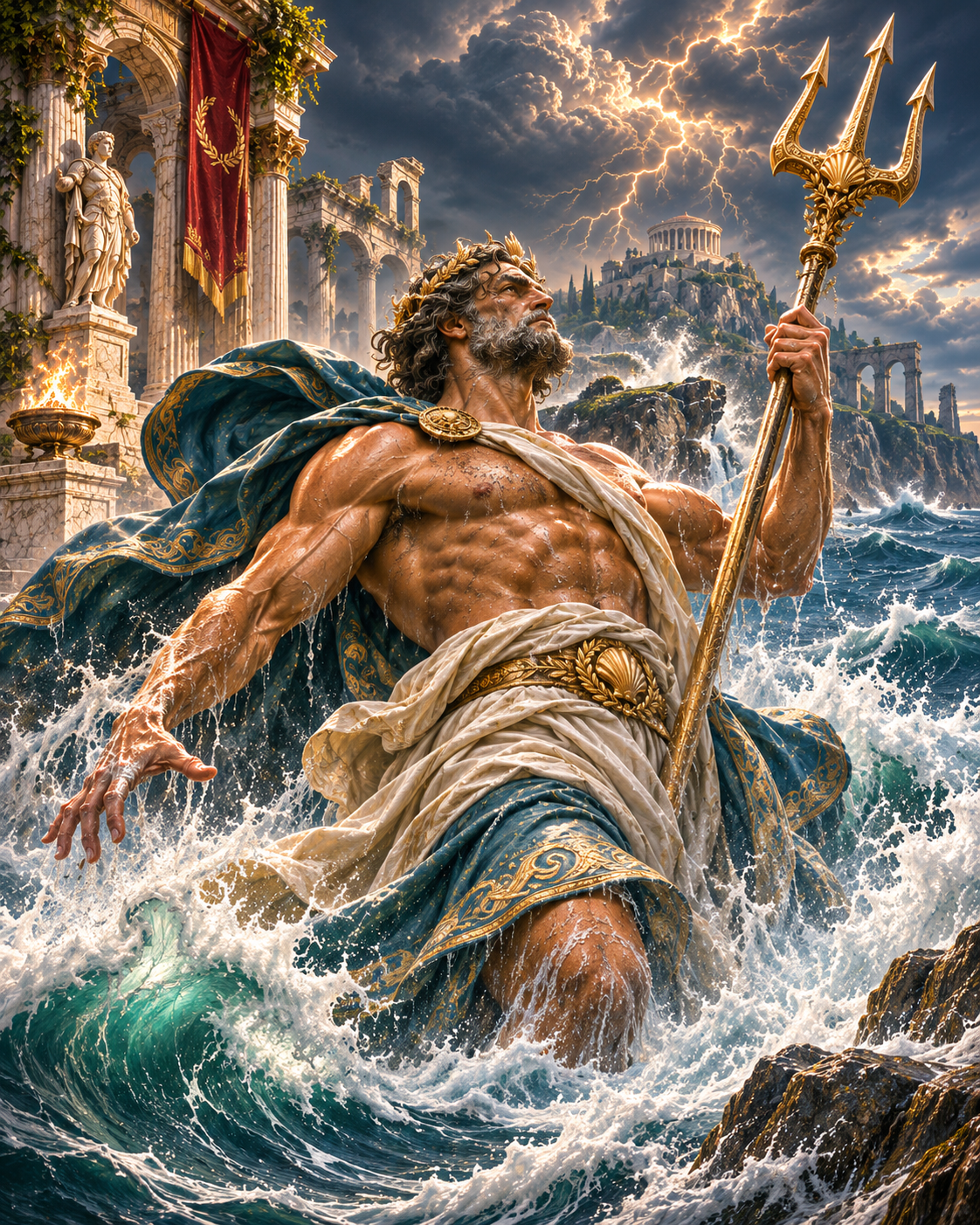
Neptune rules the sea and is shown with a trident. In Rome he was also linked to horses and water in general, and he had his own summer festival, the Neptunalia. He is usually equated with Poseidon, though his early Italian roots are less clear.
Pluto: Roman god of the underworld
Pluto is the Latin form of the Greek Plouton and is largely identified with Hades. Romans also called him Dis Pater or Orcus, the “rich father” of the dead. He was rarely worshipped in the way sky gods were and was approached with caution. Details of his realm come mainly from poets.
Saturn and Mercury
Saturn was an old Italian agricultural god later matched with the Greek Cronus. In legend he ruled Italy in a peaceful golden age. His festival, the Saturnalia in December, involved feasting and the temporary reversal of social roles. Mercury, whose name is linked to the Latin word for merchandise, was the god of trade and messages, the counterpart of Hermes. See our Hermes guide.
Vulcan, Apollo and Bacchus
Vulcan is the god of fire and the forge, associated with destructive fires as well as metalwork; Romans held a festival to him to ward off fire. Apollo is one of the few gods who kept the same name in Rome as in Greece, and his oracle at Delphi was respected by Romans. Bacchus is the Roman name for Dionysus, god of wine; in 186 BCE the Senate restricted private Bacchic cults, showing how Rome policed foreign religion.
Janus, Sol, Quirinus, Cupid and Faunus
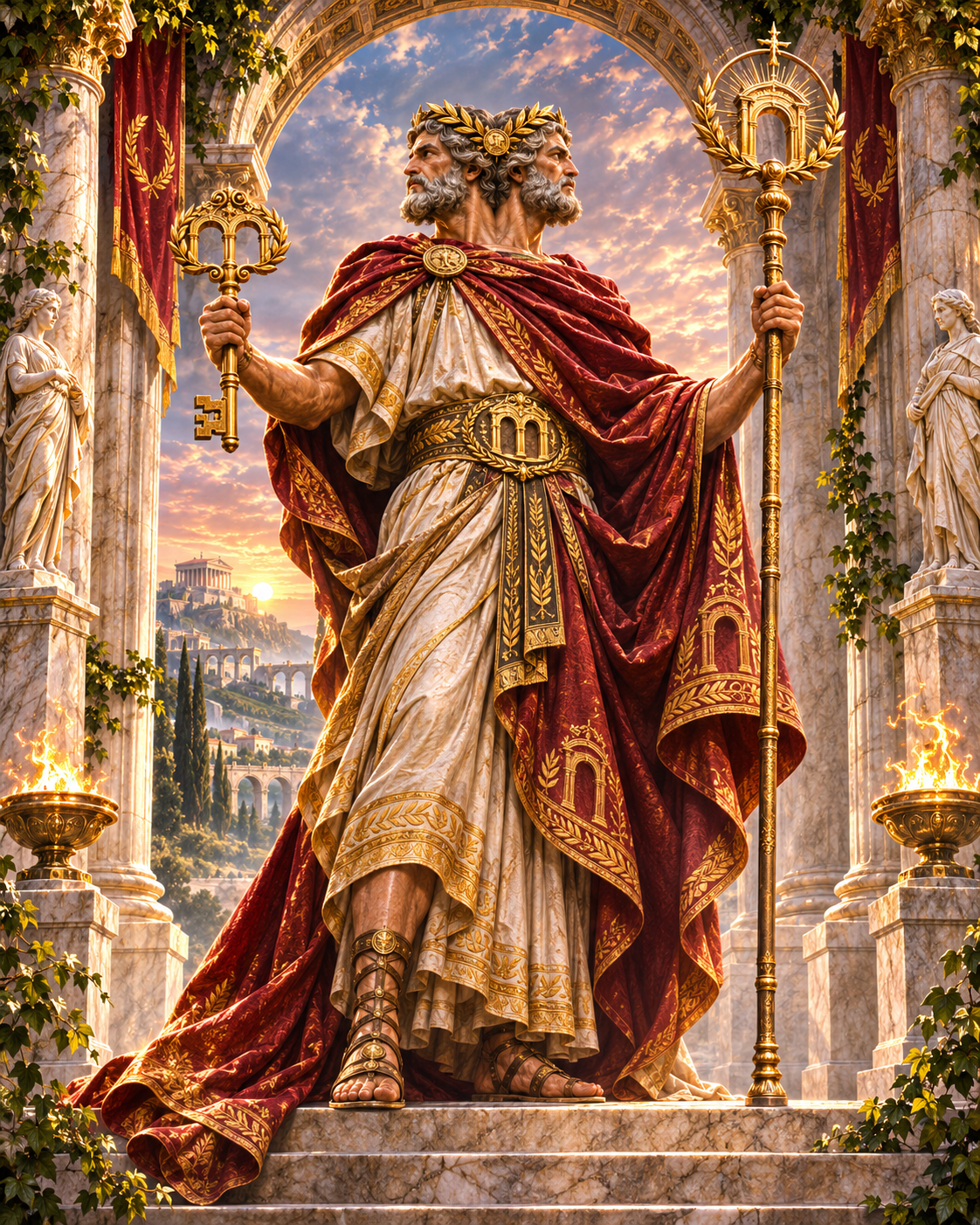
Janus is the two-faced god of doorways, beginnings and transitions, with no true Greek equivalent. He gives his name to January, and the doors of his temple in the Forum were opened in war and closed in peace. Sol is the sun god, who grew in importance in the later empire as Sol Invictus. Quirinus was an old god of the Quirinal Hill later identified with the deified Romulus. Cupid (Amor) is the god of desire and Venus’s son. Faunus is a rustic Italian god of woods and flocks, later matched with the Greek Pan.
Roman Gods vs Greek Gods
The question Roman gods vs Greek gods is the most searched topic in this field. Here is the quick reference table of Roman gods and their Greek equivalents, followed by the cultural differences.
| Roman name | Greek counterpart | Domain | Major symbols | Cultural difference |
|---|---|---|---|---|
| Jupiter | Zeus | Sky, thunder | Eagle, thunderbolt | Roman state patron; oaths and triumphs |
| Juno | Hera | Marriage, queen | Peacock | Protector of women and of the state (Juno Regina) |
| Neptune | Poseidon | Sea | Trident | Less central in Roman cult |
| Minerva | Athena | Wisdom, crafts | Owl, helmet | Strong link to craftsmen and Etruscan Menrva |
| Mars | Ares | War | Spear, shield | Far more honoured; ancestor of Romans |
| Venus | Aphrodite | Love, beauty | Dove, rose | Divine ancestor of Rome through Aeneas |
| Diana | Artemis | Hunt, moon | Bow, crescent | Sacred grove at Nemi; protector of the lower classes |
| Apollo | Apollo | Music, prophecy | Lyre, laurel | Same name; patron of Augustus |
| Vulcan | Hephaestus | Fire, forge | Hammer | Fire god feared as a danger to the city |
| Vesta | Hestia | Hearth | Sacred flame | Vestal Virgins tended Rome’s public fire |
| Mercury | Hermes | Trade, messages | Caduceus | Strong link to merchants |
| Ceres | Demeter | Grain | Wheat | Linked to the plebeians’ temple on the Aventine |
| Pluto / Dis Pater | Hades | Underworld | Helmet, Cerberus | Associated with wealth and burial |
| Bacchus | Dionysus | Wine | Grapes, thyrsus | Rites controlled by the Senate |
| Saturn | Cronus | Time, harvest | Sickle | Saturnalia, a major Roman festival |
| Cupid | Eros | Desire | Bow, arrows | Cupid and Psyche is a Roman literary tale |
| Proserpina | Persephone | Spring, underworld | Pomegranate | Paired with Ceres in Roman cult |
| Aurora | Eos | Dawn | Rosy fingers | Mostly poetic |
| Luna | Selene | Moon | Crescent | Separate from Diana in early cult |
Why Roman gods were not simply renamed Greek gods
- Older Italian roots: Jupiter, Mars, Janus, Vesta and Quirinus existed in Italy before Greek myths arrived.
- Different focus: Roman cult was about duty, ritual and the state. Greek myth often highlights personal drama.
- Gods without Greek twins: Janus, Quirinus, the Lares and Penates, Fides and many others.
- Different weights: Mars is far more important than Ares in daily worship, while Hades was feared more than Pluto.
- Local politics: gods were tied to Roman families, such as Venus and the Julian family.
Specific pairs have their own long searches. Zeus vs Jupiter: Zeus is a personal, quarrelsome king in Greek myth, Jupiter is a state guardian. Poseidon vs Neptune: nearly the same stories after Rome adopted them. Aphrodite vs Venus: Venus becomes the ancestor of Rome. Athena vs Minerva: Minerva is less warlike and more tied to crafts. Ares vs Mars: Mars is a major Roman father-god. Hades vs Pluto: names overlap; “Dis” is a distinct Roman title. Artemis vs Diana: Diana has her own Italian cult. For a full side-by-side, read our dedicated Greek vs Roman mythology guide, plus Aphrodite and Venus and Artemis and Diana.
Roman Mythology Female Characters and Goddesses
Searches for a Roman goddesses list, Roman goddess names and meanings and Roman female mythology characters are very common. The goddesses below cover love, war, wisdom, the moon, the underworld and fate.
| Goddess | Divine role | Symbols | Important story or cult |
|---|---|---|---|
| Venus | Love, beauty, fertility | Dove, rose, myrtle | Mother of Aeneas; Cupid and Psyche |
| Diana | Hunt, wild nature, moon | Bow, deer, crescent | Sacred grove at Nemi; Actaeon |
| Minerva | Wisdom, crafts, strategy | Owl, helmet | Capitoline Triad; Quinquatrus festival |
| Juno | Marriage, queen of gods | Peacock | Opponent of Aeneas in the Aeneid |
| Proserpina | Underworld queen, spring | Pomegranate | Journey to the underworld with Pluto; mother Ceres’ search |
| Luna | Moon | Crescent, chariot | Moon goddess with her own temple on the Aventine |
| Aurora | Dawn | Saffron robe | Mother of Memnon in poetry |
| Fortuna | Luck, fate | Wheel, cornucopia, rudder | Large cult sites, for example at Praeneste |
| Bellona | War | Helmet, spear, torch | Temple in the Campus Martius; Senate met envoys there |
| Psyche | Soul (mortal who becomes divine) | Butterfly wings | Cupid and Psyche in Apuleius |
Venus: Roman goddess of love and beauty
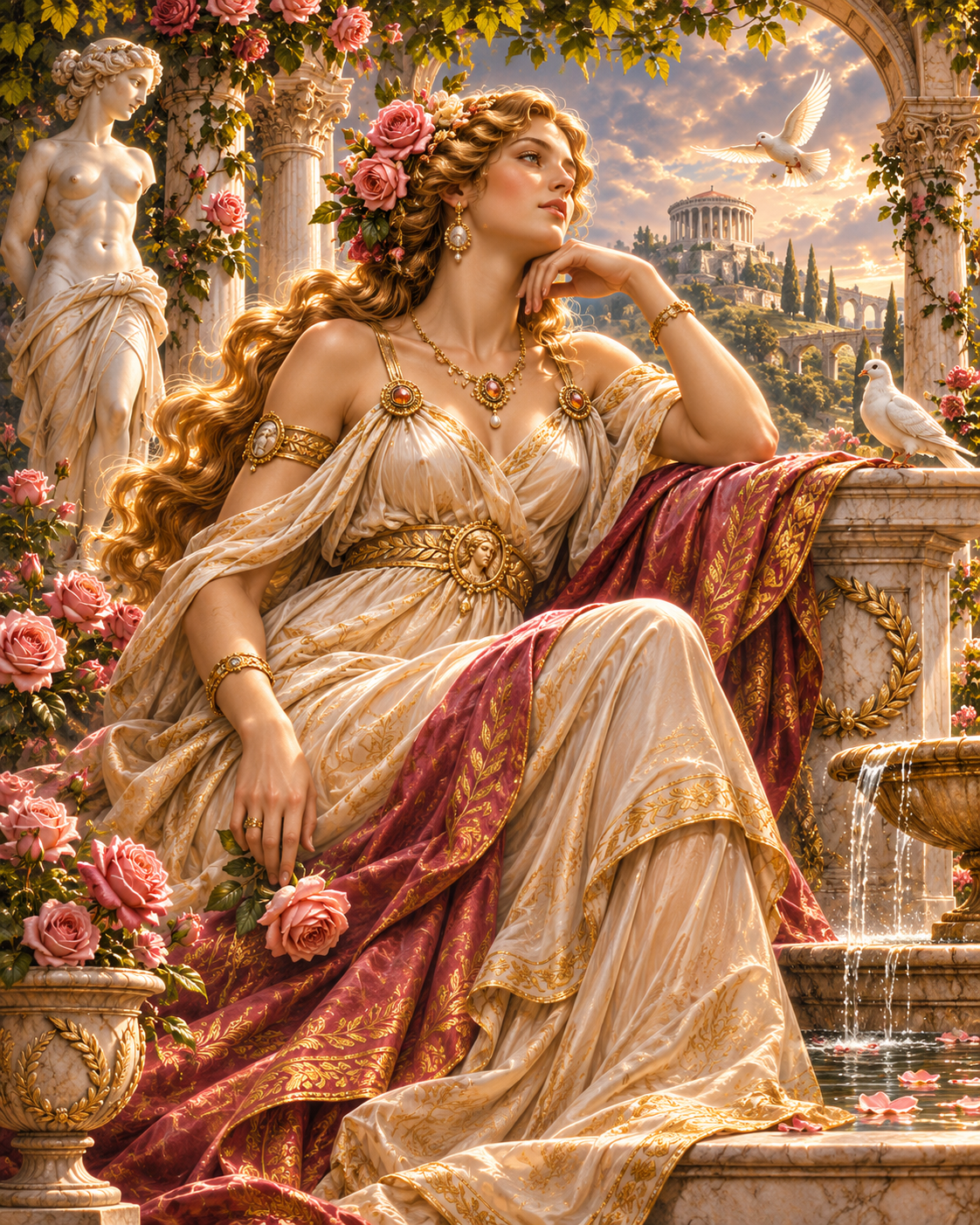
Venus started in Italy as a goddess of charm and gardens and became the Roman counterpart of Aphrodite. She mattered politically because she was said to be the mother of Aeneas, so the Romans, and especially Julius Caesar’s family, claimed descent from her. This is why Caesar built a temple to Venus Genetrix, “Venus the Mother”. She is the answer to “Roman goddess of love” and “Roman goddess of beauty” searches.
Diana: goddess of the hunt and moon
Diana was the Roman goddess of the hunt, wild places and childbirth, later strongly connected with the moon like Artemis. Her ancient sanctuary in the woods by Lake Nemi was a major Latin cult site. She was especially popular among women and the lower classes.
Minerva: goddess of wisdom
Minerva is the answer to “Roman goddess of wisdom”. She was a goddess of crafts, schools and strategy, and the owl became her emblem. Her festival, the Quinquatrus in March, was important to artisans and teachers. Compared with Athena, she is less central to war and city identity, and more tied to skill.
Juno: queen of the gods
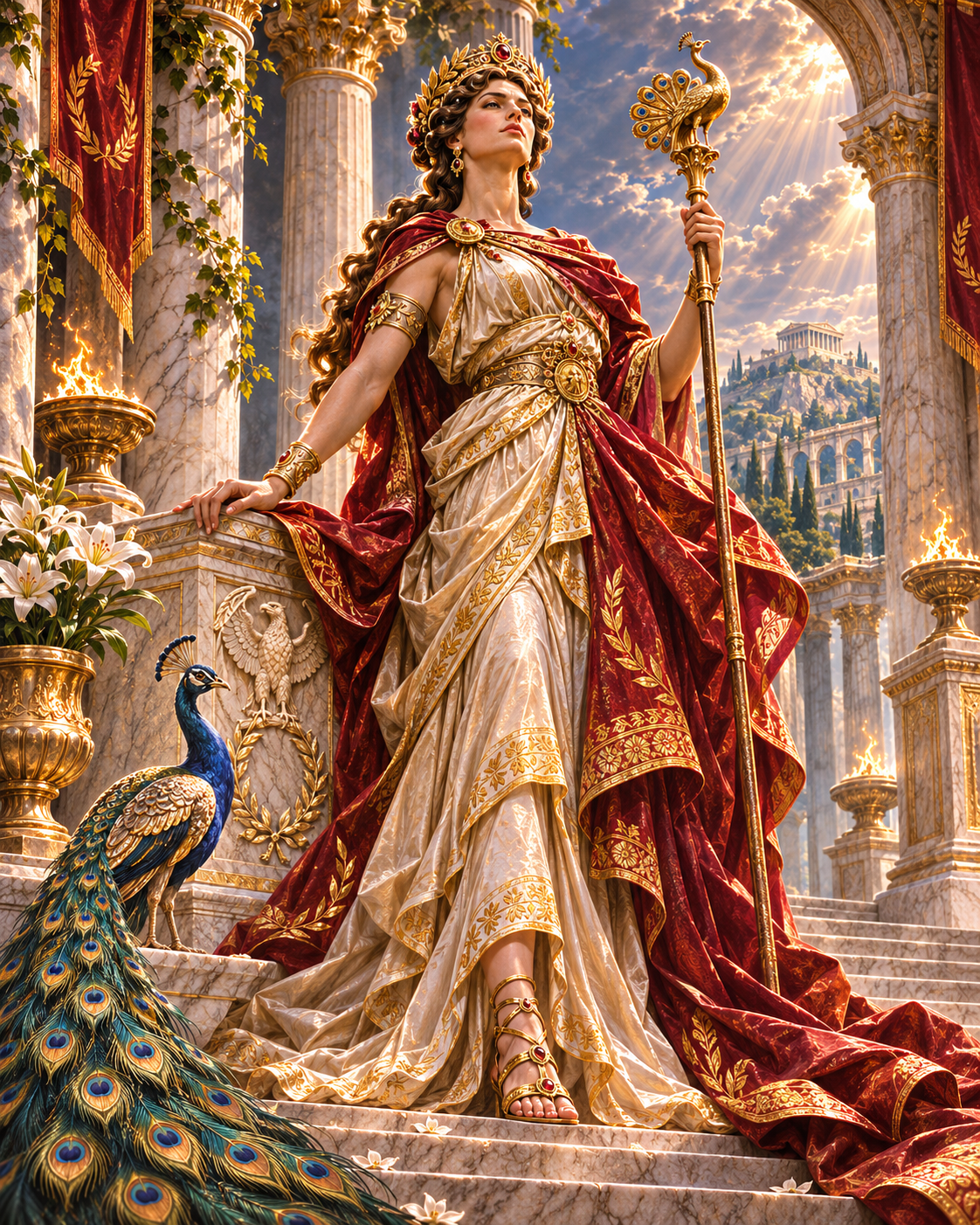
Juno is the Roman queen of the gods, protector of marriage and women, and the month of June is named after her. In the Aeneid she bitterly opposes the Trojans, which drives much of the plot. She also had many local forms, such as Juno Moneta, whose temple housed the mint and gave us the word “money”.
Proserpina, Luna and Aurora
Proserpina is the daughter of Ceres, who goes to the underworld with Pluto to be its queen. Her return each spring explains the seasons in the myth, though that is a story, not science. In Rome she was linked with Ceres in cult. See Ovid’s Fasti and Metamorphoses for the best-known telling.
Luna is the Roman moon goddess, who in early Rome was separate from Diana, though poets later merged the two. She drives a moon chariot across the sky.
Aurora is the goddess of dawn who opens the gates of day, mainly a poetic figure derived from the Greek Eos rather than a major temple goddess.
Fortuna, Bellona and Psyche
Fortuna was worshipped across Italy in many forms, including Fortuna Primigenia at Praeneste, a great oracle sanctuary. Bellona was a Roman war goddess, sometimes shown with a torch and sword, whose temple in the Campus Martius was where the Senate received foreign envoys and generals waiting for a triumph. Psyche began as a mortal princess in Apuleius’ story and became a goddess at the end; her name means “soul” in Greek.
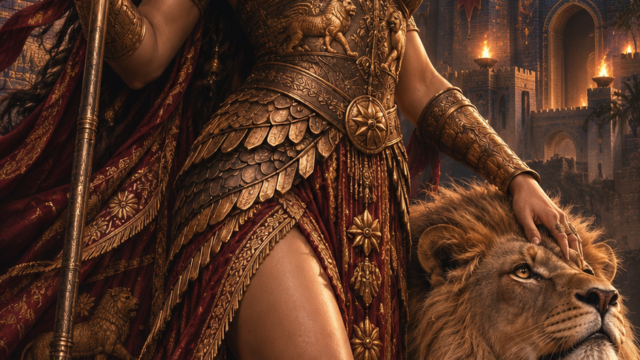
Ancient art vs modern fantasy: real Roman art shows goddesses in draped garments, with clear attributes like an owl or a bow, as in marble copies and wall paintings from Pompeii. Glamorous warrior-goddess illustrations and cinematic fantasy images are modern. Both can be enjoyed, but only one is historical.
Roman Mythology Family Tree
The Roman divine family largely follows the Greek one, because Romans adopted Greek genealogies. The relationships below are the standard literary version, not an ancient Roman official record:
- Saturn and Ops are the older generation, parents of Jupiter, Juno, Neptune, Pluto, Ceres and Vesta.
- Jupiter and Juno are king and queen; their children include Mars, Vulcan and Juventas in Roman accounts.
- Jupiter and Latona are the parents of Apollo and Diana.
- Jupiter and Maia are the parents of Mercury.
- Venus: in Roman poetry she is often daughter of Jupiter and Dione, and in other versions born from the sea; her son is Cupid, and with the Trojan Anchises she is mother of Aeneas.
- Minerva is born from Jupiter’s head, according to the usual myth.
- Ceres and Jupiter are the parents of Proserpina.
Variations exist between authors, and the family tree should be seen as a learning aid. For the Greek original, see our Greek mythology guide and our Cronus and Saturn article.
Jupiter, Juno and Minerva: The Capitoline Triad
The Capitoline Triad was the group of three gods worshipped together in the great temple on the Capitoline Hill: Jupiter in the centre, Juno and Minerva beside him. Roman tradition dates the temple’s dedication to 509 BCE, the first year of the Republic. It was the religious heart of Rome, where generals offered thanks after a triumph and where oaths and treaties were sworn.
The triad probably reflects Etruscan models, since Etruscan cities also had temples with three cellas for three gods. When Rome founded colonies, it often built a “Capitolium” there too, so the triad became a symbol of Roman rule. This is one of the clearest examples of Roman religion being a state institution and not just a set of stories.
Roman Gods and the Names of Planets
Many people ask why planets are named after Roman gods. Five planets were visible to the naked eye in antiquity, and the ancient world connected each with a god. The practice began in Mesopotamia, was taken over by the Greeks, and then translated into Latin names by the Romans. That is why we use Roman names in English today. It is a naming tradition, not astronomy, and it does not mean the gods control the planets.
| Planet | Named after | Origin of the name |
|---|---|---|
| Mercury | Mercury, messenger god | Fast-moving planet; ancient names tied it to a swift messenger |
| Venus | Venus, goddess of love | The brightest planet, linked to a beautiful goddess |
| Earth | No Roman god in English | From Old English and Germanic words for ground; Romans had Tellus or Terra as earth goddess, but the English name is not from her |
| Mars | Mars, god of war | Red colour linked to blood and war |
| Jupiter | Jupiter, king of the gods | The largest and one of the brightest planets |
| Saturn | Saturn, god of agriculture | Slow-moving planet linked to an old god |
| Uranus | Uranus (Greek Ouranos) | Discovered 1781; the name comes from Greek mythology, not Roman |
| Neptune | Neptune, god of the sea | Discovered 1846; named after its blue colour and the sea god |
| Pluto (dwarf planet) | Pluto, god of the underworld | Discovered 1930; name suggested by 11-year-old Venetia Burney; reclassified as a dwarf planet by the IAU in 2006 |
Today, the International Astronomical Union (IAU) officially names astronomical objects, and most planetary features and moons follow mythological themes. Pluto is now classified as a dwarf planet, not a planet. The same Roman habit of naming appears in calendars: Janus and January, Mars and March, Juno and June, and Saturn in the English word Saturday. Our guide to the Greek god Hermes explains how Mercury’s name connects back to Greek ideas.
Romulus and Remus: The Founding of Rome
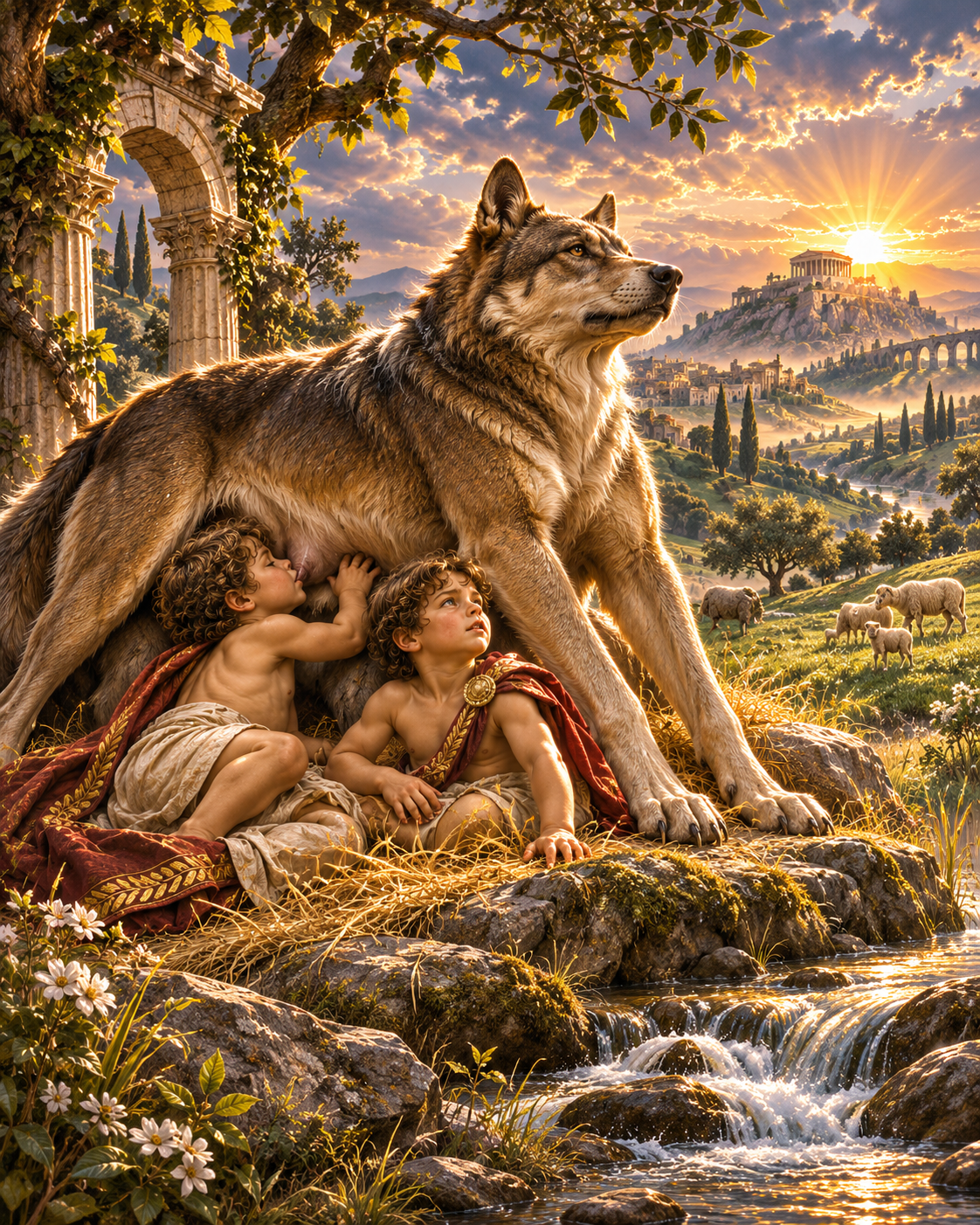
The Romulus and Remus story is Rome’s best-known founding legend. In Livy’s account, Rhea Silvia, a Vestal Virgin and the daughter of the deposed king Numitor of Alba Longa, becomes the mother of twin boys by the god Mars. Her uncle Amulius orders the twins set adrift on the Tiber. The basket drifts ashore, where a she-wolf (lupa) nurses them until the shepherd Faustulus finds them. Grown up, the brothers restore Numitor to his throne and set out to found a new city. They quarrel over where to build it and which one rules. Remus dies in the dispute, and the city is named Rome after Romulus. The traditional date is 753 BCE.
Legend vs archaeological history
The story is a legend, written down centuries after the events. Archaeology shows small settlements on the Palatine Hill and nearby hills from around the 8th century BCE that gradually merged into a city, but no evidence supports Romulus as a real founder. The famous bronze Capitoline Wolf is a symbol of this legend; recent studies suggest the wolf itself may be medieval, and the twins were added in the Renaissance.
The Sabine women and Lucretia
Two other founding legends follow. In the Sabine women story, Romulus’s men bring women from a neighbouring people into Rome to populate it, leading to a war ended when the women stand between the armies. Lucretia is a noblewoman whose mistreatment by a king’s son, in the traditional account, triggered the overthrow of the monarchy in 509 BCE. Both come mainly from Livy and are literary legends, not verified history. The Lucretia story is a sensitive one and is included only because it is central to Roman founding tradition.
Aeneas and the Aeneid
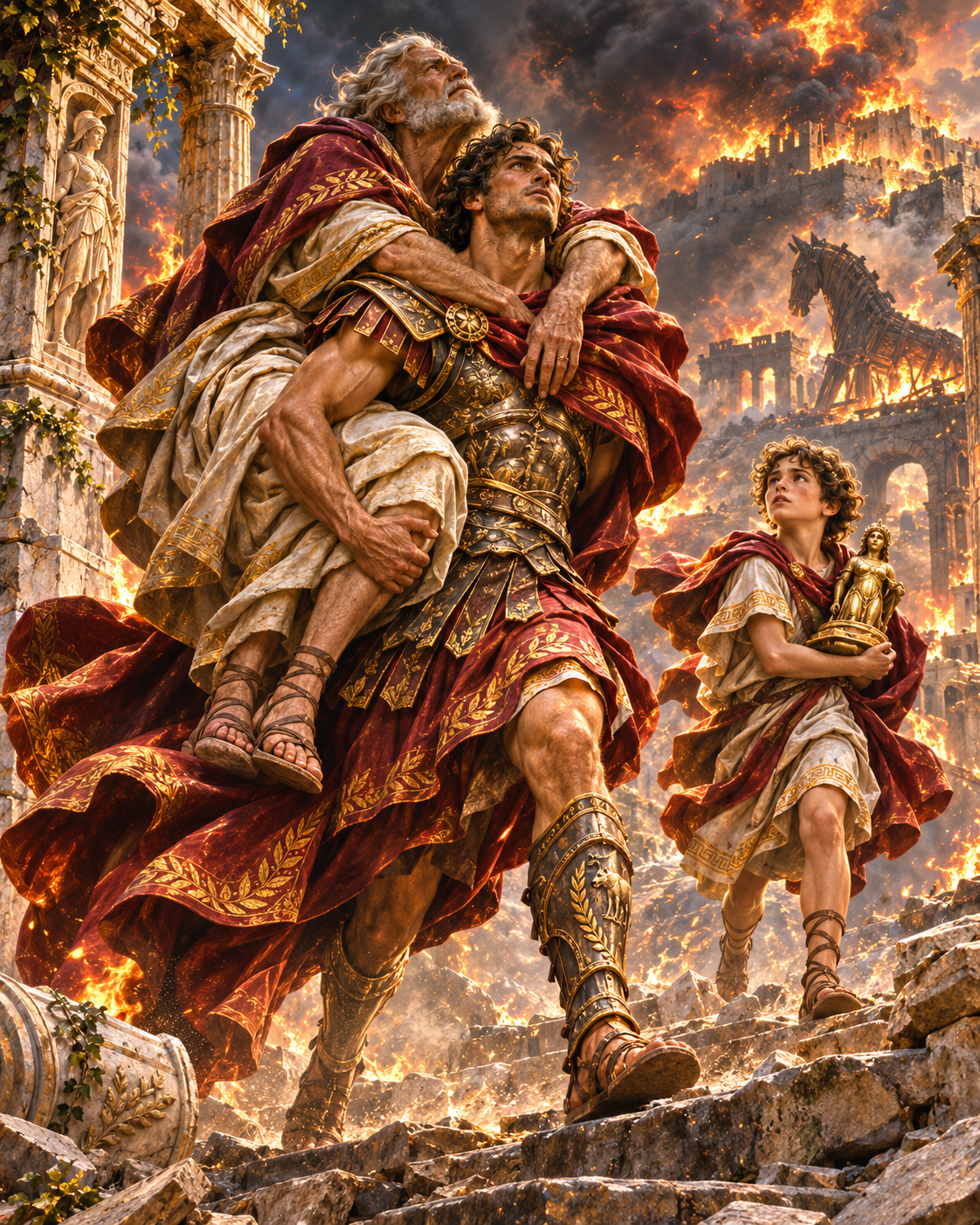
The Aeneid, written by Virgil in the years before his death in 19 BCE during the reign of Augustus, is Rome’s national epic. It follows Aeneas, a Trojan prince and son of Venus, who escapes burning Troy carrying his father and leading his son Ascanius.
The Trojan background
Aeneas appears in Homer’s Iliad as a Trojan hero protected by gods. Virgil takes him as the survivor who carries Troy’s gods to a new land, fated to found a people who will become the Romans.
Dido and the journey to Italy
Blown off course, Aeneas reaches Carthage, where Queen Dido falls in love with him. The gods remind him of his destiny, and he leaves. Dido meets a tragic end in despair, which Virgil presents as a tragedy and which Romans later linked with the Carthaginian wars.
Italy and Rome’s mythical ancestry
Aeneas visits the underworld in Book 6, where he sees the future heroes of Rome. In Italy he fights Turnus and marries Lavinia. His descendants, in the tradition, include Romulus and Remus and, through his son Iulus, the Julian family of Julius Caesar and Augustus. The poem is a mix of myth and political message, and it should be read as literature that glorified Rome.
Cupid and Psyche
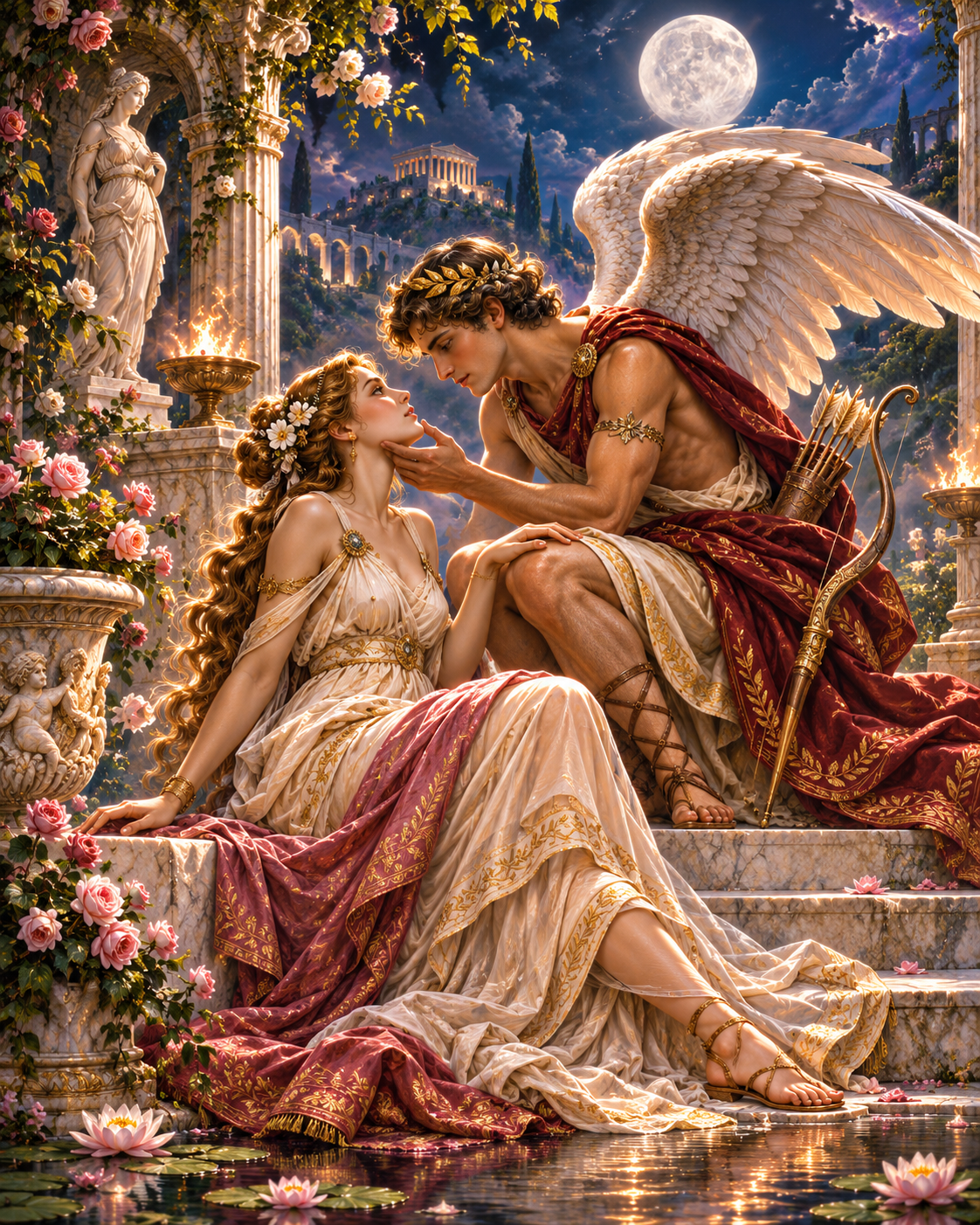
The Cupid and Psyche love story is told by the Roman author Apuleius in his novel Metamorphoses, also called The Golden Ass, written in the 2nd century CE. It is a literary tale inside a novel, not an old cult myth.
Psyche is a mortal princess so beautiful that people begin to honour her instead of Venus. Jealous, Venus sends her son Cupid to make Psyche fall for a monster, but Cupid falls in love with her himself. He visits her only at night and forbids her to see his face. Pushed by her sisters, Psyche lights a lamp, sees him, and spills hot oil on him. He flees. Psyche searches for him and is forced by Venus to complete impossible tasks, including sorting seeds and fetching a box from the underworld. Curiosity makes her open the box, but Cupid rescues her. Jupiter grants her immortality, and they marry; their daughter is called Voluptas, “Pleasure”. Readers have long seen it as a story of the soul (psyche means “soul”) finding love, but that is an interpretation.
Famous Roman Mythology Stories and Legends
Beyond the founding legends, several stories show how Rome reworked Greek and Italian tales:
- Proserpina’s journey to the underworld: Pluto takes Ceres’ daughter to his realm; Ceres’ grief halts the harvest until a deal returns Proserpina for part of each year. This is Greek in origin but central to Roman Ceres cult.
- Hercules and Cacus: in the Aeneid, Hercules defeats the fire-breathing giant Cacus near the future site of Rome. This episode is closely linked with Roman geography and the Ara Maxima cult.
- Numa and Egeria: the second king, Numa Pompilius, is said to have received religious laws from the nymph Egeria, an example of Roman religion’s founding story.
- Saturn and the Golden Age: Saturn rules Italy in a time of peace, remembered at the Saturnalia.
- Ovid’s transformations: Daphne and Apollo, Narcissus, Pyramus and Thisbe and many others are mostly Greek myths retold in Latin by Ovid.
When you read these, check whether the story is Roman or just Greek in Latin dress. For a Greek story with a Roman reading, see the Three Fates and their Roman Parcae.
Roman Mythical Creatures and Spirits
Rome had fewer monsters than Greece, but many spirits of home and land. It is useful to separate native Roman ideas from Greek-derived creatures.
Lares, Penates and household gods
The Lares were protective spirits of the household, the crossroads and the family, honoured with small daily offerings at a household shrine called a lararium. The Penates guarded the pantry and the family’s food supply. Together they are the best-known Roman household gods. Each man was also said to have a genius, a guiding spirit, and each woman a juno.
Fauns, nymphs and Lupa
Fauns grew from Faunus, an Italian woodland god, and in art resemble Greek satyrs. Nymphs are female nature spirits of springs, trees and mountains, largely adapted from Greek tradition. Lupa is the she-wolf of the founding legend, more a legendary animal than a monster.
Lemures, Furies and Cerberus
Lemures were restless spirits of the dead who, in the ritual of Lemuria in May, were driven from the house by the head of the family throwing black beans. The Furies (Furiae or Dirae) are avenging spirits adopted from the Greek Erinyes. Cerberus is the three-headed guard dog of the underworld, also Greek in origin. Other adapted creatures include centaurs, harpies and the Minotaur, all of which Rome knew mainly through Greek stories. Do not call every Roman monster “native”; many are Greek imports.
Roman Underworld and Afterlife
The Roman underworld is known mostly from poetry, especially the vivid journey in Book 6 of the Aeneid. The dead cross the river Styx with the ferryman Charon, pass Cerberus, and are judged. Good souls go to the Elysian Fields, and the wicked suffer in Tartarus. Pluto and Proserpina rule this realm.
Roman funerary beliefs
Real Roman belief was varied and less detailed than the poems. Romans honoured the Manes, the spirits of the dead, with offerings at tombs, and held festivals such as the Parentalia in February and Lemuria in May. Families kept tombs along roads, and inscriptions often wish the dead well. Philosophers like the Epicureans denied any afterlife, so the poetic underworld should not be treated as universal doctrine. For a different ancient afterlife, see our Egyptian Duat guide.
Roman Mythology Symbols and Their Meanings
| Symbol | Associated with | Meaning |
|---|---|---|
| Eagle | Jupiter; Roman legions | Power; the legionary standard (aquila) |
| Thunderbolt | Jupiter | Divine authority |
| Trident | Neptune | The sea |
| Laurel wreath | Apollo; victory | Victory and honour; worn by triumphing generals |
| She-wolf | Rome’s founding | Origin of the city, strength |
| Owl | Minerva | Wisdom |
| Cornucopia | Ceres, Fortuna, Abundantia | Abundance |
| Crescent moon | Diana, Luna | The moon and its goddesses |
| Caduceus | Mercury | Messages, trade |
| Peacock | Juno | The queen of the gods |
| Dove | Venus | Love |
| Fasces | Roman magistrates | State authority (political, not a god’s symbol) |
Be careful to separate religious symbols from political and imperial imagery. The fasces, for example, was a magistrate’s emblem, and the eagle served both Jupiter and army standards. Modern political movements later borrowed these symbols for their own purposes, which is a separate subject from ancient meaning.
Roman Mythology Tattoo Designs and Meanings
Roman mythology tattoo designs are popular because the symbols are strong and classical. Ancient Romans did not have a fixed system of tattoo meanings, so the meanings below are modern interpretations built on known symbolism.
- Roman goddess tattoos: usually Venus, Diana or Minerva in classical drapery.
- Venus tattoo designs: a shell, dove, rose or the planet symbol; suggest love, beauty and self-possession.
- Minerva owl tattoo: an owl with helmet; wisdom, study and strategy.
- Neptune trident tattoo: the sea, power and travel.
- Roman eagle tattoo: strength and authority. Check that a design does not copy political or extremist symbols.
- Laurel wreath tattoo: victory and achievement.
- Jupiter lightning tattoo: power and leadership.
- Roman mythology sleeve inspiration: combine gods, columns and temples in a classical frieze.
For comparison with another tradition, see our Egyptian mythology tattoo guide.
Roman Mythology Art and Mobile Wallpapers
Historical Roman gods artwork includes marble statues (many are Roman copies of Greek originals), Pompeii wall paintings, mosaics and coins. Later European artists like Botticelli, Titian and Rubens painted Roman myths in the Renaissance and Baroque periods. Modern Roman goddess artwork, Venus goddess wallpapers, Diana moon goddess artwork, Minerva warrior goddess art, Jupiter and Neptune wallpapers and ancient Rome fantasy artwork are digital and cinematic interpretations, not ancient art.
Popular visual themes include a marble Venus with a shell, Diana under a crescent moon, Minerva with an owl and shield, Jupiter with lightning over clouds and Neptune rising from waves. The matching artwork for this article will be added later, so please treat this page as a guide, not as a wallpaper download pack, until those images appear. For a similar gallery, see our Greek mythology images.
Roman Mythology in Modern Culture
- Language and calendar: January (Janus), March (Mars), June (Juno), and English words like “jovial”, “martial”, “mercurial” and “saturnine”.
- Astronomy: planet names, moons and missions named after Roman gods, such as NASA’s Juno spacecraft.
- Literature and art: Virgil and Ovid shaped Dante, Shakespeare and Renaissance painting.
- Fiction: Rick Riordan’s Heroes of Olympus books use the Roman side of the gods, with a Roman camp and Roman god names.
- Games and film: many ancient-world games and films borrow Roman imagery; they often mix Greek and Roman material freely, so use them for fun and not for facts.
Frequently Asked Questions
What is Roman mythology?
The myths, legends and religious beliefs of ancient Rome, including Italian gods, Greek-derived stories and founding legends like Romulus and Remus.
Who are the main Roman gods?
Jupiter, Juno, Neptune, Minerva, Mars, Venus, Apollo, Diana, Vulcan, Vesta, Mercury and Ceres, with Pluto, Saturn and Janus also important.
What are the 12 major Roman gods?
The commonly cited twelve (Dii Consentes) are Jupiter, Juno, Neptune, Minerva, Mars, Venus, Apollo, Diana, Vulcan, Vesta, Mercury and Ceres. The list comes from the poet Ennius and is a literary grouping.
What is the difference between Greek and Roman gods?
Many Roman gods are matched with Greek ones, but Roman gods had older Italian roots, a stronger link to the state and ritual, and some have no Greek equivalent, such as Janus.
Is Jupiter the same as Zeus?
They are counterparts and share many stories, but Jupiter was also Rome’s state god and patron of oaths and triumphs, so they are not identical.
Who is Venus in Roman mythology?
The goddess of love and beauty, matched with Aphrodite, and the mother of Aeneas, which made her a divine ancestor of the Romans.
Who is Diana in Roman mythology?
The goddess of the hunt, wild nature and childbirth, linked with the moon and matched with Artemis.
Who is the Roman goddess of wisdom?
Minerva, goddess of wisdom, crafts and strategy, whose symbol is the owl.
Who is the Roman god of war?
Mars, who was also a guardian of the state and the father of Romulus and Remus.
Which planets are named after Roman gods?
Mercury, Venus, Mars, Jupiter, Saturn and Neptune. Uranus has a Greek name, Earth is not named for a Roman god in English, and Pluto, named for the Roman god, is a dwarf planet.
Who were Romulus and Remus?
The legendary twin sons of Mars and Rhea Silvia, raised by a she-wolf, whose story explains Rome’s founding in 753 BCE. It is a legend, not proven history.
What is the story of Cupid and Psyche?
A tale in Apuleius’ Golden Ass about a mortal princess who wins the love of Cupid after trials set by Venus, and becomes immortal.
What are the most famous Roman mythology creatures?
Fauns, nymphs, the Lares and Penates, Lemures and the Furies, plus Greek-derived beings such as Cerberus, centaurs and harpies.
Who is the Roman god of the underworld?
Pluto, also called Dis Pater or Orcus, who rules with Proserpina.
What are the most important Roman mythology symbols?
The eagle and thunderbolt (Jupiter), trident (Neptune), owl (Minerva), laurel wreath (victory), she-wolf (Rome’s founding), cornucopia and the crescent moon.
Conclusion
Roman mythology is a layered tradition: Italian spirits and state ritual, Etruscan temples, Greek stories reshaped in Latin poetry, and founding legends that tied Rome’s power to the gods. Its influence runs through the calendar, planet names, Renaissance art and modern fiction. The most accurate way to read it is to keep the layers apart: what Romans actually worshipped, what poets borrowed from Greece, and what modern fantasy later added.
Reference sources: Encyclopaedia Britannica; World History Encyclopedia; Theoi Classical Texts Library; Metropolitan Museum of Art; British Museum; Virgil’s Aeneid, Ovid’s Metamorphoses and Fasti, Livy’s History of Rome, Apuleius’ Metamorphoses; NASA and the International Astronomical Union for planet naming.




















Share Your Opinion
Comments are closed on this post.