 Vista

Looking for robotics school project working models with pictures? This visual guide combines a Straw Robotic Hand, an Electromagnet Crane and an Automatic Street Light with an LDR sensor. They introduce three distinct ideas for roughly Classes 6–11: pulling mechanical tendons to move fingers, using current to create magnetism and sensing ambient light to control a low-voltage LED. Every poster can be opened in full size for school drawings or a supervised demonstration. These projects are not identical robots; the straw hand may not have electronics at all. Never connect classroom circuits to household mains electricity, and avoid overheating a homemade electromagnet coil.
What does each robotics project actually demonstrate?
A cardboard robotic hand uses strings and joints to imitate some finger movement. It may be operated directly by a pupil rather than an autonomous computer. An electromagnet crane relies on a current-carrying coil, which produces a magnetic field and can attract suitable ferromagnetic objects. An LDR street-light model uses a light-sensitive resistor and suitable switching electronics to control a lamp. These are different inputs and outputs: pulling string, electrical current and light intensity. Create a small comparison box listing Input, Mechanism and Output. That helps students explain the working principle instead of calling all three models artificially intelligent robots.
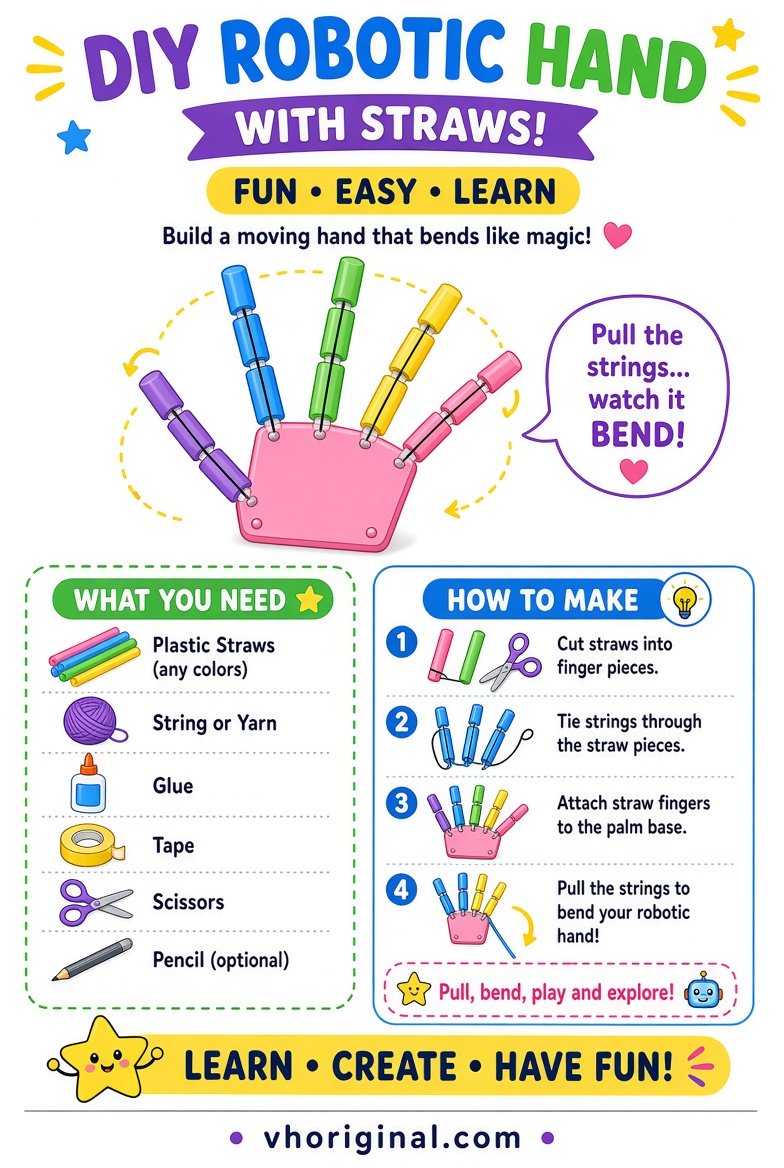
Picture 1: DIY Robotic Hand with Straws
A basic robotic hand can be made from a cardboard palm, articulated finger pieces, short sections of straw and string. The string acts as a mechanical tendon: pulling it can bend the finger sections. Letting go may allow them to return, depending on the cardboard and any return mechanism such as elastic material. This does not recreate all human muscles, nerves or touch sensors. Use a large, readable diagram showing finger joints and the string path. Smooth or cover sharp straw edges with tape. Adults should help younger children with cutting and check that no tight loops can snag fingers.
Picture 2: Electromagnet Crane Working Model
An electric current through a wire coil creates a magnetic field. A suitable iron core can strengthen the practical lifting effect. In a school model, a small crane may lift paperclips or other tiny ferromagnetic objects. Not every metal is attracted equally; copper and aluminium do not behave like ordinary iron paperclips in this setting. Coils can heat if operated with excessive current or left connected too long. Use only teacher-approved low-voltage components, suitable insulated wire and supervised short demonstrations. Never connect a coil directly across mains electricity or deliberately short a battery. Disconnect power before inspecting the wiring.
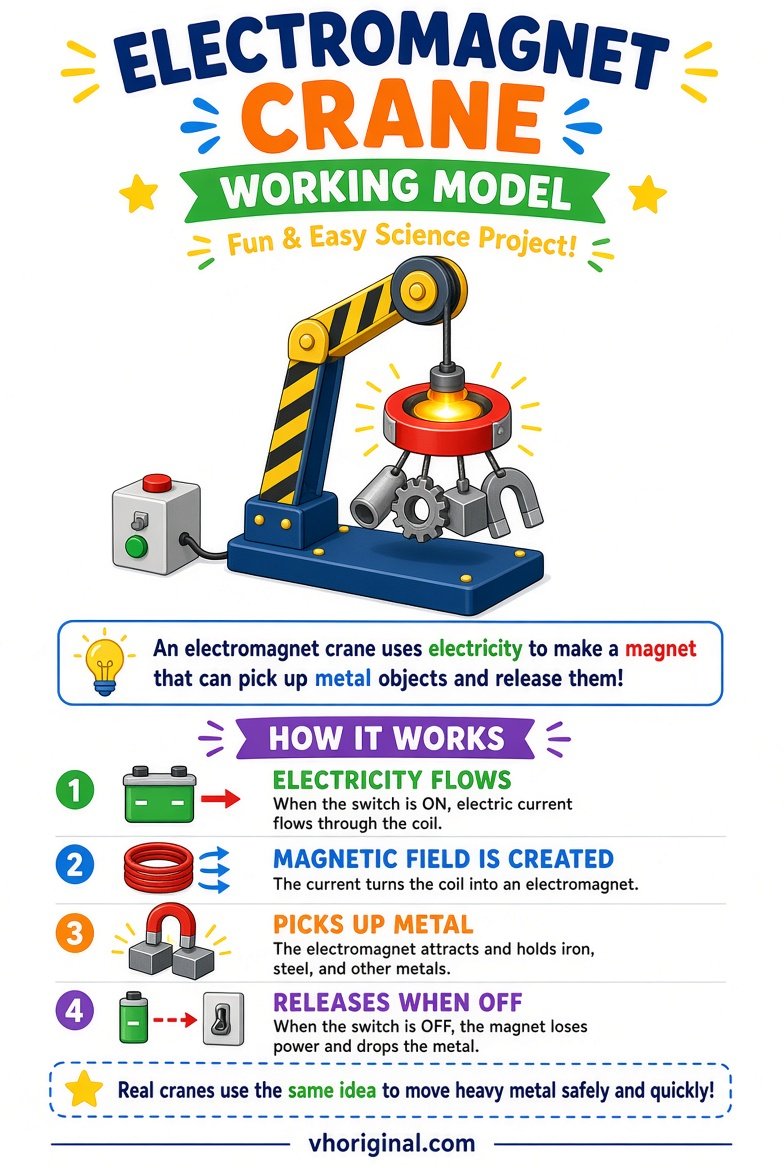
Chart note: Use only a teacher-approved low-voltage kit and small iron paperclips. Disconnect the circuit if the coil warms.
Picture 3: Automatic Street Light with LDR
A light-dependent resistor changes resistance with illumination; for common LDRs, resistance generally falls when light increases and rises in darkness. In a suitable switching circuit, the sensor signal controls a transistor or other device that powers a low-voltage LED. Simply attaching an LDR to a lamp without the required design does not guarantee automatic operation. Label the sensor, control electronics, supply and light output separately. If the circuit is intended to light up in darkness, test it by gradually shading the LDR and observing the LED. An educational circuit is not a design for a real streetlight connected to public wiring.
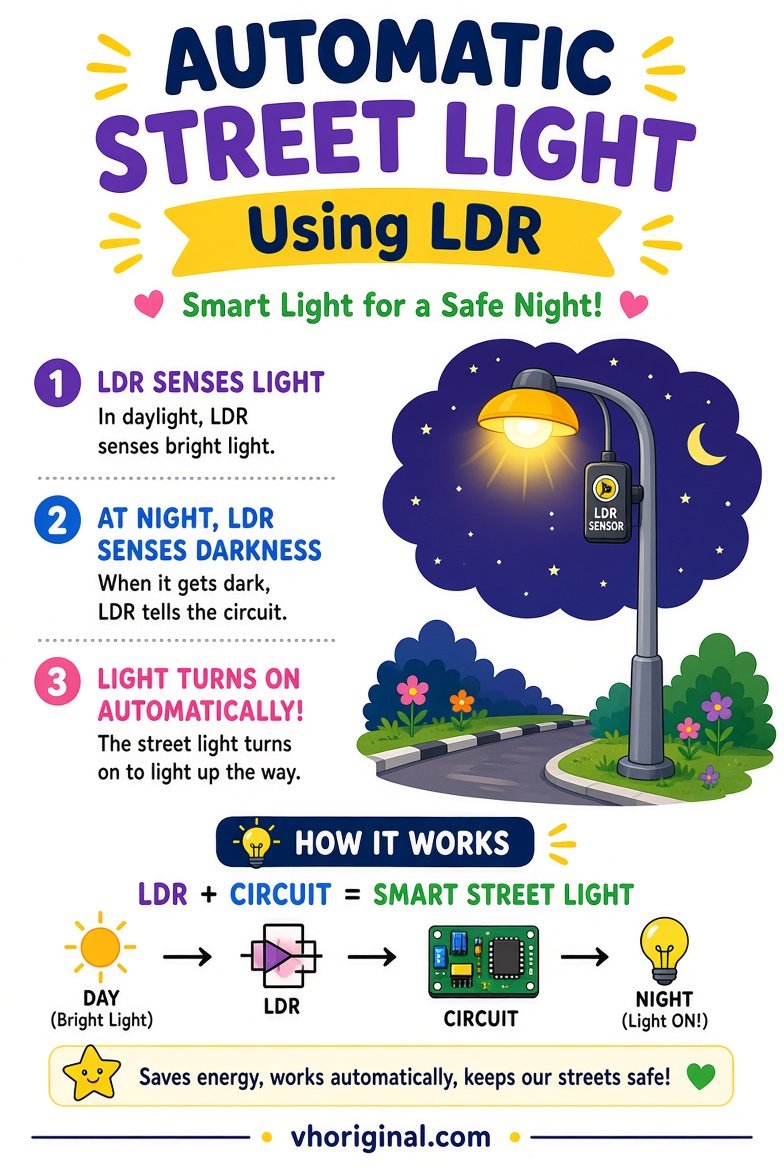
Chart note: This is a concept graphic, not a wiring diagram. An LDR’s resistance rises in darkness. Use a supervised, rated low-voltage kit with suitable LED switching electronics.
Pick the best project for your class
Younger pupils can build the string-operated hand without electricity. Older students may examine an approved electromagnet kit or a low-voltage LDR circuit. Choose the project according to teacher guidance and the learner’s ability to explain each part.
Materials and steps: build the straw hand
Gather cardboard, drinking straws, string, tape, ruler, pencil and safe scissors. Trace a palm and fingers, cut the outline under appropriate supervision and mark the joint locations. Tape short straw sections along the fingers and thread the string through the intended path. Pull carefully to bend one finger. Adjust straw alignment when the thread catches rather than applying more force. Test the individual fingers before connecting all the strings. The model shows tendon-like actuation; it cannot grasp every shape like a human hand. Write a short limitation on the school board to make the lesson precise.
Safe preparation of electromagnet and LDR circuits
Use an approved low-voltage electromagnet kit rather than improvising with unknown battery ratings or bare wire. Check the coil core, insulated connections and a suitable power switch. Limit operation to the teacher’s safe procedure, then disconnect and let the coil cool. For the LDR, use a supervised breadboard circuit or proven module with properly chosen resistor and transistor components. Check supply voltage, LED polarity and heat while testing. Do not connect faulty rechargeable cells, household outlets or high-voltage adaptors. If the LED flickers or a coil becomes hot, turn power off and ask for help.
Viva questions and simple troubleshooting
What bends the fingers of a straw hand? String tension. Why does an electromagnet pick up paperclips? The coil’s magnetic field acts on suitable material. What happens to an LDR in bright light? Its resistance usually drops. If the hand jams, inspect string routing and joints. If a crane fails, disconnect the circuit before checking the core and coil. If an LDR lamp responds in the wrong direction, review the switching arrangement rather than raising the voltage. Encourage students to distinguish a sensor from the part that does the work. Explanations are safer than trial-and-error short circuits.
Image downloads, safety and final checklist
Open the full-size posters and verify electrical pins, polarity and component ratings against the kit instructions. Keep circuits low-voltage and coils cool. Do not present the straw hand as an actual medical prosthesis. Follow school rules on printing images.
Frequently asked questions
Does a straw robotic hand need a motor?
No. Strings can be pulled by hand to demonstrate finger movement.
Will an electromagnet attract every metal?
No. Its effect differs by material; iron-based objects are suitable examples.
How does an LDR react in darkness?
For common LDRs, resistance rises as illumination falls.
Can a school LDR lamp use 230V mains?
No. Use a supervised, appropriately rated low-voltage circuit only.
Conclusion and references
These three projects work best as examples of mechanical actuation, controlled magnetism and light sensing, with their limitations and electrical safety clearly explained.
Related projects: 8 Easy Working Models · Water Fountain Model
Sources: Science Buddies — Straw Robotic Hand; TeachEngineering — Engineering Models.
Related project: levers and pulley models











Share Your Opinion
Comments are closed on this post.