 Vista
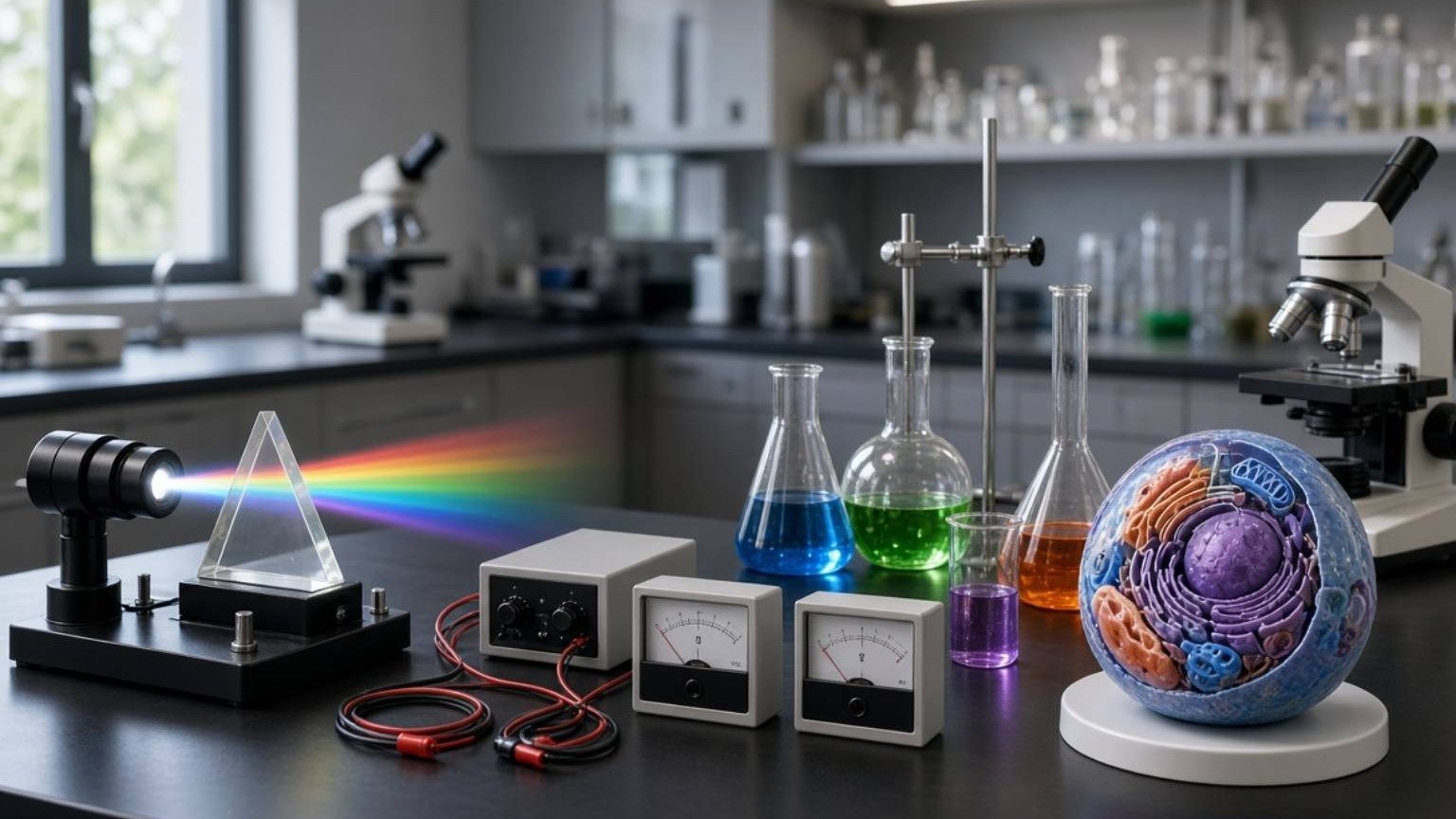
Searching for space science school project models with pictures? This guide collects four related but distinct topics: a Constellations Star Map, a Satellite Orbit Model, a conceptual Mars Habitat and a Gravity Well Demonstration. Students in approximately Classes 6–12 can explore how stars appear in patterns, why satellites stay in orbit, what a future habitat on Mars would need, and how a stretched-fabric analogy represents certain aspects of gravity. Each educational image has a full-size viewing link. These are not equally realistic simulations: a gravity well is a limited analogy, and a Mars habitat poster is a proposed concept rather than proof of an operational human settlement.
What do these four space projects teach?
A constellation chart helps identify apparent star patterns in the sky. A satellite diagram introduces motion under gravity. A Mars habitat design encourages thought about life-support engineering, and a gravity well demonstrates an imperfect visual analogy for orbital motion and curvature. They explain different ideas. Star maps involve observation, satellite paths involve physics, habitat diagrams involve design assumptions and fabric wells involve analogy. Label each section accordingly. An educational project is stronger when students explain both what the model represents and which real-world features it cannot reproduce.
Picture 1: Constellations Star Map
Constellations represent named patterns or regions of the sky. Stars that appear near one another in a pattern can actually be separated by enormous distances. Visibility changes with season, local time, latitude, cloud cover and artificial light. A student can draw a few familiar star patterns with white dots on black paper and label them carefully. A static poster is not a real-time local sky chart. To know whether a constellation is visible on a particular night, check a suitable star map for that date and location. Never send children alone into unfamiliar outdoor areas for night observation.
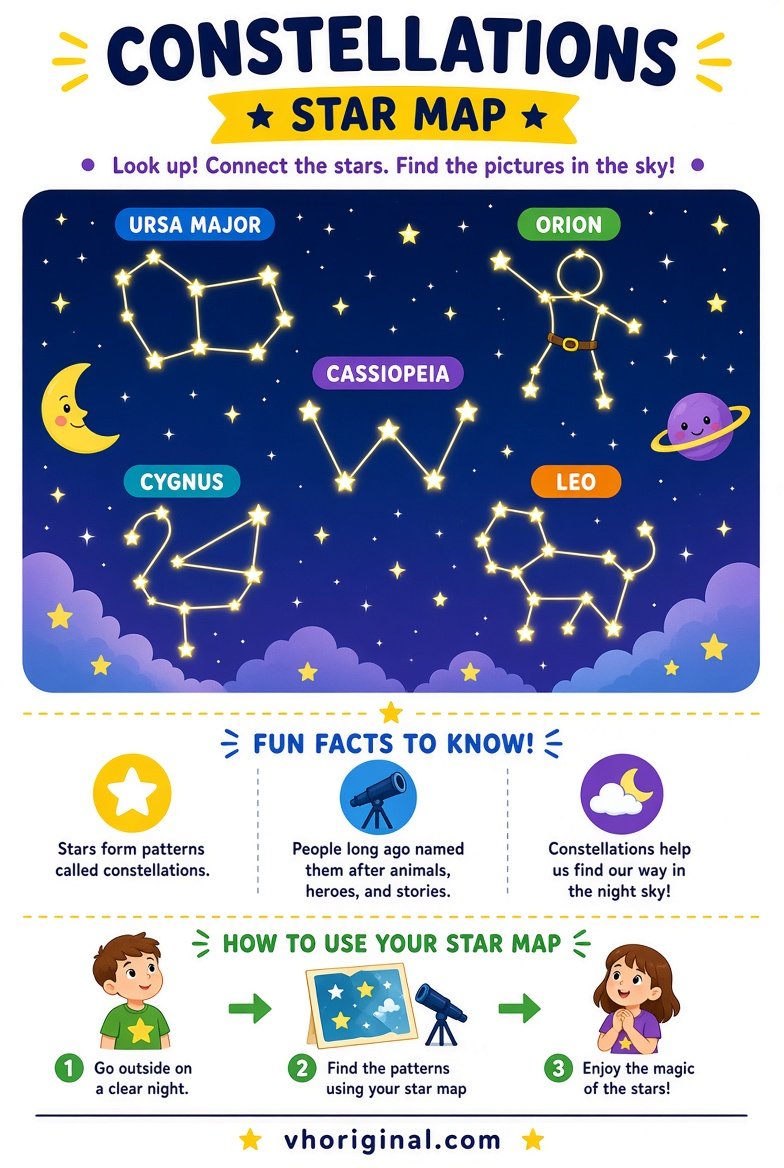
Chart note: These are stylised patterns. Use a date-, time- and location-specific sky chart to identify real constellations.
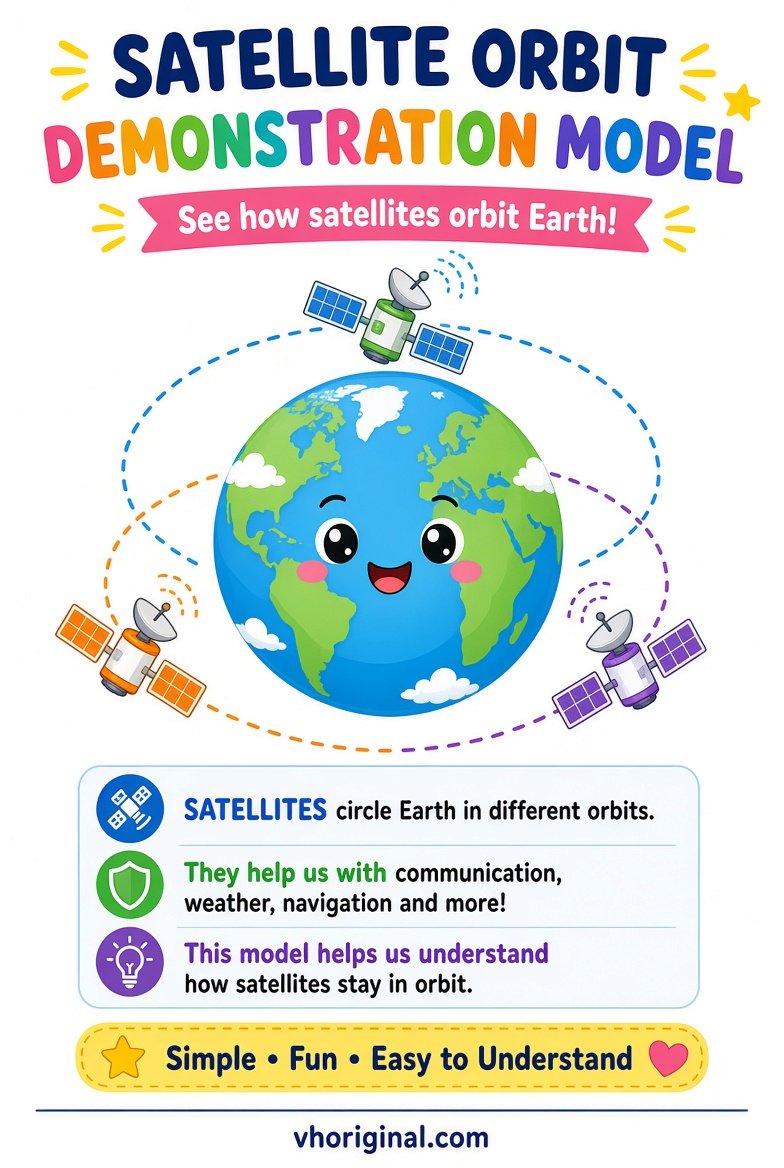
Picture 2: Satellite Orbit Demonstration
A satellite remains in orbit because its forward motion and Earth’s gravitational attraction produce a curved path; an orbital object is continuously falling around Earth. Gravity does not vanish in a low-Earth orbit. Label the Earth, satellite, orbital path and direction of motion. Different orbits have different altitudes, periods and uses, so one diagram cannot represent every satellite mission. A string and paper ball can show a path conceptually, but a real satellite is not physically tied to Earth by a string. Students should be able to describe the meaning of the arrow rather than merely copy it.
Picture 3: Mars Habitat 3D Model
A potential Mars habitat would need suitable shelter, pressure control, air, water, power, thermal protection and life support. Mars has a thin atmosphere and conditions very different from those on Earth. A school model can represent an airlock, a protected living module, solar panels and water-handling systems using labelled paper structures. It cannot prove that the imagined design is ready for deployment or has been approved by a space agency. Radiation, temperature and resource supply remain major challenges. A good poster identifies these challenges instead of depicting an ordinary unsealed house as sufficient for survival on Mars.
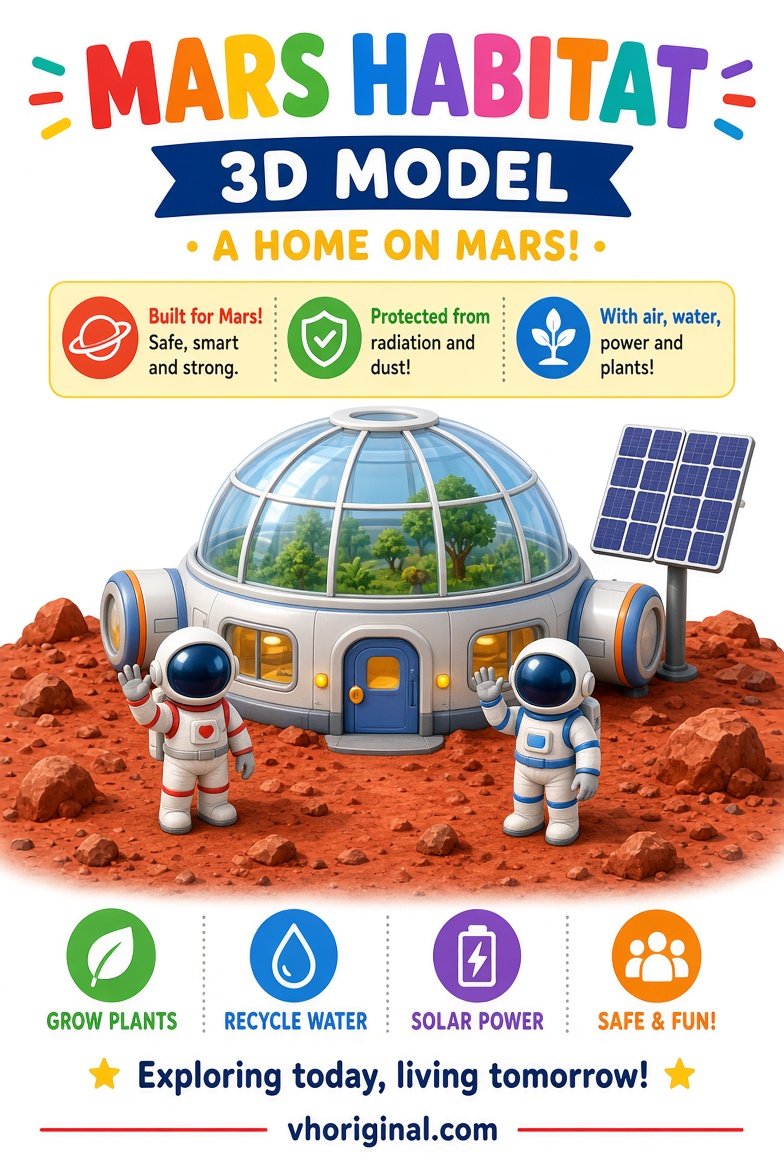
Chart note: This is a speculative classroom concept. The picture does not show a real Mars settlement or a certified habitat design.
Picture 4: Gravity Well Demonstration
The familiar gravity-well demo uses stretched fabric and a heavy ball to make a depression, then smaller balls may travel around it. This is an engaging illustration of some features of motion on a curved surface. However, the fabric sags because of Earth’s existing gravity, whereas spacetime is not literally an elastic sheet with a downward direction. Friction also slows rolling balls, unlike an idealised orbit in space. Explain these limitations openly. A gravity well can start a conversation about gravitational models, but it does not directly validate or fully reproduce general relativity in a classroom.
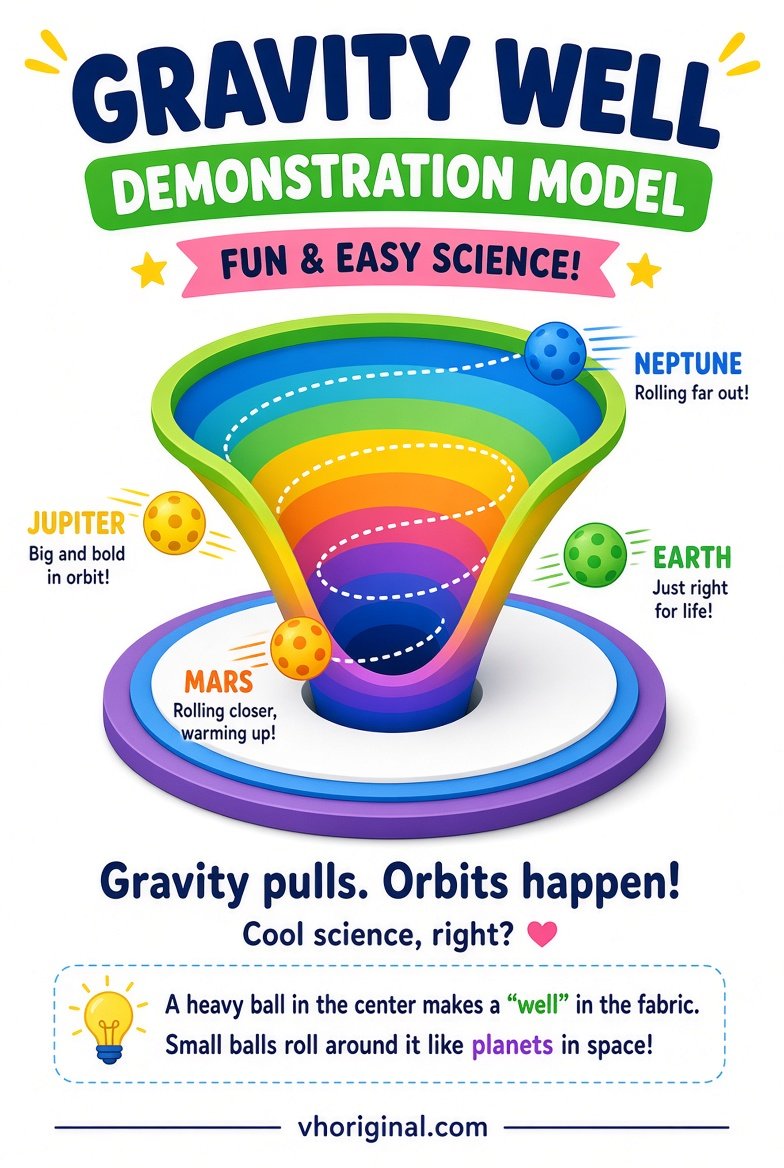
Chart note: The fabric well is an analogy. Planet positions and orbit shapes in the illustration are not to scale or a source for measurements.
Choose a model for your class level
For younger pupils, begin with a labelled star map. Older students can explain a satellite orbit, Mars life-support needs or the limitations of a gravity-well analogy. Match the work to the teacher’s instructions.
Materials and step-by-step assembly
Use black and coloured paper, cardboard, small safe paper balls, white dots, ruler, pencil, eraser and suitable glue. For the star map, place patterns and labels accurately. For the satellite display, show a small model Earth and a clearly identified orbital path. For Mars, build a protected-looking module with airlock and life-support labels. If a gravity-well demo is required, have an adult stabilise a fabric frame and use safe, lightweight objects. Do not drop heavy spheres or stretch fabric over fragile furniture. Every diagram should include one explanatory sentence and one limitation.
Class presentation and useful viva questions
Students can introduce the display by comparing observation, orbit, habitat design and analogy. Does a constellation mean all its stars are close together? No. Is orbital gravity zero? No. Does a Mars habitat drawing show an inhabited building? No. Does the fabric well literally depict spacetime as rubber? No. Follow every short answer with a reason. These questions encourage scientific thinking rather than memorising decorative labels. If an illustrated poster contains a strange orbit direction or an unrealistically open Mars shelter, correct it or label it explicitly as an artistic simplification.
Safety, limitations and image downloads
Avoid sharp cutters, unsecured heavy balls and unstable displays. Night-sky observations should take place with suitable adult supervision in a safe location. Never identify a constellation’s exact position for tonight from an undated illustration. Open the full-size image beneath each topic to inspect or save it. When printing, verify the names and scientific captions from reliable astronomy resources. If an assignment requires hand drawing, use these pictures as references. The goal is accurate questions about space.
Frequently asked questions
Are all stars in a constellation physically close?
Not necessarily; they often form an apparent pattern from Earth’s viewpoint.
Is gravitational force absent in orbit?
No. Gravity is essential to orbital motion.
Does a gravity well perfectly model spacetime?
No. It is a limited analogy involving Earth’s gravity and friction.
Is this Mars habitat a real occupied facility?
No. It is a conceptual school illustration of engineering requirements.
Conclusion and sources
The four space project pictures offer a useful mix of astronomy, orbital physics and design thinking when their limitations are explained clearly.
Related projects: Solar System Drawing · Chandrayaan-3 Model
Sources: NASA Solar System; NASA Mars; NASA Stars.
Related project: eight planets cardboard model








Share Your Opinion
Comments are closed on this post.