 Vista
NASA Mars rover discovery, November 2026: NASA’s Perseverance rover has identified unusually bright rocks rich in hydrated silica in the Idubi area of Mars. In a mission update dated November 16, 2026, scientists said recently downloaded measurements from the rover’s SuperCam indicate that these pale rocks differ from the igneous rocks previously examined nearby. On Earth, hydrated silica can develop in environments involving water, including hydrothermal, groundwater and soil-forming systems. That makes the discovery a promising clue to Mars’ earlier environmental conditions—not a declaration that liquid water is flowing there today or that scientists have discovered life.
Readers searching for NASA Mars rover latest discovery, Perseverance rover discovery 2026, silica-rich rocks on Mars, NASA Mars rover latest photos or ancient water on Mars evidence are often looking for a simple answer: what was actually discovered and why does it matter? The short version is that the mineral identification gives scientists a strong reason to investigate the rocks closely. It is not yet a complete account of exactly how they formed. Here are the location, instruments, original photograph dates, life-related implications and remaining scientific questions.
What Did NASA’s Perseverance Rover Discover on Mars in November 2026?
On November 16, NASA published a mission-team report titled “The Ghostly Rocks of ‘Idubi’ — Bright Remnants of Aqueous Systems from Long Ago.” It was written by Candice Bedford, a Purdue University research scientist, for the Mars 2020 mission team. The story centers on a group of light-toned rocks whose appearance stands out against the darker, dust-covered surface of an ancient region of Mars.
The team had previously inspected igneous rocks—those associated with molten material cooling—and impact-related rocks formed or modified during collisions. These brighter fragments appeared unusual enough to warrant additional study. The rover then used its remotely operated analytical instruments to investigate their chemistry rather than relying on color alone. According to NASA, the newly received SuperCam data confirmed that the pale rocks are not igneous in origin and are rich in hydrated silica.
That is a meaningful geological result because a rock’s mineral makeup can preserve evidence of the conditions under which it formed or was later altered. It does not mean researchers have already identified the exact water source, temperature or sequence of changes. NASA described several possible water-related formation environments by analogy with Earth and said that more detailed work is in progress. The publication discusses the potential for preservation of ancient biological traces rather than reporting the detection of such traces.
A close-range investigation, known as a proximity science campaign, is now underway at Idubi. The significance of this step is straightforward: remote instruments can identify important chemical characteristics at a distance, while contact and close-up techniques can add finer measurements of texture, composition and context. Those additional observations may help the science team distinguish between possible geological explanations for the silica-rich material.
Where Is Idubi? The Lac de Charmes Region Beyond Jezero Crater
Idubi is located in the Lac de Charmes region, an area of exposed ancient Martian crust outside Jezero crater. This is an important location detail. Perseverance is well known for investigating Jezero’s former lake and delta environment, but its 2026 work has also extended into older landscapes beyond the crater’s rim. A headline saying that the latest Idubi rocks were discovered “inside Jezero Lake” would misrepresent the reported position.
In an earlier NASA update, “Mars Has Its Charmes”, the mission team explained why this terrain matters. Many rocks in the region belong to some of the oldest material the rover has encountered. They may preserve records from Mars’ early history, when intense impact bombardment and widespread igneous processes shaped the planet’s crust. Studying rocks outside an ancient lake basin provides a different window into how Mars developed.
During exploration of Lac de Charmes, scientists encountered material that appeared to originate from cooled magma or lava, rocks associated with impacts, and examples involving a combination of processes. In the Idubi portion of the landscape, the team spotted hundreds of light-toned boulders from a distance. The variety of textures and compositions made the site particularly interesting before the November hydrated-silica identification was reported.
The September update describes an abrasion feature called Badger Peak on one unusual boulder. An attempt to collect a sample from that rock was unsuccessful because of its hardness. That event should not be confused with an announcement of failure to collect the newly confirmed silica-rich material: the November 16 report describes a detailed nearby science campaign but does not announce a new collection result or a date when a specific Idubi silica sample will be returned to Earth.
Why distinguish locations and earlier work so carefully? Because this discovery is about more than a single white stone. Researchers want to understand where the rock occurs within a complicated ancient crust, how it differs from nearby igneous and impact formations, and what sequence of geological events could have introduced hydrated silica there. The larger the contextual picture, the more informative a mineral detection becomes.
What Is Hydrated Silica, and Does It Mean Mars Had Water?
Silica refers to silicon-dioxide-rich material and is found in several mineral forms on Earth, including quartz and other geological deposits. Hydrated silica is silica-bearing material associated with water in its mineral structure or chemistry. The term hydrated is not shorthand for a modern underground lake, liquid water droplets inside a rock, or drinking water immediately available at the surface. Those would require entirely different observations.
NASA’s mission update mentions several Earth environments where hydrated silica can form. In a hydrothermal system, water interacts with rock at elevated temperatures. Groundwater environments involve water moving or reacting underground, potentially altering minerals and transporting dissolved material. Pedogenic processes occur during soil formation and chemical weathering. Although those examples differ greatly, they share water-related chemistry that may help scientists interpret mineral deposits on other planets.
Can scientists conclude that one particular ancient river ran through Idubi? Not from the November 16 announcement alone. The new SuperCam measurement identifies silica-rich material, but establishing a specific formation mechanism requires other information, such as mineral associations, microscopic structures, surrounding rock units, layering and any evidence of later alteration. Multiple geological pathways can sometimes produce similar materials. Identifying a mineral is the beginning of a more detailed explanation, not automatically the final chapter.
The discovery therefore strengthens the case for examining possible ancient water-related environments, not for presenting a new picture of a lake or hot spring as an established fact. Some candidate settings could have supported microbial life in the distant past; others may have been unsuitable because of temperature, chemistry or other conditions. Water availability is one ingredient in a habitat, not a guarantee of habitability or biology.
| What NASA reported | What it means | What it does not prove |
|---|---|---|
| Bright rocks at Idubi | Distinctive pale fragments observed on the Martian surface | That they are glowing crystals or valuable gemstones |
| SuperCam indicates hydrated silica | Strong chemical and mineralogical clue | That the exact deposit-forming process is already known |
| Water-related Earth analogues | Useful paths for understanding past Martian conditions | Present-day liquid water at the site |
| Ability of silica to preserve microfossils | Scientific reason to examine the material for ancient traces | A confirmed fossil or discovery of life on Mars |
| Close-up investigation underway | Additional observations may narrow formation explanations | That the science campaign is complete or a new sample has been returned |
Did NASA Find Life on Mars? Why Silica Can Matter for Microfossils
One of the most exciting parts of the new NASA update is also the easiest to exaggerate. On Earth, some silica deposits can preserve microfossils—small traces or remains of organisms from the past. The mineral can help retain details that might otherwise be lost over geological time. That preservation potential gives scientists a reason to examine silica deposits when searching for evidence about ancient environments and the possibility of past life.
But the capacity to preserve a fossil is not the same as finding one. NASA did not say that the Idubi rocks contain fossil microbes, confirmed organic material of biological origin, living organisms or any independently verified biosignature. The agency’s wording deliberately treats the idea as a scientific question worth investigating. A credible news article must preserve that distinction even when “NASA found aliens” would attract more clicks.
Scientists distinguish between habitability and inhabitation. Habitability asks whether an environment had conditions that could potentially support life, such as suitable chemistry, water and energy sources. Inhabitation asks whether life was actually present. Mars may have had water-related environments that are interesting for habitability studies without leaving any evidence that an organism ever lived there. Even where unusual features are detected, nonbiological explanations must be considered.
Imagine finding an ancient mineral deposit on Earth that is known sometimes to preserve microbial traces. The sensible next step would be to examine it carefully under controlled conditions, not to announce a microbe before seeing any evidence. Idubi is a planetary-scale version of that scientific logic. Rover instruments can scrutinize the composition and structure of the rocks, improving the assessment of whether the environment is a promising target for further astrobiological study.
The latest discovery may help researchers prioritize subsequent measurements, but it cannot replace an actual finding. Responsible coverage should say “silica could help preserve ancient traces of life” rather than “NASA discovered life preserved in silica.” This is an important difference for anyone trying to understand ongoing Mars exploration.
How SuperCam, Mastcam-Z and SHERLOC WATSON Investigated the Rocks
Perseverance carries several instruments designed to work together. The rover is not merely a camera on wheels: it has systems for distant imaging, chemical analysis, surface inspection and more detailed close-up measurements. NASA’s official science instrument guide describes how each tool contributes different evidence to a geological investigation.
Mastcam-Z is a mast-mounted zoom-capable camera system able to photograph distant targets, terrain and fine visual features. NASA’s November update includes a real image captured by the rover’s left Mastcam-Z on October 29, 2026, showing a pale, silica-rich rock at Idubi. The official caption identifies the mission day as Sol 2023 and the image time as 13:03:53 local mean solar time.
SuperCam uses a camera, laser and spectrometers to investigate the chemistry and mineral composition of rocks and soils from a distance. In this case, the newly received SuperCam measurements are the stated basis for NASA’s confirmation that the bright rocks are hydrated-silica-rich and not ordinary igneous rocks. The instrument’s role should not be confused with taking every close-up photograph or drilling a rock; other hardware performs different tasks.
SHERLOC is carried on the rover’s robotic arm and can study minerals and possible organic chemistry at close range. Its associated WATSON camera produces close-up images of rock surfaces. NASA published a WATSON view of an Idubi rock taken on October 29, 2026, during the same Sol 2023, at 17:33:55 local mean solar time. The credit for that image is NASA/JPL-Caltech, while the Mastcam-Z image is credited to NASA/JPL-Caltech/ASU.
These dates answer an easily overlooked question: Why are October photos appearing in November news? The image acquisition date and the article publication date are different events. The rover took its photographs on October 29, while NASA published the updated scientific interpretation on November 16, after newly downlinked data became available and the team had examined it. This is normal for spacecraft science, which requires data transfer and analysis before a public update.
The current investigation is valuable partly because NASA previously encountered silica-rich material on Jezero crater’s inner rim that was too small for certain high-resolution proximity measurements. The Idubi rocks offer targets large enough for closer instrument work. That could provide scientists with more comprehensive chemical and mineralogical context and help assess how the silica formed. The November report does not provide a guaranteed completion date for this work.
NASA Mars Rover Latest Photos 2026: Real Images vs AI Illustrations
Looking for authentic NASA Perseverance latest images 2026? The most useful source for this discovery is NASA’s original November 16 Idubi update. It includes the Mastcam-Z image of a pale silica-rich rock and a WATSON close-up. Both are attributed to the rover, with camera information, acquisition times and NASA credits. Those details are more reliable than a social-media picture labelled “Mars crystal found yesterday.”
The official Perseverance mission update archive also provides context for the rover’s earlier work in the region. NASA’s September post describes Idubi’s light-toned boulders and the wider geological setting, while the November report adds the newly identified hydrated-silica chemistry. Following both original reports makes it easier to separate what was previously observed from what has just been established.
Images found through general search can belong to different categories. A NASA rover photograph documents something actually imaged by an instrument on Mars. A scientific visualization may depict an interpretation of data, such as a hypothetical ancient landscape. A creative CGI or AI image might illustrate an exciting scene but is not a documentary record of the mission. These distinctions matter for science communication and image-search accuracy.
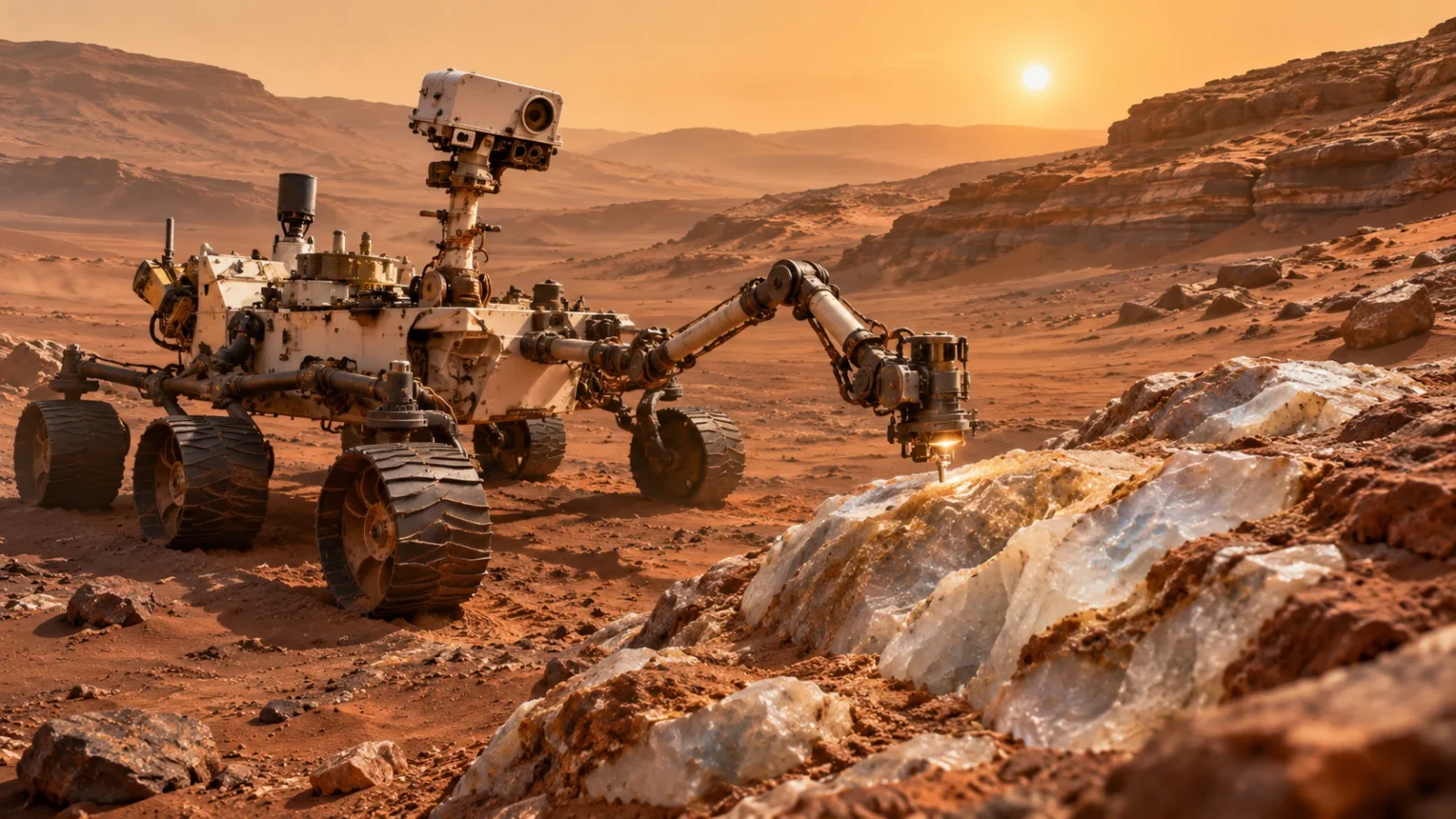
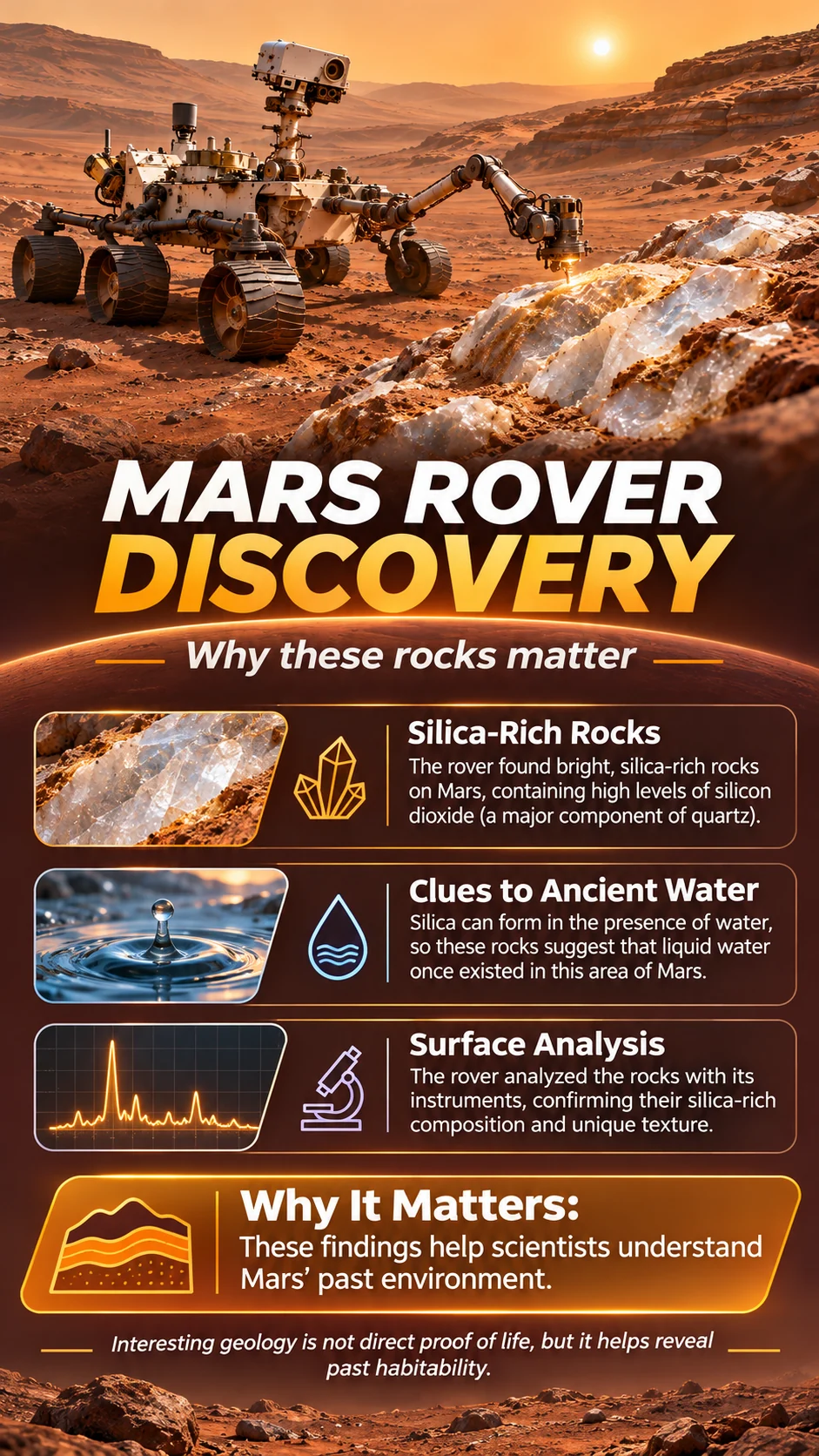
Our 16:9 OG featured art and the English informational poster above are AI-created educational illustrations. Their rover, bright crystalline-looking rocks and cinematic Martian setting are conceptual; they do not reproduce the real October 29 instrument frames. In particular, the actual NASA report does not claim giant glowing crystals, diamonds, alien eggs or pools of surface water. Those ideas should not be inferred from a stylized graphic.
For readers sharing an image, an accurate caption should indicate whether it is NASA/JPL-Caltech/ASU imagery or an original illustration. Alt text should describe the object clearly without promoting an unsupported discovery. A visually appealing article can still be truthful about which pictures are measurements and which are artistic interpretations.
Why the Idubi Discovery Matters for Future Mars Research
The long-term scientific value of Idubi is the possibility of narrowing down the history of water-related processes in very old Martian crust. The rover’s current findings create a new set of geological questions. Did the silica form through water moving below ground, through a hot-water-related system, through weathering and soil formation, or through a more complex sequence? Which minerals formed before or after it? What did that environment look like, and for how long did it persist?
Answering these questions requires combining mineral measurements with rock texture, nearby layers and regional geological context. A single mineral can form in more than one setting, so interpretation improves when independent instruments tell a consistent story. The close-range work at Idubi is a chance to build such a multi-instrument record instead of relying only on distant observations.
Scientists are also interested in the capacity of silica-rich deposits to preserve microscopic details. If an environment once supported life, well-preserved minerals might be promising locations to search for traces. However, the report’s discussion of potential preservation is a reason to carry out more research, not an announcement that an identifiable biological specimen has been found. The distinction between a useful target and a successful detection is essential.
Perseverance’s ability to move across Mars, select new targets and inspect them at increasing levels of detail makes this investigation possible. Orbiting spacecraft map broad terrain features; a rover can place instruments much closer to individual rocks. At Idubi, that means one pale rock can be compared with surrounding igneous and impact-related material and evaluated within a wider regional framework.
NASA did not announce in the November 16 post when a specific hydrated-silica sample would be collected, whether it would be selected for eventual return to Earth or when detailed results from the new campaign would be released. These questions belong in future verified updates, not in the current headline as guaranteed plans. A strong science story should leave room for what the next measurements may reveal.
NASA Perseverance Rover FAQs: Silica-Rich Rocks and Water on Mars
1. What did NASA’s Mars rover discover in November 2026?
NASA reported that Perseverance found light-toned rocks at Idubi whose SuperCam data indicate an abundance of hydrated silica. A detailed close-range investigation is underway.
2. Does hydrated silica mean liquid water exists on Mars today?
No. It is a mineralogical clue relevant to possible ancient water-related processes. The November update did not announce modern flowing or drinkable water at the Idubi site.
3. Did NASA find life, fossils or confirmed biosignatures in the rocks?
No. NASA noted that silica can preserve microfossils in some Earth settings, making the material interesting to study. It did not report discovering a fossil or life on Mars.
4. Where is Idubi on Mars?
Idubi lies within the Lac de Charmes region of ancient Martian crust outside Jezero crater, according to NASA’s mission update.
5. Where can I see the real Mars rover photos of the silica-rich rocks?
NASA’s November 16, 2026 Idubi report contains genuine Mastcam-Z and SHERLOC WATSON images acquired on October 29, 2026, with camera details and credits.
6. When will scientists collect or return a sample of the Idubi silica rocks?
The November 16 announcement did not provide a confirmed date for collecting or returning a specific hydrated-silica sample. The rover is conducting further nearby science measurements.
Conclusion: New Clues to Ancient Water, Not Proof of Life
The central finding in the NASA Mars rover discovery of November 2026 is clear: the Perseverance rover identified hydrated silica-rich rocks at Idubi using SuperCam measurements, and scientists now have a larger and more accessible target for detailed analysis. Such minerals can be relevant to understanding ancient aqueous environments and, under suitable conditions, preserving potential traces from the distant past. What formed these particular deposits remains a question for investigation.
This is a meaningful step in Mars research even without a sensational claim. It tells scientists where to focus instruments, what chemical clues to investigate and how the old terrain beyond Jezero crater may relate to Mars’ history. Readers should enjoy the remarkable original rover imagery while keeping a careful distinction between water-related geological evidence, potential habitability and confirmed life.
Sources and update: NASA, “The Ghostly Rocks of Idubi,” November 16, 2026; NASA, “Mars Has Its Charmes,” September 2026; NASA Perseverance science instruments; NASA rover mission updates archive. Verified: November 17, 2026.
Editorial note: The original October 29 rover photos are available on NASA’s website. Vista Hub’s OG image and English infographic are original AI educational illustrations, not official mission photographs. No unsupported claim about aliens, fossils, current liquid water or sample-return dates has been made.
See both original October 29, 2026 (Sol 2023) photographs in NASA’s Idubi mission report. Our cover and poster are AI illustrations.
Also read: SpaceX Starship vs Falcon 9.



















Share Your Opinion
Comments are closed on this post.