 Vista

Hades and Persephone is a Greek myth about the abduction of Demeter’s daughter, her mother’s desperate search and the agreement that allows Persephone to spend part of each year in the underworld and part with her mother. In the early Homeric Hymn to Demeter, Hades takes Persephone against her will, and Zeus has permitted the match without telling Demeter. The grieving goddess of agriculture prevents crops from growing, threatening human life. Hermes eventually brings Persephone back, but a pomegranate seed binds her to return below for part of the year. The story relates agricultural cycles to a divine family crisis and also connects to the religious traditions at Eleusis. It is not simply the consensual dark romance depicted in some modern fantasy adaptations.
Who are Hades, Persephone and Demeter?
Hades is the ruler of the Greek underworld, a brother of Zeus and Poseidon. He governs the realm of the dead but is not the Christian Devil or an embodiment of every evil. Persephone, also called Kore meaning Maiden in religious contexts, is the daughter of Demeter, the goddess associated with grain, agriculture and the fertility of cultivated land. Her father in a prominent genealogy is Zeus. These relationships matter because the story involves a decision among powerful relatives that is kept from the mother and daughter.
Unlike a simple contest between a heroic lover and a villain, the Homeric Hymn to Demeter gives considerable attention to Demeter’s suffering and the consequences of her refusal to resume her divine work. Persephone herself becomes queen of the underworld, but the early narrative begins with her unwilling removal. Later poets and artists develop other emotional emphases. For a reliable explanation, the early hymn should be named instead of treating every modern social-media retelling as though it appears in the same ancient text.
How did Hades abduct Persephone while she gathered flowers?
At the start of the Homeric Hymn to Demeter, Persephone is gathering flowers in a meadow with companions described as daughters of Oceanus. There are roses, crocuses, violets, irises and hyacinths. The earth also produces an extraordinary narcissus at Zeus’s will to attract her attention. When she reaches toward the flower, the ground opens and Hades emerges in his chariot drawn by immortal horses. He takes her into the underworld while she cries out for help.
The hymn explicitly says that Zeus granted permission for the abduction. This is a critical detail when assessing the familiar assertion that Hades merely invited Persephone to a romantic destination and she freely chose to stay. Later fictional works may reinterpret the relationship, but the early surviving account describes force and fear. Calling the abduction a wedding without explaining Persephone’s position obscures the moral tensions that give the original story its force. Ancient patriarchal assumptions can be discussed without endorsing them today.
Why did Demeter search for her daughter for nine days?
Demeter hears Persephone’s cry but does not immediately learn who has taken her. In the hymn she wanders across the earth for nine days, carrying burning torches and refusing ordinary divine comfort. On the tenth day, Hecate approaches and says she heard the cry but did not see the captor. They then seek Helios, the sun god, who has witnessed events from his vantage point. He reveals Hades’s role and the arrangement with Zeus.
The involvement of Hecate and Helios often disappears from simplified summaries that jump straight from the kidnapping to the pomegranate. But both figures matter: Hecate supports the search, while Helios gives information Demeter lacks. Helios should not be carelessly replaced by Apollo in this specific early passage just because Apollo later acquires solar associations. Demeter’s search also reveals a mother’s refusal to accept a decision made by other divine authorities over her child.
What happened at Eleusis during Demeter’s grief?
In the hymn, Demeter reaches Eleusis, near Athens, and interacts with the royal household of Celeus and Metaneira. She appears in disguise and becomes involved in the care of their child Demophon. The goddess tries to grant him extraordinary protection, but the process is interrupted when his mother is frightened. Demeter reveals her divinity and asks that a temple be built for her. This section is essential to the narrative, not merely a detour before the next dramatic meeting with Hades.
Eleusis later became famous for the Eleusinian Mysteries, religious rites associated with Demeter and Persephone. Ancient sources repeatedly emphasize the sacred nature and restricted disclosure of those rituals. Their precise secret experiences cannot be reconstructed confidently from a modern imaginative poster. It is more accurate to say that the hymn connects the divine mother-daughter story with Eleusinian sacred traditions than to invent a complete initiation ceremony that the text does not reveal.
How did Demeter’s sorrow cause the famine?
Demeter’s connection with crops makes her grief a crisis for the whole world of mortals. She prevents seeds from growing, and the earth becomes unable to provide the harvest needed for human life. This in turn threatens the sacrifices and honors normally offered to the gods. Zeus and the other immortals cannot treat the family conflict as a private issue while humanity faces starvation. The goddess’s refusal to restore agriculture becomes a form of pressure that forces the divine ruler to negotiate.
The famine is a mythic explanation of agricultural hardship, not a scientific account of why real crop failure occurs. Drought, soil, climate and agricultural practices are studied by other methods. The narrative significance lies in the power of a mother whose domain is essential to society. Demeter’s role shows that she is not simply a grieving background character; her refusal has consequences powerful enough to involve the entire divine order.

How did Hermes bring Persephone back?
Faced with the famine, Zeus sends Hermes into the underworld with instructions that Persephone must return to Demeter. Hermes, the messenger who can cross boundaries and guide souls, is especially well suited to this task. Hades eventually agrees to let Persephone leave, but the resolution has a complication. Before her departure he gives her a pomegranate seed to eat. In the hymn’s account the act occurs under a scheme that affects whether she can remain permanently above ground.
The text does not present the seed as a random decoration or a symbol whose meaning is fixed by a modern recipe. Eating food from the realm of the dead is consequential within the myth. When Persephone meets her mother again, Demeter immediately asks whether she ate anything during her stay. That question reveals that reunion alone may not restore the previous situation. The seed transforms the fate of Persephone and introduces a repeating cycle of separation and return.
How many pomegranate seeds did Persephone eat?
The Homeric Hymn to Demeter describes Hades giving Persephone a pomegranate seed. Other later versions and retellings sometimes specify a different number of seeds, commonly six, and transform the year into a six-month division. It is therefore misleading to claim that the oldest major hymn definitely says “six seeds and six months.” A useful article identifies the source: in the central ancient hymn, Persephone remains below for one-third of the year, with her mother and the gods for the other two-thirds.
The number matters because many school explanations simply equate Persephone’s months below with winter. That can be a familiar interpretive shorthand, yet the exact seasonal pattern of the Mediterranean ancient world, agriculture and local traditions is more complex. Some retellings connect the annual time below with a barren season rather than always assigning the same modern calendar months. The strongest source-based statement is that the mother-daughter separation becomes a recurring cycle associated with changes in fertility and growth.
Why does the myth explain the changing seasons?
Demeter’s withdrawal of agricultural fertility explains why the land becomes barren. Persephone’s return brings Demeter joy and the renewal of grain. Through the compromise, Persephone’s absence and presence become periodic, giving the narrative a pattern for the world of human harvests. The hymn also describes Rhea helping persuade Demeter to resume fertility after Zeus agrees to the settlement. Its aim is to show how divine arrangements affect the availability of life-giving crops and the religious meaning of agricultural cycles.
There is no reason to present the story as observational meteorology. Earth’s seasons arise from the tilt of its rotational axis and its orbit around the sun, not literally from Persephone changing houses. The myth tells us how one ancient religious tradition connected human dependence on agriculture with kinship, loss and renewal. That symbolism remains resonant even when readers understand the modern science of seasons.
Was Persephone happy as queen of the underworld?
The question has no universally simple answer because ancient versions differ and the early hymn emphasizes her abduction and eventual partial return. The text does not ask readers to conclude that every part of her experience was freely chosen. Later poetry, visual art, novels and games may depict her as politically powerful, romantically devoted, resentful or divided between two homes. Those adaptations are creative works, not a license to erase the original coercion.
As queen of the underworld, Persephone has an important religious identity beyond the moment of her kidnapping. She appears in underworld traditions and is sometimes associated with return and hope for blessed outcomes after death. The Eleusinian religious context adds further meaning, although the most restricted rites are not fully available to us. A balanced discussion can acknowledge her later authority without pretending that Hades and Persephone were universally described as a consensual ideal couple.
Hades and Persephone versus the general Hades story
Hades belongs to the wider genealogy of Zeus, Poseidon and their siblings, and his role as ruler of the dead involves Cerberus, the underworld’s regions and mythic journeys by Heracles and Orpheus. Those are distinct from the Persephone abduction and seasonal cycle that forms this article’s focus. Keeping the two search intents separate makes both more useful. The story also helps explain why Demeter has such a strong place in Greek religious imagination despite not being a battle-oriented deity.
Some readers compare the Greek seasonal myth with stories of vegetation goddesses elsewhere. Similar motifs can arise in different cultures, but they do not prove that a goddess from another religion is historically identical to Persephone. The already published Greek vs Hindu mythology comparison offers broad context without declaring identical figures. For this plot, the Homeric Hymn and the Eleusinian tradition remain essential evidence.

Hades and Persephone story timeline
| Stage | Story event | Key figure |
|---|---|---|
| Meadow | Persephone gathers flowers | Persephone |
| Abduction | Hades takes her with Zeus’s consent | Hades and Zeus |
| Search | Hecate and Helios aid Demeter | Demeter |
| Eleusis | Demeter stays among mortals | Demeter |
| Famine | Fertility is withheld | Demeter |
| Return | Hermes retrieves Persephone | Hermes |
| Compromise | Seed binds a recurring stay below | Persephone |
Five FAQs about Hades and Persephone
Did Persephone go with Hades willingly?
Not in the early Homeric Hymn to Demeter. Hades abducts her while she gathers flowers, with Zeus’s prior consent.
Why did Persephone eat pomegranate seeds?
Hades gave her a seed before she left; eating it is linked to the requirement that she return to the underworld for part of the year.
How long did Persephone stay in the underworld?
The early hymn gives one-third of the year below and two-thirds with her mother; later retellings vary.
Who helped Demeter find Persephone?
Hecate hears the cry, Helios reveals the abduction, and Hermes later brings Persephone back.
Is the Persephone story a scientific account of seasons?
No. It is a Greek religious and literary explanation of the annual cycle of agricultural fertility.
Primary sources and conclusion
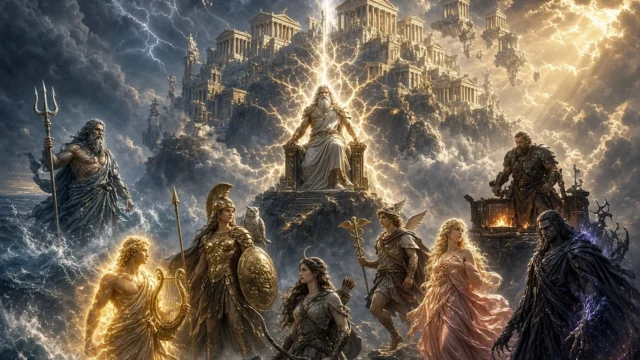
The main early narrative is the Homeric Hymn to Demeter, especially its opening, the reunion around lines 370–470 and the Eleusinian ending. Compare the translation and notes of the Harvard Center for Hellenic Studies and the Theoi Persephone source dossier. Conclusion: this is a myth of coercion, motherhood, agricultural crisis and a negotiated return. The pomegranate and seasonal rhythm matter, but the early story cannot be reduced to a romance. Updated 14 November 2026. Visuals are artistic interpretations.



















Share Your Opinion
Comments are closed on this post.