 Vista

Icarus story is the ancient Greek myth of a young man who flies too close to the sun with wings made of feathers and wax. His father, Daedalus, a brilliant craftsman, builds the wings to escape from Crete, where King Minos has blocked their departure. Before taking flight, he warns Icarus not to fly too low, where sea spray would weigh down the feathers, or too high, where the sun would soften the wax. Icarus becomes delighted by flying and rises beyond the safe course. His wax melts, he falls into the water and dies. The most familiar extended literary version survives in the Roman poet Ovid’s Metamorphoses, Book 8, rather than in Homer’s Iliad. The story is about risk, freedom, invention and a father’s grief—not merely a joke about someone who ignored instructions.
Who was Icarus in Greek mythology?
Icarus is the son of the inventive craftsman Daedalus. Unlike Zeus or Apollo, Icarus is a mortal human figure in myth. His famous achievement and tragedy take place during an escape from the island of Crete, ruled by King Minos. Icarus is not presented as an Olympian god with the natural ability to fly. He flies only because Daedalus creates a remarkable artificial device that imitates birds’ wings. The contrast between fragile human technology and the open sky is the center of the narrative.
Popular modern retellings often say simply that the young man had arrogance or hubris and deserved punishment. Those themes can be debated, but Ovid’s scene also emphasizes his youthful joy, his father’s fear and the tragic speed of the accident. Treating Icarus as a foolish caricature can erase the tenderness that gives the poem its emotional force. The narrator repeatedly turns our attention to Daedalus looking back at his son and trying to guide him through the unfamiliar air.
Who was Daedalus, and why was he trapped on Crete?
Daedalus is a legendary craftsman associated with extraordinary technical skill and the construction of the Labyrinth, the maze built to contain the Minotaur. In the wider Cretan myth cycle, that half-human, half-bull creature is linked to King Minos’s household, and the hero Theseus eventually enters the labyrinth to confront it. Ariadne’s thread helps Theseus escape. Daedalus’s work and knowledge become entangled with the political power of the Cretan king.
In Ovid’s Metamorphoses Book 8, Daedalus has grown tired of Crete and his long exile. Minos effectively blocks his departure by land and sea. Daedalus realizes that the king cannot control the open sky, so he chooses an unprecedented route. Different versions offer extra details of imprisonment or blame for the labyrinth, but the narrative’s essential point is that ordinary paths of escape have been closed. The idea of creating wings is both a remarkable invention and a desperate response to confinement.
How did Daedalus make the wings of feathers and wax?
Ovid describes Daedalus arranging feathers of different lengths in a graduated pattern, much like the pipes of a rustic musical instrument. He fastens their middle portions using thread and their lower ends with pliable wax, then bends them into an imitation of natural wings. The work is careful and ingenious, but the materials are vulnerable to heat and moisture. A modern diagram can show feathers, thread and wax, though it should never be presented as a proven aircraft design that ancient people actually built and tested.
While Daedalus works, Icarus plays with the feathers and softens the yellow wax in his fingers, unaware of the danger that the materials will later represent. This little detail matters because it makes the child curious and lively rather than presenting him as a hardened criminal. His father finishes the equipment, tests the flight and then attaches another pair of wings to Icarus. The plan is to stay together so the older craftsman can guide the younger flier.
What warning did Daedalus give Icarus before flying?
Before they leave, Daedalus tells his son to keep to a middle path. If he flies too low, the sea can dampen the wings; if he flies too high, the sun’s heat can soften the wax that holds the feathers. The warning is therefore not simply “never aim high.” It is a specific instruction to balance two opposite dangers. Too little height creates one hazard, while too much creates another. The father also tells Icarus to follow his lead rather than become distracted by the wider sky.
Ovid’s account adds touching human details: Daedalus’s hands tremble as he fastens the wings, tears mark his cheeks, and he kisses his son before the dangerous journey. Such moments show that the father is aware of the risk even though he believes the plan offers escape. A thoughtful retelling should not overlook that his own technical decision has consequences. He is both the inventor who makes flight possible and the parent who cannot fully control what happens once his son is airborne.
What happened during the flight from Crete?
Daedalus takes the lead and frequently looks back at Icarus, like a bird teaching a young one to fly. People below—such as a fisherman, shepherd and ploughman in Ovid’s literary scene—watch the strange figures moving overhead and wonder whether they are gods. The two pass islands in the Aegean world. The flight briefly creates the possibility of freedom after the confinement of Crete, which makes the coming fall more tragic. It is not a duel with a sun god or an attempt to challenge Zeus personally.
The poem’s geography includes Samos, Delos, Paros, Lebinthus and Calymne as names associated with the route, although it does not turn the myth into a reliable map for modern aviation. The islands are part of the Aegean setting and connect the story to a recognizable Mediterranean landscape. Modern maps may illustrate the region, but the supernatural wings and dramatic flight remain fictional. Readers should appreciate the geographical flavor without claiming archaeological proof of the journey.
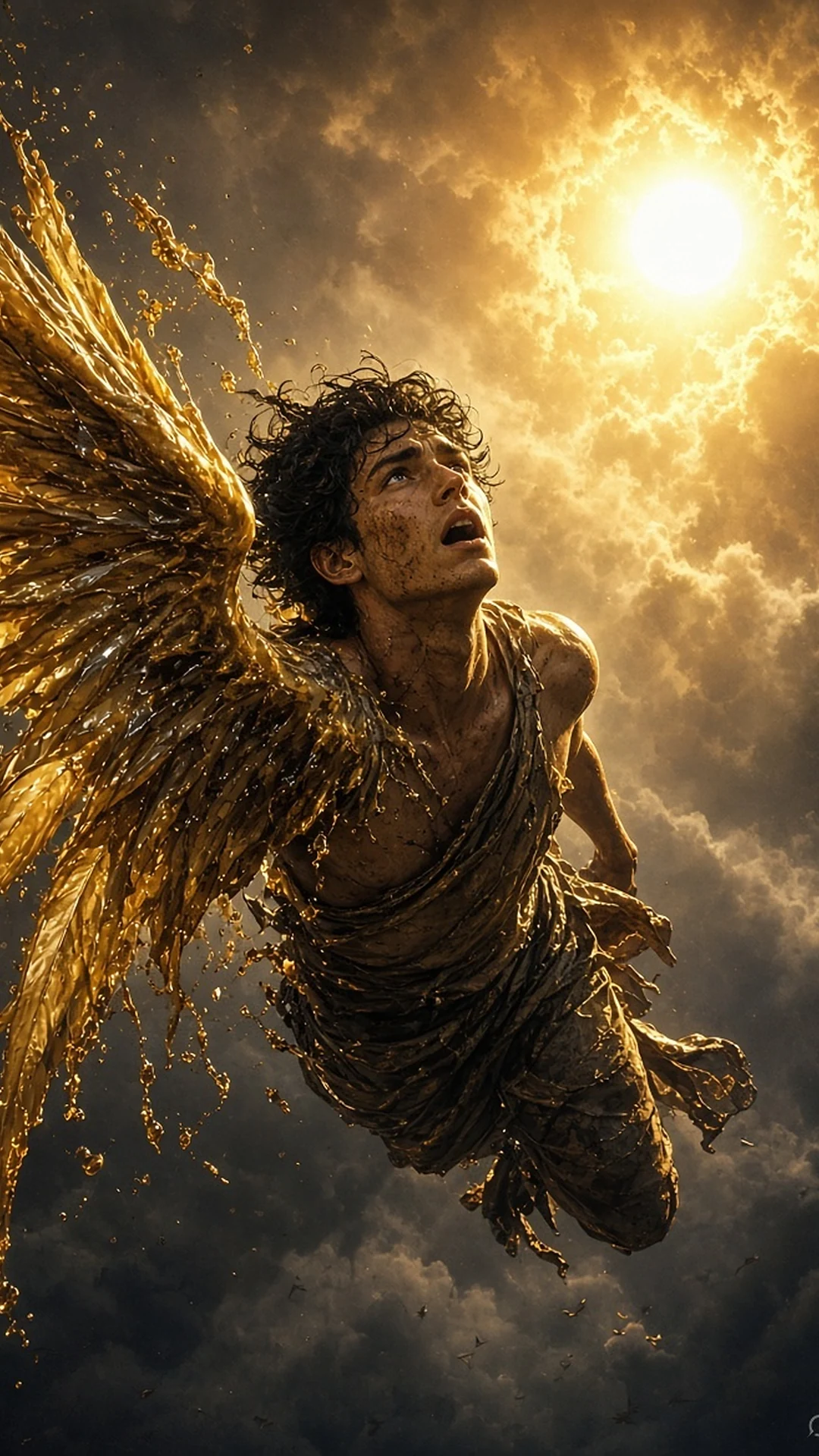
Why did Icarus fly too close to the sun?
Ovid depicts Icarus becoming delighted by flight and leaving his father’s guidance. Drawn upward by the thrill of the open sky, he rises toward the sun. The heat softens the wax holding his feathers in place, and the wings start to lose their structure. He tries to keep flying by moving his arms, but without feathers to support him he can no longer remain airborne. His triumph of freedom ends in a sudden, helpless fall.
The story is often used as a warning against overconfidence or ignoring experienced advice. That is a legitimate modern interpretation, but it should not imply Ovid wrote a precise aerodynamic analysis of the sun’s heating effect. Flying closer to the sun by an amount humans could reach with simple wings would not have the same physics depicted in the myth. Ovid is creating a poetic causal sequence using wax and heat; it is not experimental evidence of ancient powered flight.
How did Icarus die and why is it called the Icarian Sea?
In the famous sequence, Icarus falls into the sea and calls for his father, but the water covers him. Daedalus searches for his son and sees feathers floating on the waves. He recognizes what has happened, grieves and curses his own invention. Ovid associates the water with the name Icarian Sea and describes Daedalus burying Icarus, with the nearby island later called Icaria. The place-names belong to the literary tradition explaining a landscape through a tragic story.
The ending should not be shortened to “Icarus flew close to the sun and exploded” or “Apollo killed Icarus.” Neither is the central scene of Ovid’s version. The mechanism in the poem is the melting wax and the loss of wing feathers, followed by a fall into water. There is no need to add a battle with Helios or a curse from Zeus to make the tragedy more dramatic. A well-told ending has plenty of emotion already because the father survives while the son does not.
What happened to Daedalus after Icarus fell?
Daedalus survives, but his freedom comes at a terrible personal cost. Ovid goes on to a surprising episode about Perdix, the craftsman’s clever nephew in another part of his history. Daedalus’s jealousy of the boy’s talent leads to violence, and Minerva saves the nephew by changing him into a bird, a partridge. This episode complicates the idea of Daedalus as a perfectly wise and innocent adult. His gifts as an inventor do not guarantee moral judgment in every situation.
Other ancient traditions give the craftsman further travels and conflicts after Crete. For the core Icarus story, however, the central emotional resolution is the father’s grief beside the sea. The added Perdix account is useful for older readers asking whether Daedalus’s own pride contributed to the tragedy, but it should not distract from the flight. In art and poetry, the surviving father often embodies the difficult relationship between technical achievement and responsibility.
What does the Icarus myth mean today?
“Flying too close to the sun” is a common idiom for attempting something beyond one’s safe limits, taking excessive risks or letting ambition overcome judgment. A business might grow too fast without enough support; a skilled person might ignore warnings while attempting a dangerous shortcut. But Ovid’s warning includes the risk of flying too low as well. The deeper message is often balance and careful attention rather than a blanket prohibition on creativity or ambition.
Another reading emphasizes the sorrow of a parent who offers freedom through an invention but cannot guarantee a child’s choices. Still another examines the power of Minos, whose restrictions motivate the escape. The story can therefore support discussions of risk management, education, freedom and human ingenuity. These are interpretations of ancient literature, not historical evidence that humans achieved wax-wing flight. A responsible explainer states the source and invites thought rather than pretending there is only one approved moral.
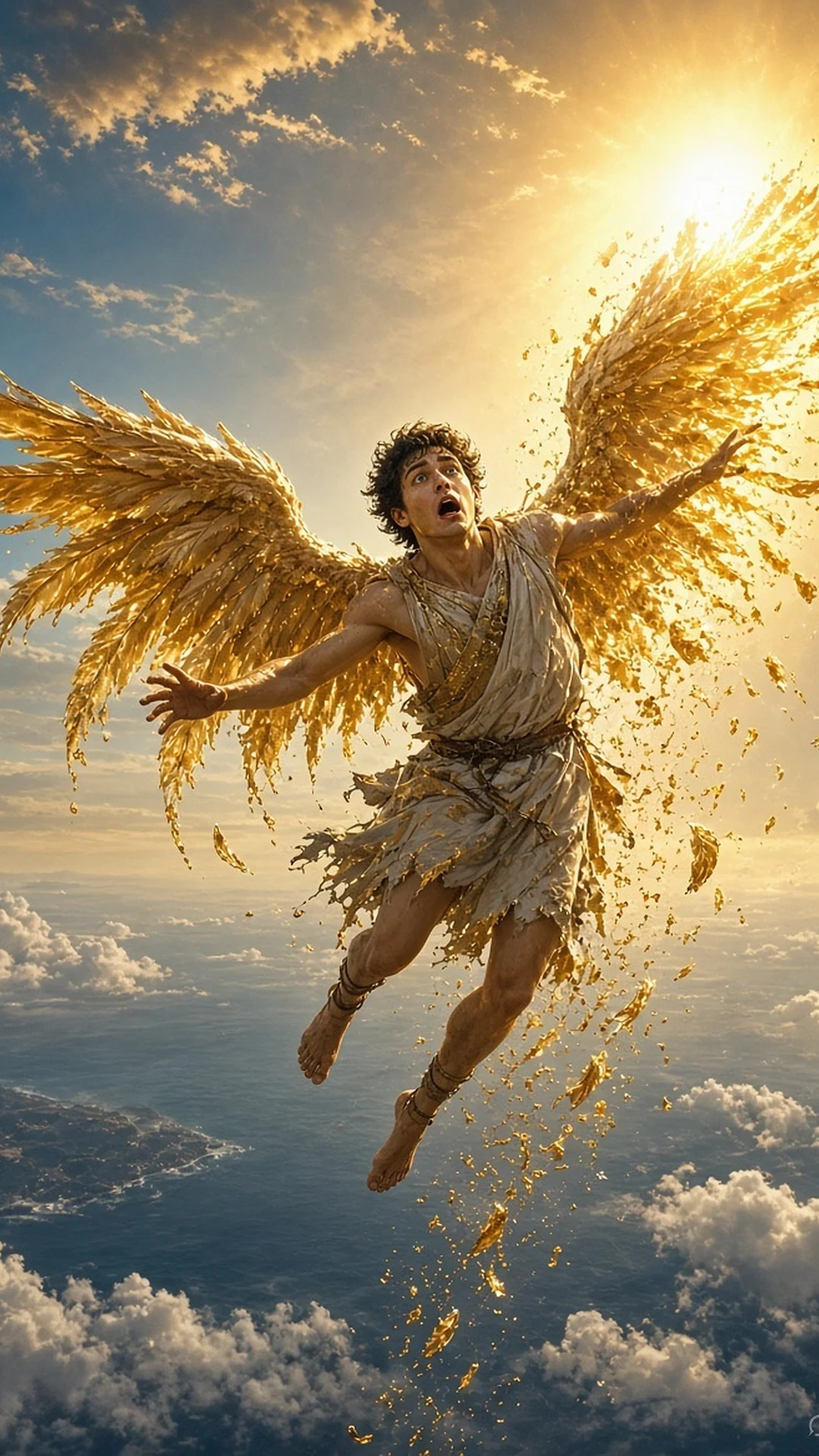
Icarus story in five stages
| Stage | What happens | Theme |
|---|---|---|
| Confinement | Minos blocks departure from Crete | Restricted freedom |
| Invention | Daedalus makes feather-and-wax wings | Human ingenuity |
| Warning | Father recommends the middle course | Two opposing risks |
| Flight | Icarus rises higher than advised | Joy and overconfidence |
| Fall | Wax softens, wings fail, son drowns | Tragic consequences |
| Aftermath | Daedalus grieves and buries Icarus | Loss and responsibility |
Icarus Greek mythology: five FAQs
Who were Icarus’s parents?
Daedalus is his famous father; the mother’s identity is less central and varies in later traditions.
Why did Icarus fly too close to the sun?
In Ovid’s version he becomes delighted with flying, leaves Daedalus’s guidance and rises too high.
What were Icarus’s wings made of?
Feathers arranged with thread and held with wax in Ovid’s detailed account.
Did Zeus or Apollo kill Icarus?
No. In Ovid he falls because the sun’s heat softens the wax and the wings lose their feathers.
What is the meaning of the Icarus story?
Often interpreted as a warning about overconfidence and ignored advice, but it also explores freedom, invention and parental grief.
Sources and conclusion
The principal detailed surviving version is Ovid, Metamorphoses Book 8, lines 183–235. For an additional English translation compare York University’s Ovid Book 8 text, and for the Cretan myth cycle see Apollodorus, Library Book 3. Conclusion: Icarus’s tragedy begins with a daring invention, continues with a father’s balanced warning and ends when a joyful flight becomes fatal. Updated 14 November 2026. Images are creative interpretations, not historical photographs.










Share Your Opinion
Comments are closed on this post.