 Vista

The Medusa story is one of the most famous—and most frequently misunderstood—myths from ancient Greece. Medusa is widely pictured with snakes for hair and a gaze that turns people to stone, yet her origin is not told in the same way by all ancient authors. In Hesiod’s Theogony, she is the only mortal one among three Gorgon sisters, with no full narrative of being transformed from a human woman. Centuries later, the Roman poet Ovid tells a different version involving her former beauty, sexual violence by Neptune and a punishment imposed by Minerva. To understand who Medusa was, why Perseus killed her and what the “curse” actually means, the two accounts must be kept separate.
Who was Medusa in Greek mythology?
Medusa belongs to a family of frightening beings called the Gorgons. Hesiod places them beyond the great Ocean near the Hesperides, at the far reaches of the mythic world. Their names are Stheno, Euryale and Medusa. The first two are immortal in this genealogy, but Medusa is mortal, allowing the later story of her death at Perseus’s hands. Her parents are the sea-related figures Phorcys and Ceto. These relationships matter because modern retellings often show Medusa as a solitary creature with no ancestry or sisters at all.
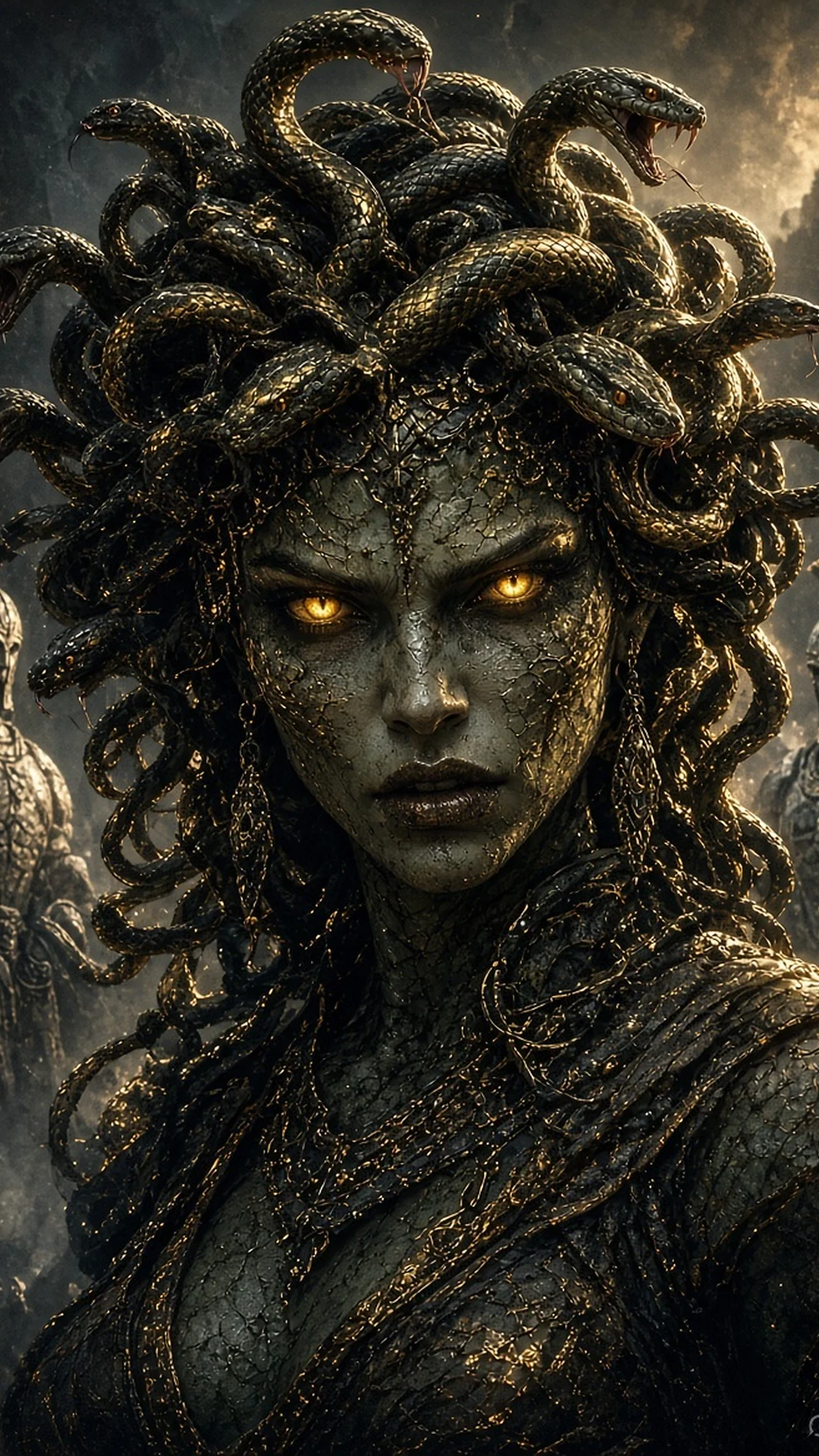
Ancient depictions of Gorgons were not always identical to the glamorous snake-haired portraits now popular online. Early Greek art frequently uses a broad face, staring eyes and terrifying expression as a protective image. Later artists and poets could portray Medusa with increasing human beauty. That visual history helps explain why there are so many variations in appearance. A modern realistic poster is an artist’s interpretation, not an archaeological photograph or a reconstruction guaranteed to match every era.
Hesiod’s version: Medusa the mortal Gorgon
In Theogony roughly lines 270–283, Hesiod names Medusa among the Gorgons born to Phorcys and Ceto. He says that the sea god Poseidon lies with her in a meadow of spring flowers. The passage gives no detailed account of Athena punishing Medusa by turning her beautiful hair into snakes. It then moves to Perseus beheading her and to the extraordinary birth of Pegasus, the winged horse, and Chrysaor from Medusa. This is a compact genealogy and event sequence rather than the long psychological origin story now associated with the character.
It is important to avoid reading words into the poem that are not there. Hesiod does not narrate the familiar temple incident of Ovid, and the nature of the encounter with Poseidon should not automatically be described using every detail from the later Roman poet. A summary that says “in the original Greek story Athena cursed Medusa for being assaulted” silently merges two separate literary versions and gives readers an incorrect timeline of sources. For this early account, a reliable translation of Hesiod is the clearest evidence.
Ovid’s later story: beautiful hair, Neptune and Minerva
In Metamorphoses Book 4, around lines 794–803, Ovid recounts a later Roman version through a speech attributed to Perseus. Medusa had once been admired for her beauty, particularly her hair. Neptune, the Roman counterpart of Poseidon, sexually violates her in a temple of Minerva, the Roman counterpart of Athena. Ovid describes Minerva responding to the desecration of her sanctuary by transforming Medusa’s hair into serpents. This is the source behind many modern questions about whether Athena “cursed” Medusa and why the victim of an assault was punished.
The episode involves sexual violence and should not be rewritten as a romantic meeting or blamed on Medusa’s beauty. But even here responsible writing requires care: interpretations of Minerva’s motives, whether Medusa was a priestess and what the passage implies have been debated by scholars. Ovid does not simply provide proof that every earlier Greek author told the same incident. He is a Roman poet creating a distinctive literary narrative centuries after Hesiod. The chronology of those sources is essential to the story’s meaning.

Why did Medusa have snakes for hair?
For many readers snake hair is Medusa’s defining feature, yet the answer depends on which version they mean. In the later Ovidian transformation story, Minerva changes her admired hair to snakes after the violation at the temple. In the early Hesiodic summary, she is already described as one of the Gorgons, and the poem does not provide that specific explanation of a change from human beauty to snakes. The artistic Gorgon tradition also predates much of the modern narrative synthesis.
The snake-haired image has acquired new meanings across time. In protective art it can repel threats; in modern storytelling it may symbolize danger, injustice, survival or power taken away. These readings can be interesting, but an editor should mark them as interpretations rather than pretend they are statements from Hesiod. A useful myth explainer can acknowledge why the character resonates now while giving its readers precise information about the surviving texts.
What was Medusa’s power: could her gaze turn people to stone?
The most familiar developed narrative gives Medusa’s head the ability to turn those who look directly at it into stone. It becomes important to the story of Perseus because the hero must approach without facing the dangerous gaze. The mythographer Apollodorus and later storytelling traditions elaborate the equipment and precautions of this quest. The severed head retains its frightening power in many versions, enabling Perseus to confront enemies after he leaves the Gorgons’ dwelling.
That power should not be confused with an established natural phenomenon. Mythological petrification is a supernatural plot device. Some retellings blur whether it is Medusa’s eyes, whole face or the detached head that produces the effect; the safest approach is to describe the power in the context of a named story. Similarly, if an illustration depicts characters frozen into marble, the scene is symbolic and should not be labelled as real ancient evidence.
How did Perseus defeat Medusa?
Perseus is sent on an apparently impossible quest to obtain Medusa’s head. In the fuller version traditionally attributed to Apollodorus, he receives aid associated with Athena and Hermes. Special equipment includes a blade, a carrying bag, winged sandals and a cap of invisibility. To avoid directly confronting the Gorgon’s dangerous face, he looks at her reflection in a polished shield. He beheads her while she sleeps in that version and escapes pursuit by her sisters.
Hesiod already knows that Perseus kills Medusa and that Pegasus and Chrysaor emerge afterward, but his poem is much shorter and does not contain all the details of the developed quest. The distinction is important for avoiding keyword overlap with a separate article focused on Perseus and Medusa, which can cover Perseus’s own childhood, the Graeae, the quest and the rescue of Andromeda. The present article concentrates on Medusa’s identity and different origin traditions rather than retelling every stage of Perseus’s life.
What happened to Medusa’s head, and why is it on Athena’s shield?
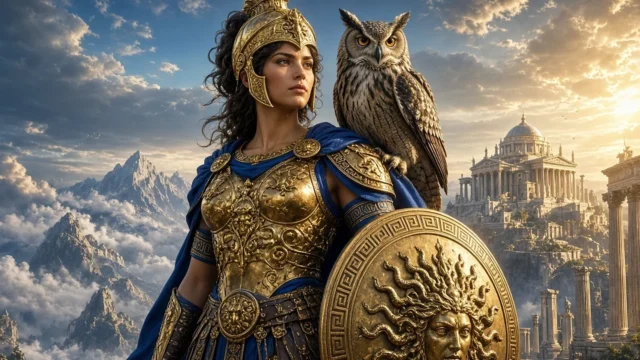
In many versions, the Gorgon’s head continues to serve as a weapon or protective emblem after the beheading. Perseus uses it against opponents, and Athena eventually displays the head on her aegis. The image is often called the Gorgoneion. Similar terrifying faces also appear in protective art and architecture. A face that frightened viewers could be used symbolically to ward off harmful forces; art historians call that kind of protective purpose apotropaic.
It would be misleading to conclude that every Gorgon mask on an ancient artifact depicts one moment from Ovid’s temple story. The visual symbol, the early genealogies and the later transformation narrative belong to overlapping but not identical traditions. Understanding this separates the old protective image from the familiar modern fantasy monster. It also explains why Medusa’s face can appear on Athena’s equipment even though the two characters’ relationships vary across sources.
Medusa: victim, monster or misunderstood figure?
Modern audiences often ask whether Medusa was a villain or a victim. Hesiod’s short account calls her a mortal Gorgon who meets a tragic fate; it is not a detailed moral trial. Ovid’s later story introduces sexual violence and the transformation that provokes questions about divine injustice. Movies, novels and contemporary art may further reimagine Medusa as a survivor, guardian or symbol of resistance. Those interpretations deserve to be discussed without overwriting what the ancient texts actually say.
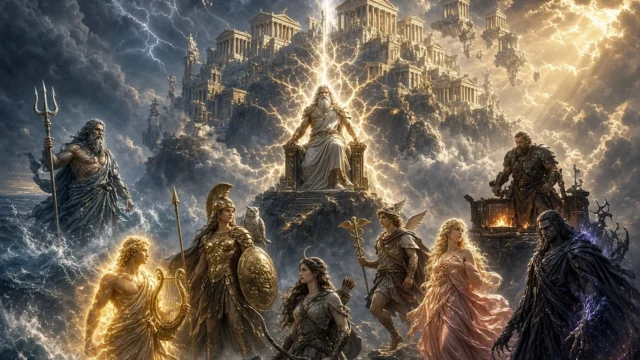
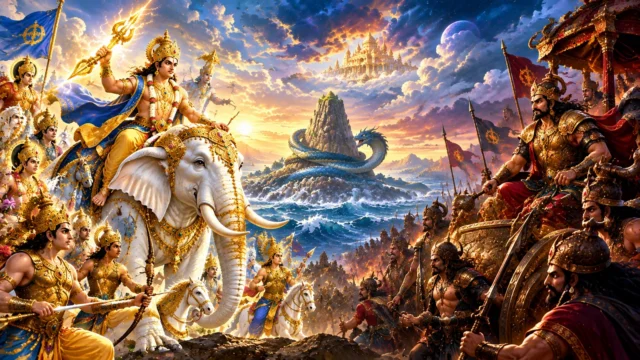
A careful answer is that Medusa has several literary identities across time. “The original story” is often a misleading phrase when it assumes every familiar episode belonged to a single first version. We can compare evidence without pretending to know an unrecorded perfect source. For cross-cultural curiosity, see our already published Greek vs Hindu mythology overview; no direct identification of Medusa with an Indian mythic figure is necessary or supported.
Medusa story FAQs
Was Medusa born a monster?
Hesiod introduces her as a mortal Gorgon without the later narrative of a transformed beautiful maiden. Ovid tells a different Roman-era origin.
Why did Athena punish Medusa?
In Ovid’s version, Minerva changes her hair after Neptune’s sexual assault in the goddess’s temple. The incident is not narrated that way by Hesiod.
Who were Medusa’s parents and sisters?
Hesiod names Phorcys and Ceto as parents and Stheno and Euryale as her two immortal Gorgon sisters.
Who killed Medusa?
The Greek hero Perseus beheads Medusa, with divine help and protective equipment detailed in later mythographic accounts.
Were Pegasus and Medusa related?
Yes. In Hesiod’s account, the winged horse Pegasus and Chrysaor emerge when Perseus cuts off her head.
Verified sources and conclusion
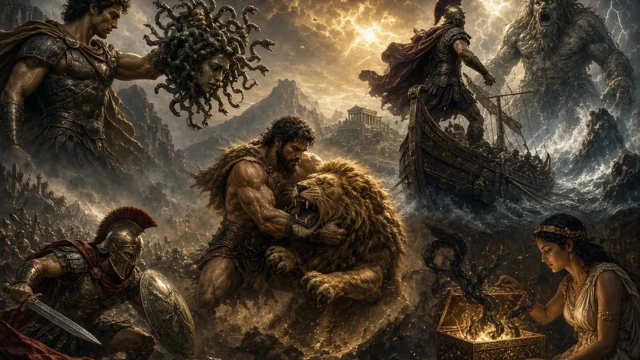
Read Hesiod, Theogony 270–283, Ovid, Metamorphoses 4.794–803, Apollodorus, Library Book 2, and the Harvard Center for Hellenic Studies translation. Conclusion: Medusa cannot be explained responsibly by merging Hesiod’s Gorgon, Ovid’s transformed maiden and modern retellings into one unqualified story. Name the source, then tell its version clearly. Updated 14 November 2026. Illustrations are imaginative artworks.
















Share Your Opinion
Comments are closed on this post.