 Vista
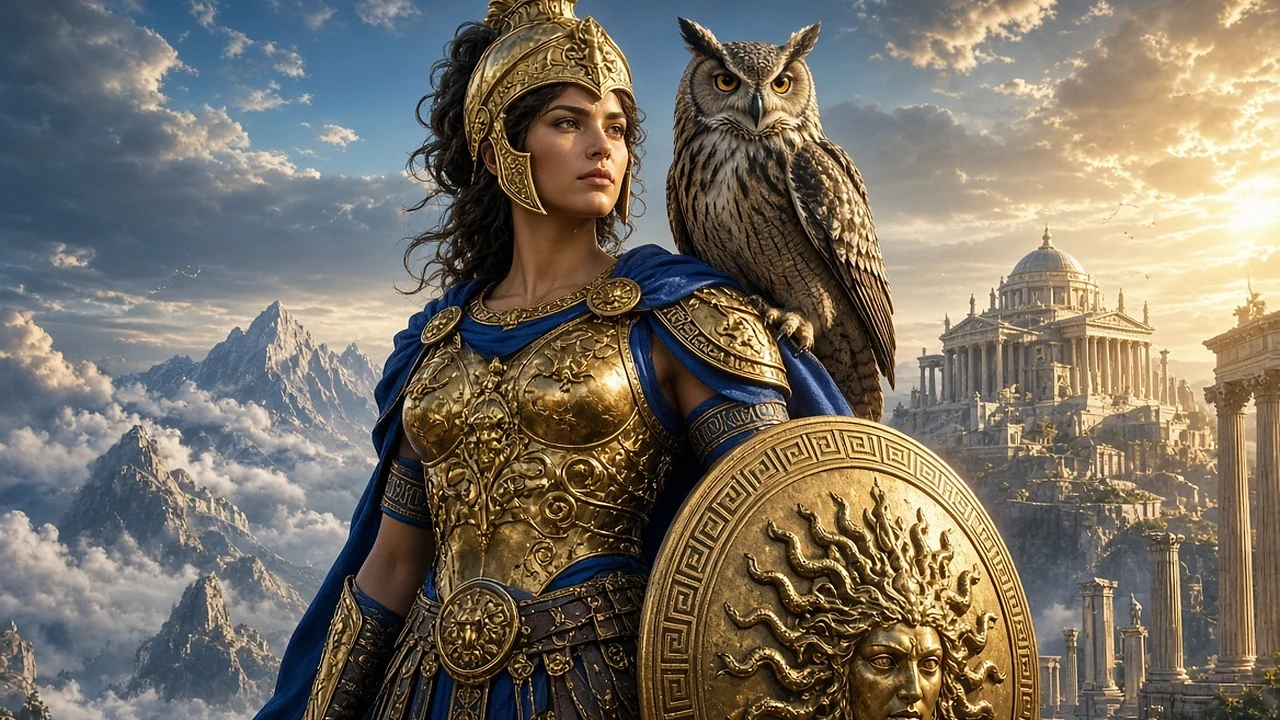
Athena in Greek mythology is the goddess of wisdom, strategic warfare, skilled crafts and the protection of cities. Her most famous symbols are the owl, olive tree, helmet, spear and aegis, a protective garment or shield often depicted with a Gorgon’s head. Ancient authors tell an extraordinary story of her birth: she emerges armed from the head of Zeus after he has swallowed Metis. Athena is also central to the mythical foundation of Athens and appears as a helper of heroes such as Perseus and Odysseus. Understanding her means more than calling her “the war goddess”: her identity combines judgment, skill, foresight and civic order.
Who was Athena, the Greek goddess of wisdom?
Athena belongs to the Olympian family and is especially associated with the city of Athens. Ancient Greek sources emphasize different facets of her role. In epic poetry she can guide a warrior or defend a favored hero; in city worship she represents protection and collective identity; and in craft traditions she presides over weaving and other disciplined skills. Her association with war differs in tone from that of Ares, whose portrayal more often emphasizes violent conflict. That contrast is useful, though it should not be exaggerated into a claim that Athena never joins actual battles or Ares has no purpose beyond evil.
The Roman goddess commonly identified with Athena is Minerva. Roman literature and religion adopted many Greek motifs, but a Roman name is not evidence that all attributes and practices were identical at every date. Images of a helmeted woman with an owl may suggest Athena, yet ancient iconography should be read with context. Her attributes are clues rather than a scientific identification formula.
How was Athena born from Zeus’s head?
Hesiod’s Theogony describes Zeus taking Metis, whose name is associated with counsel or cunning intelligence, as a wife. A prophecy warns him of a succession threat connected with the children of Metis. Zeus swallows her while she is pregnant. Later Athena emerges from his head, fully associated with power and warfare. Hesiod’s text connects the story to a wider pattern: the fear of a powerful child and the transfer of cosmic rule. Zeus’s earlier conflict with Cronus, his own father, gives this pattern additional meaning.
Some later versions provide further details about the opening of Zeus’s head, assigning a role to Hephaestus or another figure. The details can vary, so an illustration showing a particular god using an axe should not be passed off as the exact wording of every source. The central source-based points are Metis, the swallowing, and Athena’s extraordinary birth from Zeus. The tale is mythology, not a claim about biological reproduction or a historically observed event.
Why are the owl, olive tree and aegis Athena’s symbols?
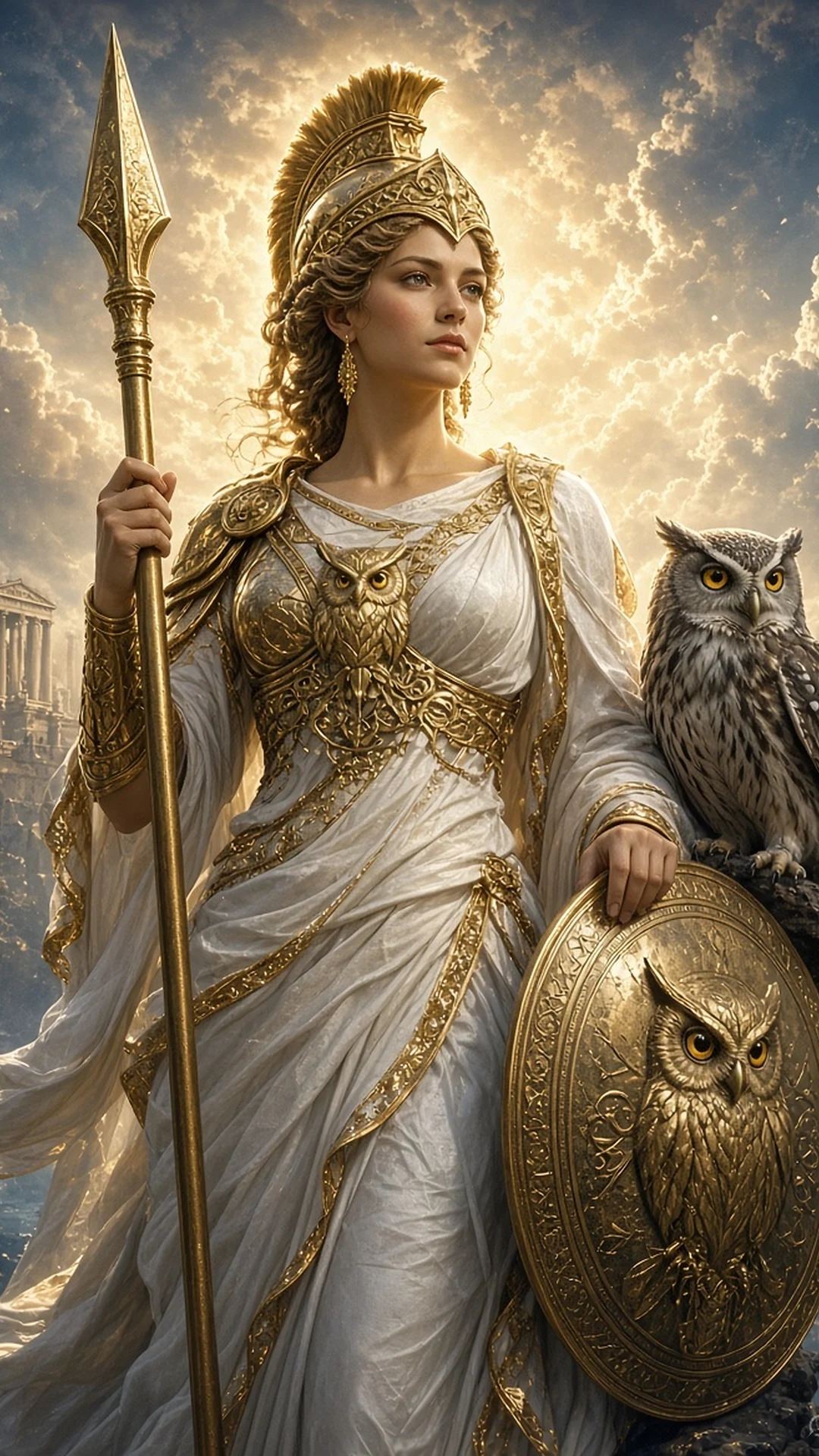
The owl is one of Athena’s most recognizable companions in art, particularly in the civic imagery of Athens. It evokes a connection with watchfulness and is now popularly treated as a symbol of wisdom. The olive tree becomes central in a story in which Athena competes with Poseidon to be patron of Athens. The aegis, often shown as a protective cloak or shield, marks her martial authority. In some artistic traditions its center shows the Gorgoneion, the frightening face of Medusa.
A helmet and spear identify Athena’s ability to intervene in conflict, but her role also encompasses orderly work, intelligent planning and technical arts. A single picture showing all these symbols is a useful modern summary, not evidence that every ancient sculpture combined them. Likewise, the association of “wisdom” with the owl is a helpful explanation but should not be presented as the only reason ancient artists depicted the bird.
Athena vs Poseidon: who became patron of Athens?
The contest for Athens is one of Athena’s best-known city legends. Athena and Poseidon both offer signs of their power to the community. In a widely told version Poseidon produces a salt-water spring on the Acropolis, while Athena offers an olive tree. The gifts represent different benefits and claims to patronage. The city’s choice favors Athena and its name is connected with her. In other versions the details of Poseidon’s gift, the judges or the outcome vary, so the image of “a horse versus an olive tree” should not be treated as the only universal account.
The story is interesting because it presents the welfare of a city as a question of competing divine gifts. It is not evidence that an actual contest between immortal beings took place on a known date. Ancient Athenian traditions and landmarks give the legend cultural importance. A sound modern retelling can explain the claim of each deity without turning the result into an insult to Poseidon or assuming Athens never honored him in other ways.
Why did Athena help Perseus and Odysseus?
In the Perseus and Medusa cycle, Athena and Hermes are associated with assistance to the hero. The mythographer Apollodorus describes useful equipment and guidance that allow Perseus to approach the dangerous Gorgon. Perseus is often shown using a polished shield to avoid Medusa’s direct gaze. Athena later receives or displays the Gorgon’s head as an emblem of protective power. This is a story about clever preparation as much as a triumph of physical strength.
In Homer’s Odyssey, Athena plays an active part in Odysseus’s homecoming and the fortunes of his son Telemachus. She advises, protects, disguises and helps arrange events, while Odysseus must still make difficult decisions. Her involvement is not a promise that the hero will avoid all suffering. Instead, it links intelligence and survival to the goddess’s character. The role of Athena in the Trojan War is also significant: in the Iliad she usually supports the Achaean or Greek side against Troy.
Did Athena curse Medusa? The crucial Greek–Roman distinction
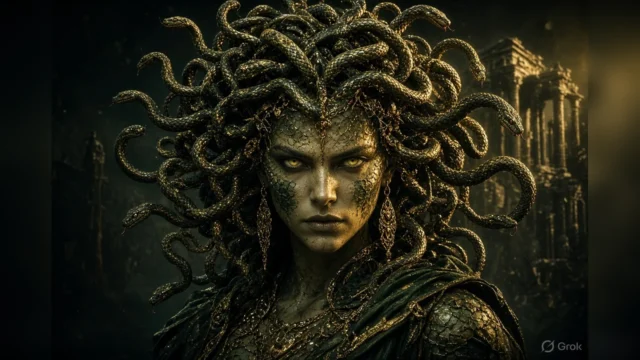
One of the most searched questions about Athena concerns Medusa’s transformation. It is important to separate the surviving sources. In Hesiod’s Theogony, Medusa is introduced as one of three Gorgon sisters, the mortal one, without a preceding narrative in which Athena changes her from a beautiful maiden. Hesiod also describes her union with Poseidon and the birth of Pegasus and Chrysaor after Perseus beheads her.
By contrast, the Roman poet Ovid, in Metamorphoses Book 4, describes Medusa as formerly beautiful and recounts Neptune violating her in Minerva’s temple. Minerva turns Medusa’s hair into snakes. This later transformation narrative should not be copied into Hesiod as though it were always the original Greek version. Modern interpretations question the punishment and the treatment of Medusa; those ethical discussions can be included with care, but they are interpretations of a particular textual version. Readers deserve to know what the ancient author actually wrote.
Athena and Arachne: skill, competition and a later famous myth
Athena’s connection with weaving becomes especially vivid in the story of Arachne. In Ovid’s Metamorphoses Book 6, the gifted mortal weaver challenges Minerva, and the encounter ends with a dramatic transformation. This Roman literary narrative highlights both artistic skill and a dangerous dispute over pride and divine power. It has become one of the best-known stories associated with Athena, but its source must be identified accurately rather than described as a scene from Homer.
In general, Athena’s associations with crafts, weaving and wise action form a coherent character: she is not simply a passive embodiment of intelligence, and she does not exist to guarantee that everyone who follows her receives a happy ending. Different Greek and Roman writers use her to explore different conflicts. Comparing the source, period and context prevents the popular image of a flawless goddess from replacing the complex ancient figure.
What is Athena’s connection with Indian mythology?
Readers sometimes compare Athena with figures representing knowledge, skill or protective power in Indian traditions. Such comparisons can illuminate broad themes, but Athena is not historically established as another name for Saraswati or Durga. The family relationships, literary histories, worship and symbols differ. Our Greek vs Hindu mythology comparison explains how to discuss similarities without erasing those differences.
FAQ: Athena in Greek mythology
Who were Athena’s parents?
Zeus and Metis are associated with her parentage in Hesiod. Athena is famously born from Zeus’s head after he swallows Metis.
What is Athena the goddess of?
Wisdom, strategic warfare, crafts, and the protection of cities are among her principal domains.
What animal symbolizes Athena?
The owl is her most recognizable associated animal, especially in imagery connected with Athens.
Why did Athens choose Athena over Poseidon?
In the popular version of the contest myth, her gift of an olive tree wins patronage over Poseidon’s salt-water spring. Versions differ.
Did Athena curse Medusa in the earliest Greek source?
The detailed transformation story is told by the later Roman author Ovid. Hesiod does not narrate that transformation in his account of Medusa.
Sources and conclusion
Useful texts: Hesiod’s Theogony for birth and genealogy; Apollodorus, Library 2 for the Perseus quest; Ovid, Metamorphoses Book 4 for the later Medusa account; and Theoi’s Athena dossier. Conclusion: Athena combines knowledge, protection, skilled work and strategy; her best-known stories become clearer when their Greek and Roman literary sources are kept distinct. Updated 14 November 2026. Images are artistic interpretations.

















Share Your Opinion
Comments are closed on this post.