 Vista

Quick answer: Karma means action and, in many Hindu philosophical contexts, the consequences associated with intentional action. Dharma means the principles, duties and order that help determine which actions are appropriate. In a simple everyday example, speaking to a colleague is karma—something you do—while speaking truthfully and respectfully because it is the right thing to do is an expression of dharma. The two are closely connected, but they are not synonyms. Karma is not merely “fate,” and dharma does not always mean organized religion.
When people ask “What is the difference between karma and dharma in Hinduism?”, the real answer is more useful than the familiar internet slogans. Both words have varied meanings in the Bhagavad Gita, the epics, philosophical schools and everyday Indian languages. This guide explains those differences without pretending there is a single definition agreed upon by every Hindu community.
What Is Karma? Action, Intention and Consequence
The Sanskrit word karma fundamentally refers to an action or deed. In many Hindu traditions, it also describes the moral and spiritual relationship between deliberate actions and their consequences. What someone chooses to do, why they do it and how it affects other beings are important aspects of discussions of karma. Some classical traditions distinguish different categories of actions, including rituals, ordinary conduct and acts performed with or without attachment to results.
That is why the phrase “karma means whatever happens to you” is incomplete. Karma is not simply a mysterious punishment sent from outside, and it is not a tool for blaming people who experience illness, poverty or injustice. Different schools debate the nature of karmic causation, the role of divine grace and liberation, and how actions relate to future lives. It would be misleading to turn those debates into a universal rule about every individual hardship.
In daily language, karma can also mean the work in front of you: studying, caring for family, earning a living, keeping a promise or participating in public life. Not every action has the same moral quality. A generous act and a deceptive act are both actions, but they are evaluated differently. Karma therefore tells us that action matters; it does not, by itself, give a complete moral guide to what ought to be done.
What Is Dharma? Duty, Ethics and Sustaining Order
Dharma is harder to translate into one English word. Depending on context, it may mean duty, right conduct, ethical order, law, teaching, a way of life or the principles that sustain a community and the world. In an epic narrative, a character may struggle to identify their dharma because several serious responsibilities pull in opposite directions. In a philosophical discussion, dharma may refer to a wider moral or cosmic order. In some Indian languages, the word is also used for religion, but that is only one of its meanings.
Dharma should not be reduced to “follow whatever your family or society tells you.” Historical descriptions of social duties, including those tied to status and gender, require critical context. Traditions have evolved and been disputed, and modern ethical life must also account for dignity, consent, equality and the law. A fair modern explanation can discuss how inherited roles appear in ancient texts without presenting discrimination as obligatory.
In practical terms, dharma asks questions such as: Is this honest? Does it protect someone who depends on me? Am I fulfilling a legitimate responsibility? Does my choice harm people unnecessarily? Do my duties conflict, and what is the least harmful reasonable course? These questions do not always have easy answers. That difficulty is precisely why dharma occupies so much space in Hindu narrative literature.
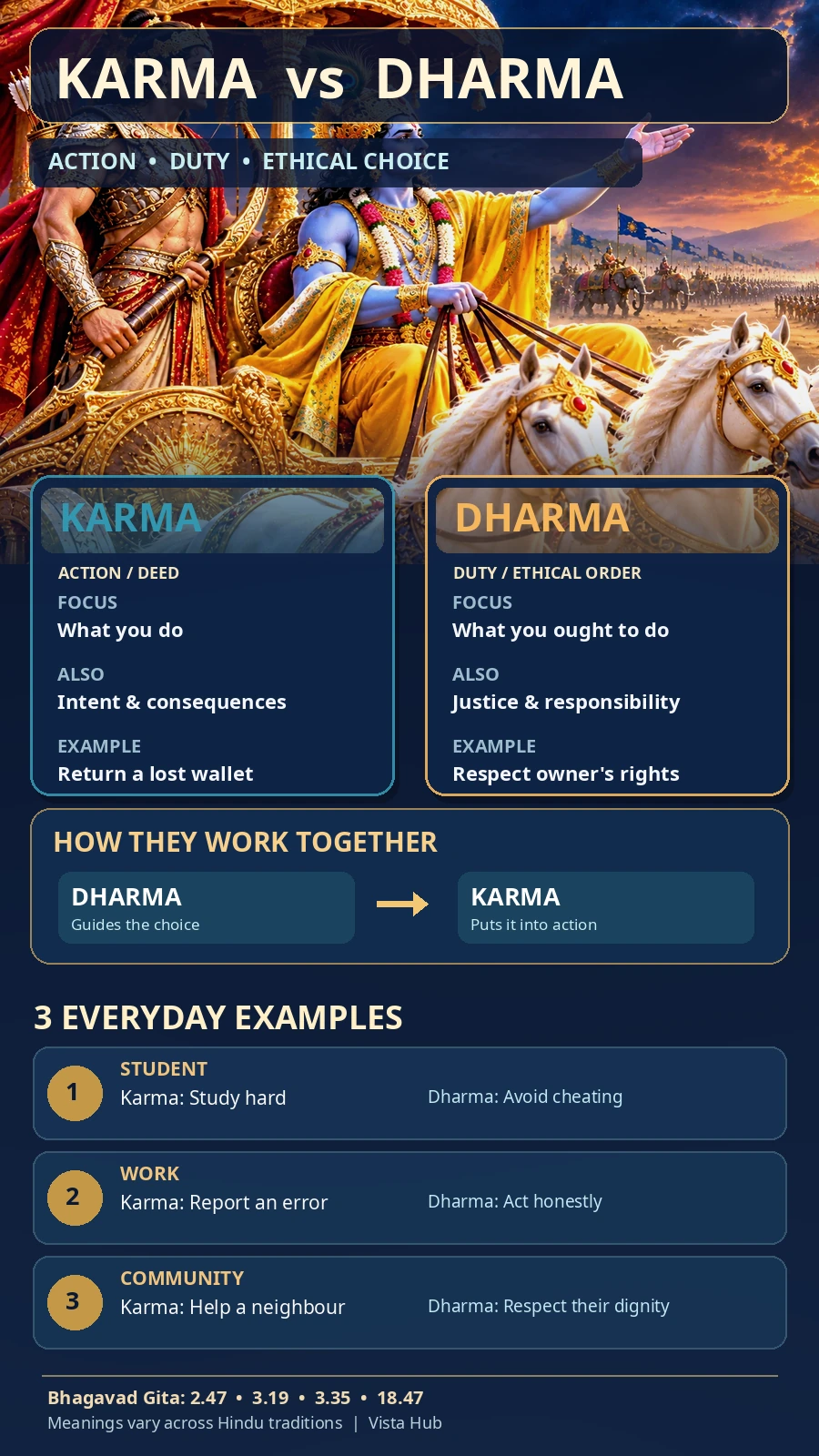
Karma vs Dharma: The Difference at a Glance
| Question | Karma | Dharma |
|---|---|---|
| Basic sense | Action, deed; also its moral consequences | Duty, ethics, right order, sustaining principles |
| Main question | What am I doing, and what follows from it? | What ought I do in this situation? |
| Focus | Conduct, intention and consequences | Responsibility, judgment and right conduct |
| Example | Returning a lost wallet is an action | Honesty and concern for its owner guide that action |
| Common mistake | “Karma is instant cosmic revenge” | “Dharma means only religion or blind obedience” |
| In the Gita | Action without attachment to results | Fulfilling one’s relevant duty with discernment |
This table is a learning aid, not a rigid formula. A Sanskrit word can have a range of meanings, and the Gita itself moves between the language of action and duty. Actions may be performed in line with dharma—or in ways that violate it. Dharmic intention does not remove the need to assess actual harm. Someone can believe that they are doing their duty and still be mistaken about what justice requires.
How Karma and Dharma Work Together
One useful way to describe the relationship is dharma guides the choice; karma is the action taken. Imagine a teacher notices a student being treated unfairly. The teacher’s responsibility to respond with fairness can be understood as dharma. Listening, investigating and taking appropriate steps are karma—the concrete acts through which that responsibility is fulfilled. Their consequences, good or harmful, are also relevant when people evaluate the action.
Or consider a small business owner who discovers a billing mistake that benefited the shop. Keeping the extra money may be easy, but honest business practice points toward correcting the error. The refund is an action. Honesty, fairness and responsibility shape its moral direction. This example shows why “good karma” is not a replacement for ethical thinking. The owner must still consider the specific facts and the people affected.
Sometimes the best action is to decline an unsafe request. A person pressured to reveal private information can meet their duty of confidentiality through refusing. This, too, is action. Hindu discussions of action do not have to be interpreted as a command to stay busy at any cost; the quality and context of decisions matter. The relationship between karma and dharma becomes clearer when the words are applied to real choices rather than treated as decorative labels.
What the Bhagavad Gita Actually Says
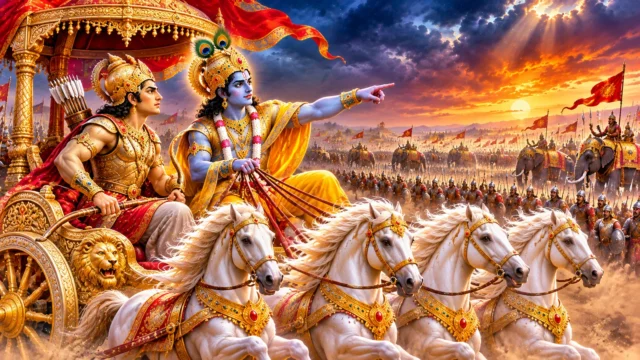
The Bhagavad Gita offers a central setting for this discussion: Arjuna faces a moral crisis on the battlefield of Kurukshetra. His responsibilities as a warrior, his relationships and the consequences of conflict pull against one another. Krishna does not simply give him a slogan. The dialogue explores action, knowledge, devotion, self-understanding and the discipline of duty.
Bhagavad Gita 2.47 emphasizes doing the work that is yours to do without becoming attached to controlling every result. It also cautions against becoming attached to inaction. This is not permission to neglect planning, accountability or other people’s well-being. The verse is often used to explain karma yoga, a disciplined approach to action that changes one’s relationship with reward and ego.
Bhagavad Gita 3.19 similarly speaks of performing what ought to be done without attachment. Bhagavad Gita 3.35 and 18.47 discuss svadharma—one’s own duty—in language that has been interpreted differently by commentators. Some traditional readings connect duties with historical social and occupational categories; modern readers should not silently substitute today’s professional self-help ideas for that original social context. Equally, an ancient text cannot be used without reflection to justify unjust conduct in the present.
For a comparison of translations and commentaries, consult the IIT Kanpur Gita resource on 2.47, 3.19, 3.35 and 18.47. Different translations are valuable because a single English phrase may not carry every shade of the Sanskrit.
Is Karma the Same as Fate? Three Common Myths
Myth 1: Karma is a punishment that arrives immediately. Reality: classical discussions of karma are more varied and often include consequences across long stretches of time. Ordinary cause and effect also matters. Missing a deadline can have consequences because people and systems respond to delays, not because anyone has measured a supernatural force.
Myth 2: A person’s suffering proves they did something wrong. Reality: this is an ethically dangerous assumption. Illness, disability, discrimination and disaster have complex causes; sufferers deserve assistance, not moral accusations. Beliefs about karma should not replace empathy, medical care or work against injustice.
Myth 3: Dharma means obeying any authority figure. Reality: the epics contain difficult disputes about competing duties. Loyalty can conflict with truth; family obligations can conflict with wider responsibilities. Ethical reflection is needed rather than automatic obedience. The Mahabharata is memorable precisely because otherwise admirable characters face hard choices and sometimes fail.
These misconceptions are common because brief internet posts promise simple certainty. The words become more illuminating when their complexity is preserved. Neither karma nor dharma should become a shortcut for judging people without knowing their circumstances.
Real-Life Examples: Student, Family, Workplace and Society
Student: Preparing carefully for an exam is karma. Refusing to cheat, respecting classmates and learning with integrity express dharma. A disappointing score need not mean the student has accumulated “bad karma.” Effort and outcome are connected, but many other factors contribute.
Family caregiver: Giving medication as prescribed, coordinating appointments and listening patiently are actions. The commitment to care, safety and respect helps guide those actions. If the caregiver is exhausted, seeking help can also be a responsible choice. Dharma is not a demand for unlimited self-sacrifice.
Employee: Reporting an important error may feel risky. The act of reporting belongs to the field of karma; professional honesty and concern for customers shape the relevant duty. The employee should use appropriate procedures and consider legal protections, rather than assuming a religious label automatically makes every action safe.
Friendship: A friend confides a serious problem. Listening with discretion is an action; protecting privacy and responding with care are ethical responsibilities. When someone is at risk of immediate harm, safety may require seeking appropriate help rather than promising absolute secrecy.
Community: Donating money is an action, but giving responsibly also requires checking whether an organization is legitimate and whether its work benefits people. Intention matters, but so do practical consequences. These examples show that karma and dharma work together most meaningfully when ethics is tied to actual conduct.
Karma Yoga, Nishkama Karma and Svadharma Explained
Karma yoga is often described as a spiritual discipline of performing action in a way that reduces attachment and ego. Nishkama karma is commonly used for action without selfish desire for its fruits. Neither phrase means becoming careless about outcomes. A doctor must still follow sound treatment standards; a student should still revise mistakes. The distinction concerns attachment and motivation, not professional negligence.
Svadharma literally signals one’s own dharma, and the Gita links it to a context of responsibility and nature. The term’s traditional background is complex and cannot be flattened into “do whatever you enjoy.” A difficult duty might be necessary even when it is not pleasurable. In modern use, people may reflect on personal strengths and ethical roles, but they should clearly distinguish this interpretation from the historical context of a particular commentary.
Another frequent term is adharma, conduct understood as opposed to dharma, such as serious injustice or deceit. Calling someone adharmic is a strong judgment and should not substitute for evidence or fair procedure. The practical question is whether a choice respects truth, rights, safety and legitimate responsibilities. These terms become useful when they sharpen moral reflection rather than shut down discussion.
What Do the Ramayana and Mahabharata Teach About Duty?
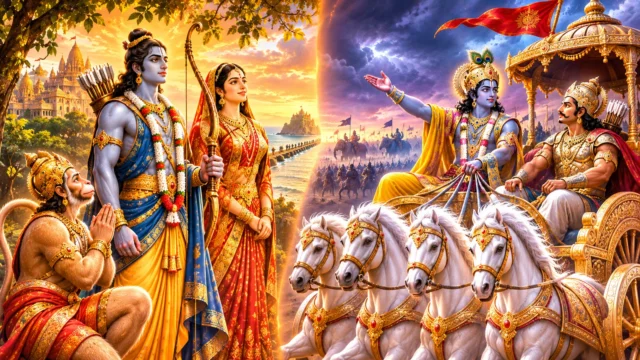
The Ramayana frequently explores promises, family loyalty, kingship and the pain of choosing one responsibility over another. It can be read as an epic of ideals, but its dilemmas invite genuine debate. Rama’s commitments, Sita’s agency and the choices of other characters cannot be reduced to a single easy slogan. Readers can explore our English guide to life lessons from the Ramayana for another entry point.
The Mahabharata goes further in foregrounding collisions between duties. Arjuna’s dilemma, Karna’s loyalty, Bhishma’s vows and the actions of the Kauravas raise difficult questions about promises, justice and consequences. A vow may be sincerely held yet have devastating effects when applied without moral judgment. See our Kurukshetra war rules and 18-day timeline for a connected discussion.
Neither epic is a modern legal handbook or a substitute for careful understanding of another person’s circumstances. Their value lies partly in showing how action and duty become difficult to separate when the stakes are high. A person can be energetic and talented while acting in an ethically misguided way; someone with admirable intentions may still need to reconsider their choices and consequences.
How to Apply Karma and Dharma Without Misusing Them
Begin with a concrete decision rather than asking whether a magical reward is waiting. Write down what you know and what you do not know. Identify who may be affected. Ask which responsibilities are legitimate and whether competing obligations can be balanced. Then consider lawful, safe options and choose an action you can explain honestly to those affected.
After acting, review what happened. Were you truthful? Did you overlook someone’s perspective? Can you correct a mistake or make amends? This reflective process is more useful than treating every success as proof of virtue or every setback as deserved punishment. The language of karma and dharma may offer spiritual meaning, but it should support rather than replace responsible judgment.
A final caution: a religious concept cannot justify abuse, discrimination, delaying medical treatment or refusing help to someone in distress. Those harms require practical support and accountability. Compassion and factual understanding belong in the conversation, alongside respect for the many Hindu traditions that interpret these terms.
FAQs About Karma vs Dharma
1. What is the main difference between karma and dharma?
Karma refers primarily to action and, in many traditions, the consequences of action. Dharma refers to duties, ethical principles and sustaining order that help guide action.
2. Is dharma the same as religion?
Not always. Dharma can mean religious teaching in some contexts, but it can also refer to duty, justice, ethical conduct and wider order.
3. Can someone have good karma but ignore dharma?
These labels are not easily separated into a universal score. A beneficial outcome does not automatically make the underlying action morally right. Evaluate intention, means, duties and harm.
4. Does the Bhagavad Gita say not to care about results?
Gita 2.47 cautions against attachment to results while emphasizing action and rejecting an attachment to inaction. It should not be read as advice to act irresponsibly.
5. What is svadharma?
Svadharma is one’s own duty. Its meaning has a complex traditional context involving prescribed responsibilities, and modern interpretations should be clearly identified as such.
6. Is karma a punishment for bad deeds?
Karma is not simply instant punishment. Hindu philosophical explanations vary, and it is wrong to assume that someone suffering a hardship must be morally at fault.
7. What is a simple karma and dharma example?
Returning a lost wallet is an action (karma). Respecting the owner’s property and choosing honesty are ethical considerations associated with dharma.
Conclusion: Dharma Gives Direction, Karma Puts It into Practice
Karma and dharma are connected but different: action and its consequences on one side, responsibility and moral direction on the other. The Bhagavad Gita’s teaching becomes richer when we see both together: act, examine your duty, resist selfish attachment and remain accountable for what you do. Hindu schools differ in their interpretations, so this is a beginner-friendly comparison, not a single final verdict on all theology. The most useful question is not “How do I collect good karma points?” but “What is the responsible action available to me now?”
Sources and reading: Bhagavad Gita 2.47, 3.19, 3.35, 18.47, IIT Kanpur Heritage edition with comparative translations and commentaries.
Editorial note (13 November 2026): This article explains religious and philosophical ideas rather than presenting measurable scientific laws of reward and punishment. Interpretations vary across Hindu schools. Modern examples are illustrative, not direct translations of scripture.





















Share Your Opinion
Comments are closed on this post.